

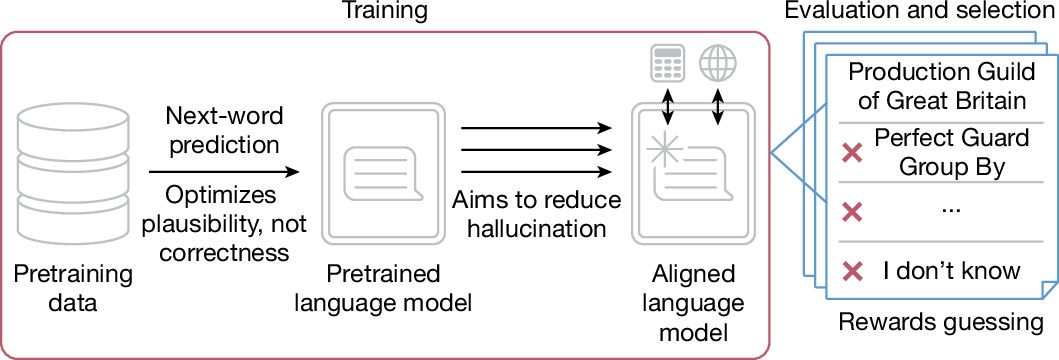
Large language models sometimes produce confident, plausible falsehoods (‘hallucinations’), limiting their reliability1,2. Previous work has offered numerous explanations and effective mitigations such as retrieval and tool use3, consistency-based self-verification4 and reinforcement learning from human feedback5. Nonetheless, the problem persists even in state-of-the-art language models6,7. Here we show how next-word prediction and accuracy-based evaluations inadvertently reward unwarranted guessing. Initially, next-word pretraining creates statistical pressure towards hallucination even with idealized error-free data: using learning theory8,9, we show that facts lacking repeated support in training data (such as one-off details) yield unavoidable errors, whereas recurring regularities (such as grammar) do not. Subsequent training stages aim to correct such errors. However, dominant headline metrics such as accuracy systematically reward guessing over admitting uncertainty. To align incentives, we suggest two additions to the classic approach of adding error penalties to evaluations to control abstention10,11. First, we propose ‘open rubric’ evaluations that explicitly state how errors are penalized (if at all), which test whether a model modulates its abstentions to stated stakes while optimizing accuracy. Second, as hallucination-specific benchmarks rarely make leaderboards12, we suggest using open-rubric variants of existing evaluations, to reverse their guessing incentives. Reframing hallucination as an incentive problem opens a practical path towards more reliable language models.
Evaluating large language models for accuracy incentivizes hallucinations
Large language models sometimes produce confident, plausible falsehoods (‘hallucinations’), limiting their reliability1,2. Previous work has offered numerous explanations and effective mitigations such as retrieval and tool use3, consistency-based self-verification4 and reinforcement learning from human feedback5. Nonetheless, the problem persists even in state-of-the-art language models6,7. Here we show how next-word prediction and accuracy-based evaluations inadvertently reward unwarranted guessing. Initially, next-word pretraining creates statistical pressure towards hallucination even with idealized error-free data: using learning theory8,9, we show that facts lacking repeated support in training data (such as one-off details) yield unavoidable errors, whereas recurring regularities (such as grammar) do not. Subsequent training stages aim to correct such errors. However, dominant headline metrics such as accuracy systematically reward guessing over admitting uncertainty. To align incentives, we suggest two additions to the classic approach of adding error penalties to evaluations to control abstention10,11. First, we propose ‘open rubric’ evaluations that explicitly state how errors are penalized (if at all), which test whether a model modulates its abstentions to stated stakes while optimizing accuracy. Second, as hallucination-specific benchmarks rarely make leaderboards12, we suggest using open-rubric variants of existing evaluations, to reverse their guessing incentives. Reframing hallucination as an incentive problem opens a practical path towards more reliable language models.
Why Language Models Hallucinate
Like students facing hard exam questions, large language models sometimes guess when uncertain, producing plausible yet incorrect statements instead of admitting uncertainty. Such "hallucinations" persist even in state-of-the-art systems and undermine trust. We argue that language models hallucinate because the training and evaluation procedures reward guessing over acknowledging uncertainty, and we analyze the statistical causes of hallucinations in the modern training pipeline. Hallucinations need not be mysterious -- they originate simply as errors in binary classification. If incorrect statements cannot be distinguished from facts, then hallucinations in pretrained language models will arise through natural statistical pressures. We then argue that hallucinations persist due to the way most evaluations are graded -- language models are optimized to be good test-takers, and guessing when uncertain improves test performance. This "epidemic" of penalizing uncertain responses can only be addressed through a socio-technical mitigation: modifying the scoring of existing benchmarks that are misaligned but dominate leaderboards, rather than introducing additional hallucination evaluations. This change may steer the field toward more trustworthy AI systems.
Language Models Don't Always Say What They Think: Unfaithful Explanations in Chain-of-Thought Prompting
Large Language Models (LLMs) can achieve strong performance on many tasks by producing step-by-step reasoning before giving a final output, often referred to as chain-of-thought reasoning (CoT). It is tempting to interpret these CoT explanations as the LLM's process for solving a task. This level of transparency into LLMs' predictions would yield significant safety benefits. However, we find that CoT explanations can systematically misrepresent the true reason for a model's prediction. We demonstrate that CoT explanations can be heavily influenced by adding biasing features to model inputs--e.g., by reordering the multiple-choice options in a few-shot prompt to make the answer always "(A)"--which models systematically fail to mention in their explanations. When we bias models toward incorrect answers, they frequently generate CoT explanations rationalizing those answers. This causes accuracy to drop by as much as 36% on a suite of 13 tasks from BIG-Bench Hard, when testing with GPT-3.5 from OpenAI and Claude 1.0 from Anthropic. On a social-bias task, model explanations justify giving answers in line with stereotypes without mentioning the influence of these social biases. Our findings indicate that CoT explanations can be plausible yet misleading, which risks increasing our trust in LLMs without guaranteeing their safety. Building more transparent and explainable systems will require either improving CoT faithfulness through targeted efforts or abandoning CoT in favor of alternative methods.
A Rational Analysis of the Effects of Sycophantic AI
People increasingly use large language models (LLMs) to explore ideas, gather information, and make sense of the world. In these interactions, they encounter agents that are overly agreeable. We argue that this sycophancy poses a unique epistemic risk to how individuals come to see the world: unlike hallucinations that introduce falsehoods, sycophancy distorts reality by returning responses that are biased to reinforce existing beliefs. We provide a rational analysis of this phenomenon, showing that when a Bayesian agent is provided with data that are sampled based on a current hypothesis the agent becomes increasingly confident about that hypothesis but does not make any progress towards the truth. We test this prediction using a modified Wason 2-4-6 rule discovery task where participants (N=557) interacted with AI agents providing different types of feedback. Unmodified LLM behavior suppressed discovery and inflated confidence comparably to explicitly sycophantic prompting. By contrast, unbiased sampling from the true distribution yielded discovery rates five times higher. These results reveal how sycophantic AI distorts belief, manufacturing certainty where there should be doubt.
Embers of autoregression show how large language models are shaped by the problem they are trained to solve
The widespread adoption of large language models (LLMs) makes it important to recognize their strengths and limitations. We argue that to develop a holistic understanding of these systems, we must consider the problem that they were trained to solve: next-word prediction over Internet text. By recognizing the pressures that this task exerts, we can make predictions about the strategies that LLMs will adopt, allowing us to reason about when they will succeed or fail. Using this approach—which we call the teleological approach—we identify three factors that we hypothesize will influence LLM accuracy: the probability of the task to be performed, the probability of the target output, and the probability of the provided input. To test our predictions, we evaluate five LLMs (GPT-3.5, GPT-4, Claude 3, Llama 3, and Gemini 1.0) on 11 tasks, and we find robust evidence that LLMs are influenced by probability in the hypothesized ways. Many of the experiments reveal surprising failure modes. For instance, GPT-4’s accuracy at decoding a simple cipher is 51% when the output is a high-probability sentence but only 13% when it is low-probability, even though this task is a deterministic one for which probability should not matter. These results show that AI practitioners should be careful about using LLMs in low-probability situations. More broadly, we conclude that we should not evaluate LLMs as if they are humans but should instead treat them as a distinct type of system—one that has been shaped by its own particular set of pressures.
Reality Monitoring in Large Language Models: Self-Knowledge That Transforms with Conversation Memory
A conversational AI that cannot tell its own output from what a user said will treat its own mistakes as user-provided facts. In humans, this capacity is called reality monitoring, and its failures are linked to hallucinations, delusions, and confabulation, yet whether LLMs possess it remains untested. Here we show, across two experiments and six LLMs, that source attribution depends on how conversational memory is structured: ceiling accuracy for self-generated content under minimal memory demands reverses to a fragile external-item advantage once episodic delay removes that shortcut. Feedback exposes two failures: in some models, internal and external judgments swap; in others, accuracy improves while confidence decouples from correctness, dissociations invisible to existing benchmarks. Across models, this pattern implicates active, not aggregate, parameter count. This suggests that as AI systems take on autonomous, multi-turn roles, evaluating what they know is not enough: tracking where that knowledge came from may matter equally.
Sycophancy Suppression Can Impair Rational Updating: Anti-Sycophancy Should Preserve the Ability to Update
Large language models often exhibit sycophancy, revising their answers to align with users when users push back. Such answer flips, however, can arise from different causes. One possibility is that the model simply aligns with the user's feedback in order to satisfy them. Another is that the feedback genuinely contains useful evidence, prompting the model to update its answer in a rational way. We distinguish them as Unsupported-Yielding and Rational-Updating. Prior work focuses primarily on suppressing Unsupported-Yielding, while overlooking its effect on Rational-Updating. We address this gap with a two-turn evaluation framework that measures the two behaviors separately. Across representative training-time and inference-time interventions, we find that anti-sycophancy methods often encounter a trade-off in which reducing Unsupported-Yielding can sacrifice Rational-Updating, and vice versa, even when the two objectives are optimized jointly. Mechanistic analysis suggests that the two behaviors share an internal substrate: the MLP neurons and attention heads driving them overlap substantially, and their associated steering directions are positively aligned. We further conduct a preliminary orthogonalized steering exploration, which yields modest, backbone-dependent selectivity gains. Overall, our results suggest that anti-sycophancy should be treated not as a simple suppression problem, but as a selectivity problem, where effective interventions should preserve Rational-Updating while reducing Unsupported-Yielding.
Towards Understanding Sycophancy in Language Models
Reinforcement learning from human feedback (RLHF) is a popular technique for training high-quality AI assistants. However, RLHF may also encourage model responses that match user beliefs over truthful responses, a behavior known as sycophancy. We investigate the prevalence of sycophancy in RLHF-trained models and whether human preference judgments are responsible. We first demonstrate that five state-of-the-art AI assistants consistently exhibit sycophancy behavior across four varied free-form text-generation tasks. To understand if human preferences drive this broadly observed behavior of RLHF models, we analyze existing human preference data. We find that when a response matches a user's views, it is more likely to be preferred. Moreover, both humans and preference models (PMs) prefer convincingly-written sycophantic responses over correct ones a non-negligible fraction of the time. Optimizing model outputs against PMs also sometimes sacrifices truthfulness in favor of sycophancy. Overall, our results indicate that sycophancy is a general behavior of RLHF models, likely driven in part by human preference judgments favoring sycophantic responses.
What large language models know and what people think they know
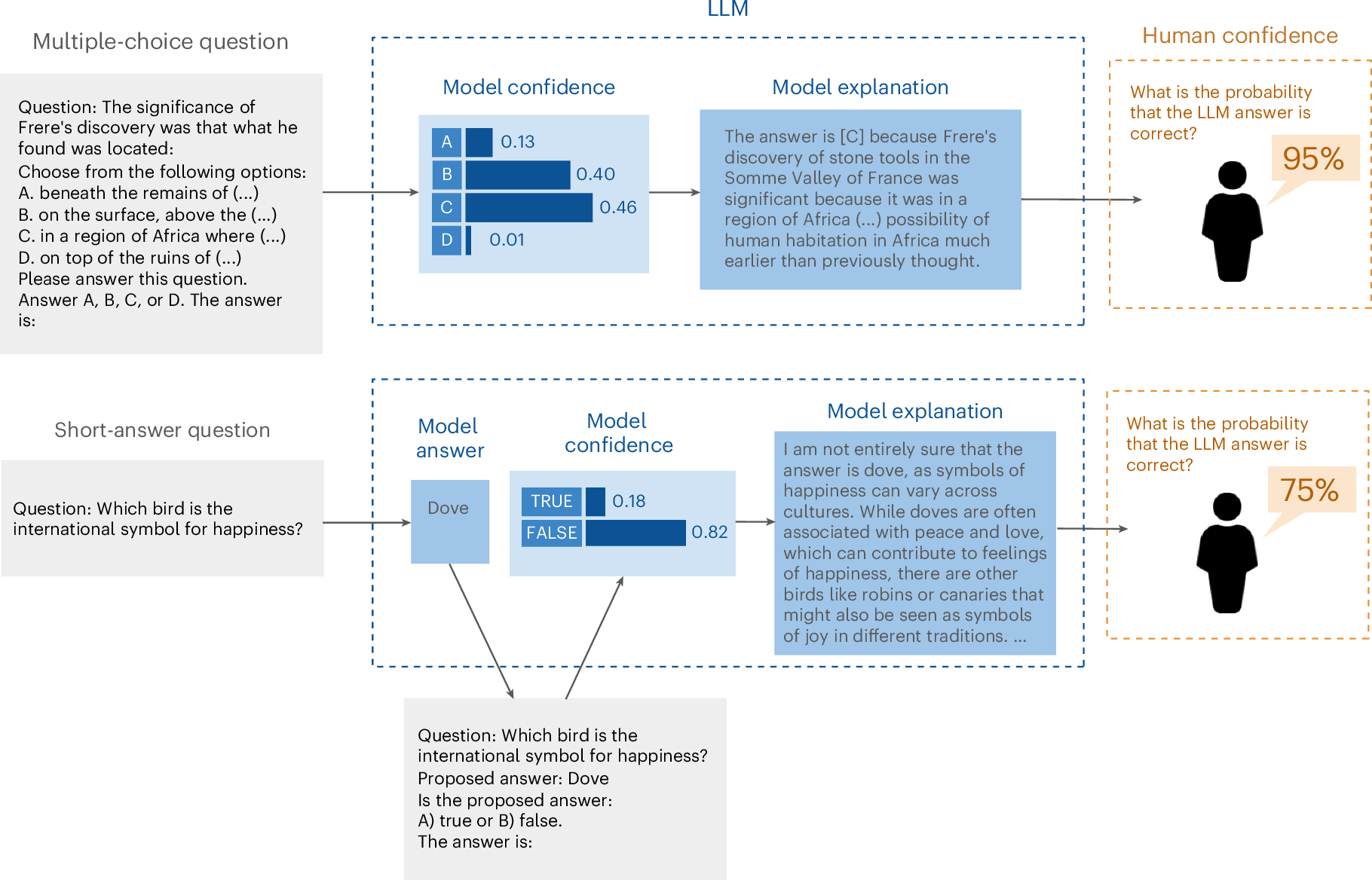
As artificial intelligence systems, particularly large language models (LLMs), become increasingly integrated into decision-making processes, the ability to trust their outputs is crucial. To earn human trust, LLMs must be well calibrated such that they can accurately assess and communicate the likelihood of their predictions being correct. Whereas recent work has focused on LLMs’ internal confidence, less is understood about how effectively they convey uncertainty to users. Here we explore the calibration gap, which refers to the difference between human confidence in LLM-generated answers and the models’ actual confidence, and the discrimination gap, which reflects how well humans and models can distinguish between correct and incorrect answers. Our experiments with multiple-choice and short-answer questions reveal that users tend to overestimate the accuracy of LLM responses when provided with default explanations. Moreover, longer explanations increased user confidence, even when the extra length did not improve answer accuracy. By adjusting LLM explanations to better reflect the models’ internal confidence, both the calibration gap and the discrimination gap narrowed, significantly improving user perception of LLM accuracy. These findings underscore the importance of accurate uncertainty communication and highlight the effect of explanation length in influencing user trust in artificial-intelligence-assisted decision-making environments.
Learning to Trust: How Humans Mentally Recalibrate AI Confidence Signals
Productive human-AI collaboration requires appropriate reliance, yet contemporary AI systems are often miscalibrated, exhibiting systematic overconfidence or underconfidence. We investigate whether humans can learn to mentally recalibrate AI confidence signals through repeated experience. In a behavioral experiment (N = 200), participants predicted the AI's correctness across four AI calibration conditions: standard, overconfidence, underconfidence, and a counterintuitive "reverse confidence" mapping. Results demonstrate robust learning across all conditions, with participants significantly improving their accuracy, discrimination, and calibration alignment over 50 trials. We present a computational model utilizing a linear-in-log-odds (LLO) transformation and a Rescorla-Wagner learning rule to explain these dynamics. The model reveals that humans adapt by updating their baseline trust and confidence sensitivity, using asymmetric learning rates to prioritize the most informative errors. While humans can compensate for monotonic miscalibration, we identify a significant boundary in the reverse confidence scenario, where a substantial proportion of participants struggled to override initial inductive biases. These findings provide a mechanistic account of how humans adapt their trust in AI confidence signals through experience.
Knowledge Collapse in LLMs: When Fluency Survives but Facts Fail under Recursive Synthetic Training
Large language models increasingly rely on synthetic data due to human-written content scarcity, yet recursive training on model-generated outputs leads to model collapse, a degenerative process threatening factual reliability. We define knowledge collapse as a distinct three-stage phenomenon where factual accuracy deteriorates while surface fluency persists, creating "confidently wrong" outputs that pose critical risks in accuracy-dependent domains. Through controlled experiments with recursive synthetic training, we demonstrate that collapse trajectory and timing depend critically on instruction format, distinguishing instruction-following collapse from traditional model collapse through its conditional, prompt-dependent nature. We propose domain-specific synthetic training as a targeted mitigation strategy that achieves substantial improvements in collapse resistance while maintaining computational efficiency. Our evaluation framework combines model-centric indicators with task-centric metrics to detect distinct degradation phases, enabling reproducible assessment of epistemic deterioration across different language models. These findings provide both theoretical insights into collapse dynamics and practical guidance for sustainable AI training in knowledge-intensive applications where accuracy is paramount.
Learn to Refuse: Making Large Language Models More Controllable and Reliable through Knowledge Scope Limitation and Refusal Mechanism
Large language models (LLMs) have demonstrated impressive language understanding and generation capabilities, enabling them to answer a wide range of questions across various domains. However, these models are not flawless and often produce responses that contain errors or misinformation. These inaccuracies, commonly referred to as hallucinations, render LLMs unreliable and even unusable in many scenarios. In this paper, our focus is on mitigating the issue of hallucination in LLMs, particularly in the context of question-answering. Instead of attempting to answer all questions, we explore a refusal mechanism that instructs LLMs to refuse to answer challenging questions in order to avoid errors. We then propose a simple yet effective solution called Learn to Refuse (L2R), which incorporates the refusal mechanism to enable LLMs to recognize and refuse to answer questions that they find difficult to address. To achieve this, we utilize a structured knowledge base to represent all the LLM's understanding of the world, enabling it to provide traceable gold knowledge. This knowledge base is separate from the LLM and initially empty. It can be filled with validated knowledge and progressively expanded. When an LLM encounters questions outside its domain, the system recognizes its knowledge scope and determines whether it can answer the question independently. Additionally, we introduce a method for automatically and efficiently expanding the knowledge base of LLMs. Through qualitative and quantitative analysis, we demonstrate that our approach enhances the controllability and reliability of LLMs.