

Optimizing news headlines for reader engagement is often conflated with clickbait, producing exaggerated or misleading phrasing that erodes editorial trust. We reframe clickbait not as a separate category but as the disproportionate amplification of otherwise legitimate engagement cues, and cast headline rewriting as a controllable generation problem in which chosen engagement attributes are strengthened under explicit faithfulness constraints. We steer a large language model at inference time with two lightweight guide models: a clickbait scorer providing negative guidance and an engagement-attribute model providing positive guidance, combined during decoding so a chosen engagement attribute can be selectively strengthened while clickbait is restrained. Both guides are trained on neutral news headlines and their synthetically amplified variants; the clickbait guide is externally validated on human-authored corpora, and the engagement guide’s attribute scores correlate with human clickbait. On held-out headlines, an ablation shows the two guides exert independent, opposite effects, and benchmarked against the decoding-time control methods DExperts and GeDi the dual guide adds an independent clickbait brake, a dedicated lever that lowers induced clickbait at a chosen engagement level and that single-axis methods lack. Independent automatic metrics and a three-annotator human study confirm higher faithfulness and lower induced clickbait than these baselines. The framework supports responsible headline optimization in journalism. The setting we report keeps rewrites faithful to the source and low in clickbait rather than pushing engagement as high as possible; a lighter brake is available when more engagement is wanted.
LLM-guided headline rewriting for clickability enhancement without...
Enhancing reader engagement while preserving informational fidelity is a central challenge in controllable text generation for news media. Optimizing news headlines for reader engagement is often...

Quantifying the Persona Effect in LLM Simulations
Large language models (LLMs) have shown remarkable promise in simulating human language and behavior. This study investigates how integrating persona variables—demographic, social, and behavioral factors—impacts LLMs' ability to simulate diverse perspectives. We find that persona variables account for \ensuremath<10% variance in annotations in existing subjective NLP datasets. Nonetheless, incorporating persona variables via prompting in LLMs provides modest but statistically significant improvements. Persona prompting is most effective in samples where many annotators disagree, but their disagreements are relatively minor. Notably, we find a linear relationship in our setting: the stronger the correlation between persona variables and human annotations, the more accurate the LLM predictions are using persona prompting. In a zero-shot setting, a powerful 70b model with persona prompting captures 81% of the annotation variance achievable by linear regression trained on ground truth annotations. However, for most subjective NLP datasets, where persona variables have limited explanatory power, the benefits of persona prompting are limited.
ICML Poster Learning syntax without semantics: Disentangled tiny language models
Language models acquire syntax and world knowledge together, entangling the two in ways that limit efficiency and controllability. We show that syntax can be learned while suppressing semantic plausibility and world‑knowledge cues, yielding more efficient and controllable models. We train tiny LMs on grammatical nonsense — syntactically well-formed text with semantic content ablated via constrained relexicalization (SAMBAL). Models trained on this data perform comparably to standard pretraining on syntactic benchmarks (BLiMP, SyntaxGym) while scoring at chance on world knowledge probes (EWoK). On targeted grammar-plausibility conflict probes, content-neutral models prefer grammaticality where standard models prefer plausibility, and their representations show more syntactic vs lexical alignment. On efficiency, disentanglement yields substantial sample and parameter gains: in low‑resource regimes, a 5M‑parameter model matches a 30M‑parameter baseline at the same data budget. On controllability, content-neutral models adapt rapidly to a new domain with minimal exposure, suggesting the feasibility of modular post‑hoc knowledge specialization.
Sparse Autoencoders for Hypothesis Generation
We describe HypotheSAEs, a general method to hypothesize interpretable relationships between text data (e.g., headlines) and a target variable (e.g., clicks). HypotheSAEs has three steps: (1) train a sparse autoencoder on text embeddings to produce interpretable features describing the data distribution, (2) select features that predict the target variable, and (3) generate a natural language interpretation of each feature (e.g., "mentions being surprised or shocked") using an LLM. Each interpretation serves as a hypothesis about what predicts the target variable. Compared to baselines, our method better identifies reference hypotheses on synthetic datasets (at least +0.06 in F1) and produces more predictive hypotheses on real datasets (~twice as many significant findings), despite requiring 1-2 orders of magnitude less compute than recent LLM-based methods. HypotheSAEs also produces novel discoveries on two well-studied tasks: explaining partisan differences in Congressional speeches and identifying drivers of engagement with online headlines.
People who frequently use ChatGPT for writing tasks are accurate and robust detectors of AI-generated text
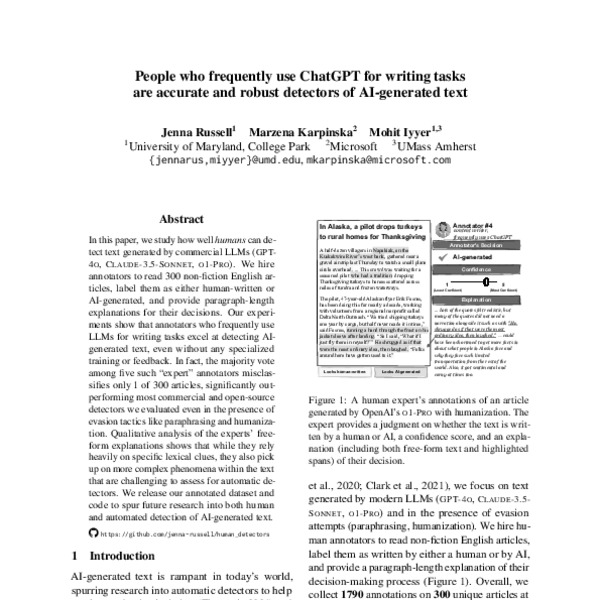
In this paper, we study how well humans can detect text generated by commercial LLMs (GPT-4o, Claude, o1). We hire annotators to read 300 non-fiction English articles, label them as either human-written or AI-generated, and provide paragraph-length explanations for their decisions. Our experiments show that annotators who frequently use LLMs for writing tasks excel at detecting AI-generated text, even without any specialized training or feedback. In fact, the majority vote among five such “expert” annotators misclassifies only 1 of 300 articles, significantly outperforming most commercial and open-source detectors we evaluated even in the presence of evasion tactics like paraphrasing and humanization. Qualitative analysis of the experts' free-form explanations shows that while they rely heavily on specific lexical clues (`AI vocabulary'), they also pick up on more complex phenomena within the text (e.g., formality, originality, clarity) that are challenging to assess for automatic detectors. We release our annotated dataset and code to spur future research into both human and automated detection of AI-generated text.
People who frequently use ChatGPT for writing tasks are accurate and robust detectors of AI-generated text
In this paper, we study how well humans can detect text generated by commercial LLMs (GPT-4o, Claude, o1). We hire annotators to read 300 non-fiction English articles, label them as either human-written or AI-generated, and provide paragraph-length explanations for their decisions. Our experiments show that annotators who frequently use LLMs for writing tasks excel at detecting AI-generated text, even without any specialized training or feedback. In fact, the majority vote among five such “expert” annotators misclassifies only 1 of 300 articles, significantly outperforming most commercial and open-source detectors we evaluated even in the presence of evasion tactics like paraphrasing and humanization. Qualitative analysis of the experts' free-form explanations shows that while they rely heavily on specific lexical clues (`AI vocabulary'), they also pick up on more complex phenomena within the text (e.g., formality, originality, clarity) that are challenging to assess for automatic detectors. We release our annotated dataset and code to spur future research into both human and automated detection of AI-generated text.
A Model of Multi-turn Human Persuadability Using Probabilistic Belief Tracing
Large language models can shift human beliefs across high-stakes domains, but most persuasion studies rely on pre/post belief change. These endpoint measures identify whether persuasion occurred, yet miss where and how beliefs moved within a dialogue. We present PERSUASIONTRACE, a framework for studying persuasion in human–LLM interaction. Built on a web-based experimental platform, PERSUASIONTRACE contributes a tool for multi-turn persuasion studies and a process-level evaluation protocol: it records multi-turn belief reports from human or simulated targets of persuasion, annotates persuader turns with rhetorical dimensions (logos/pathos/ethos), and evaluates simulators by fidelity to real human belief dynamics. Using this framework, we find that human targets group into two clusters of multi-turn belief updates and exhibit susceptibility to rhetorical strategies, and that LLMs are persuasive across generic and personalized topics, text and audio modalities, and multi-turn interactions. Prior work has chiefly used vanilla-prompted LLMs to simulate human targets, but we show that these simulators fail to replicate human belief dynamics. We introduce a Bayesian-network simulated target that maintains an explicit latent belief state over time so each persuader message yields cognitively realistic belief updates. In human-likeness evaluation, our Bayesian target scores near a human reference (81 vs 80), while baseline LLM targets score substantially lower (64). PERSUASIONTRACE reframes persuasion evaluation from endpoint movement alone to process fidelity, providing a stronger basis for scientific analysis and safer optimization of persuasive systems.
Do LLMs write like humans? Variation in grammatical and rhetorical styles
As large language models (LLMs) have grown in power and become more widely available, research has focused on their ability to complete various tasks and the biases they exhibit when doing so. In this study, we instead examine their writing style in detail. We show that instruction-tuned models, which are trained to answer questions and solve problems, have a distinct noun-heavy, informationally dense writing style, even when prompted to match the style of informal speech and writing. These findings suggest that instruction-tuned models generate text that does not align with genre conventions familiar to human audiences, and demonstrate the value of linguistic variables in evaluating the output of LLMs., Large language models (LLMs) are capable of writing grammatical text that follows instructions, answers questions, and solves problems. As they have advanced, it has become difficult to distinguish their output from human-written text. While past research has found some differences in features such as word choice and punctuation and developed classifiers to detect LLM output, none has studied the rhetorical styles of LLMs. Using several variants of Llama 3 and GPT-4o, we construct two parallel corpora of human- and LLM-written texts from common prompts. Using Douglas Biber’s set of lexical, grammatical, and rhetorical features, we identify systematic differences between LLMs and humans and between different LLMs. These differences persist when moving from smaller models to larger ones and are larger for instruction-tuned models than base models. This observation of differences demonstrates that despite their advanced abilities, LLMs struggle to match human stylistic variation. Attention to more advanced linguistic features can hence detect patterns in their behavior not previously recognized.

How LLMs Distort Our Written Language
Large language models (LLMs) are used by over a billion people globally, most often to assist with writing. In this work, we demonstrate that LLMs not only alter the voice and tone of human writing but also consistently alter the intended meaning. First, we conduct a human user study to understand how people actually interact with LLMs when using them for writing. Our findings reveal that extensive LLM use led to a nearly 70% increase in essays that remained neutral in answering the topic question. Significantly more heavy LLM users reported that the writing was less creative and not in their voice. Next, using a dataset of human-written essays that was collected in 2021 before the widespread release of LLMs, we study how asking an LLM to revise the essay based on the human-written feedback in the dataset induces large changes in the resulting content and meaning. We find that even when LLMs are prompted with expert feedback and asked to only make grammar edits, they still change the text in a way that significantly alters its semantic meaning. We then examine LLM-generated text in the wild, specifically focusing on the 21% of AI-generated scientific peer reviews at a recent top AI conference. We find that LLM-generated reviews place significantly less weight on clarity and significance of the research, and assign scores that, on average, are a full point higher. These findings highlight a misalignment between the perceived benefit of AI use and an implicit, consistent effect on the semantics of human writing, motivating future work on how widespread AI writing will affect our cultural and scientific institutions.
Are Large Language Models Sensitive to the Motives Behind Communication?
Human communication is $\textit{motivated}$: people speak, write, and create content with a particular communicative intent in mind. As a result, information that large language models (LLMs) and AI agents process is inherently framed by humans' intentions and incentives. People are adept at navigating such nuanced information: we routinely identify benevolent or self-serving motives in order to decide what statements to trust. For LLMs to be effective in the real world, they too must critically evaluate content by factoring in the motivations of the source---for instance, weighing the credibility of claims made in a sales pitch. In this paper, we undertake a comprehensive study of whether LLMs have this capacity for $\textit{motivational vigilance}$. We first employ controlled experiments from cognitive science to verify that LLMs' behavior is consistent with rational models of learning from motivated testimony, and find they successfully discount information from biased sources in a human-like manner. We then extend our evaluation to sponsored online adverts, a more naturalistic reflection of LLM agents' information ecosystems. In these settings, we find that LLMs' inferences do not track the rational models' predictions nearly as closely---partly due to additional information that distracts them from vigilance-relevant considerations. However, a simple steering intervention that boosts the salience of intentions and incentives substantially increases the correspondence between LLMs and the rational model. These results suggest that LLMs possess a basic sensitivity to the motivations of others, but generalizing to novel real-world settings will require further improvements to these models.
SimpleQA Verified: A Reliable Factuality Benchmark to Measure Parametric Knowledge
We introduce SimpleQA Verified, a 1,000-prompt benchmark for evaluating Large Language Model (LLM) short-form factuality based on OpenAI's SimpleQA. It addresses critical limitations in OpenAI's benchmark, including noisy and incorrect labels, topical biases, and question redundancy. SimpleQA Verified was created through a rigorous multi-stage filtering process involving de-duplication, topic balancing, and source reconciliation to produce a more reliable and challenging evaluation set, alongside improvements in the autorater prompt. On this new benchmark, Gemini 2.5 Pro achieves a state-of-the-art F1-score of 55.6, outperforming other frontier models, including GPT-5. This work provides the research community with a higher-fidelity tool to track genuine progress in parametric model factuality and to mitigate hallucinations. The benchmark dataset, evaluation code, and leaderboard are available at: https://www.kaggle.com/benchmarks/deepmind/simpleqa-verified.
The Dynamics of Distortion: How Successive Summarization Alters the Retelling of News
This work advances and tests a theory of how news information evolves as it is successively retold by consumers. Drawing on data from over 11,000 participants across ten experiments, the authors offer evidence that when news is repeatedly retold, it undergoes a stylistic transformation termed “disagreeable personalization,” wherein original facts are increasingly supplanted by opinions and interpretations with a slant toward negativity. The central thesis is that when retellers believe they are more (vs. less) knowledgeable than their recipient about the information they are relaying, they feel more compelled to provide guidance on its meaning and to do so in a persuasive manner. This enhanced motivation to guide persuasively, in turn, leads retellers to not only select the subset of facts they deem most essential but, critically, to provide their interpretations and opinions on those facts, with negativity being used as a means of grabbing their audience’s attention. Implications of this work for research on retelling and consumer information diffusion are explored.
