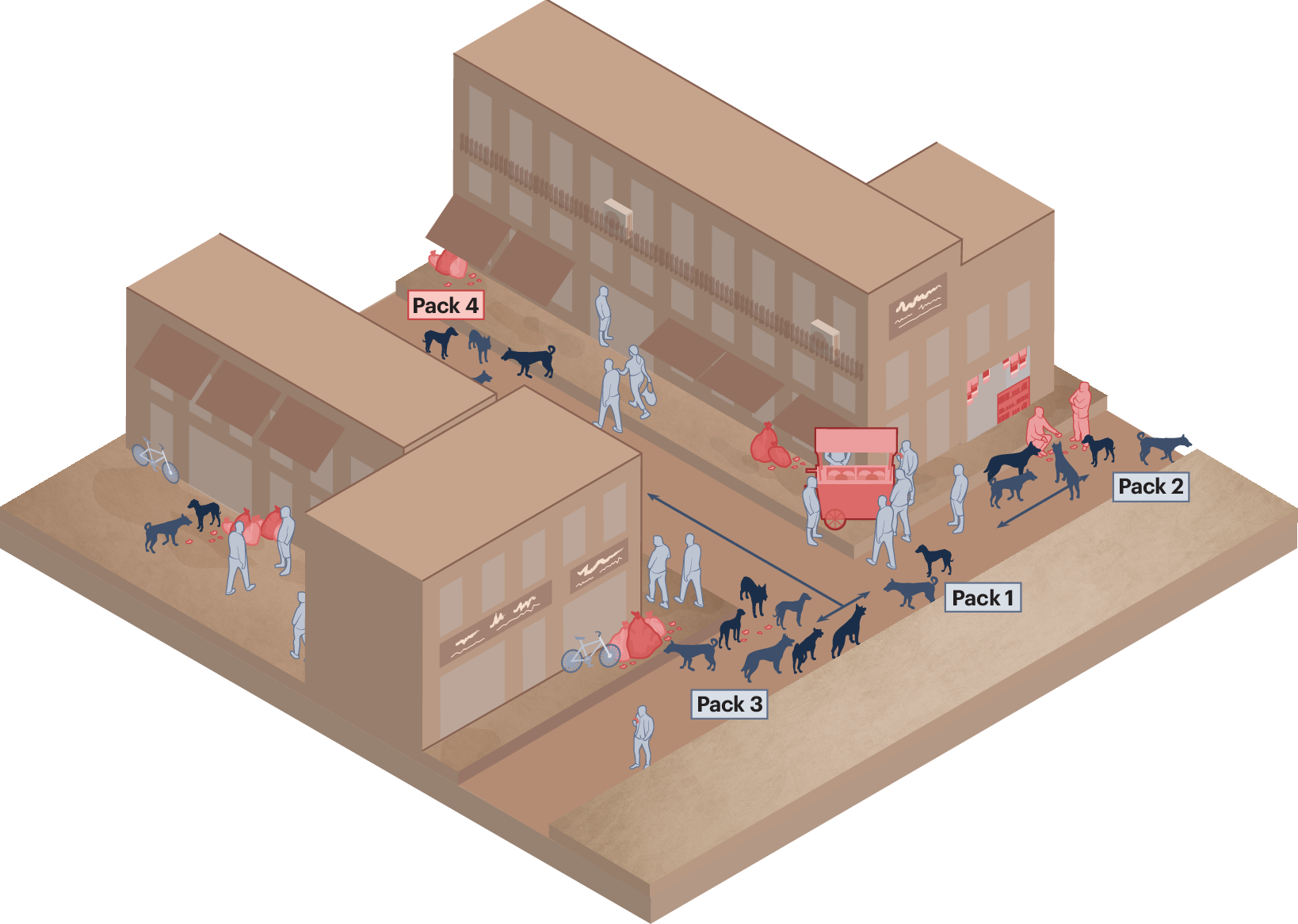
Cities in the Global South struggle with human–animal coexistence conundrums. For example, in South Asia, old and new collide: people raise livestock informally and feed free-ranging animals within heterogeneously developed, juxtaposed patches, while digital economies boom amid threats from waste piles linked with zoonotic diseases and conflicts. This is exemplified by the free-ranging dog crises in India. Humanity’s oldest companion now suffers between compassion and rising conflicts. Dogs still scavenge, guard, breed, disperse and die on streets shaped by traffic, garbage, ritual feeding and uneven care. Indian courts, attempting to address the problems, have overlooked the root cause—food subsidies. Sterilization, shelters, fencing or removals cannot succeed when urban landscapes provide food subsidies to animals without corresponding responsibility. Episodes of reactive management must yield to urban planning, acknowledging that multispecies communities in shared living spaces are complex and interconnected. Here, I suggest making compassion accountable to public health, animal well-being and urban ecology.
What if our cities were designed for wildlife as well as people?
New research argues urban planning must recognise animals, plants and ecosystems as fellow inhabitants of our cities.

Diverse Locations and a Long History: Historical Context for Urban Leopards (Panthera pardus) in the Early Anthropocene From Seoul, Korea
While the urban landscapes of the early Anthropocene may appear hostile to large carnivores, humans and leopards (Panthera pardus) are known to co-inhabit major urban centres like Mumbai (India), Nairobi (Kenya) and Johannesburg (South Africa). We provide evidence that the presence of leopards in urban landscapes is not, however, a new phenomenon and has occurred repeatedly over the early history of the Anthropocene. Using records of Amur leopards (P. p. orientalis) in Seoul, Korea, at the end of the 19th century, a capital city and major urban centre with a high human population density, we explore socio-cultural, political and ecological factors that may have facilitated human-leopard co-occurrence in an urban landscape and the factors that eventually led to the leopards' extirpation. We suggest that, in the absence of unsustainable levels of persecution by humans, leopards are able to persist in urban landscapes which contain small patches of dense vegetation and have sufficient alternative food supplies. In light of the continued expansion of urban landscapes in the 21st century and increasing conservation focus on the presence of large carnivore populations there, this paper provides historical context to human co-existence with leopards in urban landscapes during the Anthropocene – and what we can learn from it for the future.

Sovereign Accountable Commons
In the MetaCurrency Project, we’re committed to practicing what we preach, or eating our own dog food, if you prefer that way of saying it…

Run, Spot, Run: The Ethics of Keeping Pets
A life shared with pets brings many emotions. We feel love for our companions, certainly, and happiness at the thought that we’re providing them with a safe, healthy life. But there’s another emotion, less often acknowledged, that can be nearly as powerful: guilt. When we see our cats gazing wistfully out the window, or watch a goldfish swim lazy circles in a bowl, we can’t help but wonder: are we doing the right thing, keeping these independent beings locked up, subject to our control? Is keeping pets actually good for the pets themselves? That’s the question that animates Jessica Pierce’s powerful Run, Spot, Run. A lover of pets herself (including, over the years, dogs, cats, fish, rats, hermit crabs, and more), Pierce understands the joys that pets bring us. But she also refuses to deny the ambiguous ethics at the heart of the relationship, and through a mix of personal stories, philosophical reflections, and scientifically informed analyses of animal behavior and natural history, she puts pet-keeping to the test. Is it ethical to keep pets at all? Are some species more suited to the relationship than others? Are there species one should never attempt to own? And are there ways that we can improve our pets’ lives, so that we can be confident that we are giving them as much as they give us? Deeply empathetic, yet rigorous and unflinching in her thinking, Pierce has written a book that is sure to help any pet owner, unsettling assumptions but also giving them the knowledge to build deeper, better relationships with the animals with whom they’ve chosen to share their lives.

Mutual Aid: A Factor of Evolution
From Mutual Aid In the animal world we have seen that the vast majority of species live in societies, and that they find in association the best arms for the struggle for life: understood, of course, in its wide Darwinian sense — not as a struggle for the sheer means of existence, but as a … Continued
If no-one helps you after a car crash in India, this is why
Fifteen people are killed on India's roads every hour - but when crashes happen, nobody wants to help.

Human–Animal Interaction and Human Prosociality: A Meta-Analytic Review of Experimental and Correlational Studies
Pet ownership and interactions with animals confer various physiological and psychological benefits to humans. Although interactions with animals are commonplace, there is no consensus in the liter...
Data Governance for Sustainable Digital Food Systems | DigiFood
Explore our research on agricultural data governance in Kenya, India, and Colombia. We aim to support civil society with a human-rights based approach to digital food systems. Join us in promoting equitable practices for sustainable agriculture.
A social-ecological framework for analyzing and designing integrated crop–livestock systems from farm to territory levels
Integrated crop–livestock systems are often considered a promising way to address agricultural sustainability issues. Many authors claim that complementarities and synergies between crops and livestock can improve nutrient cycling and delivery of ecosystem services (ES) in agricultural systems. They have analyzed effects of interactions at the farm level and affirmed the potential advantage of developing crop–livestock interactions at the territory level. However, potential benefits of developing synergies beyond the farm level have not been clearly identified. Thus, we developed a conceptual framework that can be used to analyze, design and perform integrated assessment of crop–livestock systems at the territory level. To address crop–livestock interaction issues, we define it as a social-ecological system called the territorial crop–livestock system (TCLS). The ecological system is represented as three interacting components, crops, grasslands and animals, allowing description of various land uses and their potential effects on nutrient cycling and ES. The social system, represented as farmers interacting with natural-resource managers and agro-food chain actors, determines land use and the nature and intensity of ES delivered. We highlight the importance of coordination and learning among actors to support implementation of complex adaptive systems such as TCLSs. We illustrate the expressive power of our conceptual framework through development of a generic typology of crop–livestock systems. Then we show how our conceptual framework can be used as an intermediary object with stakeholders in participatory design approaches. We illustrate this process by representing four archetypal TCLSs. We provide an example of the design approach implemented in Southwestern France to address severe recurrent water shortages, which includes analysis of land use in the current crop–livestock system and the associated key metabolic and ES issues, identification of options for change and multi-criteria analysis of these options. We conclude that this framework shows great potential to support development of sustainable farming systems at the territory level.
Join the Political Movement for Animal Protection in Victoria
Discover how the Animal Justice Party Victoria is leading the charge in advocating for animal rights. Learn about our policies, campaigns, and how you can get involved in making a difference for animals across Victoria.

Urban problems: nature-based solutions and a Green New Deal everywhere
Nature-based Solutions with localised Green New Deals could save our settlements, and provide a just transition to a low-carbon society

Kami of the Commons: Towards Designing Agentic AI to Steward the Commons
Commons suffer from neglect, free-riding, and a persistent deficit of care. Inspired by Shinto animism -- where every forest, river, and mountain has its own \emph{kami}, a spirit that inhabits and cares for that place -- we provoke: what if every commons had its own AI steward? Through a speculative design workshop where fifteen participants used Protocol Futuring, we surface both new opportunities and new dangers. Agentic AI offers the possibility of continuously supporting commons with programmable agency and care -- stewards that mediate family life as the most intimate commons, preserve collective knowledge, govern shared natural resources, and sustain community welfare. But when every commons has its own steward, second-order effects emerge: stewards contest stewards as overlapping commons collide; individuals caught between multiple stewards face new politics of care and constraint; the stewards themselves become commons requiring governance. This work opens \emph{agentive governance as commoning design material} -- a new design space for the agency, care ethics, and accountability of AI stewards of shared resources -- radically different from surveillance or optimization.

There's no place like home
Peace of mind for pet parents and unique stays for sitters
I had to evacuate my home, what do I do next?
Finding shelter for yourself and animals, plus emergency numbers and tips.

“Bangladeshi infiltrators, Rohingyas enter India through Bengal…450 km fencing pending as state is not giving land”: Amit Shah
46K subscribers in the IndianDefense community. News and discussion for India-related defense and security

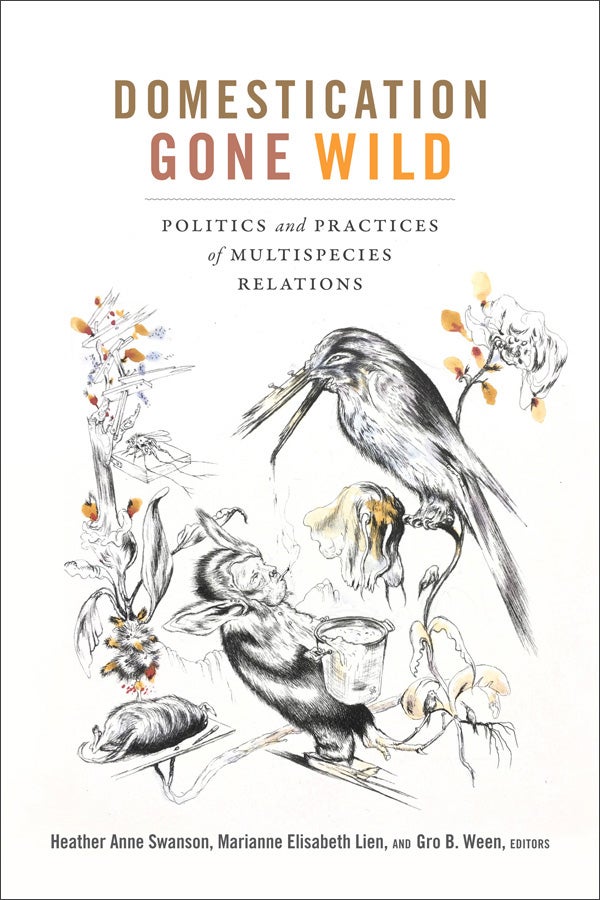
Domestication Gone Wild: Politics and Practices of Multispecies Relations
“What do Pacific salmon, British falcons, pine trees everywhere, Ifugao pigs and spirits, and Norwegian apples have in common? They perform ‘domestication’ in ways certain to change the narratives and politics of domestication for scholars of whatever discipline and for critter people all over the earth. Read this book for up-to-the-minute, deeply researched, very smart, contentious takes on the shapes of conjoined humans and nonhumans living and dying together in diverse histories of civilization, colonialism, capitalism, times-past, and times-yet-to-come. Perhaps what opens up in this book are real possibilities for caring more materially in urgent times.” - Donna J. Haraway, author of Staying with the Trouble: Making Kin in the Chthulucene