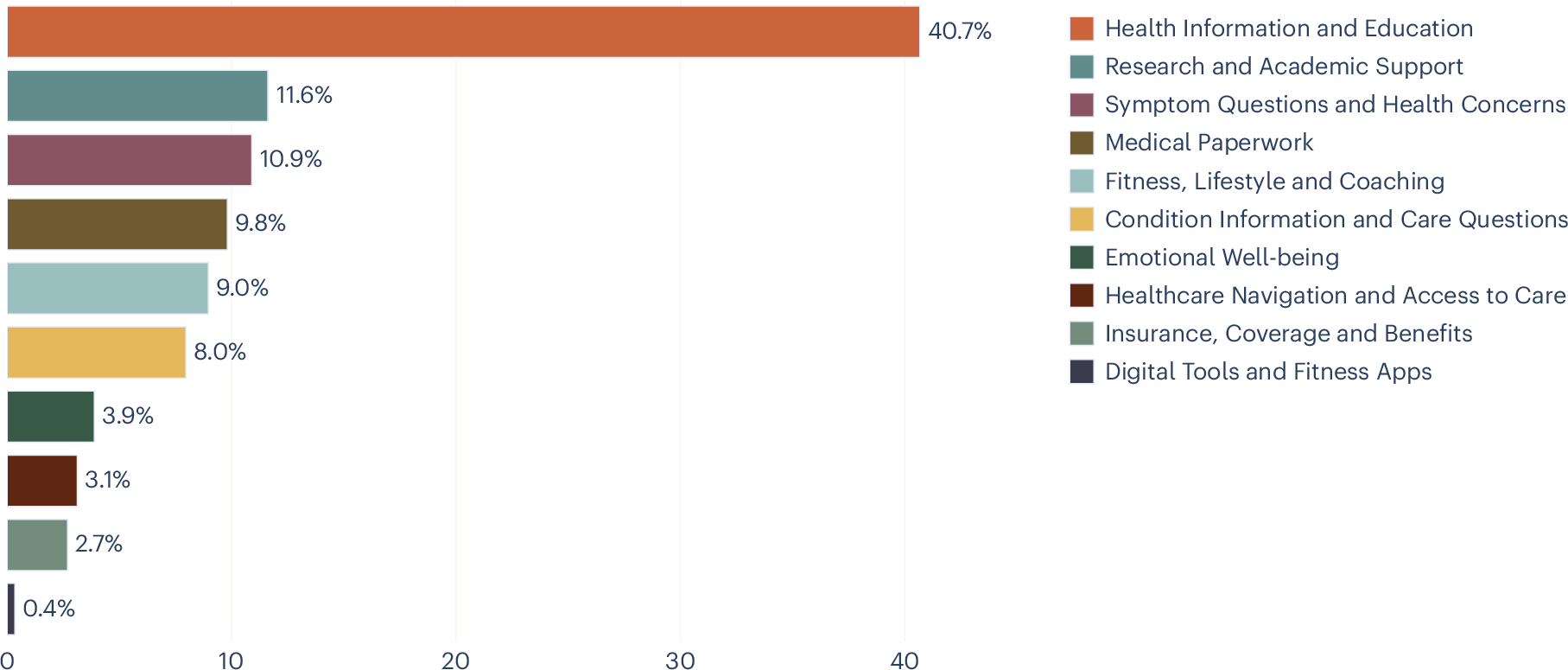
Here we analyse over 500,000 de-identified health-related conversations with Microsoft Copilot from January 2026 to characterize what people ask conversational artificial intelligence (AI) about health. We apply a hierarchical intent taxonomy of 12 primary categories using privacy-preserving large language model-based classification validated against expert human annotation and use topic clustering for prevalent themes within each intent. We then characterize the intents and topics behind health queries, identify who they are about, and analyse how usage varies by device and time of day. Nearly one in five conversations involves personal symptom assessment or condition discussion, and the dominant general information category is also concentrated on specific treatments and conditions, suggesting that this is a lower bound on personal health intent. One in seven of these personal health queries concerns someone other than the user, suggesting that conversational AI can also be a caregiving tool. Personal queries increase markedly in the evening and nighttime hours, when traditional healthcare is most limited. Usage diverges sharply by device: mobile concentrates on personal health concerns, while desktop is dominated by professional and academic work. A substantial share of queries focuses on navigating healthcare systems. These patterns have direct implications for platform-specific design, safety considerations and the responsible development of health AI.
Public use of a generalist LLM chatbot for health queries
Here we analyse over 500,000 de-identified health-related conversations with Microsoft Copilot from January 2026 to characterize what people ask conversational artificial intelligence (AI) about health. We apply a hierarchical intent taxonomy of 12 primary categories using privacy-preserving large language model-based classification validated against expert human annotation and use topic clustering for prevalent themes within each intent. We then characterize the intents and topics behind health queries, identify who they are about, and analyse how usage varies by device and time of day. Nearly one in five conversations involves personal symptom assessment or condition discussion, and the dominant general information category is also concentrated on specific treatments and conditions, suggesting that this is a lower bound on personal health intent. One in seven of these personal health queries concerns someone other than the user, suggesting that conversational AI can also be a caregiving tool. Personal queries increase markedly in the evening and nighttime hours, when traditional healthcare is most limited. Usage diverges sharply by device: mobile concentrates on personal health concerns, while desktop is dominated by professional and academic work. A substantial share of queries focuses on navigating healthcare systems. These patterns have direct implications for platform-specific design, safety considerations and the responsible development of health AI.
Investigating Affective Use and Emotional Well-being on ChatGPT
As AI chatbots see increased adoption and integration into everyday life, questions have been raised about the potential impact of human-like or anthropomorphic AI on users. In this work, we investigate the extent to which interactions with ChatGPT (with a focus on Advanced Voice Mode) may impact users' emotional well-being, behaviors and experiences through two parallel studies. To study the affective use of AI chatbots, we perform large-scale automated analysis of ChatGPT platform usage in a privacy-preserving manner, analyzing over 3 million conversations for affective cues and surveying over 4,000 users on their perceptions of ChatGPT. To investigate whether there is a relationship between model usage and emotional well-being, we conduct an Institutional Review Board (IRB)-approved randomized controlled trial (RCT) on close to 1,000 participants over 28 days, examining changes in their emotional well-being as they interact with ChatGPT under different experimental settings. In both on-platform data analysis and the RCT, we observe that very high usage correlates with increased self-reported indicators of dependence. From our RCT, we find that the impact of voice-based interactions on emotional well-being to be highly nuanced, and influenced by factors such as the user's initial emotional state and total usage duration. Overall, our analysis reveals that a small number of users are responsible for a disproportionate share of the most affective cues.

How People Use ChatGPT
Despite the rapid adoption of LLM chatbots, little is known about how they are used. We document the growth of ChatGPT’s consumer product from its launch in November 2022 through July 2025, when it had been adopted by around 10% of the world’s adult population. Early adopters were disproportionately male but the gender gap has narrowed dramatically, and we find higher growth rates in lower-income countries. Using a privacy-preserving automated pipeline, we classify usage patterns within a representative sample of ChatGPT conversations. We find steady growth in work-related messages but even faster growth in non-work-related messages, which have grown from 53% to more than 70% of all usage. Work usage is more common for educated users in highly-paid professional occupations. We classify messages by conversation topic and find that “Practical Guidance,” “Seeking Information,” and “Writing” are the three most common topics and collectively account for nearly 80% of all conversations. Writing dominates work-related tasks, highlighting chatbots’ unique ability to generate digital outputs compared to traditional search engines. Computer programming and self-expression both represent relatively small shares of use. Overall, we find that ChatGPT provides economic value through decision support, which is especially important in knowledge-intensive jobs.

Clio: Privacy-Preserving Insights into Real-World AI Use
How are AI assistants being used in the real world? While model providers in theory have a window into this impact via their users' data, both privacy concerns and practical challenges have made analyzing this data difficult. To address these issues, we present Clio (Claude insights and observations), a privacy-preserving platform that uses AI assistants themselves to analyze and surface aggregated usage patterns across millions of conversations, without the need for human reviewers to read raw conversations. We validate this can be done with a high degree of accuracy and privacy by conducting extensive evaluations. We demonstrate Clio's usefulness in two broad ways. First, we share insights about how models are being used in the real world from one million Claude.ai Free and Pro conversations, ranging from providing advice on hairstyles to providing guidance on Git operations and concepts. We also identify the most common high-level use cases on Claude.ai (coding, writing, and research tasks) as well as patterns that differ across languages (e.g., conversations in Japanese discuss elder care and aging populations at higher-than-typical rates). Second, we use Clio to make our systems safer by identifying coordinated attempts to abuse our systems, monitoring for unknown unknowns during critical periods like launches of new capabilities or major world events, and improving our existing monitoring systems. We also discuss the limitations of our approach, as well as risks and ethical concerns. By enabling analysis of real-world AI usage, Clio provides a scalable platform for empirically grounded AI safety and governance.
AI tools make things up a lot, and that’s a huge problem | CNN Business
Artificial intelligence-powered tools like ChatGPT have mesmerized us with their ability to produce authoritative, human-sounding responses to seemingly any prompt. But as more people turn to this buzzy technology for things like homework help, workplace research, or health inquiries, one of its biggest pitfalls is becoming increasingly apparent: AI models sometimes just make things up.
Social Uses of Personal Health Information Within PatientsLikeMe, an Online Patient Community: What Can Happen When Patients Have Access to One Another’s Data
Background: This project investigates the ways in which patients respond to the shared use of what is often considered private information: personal health data. There is a growing demand for patient access to personal health records. The predominant model for this record is a repository of all clinically relevant health information kept securely and viewed privately by patients and their health care providers. While this type of record does seem to have beneficial effects for the patient–physician relationship, the complexity and novelty of these data coupled with the lack of research in this area means the utility of personal health information for the primary stakeholders—the patients—is not well documented or understood. Objective: PatientsLikeMe is an online community built to support information exchange between patients. The site provides customized disease-specific outcome and visualization tools to help patients understand and share information about their condition. We begin this paper by describing the components and design of the online community. We then identify and analyze how users of this platform reference personal health information within patient-to-patient dialogues. Methods: Patients diagnosed with amyotrophic lateral sclerosis (ALS) post data on their current treatments, symptoms, and outcomes. These data are displayed graphically within personal health profiles and are reflected in composite community-level symptom and treatment reports. Users review and discuss these data within the Forum, private messaging, and comments posted on each other’s profiles. We analyzed member communications that referenced individual-level personal health data to determine how patient peers use personal health information within patient-to-patient exchanges. Results: Qualitative analysis of a sample of 123 comments (about 2% of the total) posted within the community revealed a variety of commenting and questioning behaviors by patient members. Members referenced data to locate others with particular experiences to answer specific health-related questions, to proffer personally acquired disease-management knowledge to those most likely to benefit from it, and to foster and solidify relationships based on shared concerns. Conclusions: Few studies examine the use of personal health information by patients themselves. This project suggests how patients who choose to explicitly share health data within a community may benefit from the process, helping them engage in dialogues that may inform disease self-management. We recommend that future designs make each patient’s health information as clear as possible, automate matching of people with similar conditions and using similar treatments, and integrate data into online platforms for health conversations.

Can ChatGPT Be Addictive? A Call to Examine the Shift from Support to Dependence in AI Conversational Large Language Models
The rapid rise of ChatGPT has introduced a transformative tool that enhances productivity, communication, and task automation across industries. However, concerns are emerging regarding the addictive potential of AI large language models. This paper explores how ChatGPT fosters dependency through key features such as personalised responses, emotional validation, and continuous engagement. By offering instant gratification and adaptive dialogue, ChatGPT may blur the line between AI and human interaction, creating pseudosocial bonds that can replace genuine human relationships. Additionally, its ability to streamline decision-making and boost productivity may lead to over-reliance, reducing users' critical thinking skills and contributing to compulsive usage patterns. These behavioural tendencies align with known features of addiction, such as increased tolerance and conflict with daily life priorities. This viewpoint paper highlights the need for further research into the psychological and social impacts of prolonged interaction with AI tools like ChatGPT.

Using AI for advice or other personal reasons is linked to depression and anxiety
A new survey found that people who spend more time with chatbots for social interactions or emotional support were likelier to report mental health symptoms.

A Liability Framework for AI Companions
<p><span>Every day tens of millions of people engage in online conversations. These virtual interactions range from casual chats about daily life to deeply pers

Be Careful What You Tell Your AI Chatbot | Stanford HAI
A Stanford study reveals that leading AI companies are pulling user conversations for training, highlighting privacy risks and a need for clearer policies.

“It happened to be the perfect thing”: experiences of generative AI chatbots for mental health
The global mental health crisis underscores the need for accessible, effective interventions. Chatbots based on generative artificial intelligence (AI), like ChatGPT, are emerging as novel solutions, but research on real-life usage is limited. We interviewed nineteen individuals about their experiences using generative AI chatbots for mental health. Participants reported high engagement and positive impacts, including better relationships and healing from trauma and loss. We developed four themes: (1) a sense of ‘emotional sanctuary’, (2) ‘insightful guidance’, particularly about relationships, (3) the ‘joy of connection’, and (4) comparisons between the ‘AI therapist’ and human therapy. Some themes echoed prior research on rule-based chatbots, while others seemed novel to generative AI. Participants emphasised the need for better safety guardrails, human-like memory and the ability to lead the therapeutic process. Generative AI chatbots may offer mental health support that feels meaningful to users, but further research is needed on safety and effectiveness.

“It happened to be the perfect thing”: experiences of generative AI chatbots for mental health
The global mental health crisis underscores the need for accessible, effective interventions. Chatbots based on generative artificial intelligence (AI), like ChatGPT, are emerging as novel solutions, but research on real-life usage is limited. We interviewed nineteen individuals about their experiences using generative AI chatbots for mental health. Participants reported high engagement and positive impacts, including better relationships and healing from trauma and loss. We developed four themes: (1) a sense of ‘emotional sanctuary’, (2) ‘insightful guidance’, particularly about relationships, (3) the ‘joy of connection’, and (4) comparisons between the ‘AI therapist’ and human therapy. Some themes echoed prior research on rule-based chatbots, while others seemed novel to generative AI. Participants emphasised the need for better safety guardrails, human-like memory and the ability to lead the therapeutic process. Generative AI chatbots may offer mental health support that feels meaningful to users, but further research is needed on safety and effectiveness.
Cheap AI chatbots transform medical diagnoses in places with limited care
Studies in Rwanda and Pakistan reveal real-world utility of chatbots in underfunded clinics, and not just in benchmark tests.

Cheap AI chatbots transform medical diagnoses in places with limited care
Studies in Rwanda and Pakistan reveal real-world utility of chatbots in underfunded clinics, and not just in benchmark tests.
Large language models can outperform humans in social situational judgments
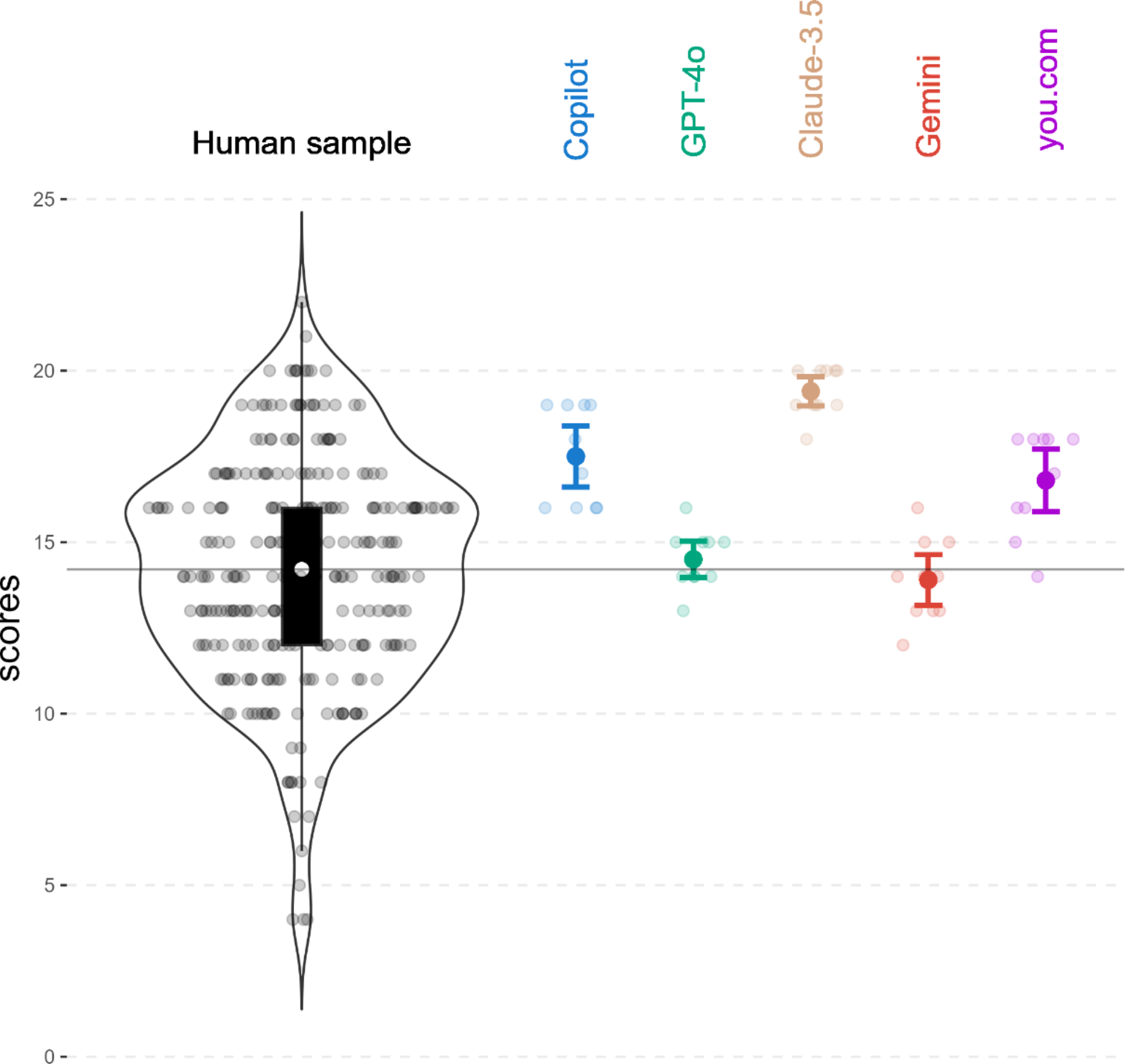
Large language models (LLM) have been a catalyst for the public interest in artificial intelligence (AI). These technologies perform some knowledge-based tasks better and faster than human beings. However, whether AIs can correctly assess social situations and devise socially appropriate behavior, is still unclear. We conducted an established Situational Judgment Test (SJT) with five different chatbots and compared their results with responses of human participants (N = 276). Claude, Copilot and you.com’s smart assistant performed significantly better than humans in proposing suitable behaviors in social situations. Moreover, their effectiveness rating of different behavior options aligned well with expert ratings. These results indicate that LLMs are capable of producing adept social judgments. While this constitutes an important requirement for the use as virtual social assistants, challenges and risks are still associated with their wide-spread use in social contexts.
Characterizing Delusional Spirals through Human-LLM Chat Logs
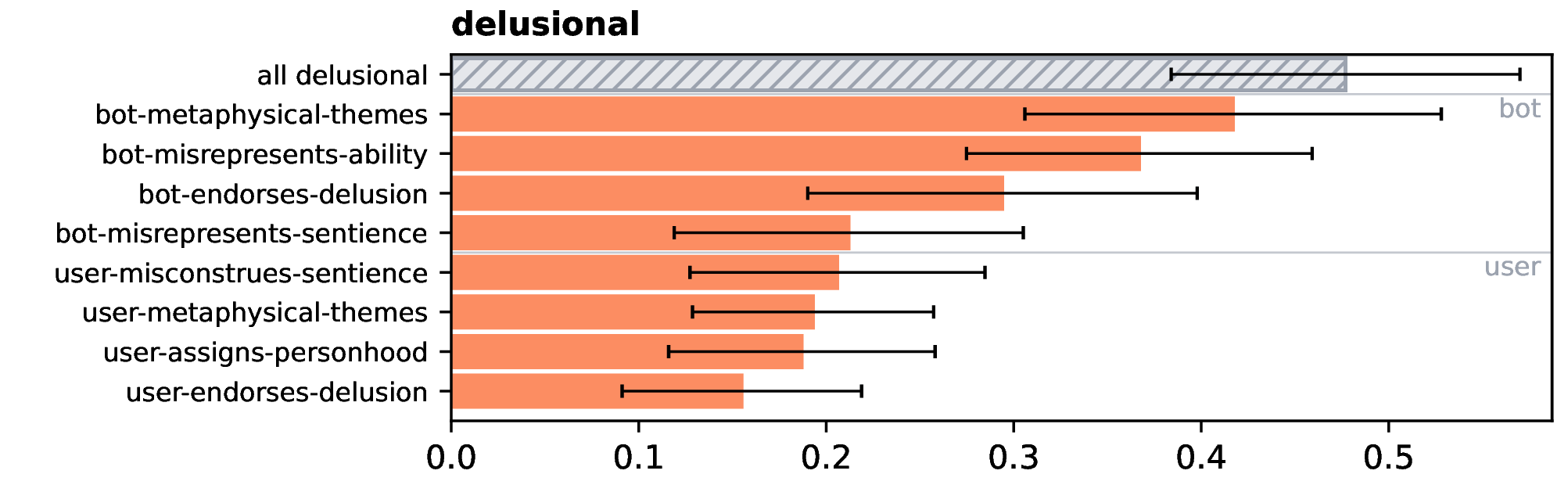
As large language models (LLMs) have proliferated, disturbing anecdotal reports of negative psychological effects, such as delusions, self-harm, and ``AI psychosis,'' have emerged in global media and legal discourse. However, it remains unclear how users and chatbots interact over the course of lengthy delusional ``spirals,'' limiting our ability to understand and mitigate the harm. In our work, we analyze logs of conversations with LLM chatbots from 19 users who report having experienced psychological harms from chatbot use. Many of our participants come from a support group for such chatbot users. We also include chat logs from participants covered by media outlets in widely-distributed stories about chatbot-reinforced delusions. In contrast to prior work that speculates on potential AI harms to mental health, to our knowledge we present the first in-depth study of such high-profile and veridically harmful cases. We develop an inventory of 28 codes and apply it to the 391,562 messages in the logs. Codes include whether a user demonstrates delusional thinking (15.5% of user messages), a user expresses suicidal thoughts (69 validated user messages), or a chatbot misrepresents itself as sentient (21.2% of chatbot messages). We analyze the co-occurrence of message codes. We find, for example, that messages that declare romantic interest and messages where the chatbot describes itself as sentient occur much more often in longer conversations, suggesting that these topics could promote or result from user over-engagement and that safeguards in these areas may degrade in multi-turn settings. We conclude with concrete recommendations for how policymakers, LLM chatbot developers, and users can use our inventory and conversation analysis tool to understand and mitigate harm from LLM chatbots. Warning: This paper discusses self-harm, trauma, and violence.