


The discovery of a nonphotosynthetic plastid in malaria and other apicomplexan parasites has sparked a contentious debate about its evolutionary origin. Molecular data have led to conflicting conclusions supporting either its green algal origin or red algal origin, perhaps in common with the plastid of related dinoflagellates. This distinction is critical to our understanding of apicomplexan evolution and the evolutionary history of endosymbiosis and photosynthesis; however, the two plastids are nearly impossible to compare due to their nonoverlapping information content. Here we describe the complete plastid genome sequences and plastid-associated data from two independent photosynthetic lineages represented by Chromera velia and an undescribed alga CCMP3155 that we show are closely related to apicomplexans. These plastids contain a suite of features retained in either apicomplexan (four plastid membranes, the ribosomal superoperon, conserved gene order) or dinoflagellate plastids (form II Rubisco acquired by horizontal transfer, transcript polyuridylylation, thylakoids stacked in triplets) and encode a full collective complement of their reduced gene sets. Together with whole plastid genome phylogenies, these characteristics provide multiple lines of evidence that the extant plastids of apicomplexans and dinoflagellates were inherited by linear descent from a common red algal endosymbiont. Our phylogenetic analyses also support their close relationship to plastids of heterokont algae, indicating they all derive from the same endosymbiosis. Altogether, these findings support a relatively simple path of linear descent for the evolution of photosynthesis in a large proportion of algae and emphasize plastid loss in several lineages (e.g., ciliates, Cryptosporidium , and Phytophthora) .
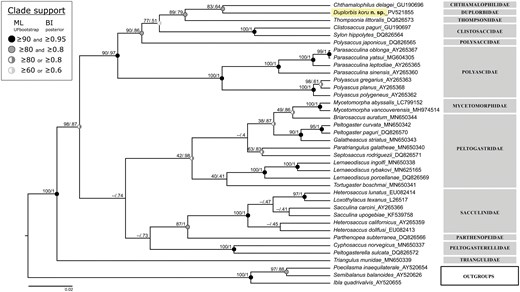
Description of a new species of the hyperparasitic barnacle <i>Duplorbis</i> Smith, 1906 and its cypris larva, with the molecular phylogenetic placement of the enigmatic family Duplorbidae Høeg & Rybakov, 1992 (Cirripedia: Rhizocephala)
Abstract Most species of Rhizocephala are obligate parasites of decapod crustaceans, but species in three families parasitize non-decapod hosts: Chthamalophilidae Bocquet-Védrine, 1961 (parasites of barnacles), Duplorbidae Høeg & Rybakov, 1992 (parasites of isopods and cumaceans), and Thompsoniidae Høeg & Rybakov, 1992 (mostly parasites of decapods but includes one species that is a parasite of stomatopods). Hyperparasitism (form of parasitism in which a secondary parasite lives on or in a primary parasite of a host) is extremely rare in Rhizocephala, but Duplorbis Smith, 1906, the type genus of the enigmatic family Duplorbidae, currently contains two named species hyperparasitic on bopyrid isopods (abdominal and branchial parasites of decapods) and one species on free-living isopods. A lectotype is selected for Duplorbis smithi Nierstrasz & Brender à Brandis, 1923. Recent work on the parasites of squat lobsters from New Zealand revealed a putative new species of this genus, described herein as Duplorbis korun. sp., hyperparasitic on branchial bopyrids of the genera Paragigantione Barnard, 1920 and Parapleurocryptella Bourdon, 1972. Each parasitized female bopyrid contained 3–8 externae of D. korun. sp. in the brood chamber. Externae of one host contained mature cypris larvae, a stage previously poorly known in this genus. These larvae are described herein using SEM and are shown to have a pair of long frontal filaments (retained from the nauplius stage), an exclusive feature shared among Duplorbidae. The first molecular (18S rRNA sequence) analysis of the family was also conducted. Duplorbids appear nested within a well-supported monophyletic lineage also comprising of Polyascidae Høeg & Glenner in Høeg, Noever, Rees, Crandall & Glenner, 2019, Polysaccidae Lützen & Takahashi, 1996, Clistosaccidae Boschma, 1928, Thompsoniidae Høeg & Rybakov, 1992, and Chthamalophilidae Bocquet-Védrine, 1961, most closely related to chthamalophilids. The discovery of this new species expands our knowledge of the species diversity, host use, and larval development of hyperparasitic rhizocephalans.
A cellular entity retaining only its replicative core: Hidden archaeal lineage with an ultra-reduced genome
Abstract Defining the minimal genetic requirements for cellular life remains a fundamental question in biology. Genomic exploration continually reveals novel microbial lineages, often exhibiting extreme genome reduction, particularly within symbiotic relationships. Here, we report the discovery of Candidatus Sukunaarchaeum mirabile, a novel archaeon with an unprecedentedly small genome of only 238 kbp —less than half the size of the smallest previously known archaeal genome— from a dinoflagellate-associated microbial community. Phylogenetic analyses place Sukunaarchaeum as a deeply branching lineage within the tree of Archaea, representing a novel major branch distinct from established phyla. Environmental sequence data indicate that sequences closely related to Sukunaarchaeum form a diverse and previously overlooked clade in microbial surveys. Its genome is profoundly stripped-down, lacking virtually all recognizable metabolic pathways, and primarily encoding the machinery for its replicative core: DNA replication, transcription, and translation. This suggests an unprecedented level of metabolic dependence on a host, a condition that challenges the functional distinctions between minimal cellular life and viruses. The discovery of Sukunaarchaeum pushes the conventional boundaries of cellular life and highlights the vast unexplored biological novelty within microbial interactions, suggesting that further exploration of symbiotic systems may reveal even more extraordinary life forms, reshaping our understanding of cellular evolution. Graphical Abstract

The invasive soft coral Xenia umbellata has been confirmed in Cuban waters
Octocoral colonies with unusual morphology were detected in September 2022 and October 2023 in two coastal areas east of Havana, Cuba, and tentatively identified as Unomia stolonifera. U. stolonifera is an invasive octocoral from the Indo-Pacific that was first reported in the Caribbean off Venezuela in the 2000s, where it has spread rapidly, smothering coral reefs and substantially altering benthic communities. After obtaining tissue samples from a Cuban octocoral colony, we re-examined the specimen using molecular barcoding of three mitochondrial regions (16S/ND2, mtMutS, COI) and the nuclear large ribosomal subunit (28S rRNA), and we unequivocally identified it as Xenia umbellata. X. umbellata, a native of the Red Sea, was first identified in southern Puerto Rico in October 2023 and has since been found in various marine ecosystems along the southern coast of the island. The presence of either invasive octocoral species in Cuba or elsewhere in the Caribbean would be of a serious environmental concern due to their documented tolerance, totipotentiality, propagation capacity and significant negative interactions with local benthic fauna. Attempts to eradicate the invasive soft coral colonies from Cuban waters have been initiated with apparent success, helping to control further expansion. The most likely introduction pathway is the accidental or intentional releases from the aquarium trade but transport via ballast water cannot be ruled out. We cannot discount the possibility of independent invasion events from different routes to Puerto Rico and Cuba occurring within a year of each other. Propagation from Cuba to Puerto Rico, or vice versa, which we consider highly improbable, would likely imply that soft coral populations may also have been established on Hispaniola but have remained undetected in the Dominican Republic and Haiti to date.
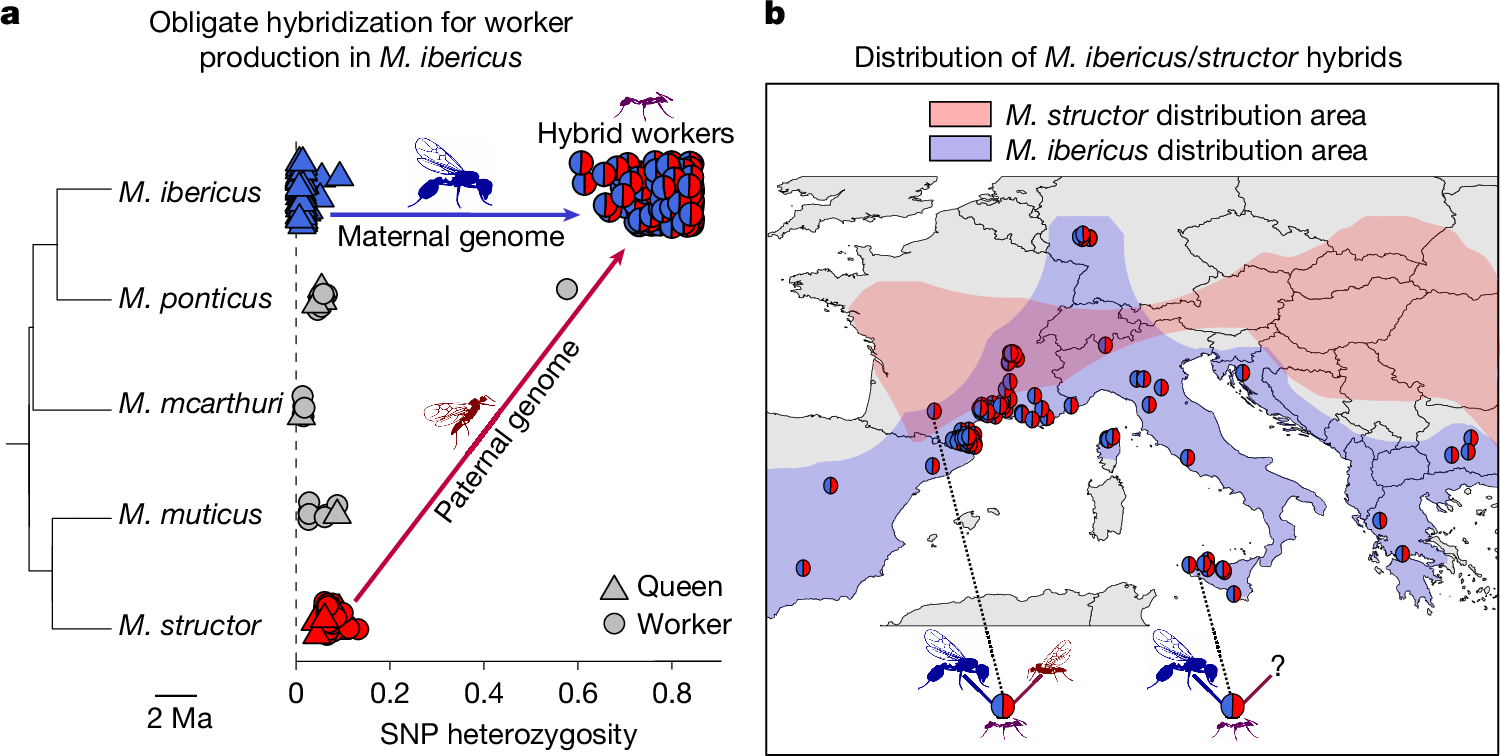
One mother for two species via obligate cross-species cloning in ants
Living organisms are assumed to produce same-species offspring1,2. Here, we report a shift from this norm in Messor ibericus, an ant that lays individuals from two distinct species. In this life cycle, females must clone males of another species because they require their sperm to produce the worker caste. As a result, males from the same mother exhibit distinct genomes and morphologies, as they belong to species that diverged over 5 million years ago. The evolutionary history of this system appears as sexual parasitism3 that evolved into a natural case of cross-species cloning4,5, resulting in the maintenance of a male-only lineage cloned through distinct species’ ova. We term females exhibiting this reproductive mode as xenoparous, meaning they give birth to other species as part of their life cycle.
Conflict between Intrinsic Leaf Asymmetry and Phyllotaxis in the Resupinate Leaves of Alstroemeria psittacina
Spiral phyllotactic patterning is the result of intricate auxin transport relationships in the shoot apical meristem (SAM) that act to place auxin maxima at the future sites of leaf initiation. Inherent to this process is a bias in auxin distribution in leaf primordia, such that increased auxin is found on the descending side of the leaf (towards the older neighbor) compared to the ascending side (towards the younger neighbor), creating phyllotactically-dependent leaf asymmetry. Separate from phyllotactic-dependent asymmetry is handedness in plants—that is, genetically encoded, fixed chirality, such as the twining of certain vines and the torsions induced by microtubule mutations. Here, we perform a morphometric analysis on the resupinate leaves of Alstroemeria psittacina. Interestingly, the twist in leaves always occurs in a single direction, regardless of the phyllotactic direction of the plant. Because of the resupination, leaves in this species possess an inherent handedness. However, this asymmetry is modulated in a phyllotactic-dependent manner, consistent with the known developmental constraints of phyllotaxis upon leaf morphology. This creates the interesting circumstance in A. psittacina that leaves arising from plants with a counter-clockwise phyllotactic direction are 1) more asymmetric, 2) larger, and 3) possess symmetrical shape differences relative to leaves from plants with clockwise phyllotaxis. The mechanism underlying these differences likely involves a developmental delay in clockwise leaves caused by the conflict between the phyllotaxis-dependent asymmetry and asymmetry resulting from resupination. The evolutionary implications of a dimorphic population without a genetic basis for selection to act upon are discussed.

Symbiotic organs in insects: diversity, functional implications, and terminology
Abstract With over a million described species, insects represent the most successful group of animals on Earth. One of the drivers of insect diversity is their ability to engage in multifold beneficial symbioses with microorganisms, often involving specialized host organs to accommodate intra- or extracellular symbionts. The existence of such organs and their importance for sustaining and transmitting beneficial symbionts has been known for over a century, and specific terms have been established for categorizing organs harbouring intracellular bacteria (bacteriomes) or fungi (mycetomes), or cuticular crypts containing extracellular fungi (mycetangia). For others, however, general terms are lacking, e.g. organs containing extracellular bacteria associated with the cuticle or with the digestive tract. Furthermore, previously established terms have been misused in other contexts. Notably, ‘bacteriome’ has been increasingly employed in the microbiome field to refer to bacterial communities, instead of the term’s original meaning of specialized organs housing intracellular bacterial symbionts. Here, we review and categorize the diversity of symbiotic organs in insects and propose a unified terminology. Our hope is that this common language will facilitate communication and thereby support the field of symbiosis research in unravelling commonalities and differences in the evolution, ecology, development, physiology and molecular basis across symbiotic interactions. This article is part of the theme issue ‘Life in natural microcosms’.

A Cell So Minimal That It Challenges Definitions of Life | Quanta Magazine
The newly described microbe represents a world of parasitic, intercellular biodiversity only beginning to be revealed by genome sequencing.

Growth, metabolic partitioning, and the size of microorganisms
Population growth rate is a fundamental ecological and evolutionary characteristic of living organisms, but individuals must balance the metabolism devoted to biosynthesis and reproduction against the maintenance of existing structure and other functionality. Here we present a mathematical model that relates metabolic partitioning to the form of growth. The model captures the observed growth trajectory of single cells and individuals for a variety of species and taxa spanning prokaryotes, unicellular eukaryotes, and small multicellular eukaryotes. Our analysis suggests that the per-unit costs of biosynthesis and maintenance are conserved across prokaryotes and eukaryotes. However, the relative metabolic expenditure on growth and maintenance of whole organisms clearly differentiates taxa: prokaryotes spend an increasing fraction of their entire metabolism on growth with increasing cell size, whereas eukaryotes devote a diminishing fraction. These differences allow us to predict the minimum and maximum size for each taxonomic group, anticipating observed evolutionary life-history transitions. The framework provides energetic insights into taxonomic tradeoffs related to growth and metabolism and constrains traits that are important for size-structured modeling of microbial communities and their ecological and biogeochemical effects.

Siphonophore
Siphonophores are cnidarian animals of the hydrozoan order Siphonophorae. According to the World Register of Marine Species, the order contains 194 species described thus far.

Wollschweber
Die Wollschweber (Bombyliidae), auch Trauerschweber, Hummelschweber oder seltener Trauerfliege, sind eine Familie der Zweiflügler (Diptera) und werden den Fliegen (Brachycera) zugeordnet. Weltweit sind etwa 6000 Arten dieser Gruppe bekannt, davon 41 in Deutschland.

‘Highly Plausible’ Aliens on Europa Are Earthlings’ Descendants, Study Says
A new study suggests that bacteria dispersed through space on dust grains could potentially arrive intact and alive on Jupiter’s moon Europa.

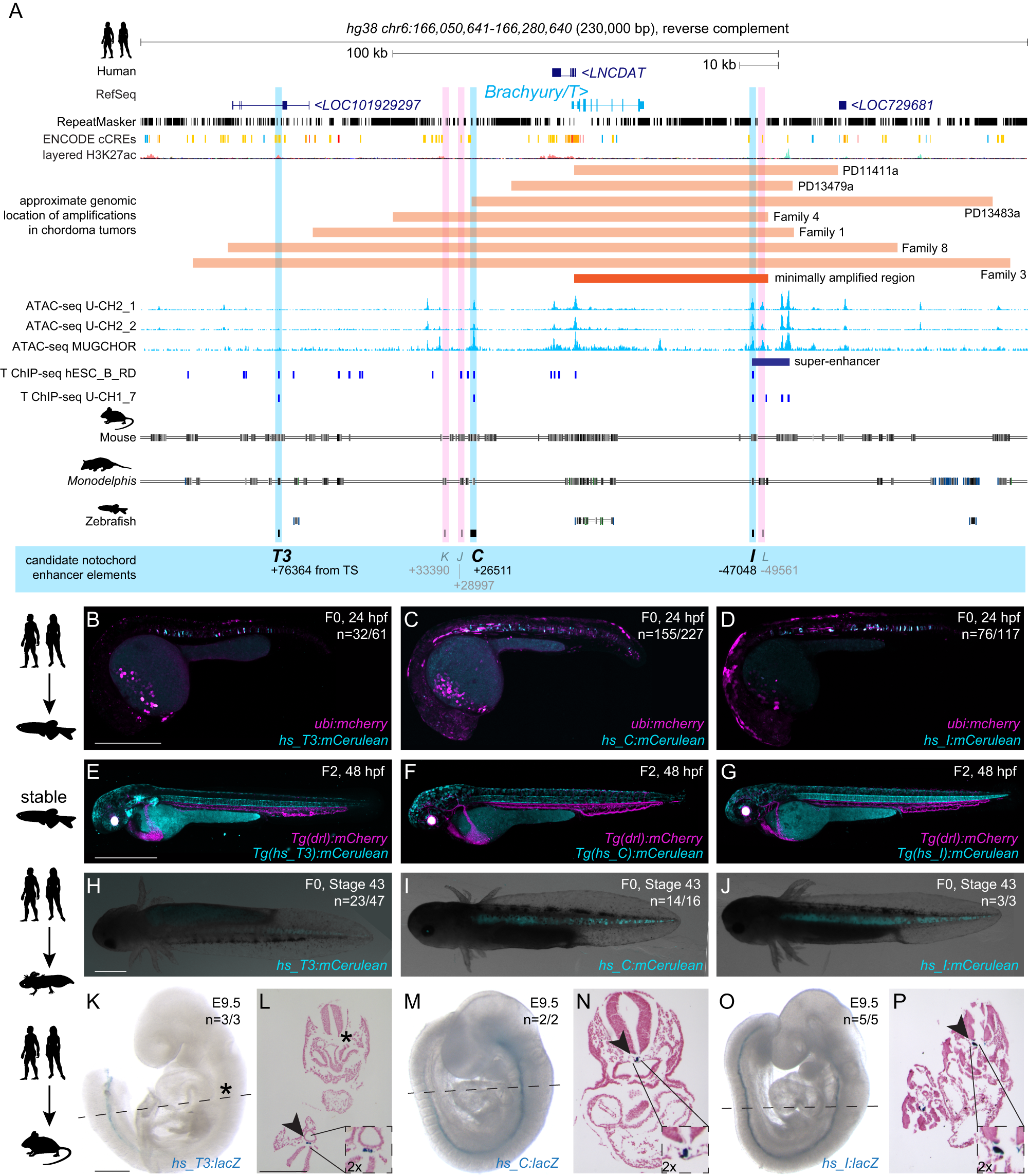
Conserved enhancers control notochord expression of vertebrate Brachyury
The cell type-specific expression of key transcription factors is central to development and disease. Brachyury/T/TBXT is a major transcription factor for gastrulation, tailbud patterning, and notochord formation; however, how its expression is controlled in the mammalian notochord has remained elusive. Here, we identify the complement of notochord-specific enhancers in the mammalian Brachyury/T/TBXT gene. Using transgenic assays in zebrafish, axolotl, and mouse, we discover three conserved Brachyury-controlling notochord enhancers, T3, C, and I, in human, mouse, and marsupial genomes. Acting as Brachyury-responsive, auto-regulatory shadow enhancers, in cis deletion of all three enhancers in mouse abolishes Brachyury/T/Tbxt expression selectively in the notochord, causing specific trunk and neural tube defects without gastrulation or tailbud defects. The three Brachyury-driving notochord enhancers are conserved beyond mammals in the brachyury/tbxtb loci of fishes, dating their origin to the last common ancestor of jawed vertebrates. Our data define the vertebrate enhancers for Brachyury/T/TBXTB notochord expression through an auto-regulatory mechanism that conveys robustness and adaptability as ancient basis for axis development.
inspired by @pfrazee.com's demo at @seattle.atprotocol.community. askmosphere: events edition asking it about @atproto.nyc #atprototype
atproto

Collection of collections of everything related to atproto
Discontinued AT projects (by Victoria) — Semble
AT Status (by Victoria) — Semble
AT Protocol status pages (by あ) — Semble
atproto explainers (by Ronen Tamari) — Semble
⁂ Standarding yo site (by Tynan Purdy ⁂) — Semble
blog-to-atproto (by Ariel M. (she/her)) — Semble
