


Significance Most government benefits programs exhibit a sizable participation gap, with eligible individuals forgoing billions of dollars in government benefits each year. Many policymakers have focused on addressing this participation gap, as receiving government benefits has been shown to reduce poverty, childhood hunger, educational gaps, and physical and mental illness. The current work presents psychological ownership framing as a behavioral science intervention, and we show that it can help address this benefits participation gap. These interventions are subtle, simple to implement, and cheaper to execute relative to logistical interventions. Moreover, the data show that psychological ownership interventions can be more efficacious than other common psychological interventions such as social norms and urgency. , Each year, eligible individuals forgo billions of dollars in financial assistance in the form of government benefits. To address this participation gap, we identify psychological ownership of government benefits as a factor that significantly influences individuals’ interest in applying for government benefits. Psychological ownership refers to how much an individual feels that a target is their own. We propose that the more individuals feel that government benefits are their own, the less likely they are to perceive applying for them as an aversive ask for help, and thus, the more likely they are to pursue them. Three large-scale field experiments among low-income individuals demonstrate that higher psychological ownership framing of government benefits significantly increases participants’ pursuit of benefits and outperforms other common psychological interventions. An additional experiment shows that this effect occurs because greater psychological ownership reduces people’s general aversion to asking for assistance. Relative to control messages, these psychological ownership interventions increased interest in claiming government benefits by 20% to 128%. These results suggest that psychological ownership framing is an effective tool in the portfolio of potential behavioral science interventions and a simple way to stimulate interest in claiming benefits.
Psychological Ownership in Financial Decisions
Policy makers have long intuitively realized the benefit of encouraging strong psychological ownership toward social programs. For example, Franklin D. Roosevelt in the 1930s purposely designed the Social Security program to include a high feeling of ownership by workers, to generate a sense of responsibility and protection from future legislation. Recent research suggests that this sense of ownership continues to be an important part of the SSA program and is a significant predictor of when retirees claim their benefits. Strong feelings of ownership also exist for other programs (e.g., Medicare) and financial services (e.g., investments), and there are significant implications of that psychological ownership on consumers’ decisions and behavior around these programs. Policy makers and marketers may wish to consider the role of interventions that affect consumers’ psychological ownership, along with feelings of trust and fairness, for such products.

Knowing When to Spend: Unintended Financial Consequences of Earmarking to Encourage Savings
Maintaining savings is an important financial goal. Yet there are times when savings should be spent, such as when people face unavoidable costs, and spending their savings allows them to avoid high interest rate debt. Existing behavioral research has focused on consumer decisions between savings and discretionary spending and has proposed interventions to promote savings in these contexts. However, when spending is not discretionary, such interventions could risk exacerbating a pattern found in economic research in which people borrow high interest rate debt while maintaining savings that earn low levels of interest. To examine how mental accounting interacts with considerations of personal responsibility and guilt to contribute to this pattern, this article explores whether people spend their savings when they need money most: during emergencies. Six studies reveal that people's tendency to preserve savings by borrowing from a high interest rate credit option varies as a function of the savings’ intended use. Paradoxically, people are most likely to turn to high interest rate credit with the belief that doing so is the responsible option.

Do people like financial nudges?
Do people like financial nudges? To answer that question we conducted a pre-registered survey presenting people with 36 hypothetical scenarios describing financial interventions. We varied levels of transparency (i.e., explaining how the interventions worked), framing (interventions framed in terms of spending, or saving), and ‘System’ (interventions could target either System 1 or System 2). Participants were a random sample of 2,100 people drawn from a representative Australian population. All financial interventions were tested across six dependent variables: approval, benefit, ethics, manipulation, the likelihood of use, as well as the likelihood of use if the intervention were to be proposed by a bank. Results indicate that people generally approve of financial interventions, rating them as neutral to positive across all dependent variables (except for manipulation, which was reverse coded). We find effects of framing and System. People have strong and significant preferences for System 2 interventions, and interventions framed in terms of savings. Transparency was not found to have a significant impact on how people rate financial interventions. Financial interventions continue to be rated positive, regardless of the messenger. Looking at demographics, we find that participants who were female, younger, living in metro areas and earning higher incomes were most likely to favor financial interventions, and this effect is especially strong for those aged under 45. We discuss the implications for these results as applied to the financial sector.

Reducing debt improves psychological functioning and changes decision-making in the poor
Significance The impact of chronic debt on the poor is psychological, not just financial. We hypothesize that chronic debt impairs psychological functioning and decision-making, contributing to the poverty trap. This is because debt is not considered fungible and is viewed as costly mental accounts that consume cognitive bandwidth. We test this using quasiexperimental evidence from a one-off, unanticipated debt-relief program worth several months’ household income. Comparing the poor before and after debt relief, those with more debt accounts paid off experienced greater improvements in cognitive functioning, reported less anxiety, and became less present-biased. These findings provide actionable evidence for poverty-alleviation policy. , We examine how chronic debt affects behavior by studying how a large, unanticipated debt-relief program affected psychological functioning and economic decision-making in beneficiaries. A charity granted low-income households debt relief worth up to Singapore dollars 5,000 (∼3 month’s household income). We exploited quasiexperimental variation in the structure of debt relief: For the same dollar amount of relief, some beneficiaries had more debt accounts eliminated, while others had fewer paid off. Comparing 196 beneficiaries before and after debt relief, and controlling for debt-relief amount, having an additional debt account paid off improves cognitive functioning by about one-quarter of a SD and reduces the likelihood of exhibiting anxiety by 11% and of present bias by 10%. To achieve the same effect on cognitive functioning of eliminating one debt account, a beneficiary must receive debt relief worth ∼1 month’s household income. There is no effect of debt-relief magnitude on anxiety and decision-making. We exclude training and calendar effects, debt-causing behaviors, and liquidity constraints as explanations. Instead, these results support the hypothesis that chronic debt impairs behavior because the mental-accounting costs of owing distinct debt accounts consume mental bandwidth. Poverty-alleviation policies aimed at the indebted poor should consider addressing mental accounting and bandwidth taxes.

The persistence of cognitive biases in financial decisions across economic groups
While economic inequality continues to rise within countries, efforts to address it have been largely ineffective, particularly those involving behavioral approaches. It is often implied but not tested that choice patterns among low-income individuals may be a factor impeding behavioral interventions aimed at improving upward economic mobility. To test this, we assessed rates of ten cognitive biases across nearly 5000 participants from 27 countries. Our analyses were primarily focused on 1458 individuals that were either low-income adults or individuals who grew up in disadvantaged households but had above-average financial well-being as adults, known as positive deviants. Using discrete and complex models, we find evidence of no differences within or between groups or countries. We therefore conclude that choices impeded by cognitive biases alone cannot explain why some individuals do not experience upward economic mobility. Policies must combine both behavioral and structural interventions to improve financial well-being across populations.

Unconditional cash transfers reduce homelessness
Homelessness is an economic and social crisis. In a cluster-randomized controlled trial, we address a core cause of homelessness—lack of money—by providing a one-time unconditional cash transfer of CAD$7,500 to each of 50 individuals experiencing homelessness, with another 65 as controls in Vancouver, BC. Exploratory analyses showed that over 1 y, cash recipients spent fewer days homeless, increased savings and spending with no increase in temptation goods spending, and generated societal net savings of $777 per recipient via reduced time in shelters. Additional experiments revealed public mistrust toward the ability of homeless individuals to manage money and demonstrated interventions to increase public support for a cash transfer policy using counter-stereotypical or utilitarian messaging. Together, this research offers a new approach to address homelessness and provides insights into homelessness reduction policies.

Identifying heterogeneity using recursive partitioning: evidence from SMS nudges encouraging voluntary retirement savings in Mexico
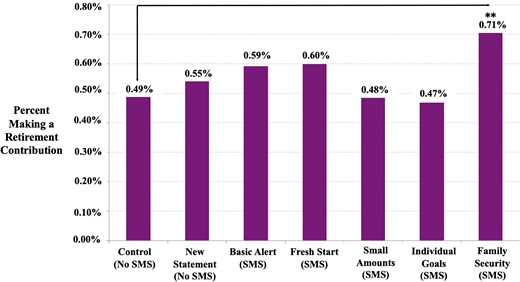
Abstract Individuals regularly struggle to save for retirement. Using a large-scale field experiment (N=97,149) in Mexico, we test the effectiveness of several behavioral interventions relative to existing policy and each other geared toward improving voluntary retirement savings contributions. We find that an intervention framing savings as a way to secure one’s family future significantly improves contribution rates. We leverage recursive partitioning techniques and identify that the overall positive treatment effect masks subpopulations where the treatment is even more effective and other groups where the treatment has a significant negative effect, decreasing contribution rates. Accounting for this variation is significant for theoretical and policy development as well as firm profitability. Our work also provides a methodological framework for how to better design, scale, and deploy behavioral interventions to maximize their effectiveness.
How Are SNAP Benefits Spent? Evidence from a Retail Panel
We use a novel retail panel with detailed transaction records to study the effect of the Supplemental Nutrition Assistance Program (SNAP) on house-hold spending. We use administrative data to motivate three approaches to causal inference. The marginal propensity to consume SNAP-eligible food (MPCF) out of SNAP benefits is 0.5 to 0.6. The MPCF out of cash is much smaller. These patterns obtain even for households for whom SNAP benefits are economically equivalent to cash because their benefits are below their food spending. Using a semiparametric framework, we reject the hypothesis that households respect the fungibility of money. A model with mental accounting can match the facts.
Temporal Reframing and Participation in a Savings Program: A Field Experiment
This study explores whether framing savings in more or less granular formats can increase sign-ups for a recurring deposit program in a FinTech environment. , A growing number of American workers are now freelancers and thus, responsible for their own retirement savings, yet they face psychological hurdles that hamper them from saving enough money for the long term. Although prior theory-derived interventions have been successful in addressing some of these obstacles, encouraging participation in saving programs is a challenging endeavor for policy makers and consumers alike. In a field setting, we test whether framing savings in more or less granular formats (for example, saving daily versus monthly) can encourage continued saving behavior through increasing the take up of a recurring deposit program. Among thousands of new users of a financial technology app, we find that framing deposits in daily amounts as opposed to monthly amounts quadruples the number of consumers who enroll. Furthermore, framing deposits in more granular terms reduced the participation gap between lower- and higher-income consumers: three times as many consumers in the highest rather than lowest income bracket participated in the program when it was framed as a $150 monthly deposit, but this difference in participation was eliminated when deposits were framed as $5 per day.

Role Integration Increases the Fungibility of Mentally Accounted Funds
Bridging the gap between the mental accounting and identities/roles literatures, the present research examines how the extent to which an individual's life roles (e.g., “employee,” “spouse”) are integrated (i.e., have more flexible and permeable psychological boundaries between them) moderates the fungibility of mentally accounted funds. Specifically, individuals with more integrated roles are more able to circumvent the constraints typically imposed by mental budgeting and earmarking; therefore, they are more likely to use funds that are allocated or budgeted for the purposes of one role to service the needs/wants of another role. This holds regardless of whether funds have been (1) allocated to a broader role-specific mental account for future expenditures or (2) earmarked for a specific purchase. The authors find evidence that the effect of role integration arises because those with more integrated roles believe that making purchases for one role using funds allocated or budgeted for the other role is more justifiable.
Can Consumers Make Affordable Care Affordable? The Value of Choice Architecture
Tens of millions of people are currently choosing health coverage on a state or federal health insurance exchange as part of the Patient Protection and Affordable Care Act. We examine how well people make these choices, how well they think they do, and what can be done to improve these choices. We conducted 6 experiments asking people to choose the most cost-effective policy using websites modeled on current exchanges. Our results suggest there is significant room for improvement. Without interventions, respondents perform at near chance levels and show a significant bias, overweighting out-of-pocket expenses and deductibles. Financial incentives do not improve performance, and decision-makers do not realize that they are performing poorly. However, performance can be improved quite markedly by providing calculation aids, and by choosing a “smart” default. Implementing these psychologically based principles could save purchasers of policies and taxpayers approximately 10 billion dollars every year.
Behaviorally Informed Policies for Household Financial Decisionmaking
Low incomes, limited financial literacy, fraud, and deception are just a few of the many intractable economic and social factors that contribute to the financial difficulties that households face today. Addressing these issues directly is difficult and costly. But poor financial outcomes also result from systematic psychological tendencies, including imperfect optimization, biased judgments and preferences, and susceptibility to influence by the actions and opinions of others. Some of these psychological tendencies and the problems they cause may be countered by policies and interventions that are both low cost and scalable. We detail the ways that these behavioral factors contribute to consumers’ fiancial mistakes and suggest a set of interventions that the federal government, in its dual roles as regulator and employer, could feasibly test or implement to improve household financial outcomes in a variety of domains: retirement, short-term savings, debt management, the take-up of government benefits, and tax optimization.
The Benefits of Emergency Reserves: Greater Preference and Persistence for Goals that Have Slack with a Cost
Marketers of programs that are designed to help consumers reach goals face dual challenges of making the program attractive enough to encourage consumer signup while still motivating consumers to reach desirable goals and thus stay satisfied with the program. The authors offer a possible solution to this challenge: the emergency reserve, or slack with a cost. They demonstrate how an explicitly defined emergency reserve not only is preferred over other options for goal-related programs but can also lead to increased persistence. Study 1 demonstrates that consumers prefer programs with emergency reserves to programs that do not have them, and Study 2 further clarifies that consumers' preference for an emergency reserve depends on the presence of a superordinate goal. Study 3 reveals that consumers prefer goals with emergency reserves because they perceive them to have both higher attainability and value than other goals. Study 4 demonstrates that reserves can lead to increased goal persistence in a realistic task that involves persistence over time. Finally, Studies 5 and 6 reveal that consumers persist more with reserve goals because they want to avoid using the “emergency” reserve.
If you rise, I fall: Equality is prevented by the misperception that it harms advantaged groups
Nine preregistered studies ( n = 4197) demonstrate that advantaged group members misperceive equality as necessarily harming their access to resources and inequality as necessarily benefitting them. Only when equality is increased within their ingroup, instead of between groups, do advantaged group members accurately perceive it as unharmful. Misperceptions persist when equality-enhancing policies offer broad benefits to society or when resources, and resource access, are unlimited. A longitudinal survey of the 2020 U.S. voters reveals that harm perceptions predict voting against actual equality-enhancing policies, more so than voters’ political and egalitarian beliefs. Finally two novel-groups experiments reveal that advantaged participants’ harm misperceptions predict voting for inequality-enhancing policies that financially hurt them and against equality-enhancing policies that financially benefit them. Misperceptions persist even after an intervention to improve decision-making. This misperception that equality is necessarily zero-sum may explain why inequality prevails even as it incurs societal costs that harm everyone. , Advantaged groups misperceive equality as harming their resource access, which predicts voting against equality policies.

Can One Donation a Day Keep Depression Away? Three Randomized Controlled Trials of an Online Micro-Charitable Giving Intervention
Prosocial interventions grounded in social interactions have shown limited effectiveness in alleviating depressive symptoms, possibly because of the discomfort and unease that depressed individuals experience during such interactions. We developed and examined an innovative prosocial intervention—an online micro-charitable giving intervention, in which individuals voluntarily donated at least one Chinese cent (¥0.01, or about $0.0014) daily. We conducted three preregistered, 2-month randomized controlled trials with depressed individuals (Sample 1: N = 125, Sample 2: N = 296, Sample 3: N = 462). Results showed that, compared with the waitlist group, the intervention group exhibited significantly greater improvements in both depressive symptoms (Cohen’s d s = −0.19 to −0.46) and emotional positivity (Cohen’s d s = 0.22 to 0.49), and that emotional positivity mediated the intervention’s effect on the reduction of depressive symptoms. Exploratory analysis found a slightly larger intervention effect for generous donors than for minimal donors. This low-cost, easily accessible prosocial intervention holds potential for the prevention of depression. Statement of Relevance Can donating one cent (specifically one Chinese cent, or about $0.0014) alleviate depressive symptoms? We have developed a practical and effective intervention—donating at least one cent daily on an online charity platform—and have discovered that this intervention effectively mitigates depressive symptoms in depressed individuals. Despite the nominal purchasing power of one cent in contemporary society, this act of giving has been shown to significantly enhance mental health. Our findings could be relevant to everyone in society; charitable donations promote societal harmony and, in addition, offer a cost-effective way to alleviate depressive symptoms. As the intervention instruction asserts, “Charity encompasses love, regardless of its size, as even one cent holds value.”
Payment method and perceptions of ownership
How consumers pay influences how they feel about a transaction. In particular, paying by card has been argued to have an effect on the perception of cost, making it less salient and painful. We propose and show that payment method also influences how consumers feel about the acquired good. Specifically, we focus on effects of the payment method on psychological ownership, i.e., the perception of an object as “mine.” We propose that cash payment results in stronger psychological ownership because it influences the extent of perceived investment in an object. We provide evidence for the proposed effect from field and laboratory settings. Results of a longitudinal exit survey and an experiment show that cash payers report higher levels of immediate psychological ownership than card payers. However, this effect seems to depend on the meanings associated with a payment method. Asian students (who associate credit card payment with investment and debt) do not exhibit this effect. Moreover, the initial boost in psychological ownership seems to be comparably short-lived. While those paying in cash experience no further increase in psychological ownership over time, those paying by card do.
