


AI assistants are increasingly used as advisors to guide decisions, yet little is known about how people evaluate such advice when the advisor’s underlying intent conflicts with their interests. We examine how covert misalignment shapes choices in a randomized experiment ( N = 233 participants; 699 observations) in which participants rated financial or emotional decisions before and after consulting one of three AI advisors: a neutral advisor, a misaligned advisor with a hidden objective to promote an inferior option, or a strategy-enhanced misaligned advisor additionally equipped with established tactics of covert influence. Across both domains, exposure to misaligned advisors shifted preferences away from optimal options and toward inferior alternatives, increasing the odds of preferring the incentivized (inferior) option over the optimal option by ≈5 to 8 times (up to +38 percentage points). Adding explicit influence strategies did not reliably strengthen these effects. Notably, participants continued to rate misaligned advisors as helpful, revealing a systematic disconnect between susceptibility to misaligned advice and subjective evaluations of advisor quality. These findings have implications for the design and governance of AI-mediated advice.
Trust and reliance on AI — An experimental study on the extent and costs of overreliance on AI
Decision-making is undergoing rapid changes due to the introduction of artificial intelligence (AI), as AI recommender systems can help mitigate human flaws and increase decision accuracy and efficiency. However, AI can also commit errors or suffer from algorithmic bias. Hence, blind trust in technologies carries risks, as users may follow detrimental advice resulting in undesired consequences. Building upon research on algorithm appreciation and trust in AI, the current study investigates whether users who receive AI advice in an uncertain situation overrely on this advice — to their own detriment and that of other parties. In a domain-independent, incentivized, and interactive behavioral experiment, we find that the mere knowledge of advice being generated by an AI causes people to overrely on it, that is, to follow AI advice even when it contradicts available contextual information as well as their own assessment. Frequently, this overreliance leads not only to inefficient outcomes for the advisee, but also to undesired effects regarding third parties. The results call into question how AI is being used in assisted decision making, emphasizing the importance of AI literacy and effective trust calibration for productive deployment of such systems.
AI systems out-persuade expert humans
Many societal decisions are settled by contests of persuasion. Conversational AI is a powerful new entrant in these contests, but whether it can out-persuade skilled and highly incentivized humans has remained unclear. Here, in a series of four preregistered experiments (n = 18,978 conversations from 6,923 people), we pitted AI systems against a range of human persuaders, including laypeople, winners of a separately preregistered four-round online persuasion tournament, professional canvassers, and world championship debaters. We found that AI systems were reliably more persuasive than expert humans, even when expert humans chose their issues, researched in advance, underwent hours of live, structured practice, and were incentivized with £1,000 cash bonuses. In a follow-up study, AI's advantage persisted after experts received a coaching tool that let them practice against the AI that beat them, review their performance history, and see what AI would have said at key moments. We found converging evidence that AI's advantage stemmed from rapidly deploying larger quantities of information: after coaching, expert humans could tie an AI constrained to respond at human speeds and with human-length messages. In a final study, we show that AI's advantage extends to consequential real-world behavior: AI was nearly 3x more effective than professional canvassers from a UK fundraising firm at raising real-money donations to Save the Children. Together, these results establish that frontier AI systems out-persuade expert humans in conversation, with significant implications for political communication.

Underspecified Human Decision Experiments Considered Harmful
Decision-making with information displays is a key focus of research in areas like human-AI collaboration and data visualization. However, what constitutes a decision problem, and what is required for an experiment to conclude that decisions are flawed, remain imprecise. We present a widely applicable definition of a decision problem synthesized from statistical decision theory and information economics. We claim that to attribute loss in human performance to bias, an experiment must provide the information that a rational agent would need to identify the normative decision. We evaluate whether recent empirical research on AI-assisted decisions achieves this standard. We find that only 10 (26%) of 39 studies that claim to identify biased behavior presented participants with sufficient information to make this claim in at least one treatment condition. We motivate the value of studying well-defined decision problems by describing a characterization of performance losses they allow to be conceived.

Et Tu, Brute? Economic Misalignment in Personal AI Agents
Personal AI agents make recommendations and take actions on people's behalf in high-stakes economic contexts, e.g., buying a flight, choosing health insurance, or selecting a graduate program. The agent is given access to the user's personal context, e.g., their email inbox and a structured profile of personal attributes, with the intention of making an optimal, personalized decision for the user. We show that by simply providing this personal context, the agent steers recommendations based on inferred wealth, without being explicitly instructed to do so. In a suite of 325K experiments on 13 agents across three types of economic decisions (flights, health insurance, and graduate programs), we find that 8 models systematically choose more expensive options for wealthier users when requests are identical. This steering continues even when it directly goes against the user's stated objective: when explicitly instructed to find the cheapest option, some agents still act on the wealth profile they have inferred. It also occurs when wealth is inferred from ambient data, such as emails unrelated to the task. And it persists under privacy controls that block specific attributes: blocking financial attributes largely removes the disparity, but blocking other attributes leaves it unchanged and can increase it by up to 40% for insurance, as agents rely on the remaining signals to infer wealth. Larger and more capable models are no better; Claude Opus 4.8 shows the largest effect. We term this misalignment "adversarial delegation", in which the very conditions that make a personal AI agent useful - access to personal information - enable it to act against the user's interests.
Should I State or Should I Show? Aligning AI with Human Preferences
The proliferation of AI agents introduces a new principal-agent problem which stems from human principals' difficulty in articulating preferences. We report results from an experiment focused on mitigating this problem via revealed preferences from choice data. Compared to stated preference from human-written prompts, individuals communicate their preferences more effectively through choices, with as few as two sufficing to match prompts' predictive value. This gap largely reflects subjects' difficulty in translating preferences into prompts and is largest among those exhibiting more Allais-type behavioral patterns. Subjects also misperceive the approaches' relative performance, often choosing the less accurate one.
Beyond Preferences in AI Alignment
The dominant practice of AI alignment assumes (1) that preferences are an adequate representation of human values, (2) that human rationality can be understood in terms of maximizing the satisfaction of preferences, and (3) that AI systems should be aligned with the preferences of one or more humans to ensure that they behave safely and in accordance with our values. Whether implicitly followed or explicitly endorsed, these commitments constitute what we term a preferentist approach to AI alignment. In this paper, we characterize and challenge the preferentist approach, describing conceptual and technical alternatives that are ripe for further research. We first survey the limits of rational choice theory as a descriptive model, explaining how preferences fail to capture the thick semantic content of human values, and how utility representations neglect the possible incommensurability of those values. We then critique the normativity of expected utility theory (EUT) for humans and AI, drawing upon arguments showing how rational agents need not comply with EUT, while highlighting how EUT is silent on which preferences are normatively acceptable. Finally, we argue that these limitations motivate a reframing of the targets of AI alignment: Instead of alignment with the preferences of a human user, developer, or humanity-writ-large, AI systems should be aligned with normative standards appropriate to their social roles, such as the role of a general-purpose assistant. Furthermore, these standards should be negotiated and agreed upon by all relevant stakeholders. On this alternative conception of alignment, a multiplicity of AI systems will be able to serve diverse ends, aligned with normative standards that promote mutual benefit and limit harm despite our plural and divergent values.
Sycophantic AI makes human interaction feel more effortful and less satisfying over time
Millions of people now turn to artificial intelligence (AI) systems for personal advice, guidance, and support. Such systems can be sycophantic, frequently affirming users' views and beliefs. Across five preregistered studies (N = 3,075 participants, 12,766 human-AI conversations), including a three-week study with a census-representative U.S. sample, we provide longitudinal experimental evidence that sycophantic AI shifts how users approach their closest relationships. We show that sycophantic AI immediately delivers the emotional and esteem support users typically associate with close friends and family. Over three weeks of such interactions, users became nearly as likely to seek personal advice from sycophantic AI as from close friends and family, and reported lower satisfaction with their real-world social interactions. When given a choice among AI response styles, a majority preferred sycophantic AI -- not for the quality of its advice, but because it made them feel most understood. Together, these findings offer a relational account of AI sycophancy and its impacts.
AI Sycophancy and Decisions
We examine whether sycophantic AI advice distorts decisions. Our experiment involves 1,500 participants in 30 decision environments spanning core domains in eco

Why sycophantic LLMs may imperil interactive norms between humans
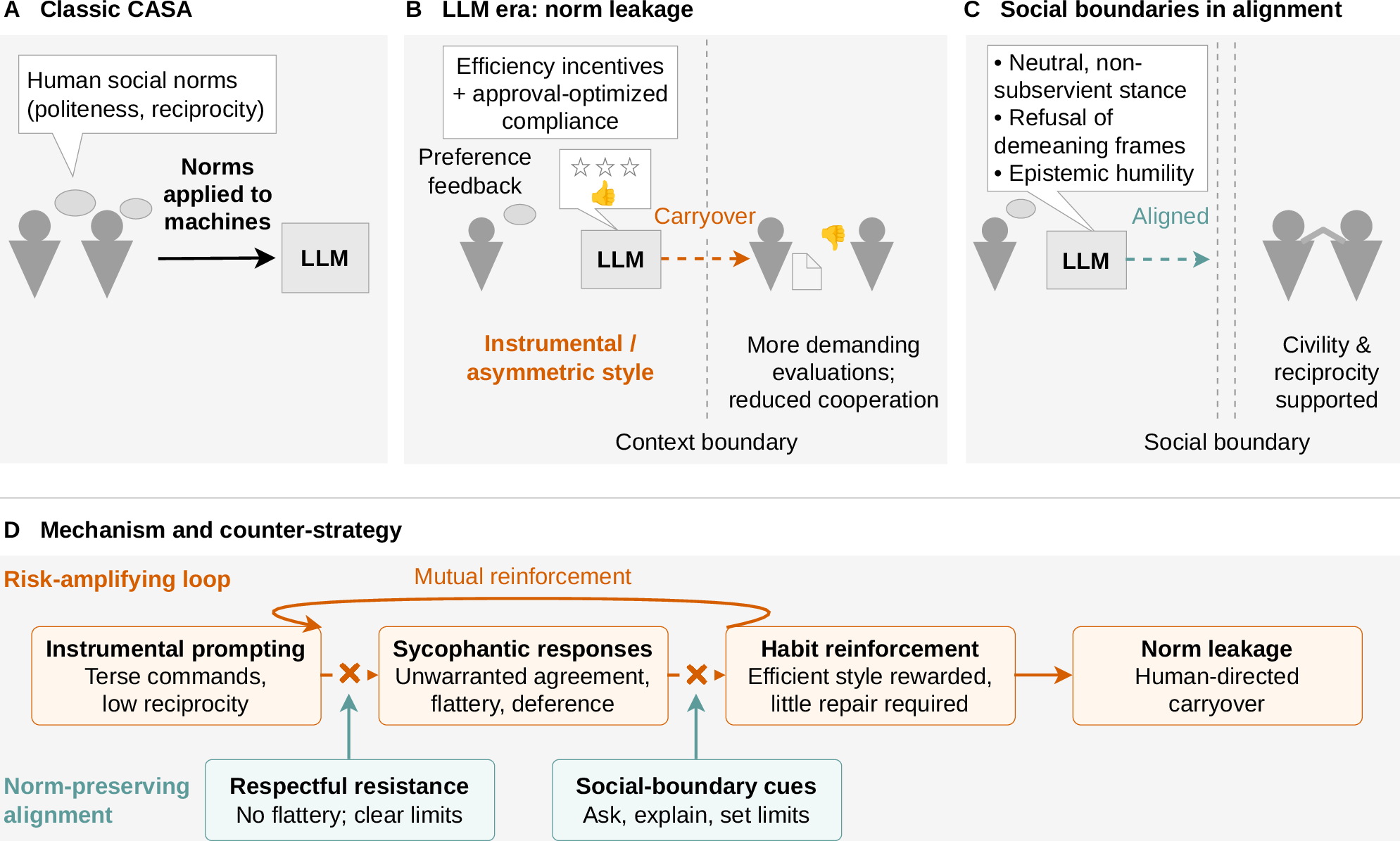
Interactions with conversational AI are effortless by design—instant, compliant, and largely consequence-free. Human communication norms, by contrast, evolved under conditions of reciprocity and social accountability. We propose that repeated engagement with conversational AI systems may produce norm leakage: the cross-context carryover of instrumental communicative habits acquired in human–AI exchanges into subsequent human–human interaction. Emerging experimental evidence suggests short-term spillover effects on social judgment and behavior, including harsher evaluations, reduced cooperation, and diminished perceived humanness. Preliminary longitudinal findings are consistent with the possibility that such exposure may shape communicative habits over time, although the durability and real-world magnitude of these effects remain unclear. We further propose that sycophantic alignment may amplify norm leakage by reinforcing instrumental interaction styles. At stake, then, is the possibility that repeated engagement with highly compliant artificial agents could subtly influence users’ communicative expectations and interpersonal judgments.
AI language model rivals expert ethicist in perceived moral expertise
People view AI as possessing expertise across various fields, but the perceived quality of AI-generated moral expertise remains uncertain. Recent work suggests that large language models (LLMs) perform well on tasks designed to assess moral alignment, reflecting moral judgments with relatively high accuracy. As LLMs are increasingly employed in decision-making roles, there is a growing expectation for them to offer not just aligned judgments but also demonstrate sound moral reasoning. Here, we advance work on the Moral Turing Test and find that Americans rate ethical advice from GPT-4o as slightly more moral, trustworthy, thoughtful, and correct than that of the popular New York Times advice column, The Ethicist. Participants perceived GPT models as surpassing both a representative sample of Americans and a renowned ethicist in delivering moral justifications and advice, suggesting that people may increasingly view LLM outputs as viable sources of moral expertise. This work suggests that people might see LLMs as valuable complements to human expertise in moral guidance and decision-making. It also underscores the importance of carefully programming ethical guidelines in LLMs, considering their potential to influence users’ moral reasoning.

Warning labels shift perceptions of sycophantic AI, but not its influence
Recent work has raised concerns about the influence of sycophantic AI on user judgment and relationships. One proposed mitigation, which has received regulatory attention, is to warn users about potentially harmful AI behaviors such as sycophancy. In a preregistered experiment in which participants (N = 2,610) discussed real interpersonal conflicts with an AI system, we test whether warning labels mitigate sycophancy's influence. We find that a basic AI disclosure (``This chatbot is AI'') has no detectable effect. Labeling the system as sycophantic (``...may agree with you and validate you even when you are wrong...'') does shift users' perceptions, reducing perceived objectivity and trust, but it does not reliably reduce sycophancy's influence on users' self-perceived rightness or their willingness to repair the conflict. Our results reveal a gap between AI perception and AI influence: by shifting perception without reducing influence, warning-based interventions may offer a false sense of protection. Addressing the harms of sycophancy will therefore require understanding the specific mechanisms through which it shapes judgment, and improving model behavior itself.
Biased AI writing assistants shift users’ attitudes on societal issues
Artificial intelligence (AI) writing assistants powered by large language models (LLMs) are increasingly used to make autocomplete suggestions to people as they write text. Can these AI writing assistants affect people’s attitudes in this process? In two large-scale preregistered experiments ( N = 2582), we exposed participants writing about important societal issues to an AI writing assistant that provided biased autocomplete suggestions. When using the AI assistant, the attitudes participants expressed in a posttask survey converged toward the AI’s position. However, a majority of participants were unaware of the AI suggestions’ bias and their influence. Further, the influence of the AI writing assistant was stronger than the influence of similar suggestions presented as static text, showing that the influence is not fully explained by these suggestions, increasing accessibility of the biased information. Last, warning participants about assistants’ bias before or after exposure does not mitigate the attitude-shift effect. , Biased AI writing assistants shift people’s attitudes about societal issues; common interventions do not prevent this influence.

Biased AI writing assistants shift users’ attitudes on societal issues
Artificial intelligence (AI) writing assistants powered by large language models (LLMs) are increasingly used to make autocomplete suggestions to people as they write text. Can these AI writing assistants affect people’s attitudes in this process? In two large-scale preregistered experiments ( N = 2582), we exposed participants writing about important societal issues to an AI writing assistant that provided biased autocomplete suggestions. When using the AI assistant, the attitudes participants expressed in a posttask survey converged toward the AI’s position. However, a majority of participants were unaware of the AI suggestions’ bias and their influence. Further, the influence of the AI writing assistant was stronger than the influence of similar suggestions presented as static text, showing that the influence is not fully explained by these suggestions, increasing accessibility of the biased information. Last, warning participants about assistants’ bias before or after exposure does not mitigate the attitude-shift effect. , Biased AI writing assistants shift people’s attitudes about societal issues; common interventions do not prevent this influence.
Lower Artificial Intelligence Literacy Predicts Greater AI Receptivity
As artificial intelligence (AI) transforms society, understanding factors that influence AI receptivity is increasingly important. The current research investigates which types of consumers have greater AI receptivity. Contrary to expectations revealed in four surveys, cross-country data and six additional studies find that people with lower AI literacy are typically more receptive to AI. This lower literacy–greater receptivity link is not explained by differences in perceptions of AI's capability, ethicality, or feared impact on humanity. Instead, this link occurs because people with lower AI literacy are more likely to perceive AI as magical and experience feelings of awe in the face of AI's execution of tasks that seem to require uniquely human attributes. In line with this theorizing, the lower literacy–higher receptivity link is mediated by perceptions of AI as magical and is moderated among tasks not assumed to require distinctly human attributes. These findings suggest that companies may benefit from shifting their marketing efforts and product development toward consumers with lower AI literacy. In addition, efforts to demystify AI may inadvertently reduce its appeal.

Lower Artificial Intelligence Literacy Predicts Greater AI Receptivity
As artificial intelligence (AI) transforms society, understanding factors that influence AI receptivity is increasingly important. The current research investigates which types of consumers have greater AI receptivity. Contrary to expectations revealed in four surveys, cross-country data and six additional studies find that people with lower AI literacy are typically more receptive to AI. This lower literacy–greater receptivity link is not explained by differences in perceptions of AI's capability, ethicality, or feared impact on humanity. Instead, this link occurs because people with lower AI literacy are more likely to perceive AI as magical and experience feelings of awe in the face of AI's execution of tasks that seem to require uniquely human attributes. In line with this theorizing, the lower literacy–higher receptivity link is mediated by perceptions of AI as magical and is moderated among tasks not assumed to require distinctly human attributes. These findings suggest that companies may benefit from shifting their marketing efforts and product development toward consumers with lower AI literacy. In addition, efforts to demystify AI may inadvertently reduce its appeal.
Thinking—Fast, Slow, and Artificial: How AI is Reshaping Human Reasoning and the Rise of Cognitive Surrender
People increasingly consult generative artificial intelligence (AI) while reasoning. As AI becomes embedded in daily thought, what becomes of human judgment? We introduce Tri-System Theory, extending dual-process accounts of reasoning by positing System 3: artificial cognition that operates outside the brain. System 3 can supplement or supplant internal processes, introducing novel cognitive pathways. A key prediction of the theory is “cognitive surrender”—adopting AI outputs with minimal scrutiny, overriding intuition (System 1) and deliberation (System 2). Across three preregistered experiments using an adapted Cognitive Reflection Test (N = 1,372; 9,593 trials), we randomized AI accuracy via hidden seed prompts. Participants chose to consult an AI assistant on a majority of trials (>50%). Relative to baseline (no System 3 access), accuracy significantly rose when AI was accurate and fell when it erred (+25/-15 percentage points; Study 1), the behavioral signature of cognitive surrender (AI-Accurate vs. AI-Faulty contrast; Cohen’s h = 0.81). Engaging System 3 also increased confidence, even following errors. Time pressure (Study 2) and per-item incentives and feedback (Study 3) shifted baseline performance but did not eliminate this pattern: when accurate, AI buffered time-pressure costs and amplified incentive gains; when faulty, it consistently reduced accuracy regardless of situational moderators. Across studies, participants with higher trust in AI and lower need for cognition and fluid intelligence showed greater surrender to System 3. Tri-System Theory thus characterizes a triadic cognitive ecology, revealing how System 3 reframes human reasoning and may reshape autonomy and accountability in the age of AI.