


This article provides researchers with a guide to properly construe and conduct analyses of conditional indirect effects, commonly known as moderated mediation effects. We disentangle conflicting d...
Introduction to Statistical Mediation Analysis
This volume introduces the statistical, methodological, and conceptual aspects of mediation analysis. Applications from health, social, and developmental psychology, sociology, communication, exercise science, and epidemiology are emphasized throughout. Single-mediator, multilevel, and longitudinal models are reviewed. The author's goal is to help the reader apply mediation analysis to their own data and understand its limitations. Each chapter features an overview, numerous worked examples, a summary, and exercises (with answers to the odd numbered questions). The accompanying CD contains outputs described in the book from SAS, SPSS, LISREL, EQS, MPLUS, and CALIS, and a program to simulate the model. The notation used is consistent with existing literature on mediation in psychology. The book opens with a review of the types of research questions the mediation model addresses. Part II describes the estimation of mediation effects including assumptions, statistical tests, and the construction of confidence limits. Advanced models including mediation in path analysis, longitudinal models, multilevel data, categorical variables, and mediation in the context of moderation are then described. The book closes with a discussion of the limits of mediation analysis, additional approaches to identifying mediating variables, and future directions. Introduction to Statistical Mediation Analysis is intended for researchers and advanced students in health, social, clinical, and developmental psychology as well as communication, public health, nursing, epidemiology, and sociology. Some exposure to a graduate level research methods or statistics course is assumed. The overview of mediation analysis and the guidelines for conducting a mediation analysis will be appreciated by all readers.

mediation: R Package for Causal Mediation Analysis
In this paper, we describe the R package mediation for conducting causal mediation analysis in applied empirical research. In many scientific disciplines, the goal of researchers is not only estimating causal effects of a treatment but also understanding the process in which the treatment causally affects the outcome. Causal mediation analysis is frequently used to assess potential causal mechanisms. The mediation package implements a comprehensive suite of statistical tools for conducting such an analysis. The package is organized into two distinct approaches. Using the model-based approach, researchers can estimate causal mediation effects and conduct sensitivity analysis under the standard research design. Furthermore, the design-based approach provides several analysis tools that are applicable under different experimental designs. This approach requires weaker assumptions than the model-based approach. We also implement a statistical method for dealing with multiple (causally dependent) mediators, which are often encountered in practice. Finally, the package also offers a methodology for assessing causal mediation in the presence of treatment noncompliance, a common problem in randomized trials.

Reconsidering Baron and Kenny: Myths and Truths about Mediation Analysis
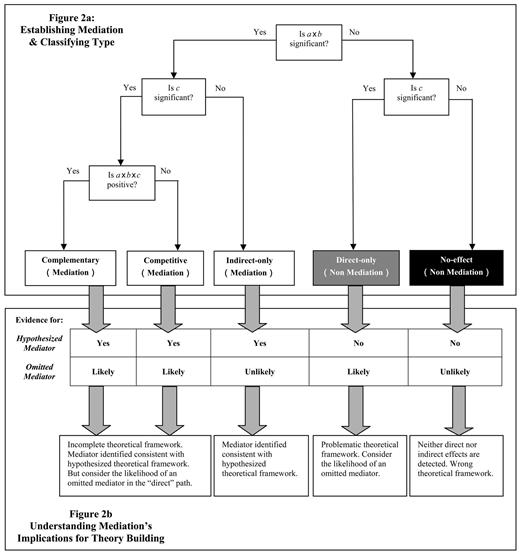
Abstract. Baron and Kenny’s procedure for determining if an independent variable affects a dependent variable through some mediator is so well known that i
Asymptotic and resampling strategies for assessing and comparing indirect effects in multiple mediator models
Hypotheses involving mediation are common in the behavioral sciences. Mediation exists when a predictor affects a dependent variable indirectly through at least one intervening variable, or mediator. Methods to assess mediation involving multiple simultaneous mediators have received little attention in the methodological literature despite a clear need. We provide an overview of simple and multiple mediation and explore three approaches that can be used to investigate indirect processes, as well as methods for contrasting two or more mediators within a single model. We present an illustrative example, assessing and contrasting potential mediators of the relationship between the helpfulness of socialization agents and job satisfaction. We also provide SAS and SPSS macros, as well as Mplus and LISREL syntax, to facilitate the use of these methods in applications.
The central role of the propensity score in observational studies for causal effects
Abstract. The propensity score is the conditional probability of assignment to a particular treatment given a vector of observed covariates. Both large and
Human Adults and LLMs as Scientists: Who Benefits from Active Exploration?
A long-standing finding in the causal learning literature is that adults struggle to identify conjunctive causal rules, where an effect requires the simultaneous presence of multiple causes, while...

How Field Experiments in Economics Can Complement Psychological Research on Judgment Biases
This review summarizes results of field experiments examining individual behaviors across several market settings—from open-air markets to rideshare markets to tax-compliance markets—where people sort themselves into market roles wherein they make consequential decisions. Using three distinct examples from my own research on the endowment effect, left-digit bias, and omission bias, I showcase how field experiments can help researchers understand mediators, heterogeneity, and causal moderation involved in judgment biases in the field. In this manner, the review highlights that economic field experiments can serve an invaluable intellectual role alongside traditional laboratory research.

A Statistical Interrogation of “The Case for Causality, Part 1” by Rausch and Haidt – Matthew B. Jané
I don’t know anything about the literature on social media and mental health so my focus on this post is to interrogate the statistical approach taken by the article written by Zach Rausch and Jonathon Haidt (link here) and to some extent the original meta-analysis by Ferguson.

Do social media experiments prove a link with mental health: A methodological and meta-analytic review.
Recognising, Anticipating, and Mitigating LLM Pollution of Online Behavioural Research
Online behavioural research faces an emerging threat as participants increasingly turn to large language models (LLMs) for advice, translation, or task delegation: LLM Pollution. We identify three interacting variants through which LLM Pollution threatens the validity and integrity of online behavioural research. First, Partial LLM Mediation occurs when participants make selective use of LLMs for specific aspects of a task, such as translation or wording support, leading researchers to (mis)interpret LLM-shaped outputs as human ones. Second, Full LLM Delegation arises when agentic LLMs complete studies with little to no human oversight, undermining the central premise of human-subject research at a more foundational level. Third, LLM Spillover signifies human participants altering their behaviour as they begin to anticipate LLM presence in online studies, even when none are involved. While Partial Mediation and Full Delegation form a continuum of increasing automation, LLM Spillover reflects second-order reactivity effects. Together, these variants interact and generate cascading distortions that compromise sample authenticity, introduce biases that are difficult to detect post hoc, and ultimately undermine the epistemic grounding of online research on human cognition and behaviour. Crucially, the threat of LLM Pollution is already co-evolving with advances in generative AI, creating an escalating methodological arms race. To address this, we propose a multi-layered response spanning researcher practices, platform accountability, and community efforts. As the challenge evolves, coordinated adaptation will be essential to safeguard methodological integrity and preserve the validity of online behavioural research.
Recognising, Anticipating, and Mitigating LLM Pollution of Online Behavioural Research
Online behavioural research faces an emerging threat as participants increasingly turn to large language models (LLMs) for advice, translation, or task delegation: LLM Pollution. We identify three interacting variants through which LLM Pollution threatens the validity and integrity of online behavioural research. First, Partial LLM Mediation occurs when participants make selective use of LLMs for specific aspects of a task, such as translation or wording support, leading researchers to (mis)interpret LLM-shaped outputs as human ones. Second, Full LLM Delegation arises when agentic LLMs complete studies with little to no human oversight, undermining the central premise of human-subject research at a more foundational level. Third, LLM Spillover signifies human participants altering their behaviour as they begin to anticipate LLM presence in online studies, even when none are involved. While Partial Mediation and Full Delegation form a continuum of increasing automation, LLM Spillover reflects second-order reactivity effects. Together, these variants interact and generate cascading distortions that compromise sample authenticity, introduce biases that are difficult to detect post hoc, and ultimately undermine the epistemic grounding of online research on human cognition and behaviour. Crucially, the threat of LLM Pollution is already co-evolving with advances in generative AI, creating an escalating methodological arms race. To address this, we propose a multi-layered response spanning researcher practices, platform accountability, and community efforts. As the challenge evolves, coordinated adaptation will be essential to safeguard methodological integrity and preserve the validity of online behavioural research.
The C-Word: Scientific Euphemisms Do Not Improve Causal Inference From Observational Data
Causal inference is a core task of science. However, authors and editors often refrain from explicitly acknowledging the causal goal of research projects; they refer to causal effect estimates as associational estimates. This commentary argues that using the term “causal” is necessary to improve the quality of observational research. Specifically, being explicit about the causal objective of a study reduces ambiguity in the scientific question, errors in the data analysis, and excesses in the interpretation of the results.

No effect of different types of media on well-being
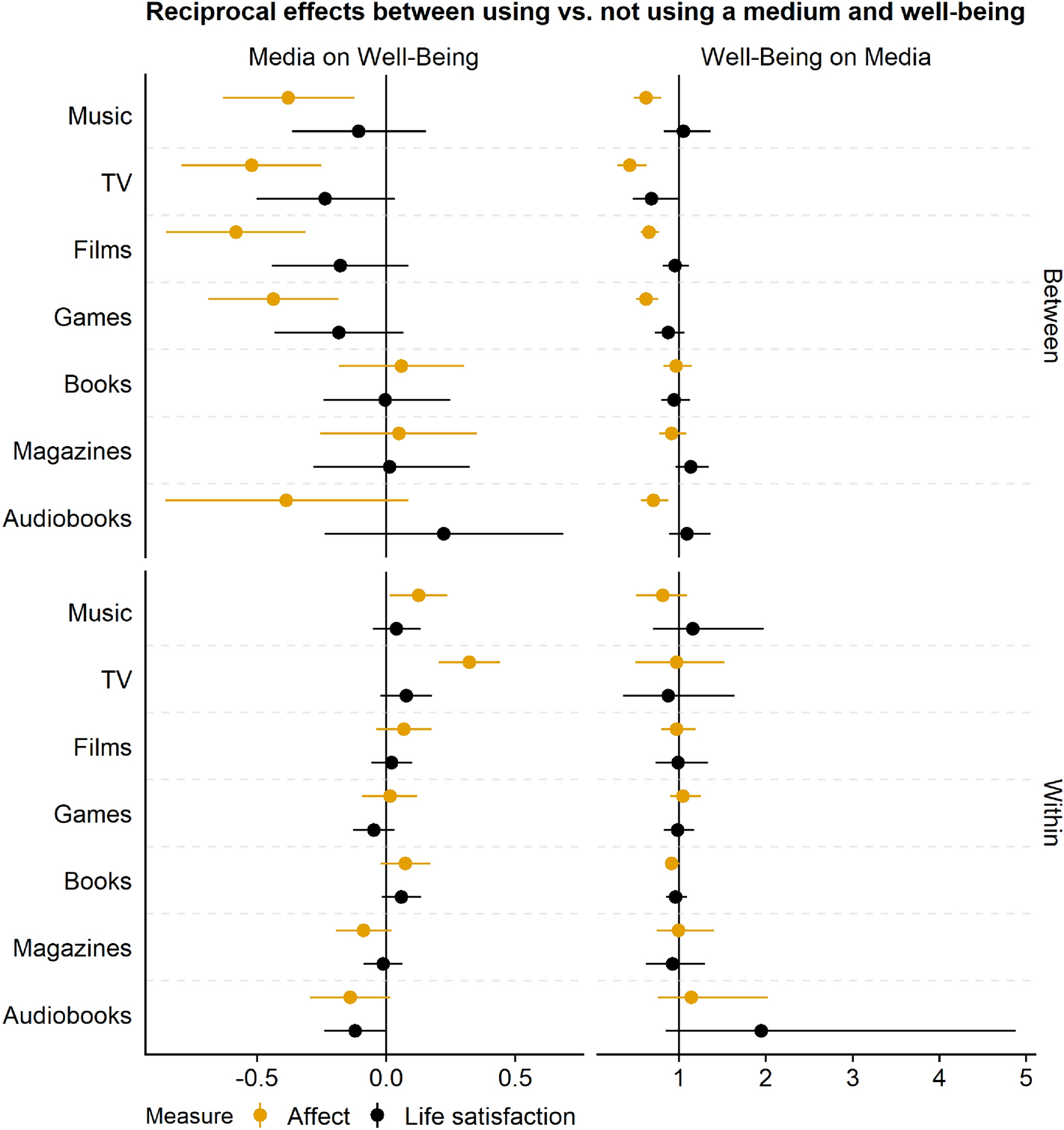
It is often assumed that traditional forms of media such as books enhance well-being, whereas new media do not. However, we lack evidence for such claims and media research is mainly focused on how much time people spend with a medium, but not whether someone used a medium or not. We explored the effect of media use during one week on well-being at the end of the week, differentiating time spent with a medium and use versus nonuse, over a wide range of different media types: music, TV, films, video games, (e-)books, (digital) magazines, and audiobooks. Results from a six-week longitudinal study representative of the UK population 16 years and older (N = 2159) showed that effects were generally small; between-person relations but rarely within-person effects; mostly for use versus nonuse and not time spent with a medium; and on affective well-being, not life satisfaction.
Why Adjusted Regression Coefficients Are Less Descriptive Than They Look | R Psychologist
An interactive article about how regression adjustment works and the pitfalls of conditional associations in descriptive studies.
African Content Moderators Have Worse Mental Health than Global Peers, Study Finds
A new study finds African content moderators report worse mental health than global peers, amid low pay, precarious work, and exposure to traumatic content.

“Having All of Your Internal Resources Exhausted Beyond Measure and Being Left with No Clean-Up Crew”: Defining Autistic Burnout
Background: Although autistic adults often discuss experiencing “autistic burnout” and attribute serious negative outcomes to it, the concept is almost completely absent from the academic and clinical literature. Methods: We used a community-based participatory research approach to conduct a thematic analysis of 19 interviews and 19 public Internet sources to understand and characterize autistic burnout. Interview participants were autistic adults who identified as having been professionally diagnosed with an autism spectrum condition. We conducted a thematic analysis, using a hybrid inductive–deductive approach, at semantic and latent levels, through a critical paradigm. We addressed trustworthiness through multiple coders, peer debriefing, and examination of contradictions. Results: Autistic adults described the primary characteristics of autistic burnout as chronic exhaustion, loss of skills, and reduced tolerance to stimulus. They described burnout as happening because of life stressors that added to the cumulative load they experienced, and barriers to support that created an inability to obtain relief from the load. These pressures caused expectations to outweigh abilities resulting in autistic burnout. Autistic adults described negative impacts on their health, capacity for independent living, and quality of life, including suicidal behavior. They also discussed a lack of empathy from neurotypical people and described acceptance and social support, time off/reduced expectations, and doing things in an autistic way/unmasking as associated in their experiences with recovery from autistic burnout. Conclusions: Autistic burnout appears to be a phenomenon distinct from occupational burnout or clinical depression. Better understanding autistic burnout could lead to ways to recognize, relieve, or prevent it, including highlighting the potential dangers of teaching autistic people to mask or camouflage their autistic traits, and including burnout education in suicide prevention programs. These findings highlight the need to reduce discrimination and stigma related to autism and disability. Lay summary Why was this study done? Autistic burnout is talked about a lot by autistic people but has not been formally addressed by researchers. It is an important issue for the autistic community because it is described as leading to distress; loss of work, school, health, and quality of life; and even suicidal behavior. What was the purpose of this study? This study aimed to characterize autistic burnout, understand what it is like, what people think causes it, and what helps people recover from or prevent it. It is a first step in starting to understand autistic burnout well enough to address it. What did the researchers do? Our research group—the Academic Autism Spectrum Partnership in Research and Education—used a community-based participatory research approach with the autistic community in all stages of the study. We analyzed 9 interviews from our study on employment, 10 interviews about autistic burnout, and 19 public Internet sources (five in-depth). We recruited in the United States by publicizing on social media, by word of mouth, and through community connections. When analyzing interviews, we took what people said at face value and in deeper social context, and looked for strong themes across data. What were the results of the study? The primary characteristics of autistic burnout were chronic exhaustion , loss of skills , and reduced tolerance to stimulus . Participants described burnout as happening because of life stressors that added to the cumulative load they experienced, and barriers to support that created an inability to obtain relief from the load. These pressures caused expectations to outweigh abilities resulting in autistic burnout . From this we created a definition: Autistic burnout is a syndrome conceptualized as resulting from chronic life stress and a mismatch of expectations and abilities without adequate supports. It is characterized by pervasive, long-term (typically 3+ months) exhaustion, loss of function, and reduced tolerance to stimulus. Participants described negative impacts on their lives, including health , capacity for independent living , and quality of life , including suicidal behavior. They also discussed a lack of empathy from neurotypical people. People had ideas for recovering from autistic burnout including acceptance and social support , time off/reduced expectations , and doing things in an autistic way/unmasking . How do these findings add to what was already known? We now have data that autistic burnout refers to a clear set of characteristics, and is different from workplace burnout and clinical depression. We have the start of a model for why autistic burnout might happen. We know that people have been able to recover from autistic burnout and have some insights into how. What are the potential weaknesses in the study? This was a small exploratory study with a convenience sample. Although we were able to bring in some diversity by using three data sources, future work would benefit from interviewing a wider range of participants, especially those who are not white, have higher support needs, and have either very high or very low educational attainment. More research is needed to understand how to measure, prevent, and treat autistic burnout. How will these findings help autistic adults now or in the future? These findings validate the experience of autistic adults. Understanding autistic burnout could lead to ways to help relieve it or prevent it. The findings may help therapists and other practitioners recognize autistic burnout, and the potential dangers of teaching autistic people to mask autistic traits. Suicide prevention programs should consider the potential role of burnout. These findings highlight the need to reduce discrimination and stigma around autism and disability.