


This paper examines the fetish of the click through a technofeminist history of the computer mouse as vulva. It argues that this material turn is a necessary corrective to abstractions of the click...

Sex Workers Built the Internet
An internet history that centers sex workers’ voices and experiences
Against the Couple-Form | LIES Journal
Libidinal flows cut through the social world. Amorous and sexual relations do not exist in some domain safely taped off from the rest of society. Rather they are constituent elements of nearly every aspect of social life. Desire flows and circulates amongst places of employment, intellectual debates, political organizing, artistic circles, playgrounds, and cemeteries. The elderly patient grabs at the breast of a nurse hunched over him. A governmental official strips his newly hired intern down to her leopard print thong during an important briefing in his office. The incarcerated man holds his hand up to the glass of the visiting booth, attempting to touch his wife after twenty years of their bodily separation. These flows of libidinal desire operate within and amongst broader social mechanisms, such that they help animate the dynamics of economic and political life. Often a locus of politics, desire permeates the so-called ‘public’ terrain.
“Computers enable fantasies” – On the continued relevance of Weizenbaum’s warnings
“The computer has long been a solution looking for problems—the ultimate technological fix which insulates us from having to look at problems.” – Joseph Weizenbaum (1983) Trying to kee…

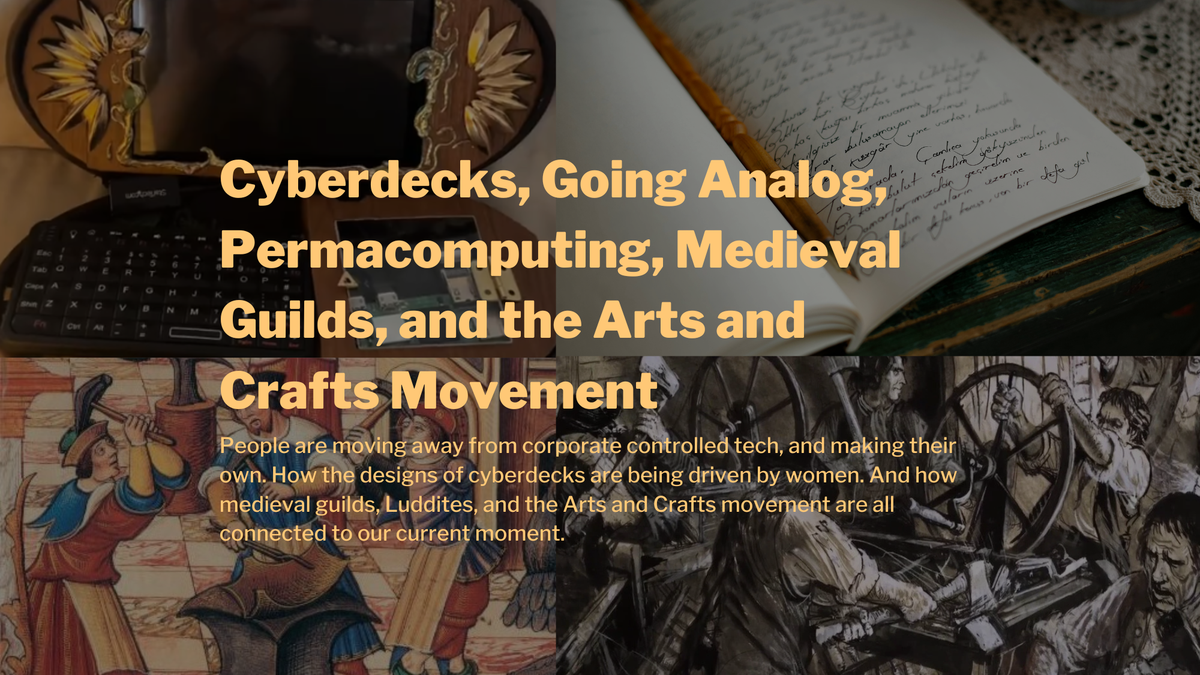
Cyberdecks, Going Analog, Permacomputing, Medieval Guilds, and the Arts and Crafts Movement
People are moving away from corporate controlled tech, and making their own. How the designs of cyberdecks are being driven by women. And how medieval guilds, Luddites, and the Arts and Crafts movement are all connected to our current moment.
Thoughts on Cyberpositionality: The Construction of Digital Communities in Digital Spaces, Damien Patrick Williams
I found Rebecca Monteleone, Martin Perez Comisso, and Elma Hajric’s “Cyberpositionality: Sociotechnical Location in the Digital Age” (2024) to be an extremely timely and important article which can…

A Rape in Cyberspace - The Village Voice
December 23, 1993 They say he raped them that night. They say he did it with a cunning little doll, fashioned in their image and imbued with the power to make them do whatever he desired. They say that by manipulating the doll he forced them to have sex with him, and with each other, […]
Joanna Russ- SF and Technology as Mystification
Talk about technology, long familiar to science-fiction readers and writers, is getting popular in Academia too. Particularly interesting to humanists is the connection between technology and whatever their own particular subject happens to be; I've attended three such formal symposia in the last five years, six including SF conventions, and including informal discussions among students, in writing classes, SF classes, and elsewhere, somewhere between fifty and sixty.
What the Internet Is Teaching Young Men About Desire
When pornography becomes the default sex education, it reshapes how a generation learns about power, intimacy, and attention

How Liminalism Became the Defining Aesthetic of Our Time
This crowd-curated digital movement is one of the most pertinent and explicit reactions to our particular slice of dystopian late capitalism.
triumph of the nerds
CyberSpaceLand
CyberSpaceLand is a VJ performance with some software, several gadgets, some network packets and a person who moves around a lot operating it all. VJ Ãbergeek enters queries into the CyberSpaceLand search engine, on topics ranging from cheerful memes to existential angst. The search results become live-animated on-screen visuals: funky, fluffy, and maybe even cool. Hyperactive Ãbergeek controls the visuals in realtime with a variety of gadgets ranging from dance pads to drumsticks. Amy Alexander (VJ Ãbergeek) has performed CyberSpaceLand in a variety of venues from nightclubs to festivals to museums to the streets. Performances vary with the setting, ranging from more theatrical and character-based to laid-back and ambient. The content and visuals have evolved over the years, and no two performances are ever the same. You really want to know more?
“The internet represents a closing of the parenthesis and a return to older models of understanding. Human consciousness in the digital age, which de-emphasizes the categorization that marked the age of print, makes us think in a way that is reminiscent of a medieval peasant.”
The Gutenberg Parenthesis
web.mit.edu
