


This paper examines the fetish of the click through a technofeminist history of the computer mouse as vulva. It argues that this material turn is a necessary corrective to abstractions of the click...
The rise of Whatever
This was originally titled “I miss when computers were fun”. But in the course of writing it, I discovered that there is a reason computers became less fun, a dark thread woven through a number of events in recent history. Let me back up a bit.


Sex Workers Built the Internet
An internet history that centers sex workers’ voices and experiences
Sex Workers Built the Internet
An internet history that centers sex workers’ voices and experiences
Father of the Mouse: Doug Engelbart. An exclusive interview in SuperKids Software Review.
History of the computer mouse.
Against the Couple-Form | LIES Journal
Libidinal flows cut through the social world. Amorous and sexual relations do not exist in some domain safely taped off from the rest of society. Rather they are constituent elements of nearly every aspect of social life. Desire flows and circulates amongst places of employment, intellectual debates, political organizing, artistic circles, playgrounds, and cemeteries. The elderly patient grabs at the breast of a nurse hunched over him. A governmental official strips his newly hired intern down to her leopard print thong during an important briefing in his office. The incarcerated man holds his hand up to the glass of the visiting booth, attempting to touch his wife after twenty years of their bodily separation. These flows of libidinal desire operate within and amongst broader social mechanisms, such that they help animate the dynamics of economic and political life. Often a locus of politics, desire permeates the so-called ‘public’ terrain.
“Computers enable fantasies” – On the continued relevance of Weizenbaum’s warnings
“The computer has long been a solution looking for problems—the ultimate technological fix which insulates us from having to look at problems.” – Joseph Weizenbaum (1983) Trying to kee…

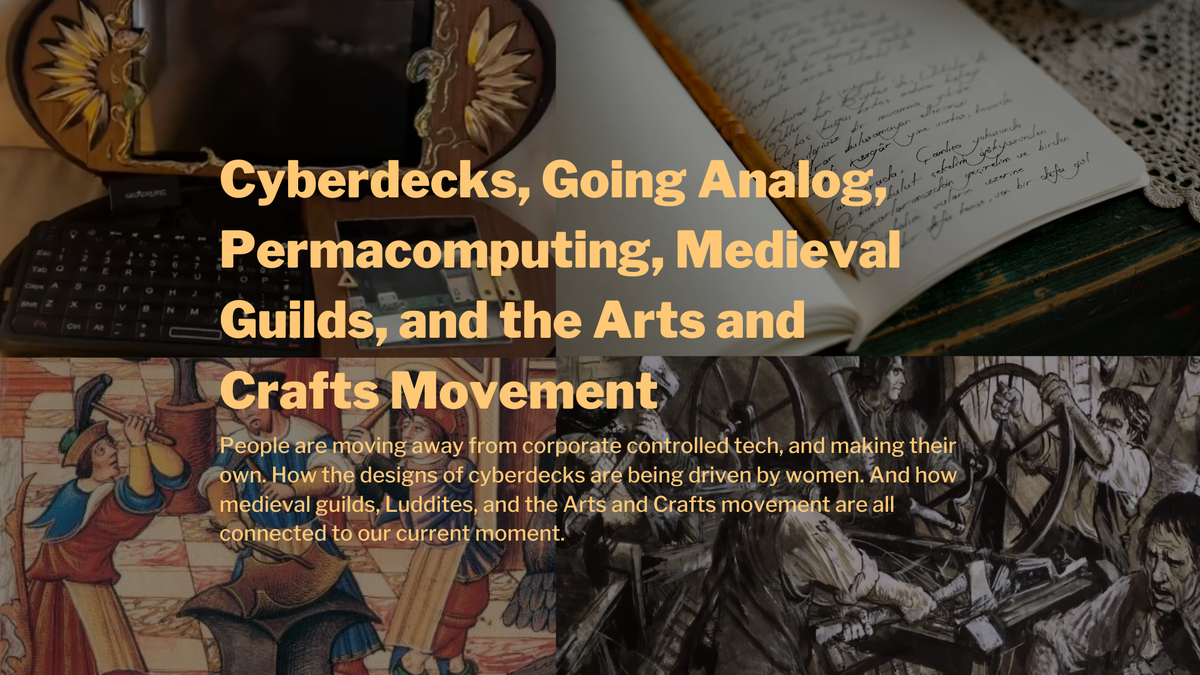
Cyberdecks, Going Analog, Permacomputing, Medieval Guilds, and the Arts and Crafts Movement
People are moving away from corporate controlled tech, and making their own. How the designs of cyberdecks are being driven by women. And how medieval guilds, Luddites, and the Arts and Crafts movement are all connected to our current moment.
Thoughts on Cyberpositionality: The Construction of Digital Communities in Digital Spaces, Damien Patrick Williams
I found Rebecca Monteleone, Martin Perez Comisso, and Elma Hajric’s “Cyberpositionality: Sociotechnical Location in the Digital Age” (2024) to be an extremely timely and important article which can…

Wired women : gender and new realities in cyberspace
Come in, CQ: the body on the wire / Ellen Ullman -- The memoirs of a token: an aging Berkeley feminist examines Wired / Paulina Borsook -- How hard can it be? / Karen Coyle -- Closure was never a goal in this piece / Judy Malloy and Cathy Marshall -- Estrogen brigades and "big tits" threads: media fandom online and off / Susan Clerc -- Elites, lamers, narcs and whores: exploring the computer underground / Netta "grayarea" Gilboa -- We are geeks, and we are not guys: the systers mailing list / L. Jean Camp -- Not for the faint of heart: contemplations on Usenet / Judy Anderson "yduJ" -- The price of admission: harassment and free speech in the wild, wild West / Stephanie Brail -- Sex, fear and condescension on campus: cybercensorship at Carnegie Mellon / Donna M. Riley -- Cocktails and thumbtacks in the old West: what would Emily Post say? / Laurel A. Sutton -- "So please stop, thank you": girls online / Michele Evard -- MUDder? I hardly know 'er: adventures of a feminist MUDder / Lori Kendall -- Like magic, only real / Tari Lin Fanderclai -- Coming apart at the seams: sex, text and the virtual body / Shannon McRae; Includes bibliographical references; Ellen Ullman shares an email courtship - Paulina Borsook exposes gender attitudes at the digerati's magazine of record - Karen Coyle on overcoming macho stereotypes - Judy Malloy and Cathy Marshall reflect on their art/research collaboration - Susan Clerc and the zeal of media fandom - Netta Gilboa explores hackers' attitudes toward women - Jean Camp on the Internet's safe havens - Judy Anderson's advice on dodging Usenet flames - Stephanie Brail seeks the line between free speech and harassment - Donna Riley reveals the story of the Clitoral Hoods - Laurel Sutton and the nuances of netiquette - Michele Evard takes news-groups to the fifth grade - Lori Kendall wonders if gender is meaningless online - Tari Lin Fanderclai on MUDs as a powerful teaching tool - Shannon McRae takes a look at "virtual sex"

A Rape in Cyberspace - The Village Voice
December 23, 1993 They say he raped them that night. They say he did it with a cunning little doll, fashioned in their image and imbued with the power to make them do whatever he desired. They say that by manipulating the doll he forced them to have sex with him, and with each other, […]
“The internet represents a closing of the parenthesis and a return to older models of understanding. Human consciousness in the digital age, which de-emphasizes the categorization that marked the age of print, makes us think in a way that is reminiscent of a medieval peasant.”
The Gutenberg Parenthesis
web.mit.eduInterestingly, as the digital sublime emerged, feminists like Joanna Russ were early on in recognizing this sublime as (male) addiction and fetishization.

𝕮
"SF and Technology as Mystification" by Joanna Russ (1978) depauw.edu/sfs/backissues/16/russ16.htm

