


Background: We aimed to examine the association between social media use and loneliness two years after the COVID-19 pandemic outbreak. Methods: Participants were 1649 adults who completed a cross-...
Associations between social media use and loneliness in a cross-national population: do motives for social media use matter?
Background: We aimed to examine the association between social media use and loneliness two years after the COVID-19 pandemic outbreak. Methods: Participants were 1649 adults who completed a cross-sectional online survey disseminated openly in Norway, United Kingdom, USA, and Australia between November 2021 and January 2022. Linear regressions examined time spent on social media and participants’ characteristics on loneliness, and interactions by motives for social media use. Results: Participants who worried more about their health and were younger, not employed, and without a spouse or partner reported higher levels of loneliness compared to their counterparts. More time spent on social media was associated with more loneliness (β = 0.12, p < 0.001). Three profile groups emerged for social media use motives: 1) social media use motive ratings on avoiding difficult feelings higher or the same as for maintaining contact; 2) slightly higher ratings for maintaining contact; and 3) substantially higher ratings for maintaining contact. Time spent on social media was significant only in motive profile groups 2 and 3 (β = 0.12 and β = 0.14, both p < 0.01). Conclusions: Our findings suggest that people who use social media for the motive of maintaining their relationships feel lonelier than those who spend the same amount of time on social media for other reasons. While social media may facilitate social contact to a degree, they may not facilitate the type of contact sought by those who use social media primarily for this reason.

Loneliness in the United States: A 2018 National Panel Survey of Demographic, Structural, Cognitive, and Behavioral Characteristics
Purpose: To inform health behavior intervention design, we sought to quantify loneliness and its correlates, including social media use, among adults in the United States. Design: Cross-sectional research panel questionnaire. Setting: Responses were gathered from individuals in all 50 states surveyed via Internet from February 2018 to March 2018. Participants: A total of 20 096 US panel respondents aged 18+. Measures: The University of California at Los Angeles (UCLA) Loneliness Scale (theoretical score range = 20-80) was administered along with demographic, structural, cognitive, and behavioral items. Analysis: After calibrating the sample to population norms, we conducted multivariable linear regression analysis. Results: The overall mean survey-weighted loneliness score was 44.03 (standard error = 0.09). Social support (standardized β [sβ] = −0.19) and meaningful daily interactions (sβ = −0.14) had the strongest associations with lower loneliness, along with reporting good relationships, family life, physical and mental health, friendships, greater age, being in a couple, and balancing one’s daily time. Social anxiety was most strongly associated with greater loneliness (sβ = +0.20), followed by self-reported social media overuse (sβ = +0.05) and daily use of text-based social media (sβ = +0.03). Conclusion: Our findings confirm that loneliness decreases with age, and that being in a relationship as well as everyday behavioral factors in people’s control are most strongly related to loneliness. Population health promotion efforts to reduce loneliness should focus on improving social support, decreasing social anxiety, and promoting healthy daily behaviors.

Impact of the COVID-19 pandemic on social media
Social media became an important platform for interaction during the COVID-19 pandemic, coinciding with the onset of social distancing. According to a study conducted by Facebook's analytics department, messaging rates rose by over 50% during this period. Individuals confined to their homes utilized social media not only to maintain social connections but also as a source of entertainment to alleviate boredom. Concerns arose regarding the overreliance on social media for primary social interactions, particularly given the constraints imposed by the pandemic.

Reciprocal Relationships between Trajectories of Loneliness and Screen Media Use during Adolescence
Adolescence is the peak period for loneliness. Now a ubiquitous part of the adolescent landscape, electronic screens may provide avenues for ameliorating feelings of loneliness. Conversely, they may act as risk factors for the development of such feelings. Although cross-sectional studies to date have investigated the relationship between screen use and loneliness, longitudinal studies are needed if causal and directional associations are to be investigated. Utilising an accelerated longitudinal design and online survey we collected four waves of data from 1919 secondary school adolescents aged 10–15 years over two years. Random intercept cross-lagged panel models tested whether changes in five types of screen use (i.e., total screen time, social media use, gaming, passive screen use, and web use) are associated with changes in loneliness in the subsequent time-point, or changes in loneliness are associated with changes in screen use in the subsequent time-point. We found significant reciprocal associations between screen use and loneliness, with the strongest associations between social networking and electronic gaming and quality of friendships. These findings highlight that any significant increase in an adolescent’s screen use may be a potential indicator of changes in quality of friendships or feelings of isolation.

Ten Myths About the Effect of Social Media Use on Well-Being
This viewpoint reviews the empirical evidence regarding the association between social media use and well-being, including life satisfaction and affective well-being, and the association between social media use and ill-being, including loneliness, anxiety, and depressive symptomology. To frame this discussion, this viewpoint will present 10 widely believed myths about social media, each drawn from popular discourse on the topic. In rebuttal, this viewpoint will offer a warranted claim supported by the research. The goal is to bring popular beliefs into dialogue with state-of-the-art quantitative social scientific evidence. It is the intention of this viewpoint to provide a more accurate and nuanced claim to challenge each myth. This viewpoint will bring attention to the importance of using rigorous scientific evidence to inform public debates about social media use and well-being, especially among adolescents and young adults.

Loneliness is taking friend-making apps mainstream
Post-pandemic loneliness is driving young adults to seek friends more intentionally.

Two tests of social displacement through social media use
The present manuscript presents two tests of the hypothesis that social media use decreases social interaction, leading to decreased well-being. Study 1 used the Longitudinal Study of American Yout...

What is Causing Our Epidemic of Loneliness and How Can We Fix It?
Researchers share what Americans have to say about social disconnection and potential solutions

Loneliness epidemic
The concept of a "loneliness epidemic" relating to rising rates of social isolation was first described in the 2000s. Robert D. Putnam's 2000 study Bowling Alone was an early instance of describing loneliness as an epidemic, arguing that decreased participation in civic life and community groups was weakening social bonds in the United States.[5]
The Impact of Social Media on Adolescent Mental Health: A Meta-Analysis
Introduction: The proliferation of social media has raised significant concerns about its potential effects on the mental health of adolescents. This meta-analysis aims to provide a comprehensive assessment of the existing research on the relationship between social media use and various mental health outcomes in adolescents. Methods: A systematic search of electronic databases (PubMed, PsycINFO, Scopus, Web of Science) from January 2018 to June 2024 was conducted to identify relevant studies. Studies were included if they examined the association between social media use and mental health outcomes in adolescents (aged 10-19) and reported quantitative data. Effect sizes were calculated and pooled using random-effects models. Results: A total of 45 studies (N = 153,285 adolescents) met the inclusion criteria. The meta-analysis revealed small but significant associations between increased social media use and increased depressive symptoms (r = 0.12), anxiety (r = 0.10), and loneliness (r = 0.15). Furthermore, a significant negative association was found between social media use and self-esteem (r = -0.08). The analysis also identified several moderators of these effects, including gender, age, and type of social media platform. Conclusion: The findings of this meta-analysis suggest that increased social media use is associated with a range of negative mental health outcomes in adolescents. However, the effects are small, and the relationship is complex, with several moderating factors. Further research is needed to understand the mechanisms underlying these associations and to develop effective interventions to mitigate the potential negative effects of social media on adolescent mental health.
Hard Questions: Is Spending Time on Social Media Bad for Us?
With people spending more time on social media, many rightly wonder whether that time is good for us. Do people connect in meaningful ways online? Or are they simply consuming trivial updates and polarizing memes at the expense of time with loved ones?

The Longitudinal Association Between Social-Media Use and Depressive Symptoms Among Adolescents and Young Adults: An Empirical Reply to Twenge et al. (2018)
Research by Twenge, Joiner, Rogers, and Martin has indicated that there may be an association between social-media use and depressive symptoms among adolescents. However, because of the cross-sectional nature of this work, the relationship among these variables over time remains unclear. Thus, in this longitudinal study we examined the associations between social-media use and depressive symptoms over time using two samples: 594 adolescents ( M age = 12.21) who were surveyed annually for 2 years, and 1,132 undergraduate students ( M age = 19.06) who were surveyed annually for 6 years. Results indicate that among both samples, social-media use did not predict depressive symptoms over time for males or females. However, greater depressive symptoms predicted more frequent social-media use only among adolescent girls. Thus, while it is often assumed that social-media use may lead to depressive symptoms, our results indicate that this assumption may be unwarranted.
Social Media and Depression Symptoms: a Meta-Analysis
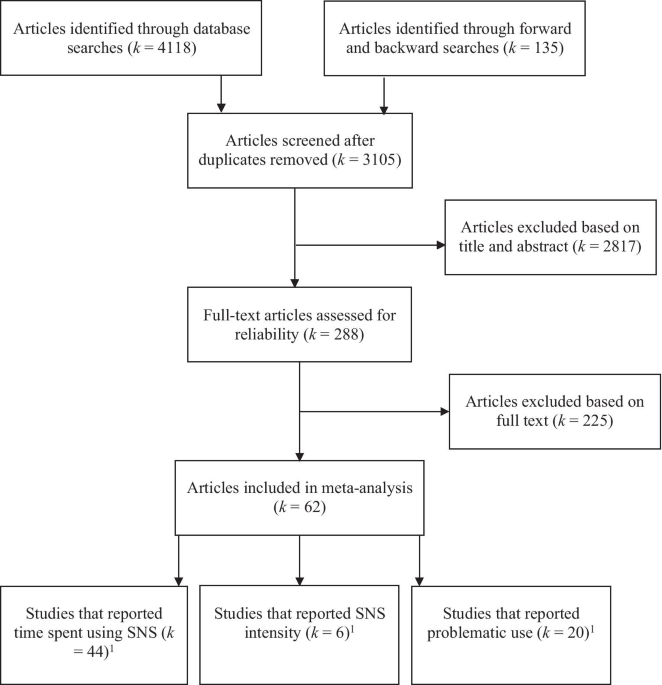
Social Networking Sites (SNS) have close to 3 billion users worldwide. Recently, however, SNS have come under media scrutiny for their potential association with depression. Two previous meta-analyses failed to find evidence for a robust concurrent association between SNS use and depression symptoms. However, these analyses focused primarily on the time spent using SNS. The current meta-analysis is the first to consider the multi-dimensional nature of SNS use, and examines separately the quantitative associations of depression symptoms to SNS use in three types of SNS studies examining three distinct constructs of SNS use: time spent using SNS, intensity of SNS use, and problematic SNS use. Sixty-two studies (N = 451, 229) met inclusion criteria. Depression symptoms were significantly, but weakly, associated with time spent using SNS (r = 0.11) and intensity of SNS use (r = 0.09). However, the association of depression symptoms to problematic SNS use was moderate (r = 0.29), was significantly higher than for time spent using SNS (Qbetween = 35.85, p < 0.001) or intensity of SNS use (Qbetween = 13.95, p < 0.001), and was not significantly moderated by age, gender, year of study publication, or mode of recruitment. These results suggest that future research examining causal models of the relation of SNS use and depression, as well as research on intervention and prevention, should focus in more detail on individuals who are engaging in a pattern of problematic SNS use.
Researchers Confront an Epidemic of Loneliness (Published 2016)
Social isolation is linked to physical illness and to functional and cognitive decline. Programs to reach out to the elderly are growing, particularly in Britain.

Does Using Social Media Jeopardize Well-Being? The Importance of Separating Within- From Between-Person Effects
Social networking sites (SNS) are frequently criticized as a driving force behind rising depression rates. Yet empirical studies exploring the associations between SNS use and well-being have been predominantly cross-sectional, while the few existing longitudinal studies provided mixed results. We examined prospective associations between SNS use and multiple indicators of well-being in a nationally representative sample of Dutch adults ( N ∼ 10,000), comprising six waves of annual measures of SNS use and well-being. We used an analytic method that estimated prospective effects of SNS use and well-being while also estimating time-invariant between-person associations between these variables. Between individuals, SNS use was associated with lower well-being. However, within individuals, year-to-year changes in SNS use were not prospectively associated with changes in well-being (or vice versa). Overall, our analyses suggest that the conclusions about the causal impact of social media on rising mental health problems in the population might be premature.