Abstract Why do consumers sometimes act against their own better judgment, engaging in behavior that is often regretted after the fact and that would have been rejected with adequate forethought? More generally, how do consumers attempt to maintain self-control in the face of time-inconsistent preferences? This article addresses consumer impatience by developing a decision-theoretic model based on reference points. The model explains how and why consumers experience sudden increases in desire for a product, increases that can result in the temporary overriding of long-term preferences. Tactics that consumers use to control their own behavior are also discussed. Consumer self-control is framed as a struggle between two psychological forces, desire and willpower. Finally, two general classes of self-control strategies are described: those that directly reduce desire, and those that overcome desire through will power.
Self-Control and the Theory of Consumption
To study the behavior of agents who are susceptible to temptation in infinite horizon consumption problems under uncertainty, we define and characterize dynamic self-control (DSC) preferences. DSC pr...

Self-Control and Optimal Goals: A Theoretical Analysis
Consumers set goals to achieve a variety of objectives such as losing weight, saving for retirement, and achieving better health. A large body of literature in psychology and consumer behavior shows that goals can help consumers achieve these objectives. However, there is almost no research that examines how we should set optimal goals. The purpose of this paper is to develop a parsimonious framework that examines how goals can help performance and how we should set optimal goals. We use the literature on hyperbolic discounting to model these issues. Our results show that goals can often increase performance but can also sometimes encourage procrastination. We show that some goals are worse than having no goals, even when the goals are achieved and the consumer exerts more effort because of the goal. We also find that the presence of goals can lead to myopic consumers behaving as if they were hyperopic. Our results also show that the most difficult goals should be assigned to consumers with moderate levels of motivation and self-control problems. We also find that it is sometimes optimal to set goals that are never achieved.

Yielding to Temptation: Self‐Control Failure, Impulsive Purchasing, and Consumer Behavior
Abstract. Self-control is a promising concept for consumer research, and self-control failure may be an important cause of impulsive purchasing. Three caus
Anticipation and Choice Heuristics in the Dynamic Consumption of Pain Relief
Humans frequently need to allocate resources across multiple time-steps. Economic theory proposes that subjects do so according to a stable set of intertemporal preferences, but the computational demands of such decisions encourage the use of formally less competent heuristics. Few empirical studies have examined dynamic resource allocation decisions systematically. Here we conducted an experiment involving the dynamic consumption over approximately 15 minutes of a limited budget of relief from moderately painful stimuli. We had previously elicited the participants’ time preferences for the same painful stimuli in one-off choices, allowing us to assess self-consistency. Participants exhibited three characteristic behaviors: saving relief until the end, spreading relief across time, and early spending, of which the last was markedly less prominent. The likelihood that behavior was heuristic rather than normative is suggested by the weak correspondence between one-off and dynamic choices. We show that the consumption choices are consistent with a combination of simple heuristics involving early-spending, spreading or saving of relief until the end, with subjects predominantly exhibiting the last two.
It’s the Effort That Counts: The Effect of Self-Control on Goal Progress Perceptions
Does the amount of self-control consumers must exert to choose a goal-consistent action influence their perceptions of goal progress? For example, if you choose to go to the gym when one of your favorite TV shows is on (vs. when nothing interesting is on TV), do you perceive that you have made a differential amount of progress toward your goal, despite completing the exact same workout? In eight studies (N = 7,515), the authors demonstrate that consumers perceive that they have made more progress on their goals when more (vs. less) self-control is required to choose to complete an identical goal-consistent task. This is because when consumers exert more (vs. less) self-control to choose a goal-consistent task over the goal-inconsistent alternatives, they infer higher commitment to the goal. The higher inferred commitment, in turn, leads consumers to perceive that future goal pursuit will be easier. The authors demonstrate this effect across a variety of tasks and means of exerting self-control, as well as with both hypothetical scenarios and real-behavior studies.

Behavioural economics, consumer behaviour and consumer policy: state of the art
Counter to the traditional assumption of neoclassical economics that individuals are rational Homo oeconomici that always seek to maximize their utility and follow their ‘true’ preferences, research in behavioural economics has demonstrated that people's judgements and decisions are often subject to systematic biases and heuristics, and are strongly dependent on the context of the decision. In this article, we briefly review the transition of research from neoclassical economics to behavioural economics, and discuss how the latter has influenced research in consumer behaviour and consumer policy. In particular, we discuss the impacts of key principles such as status quo bias, the endowment effect, mental accounting and the sunk-cost effect, other heuristics and biases related to availability, salience, the anchoring effect and simplicity rules, as well as the effects of other supposedly irrelevant factors such as music, temperature and physical markers on consumers’ decisions. These principles not only add significantly to research on consumer behaviour – they also offer readily available practical implications for consumer policy to nudge behaviour in beneficial directions in consumption domains including financial decision making, product choice, healthy eating and sustainable consumption.
Save More Today or Tomorrow: The Role of Urgency in Precommitment Design
To encourage farsighted behaviors, previous research suggests that marketers should invite consumers to precommit to adopting these behaviors “later.” However, the authors propose that people will draw different inferences from different types of precommitment offers, and that these inferences can help explain when precommitment is (and is not) effective at increasing adoption of farsighted behaviors. Specifically, the authors theorize that simultaneously offering consumers the opportunity to adopt a farsighted behavior now or later (i.e., offering “simultaneous precommitment”) may signal that the behavior is not urgently recommended; however, offering consumers the opportunity to adopt that behavior immediately and then, only if they decline, inviting them to adopt it later (i.e., offering “sequential precommitment”) may signal just the opposite. In a multisite field experiment (N = 5,196), the authors find that simultaneously giving consumers the chance to increase their savings now or later reduced retirement savings. Two preregistered lab studies (N = 5,080) show that simultaneous precommitment leads people to infer that taking action is not urgently recommended, and such inferences predict less adoption of recommended behaviors. Importantly, offering sequential precommitment increases inferred urgency, predicting greater adoption. Together, this research advances knowledge about the limits and potential of precommitment.
Context-Dependent Drivers of Discretionary Debt Decisions: Explaining Willingness to Borrow for Experiential Purchases
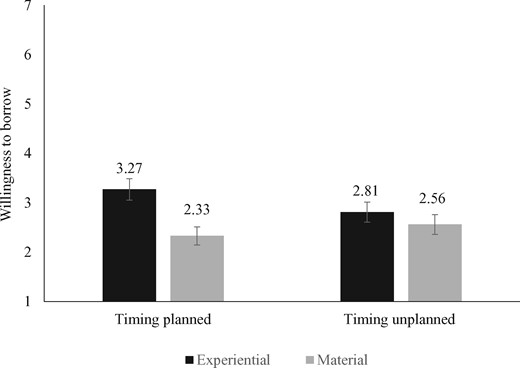
Abstract Mental accounting research suggests that consumers prefer borrowing for longer-lasting purchases in order to receive benefits from the purchases as they pay for them. In contrast, two sets of archival data and five lab studies show that consumers are more willing to borrow for experiential versus material purchases, even though experiential purchases tend to have a shorter physical duration. Further, framing the same purchase as more experiential than material increases willingness to borrow. This effect occurs because purchase timing is more important for experiential purchases—a function of consumers’ aversion to missing out on planned consumption. Thus, we moderate the proposed effect by varying whether the borrowing decision impacts planned consumption. Other differences between material and experiential purchases, such as scarcity or expected happiness, cannot similarly explain our results. Moreover, our conceptualization allows us to reconcile the apparent contradiction between the previous and current research by examining the relative impact of purchase-timing importance and payment-benefit duration matching in different contexts (i.e., “purchasing” and “source-of-funding” decisions).
Consumer Financial Decision Making: Where We’ve Been and Where We’re Going
When making purchasing decisions, consumers consider their available budget and determine what payment method they will use as well as how they will finance the purchase. Consumers must also plan for long-term consumption by considering short- and long-term savings objectives, taking into account how they will invest money saved, as well as how they will borrow needed money and repay outstanding loans. This issue of the Journal of Association of Consumer Research explores financial decision making, which we define as the accumulation and use of resources across time, as reflected by consumers’ behavior and choices.

Malleable Mental Accounting: The Effect of Flexibility on the Justification of Attractive Spending and Consumption Decisions
Mental accounts are often characterized as self‐control devices that consumers employ to prevent excess spending and consumption. However, under certain conditions of ambiguity, the mental accounting process is malleable; that is, consumers have flexibility in assigning expenses to different mental accounts. We demonstrate how consumers flexibly classify expenses, or construct accounts, to justify spending. An expense that can be assigned to more than one account (i.e., an ambiguous expense) is more likely to be incurred than an unambiguous expense that is constrained either by existing budgets or by previously constructed accounts. We explore the justification processes that underlie these results and their implications for mental accounts as self‐control devices.

Characterizing the causes, dynamics, and consequences of choice deferral
The fact that people often avoid making decisions is well known, and past research has helped to identify some of the conditions and reasons for doing so. For instance, people may forgo choices between bad options because they prefer not to end up with one of those options. It is much less clear when and why people avoid choosing in cases where they eventually will have to make a given decision. To study such instances of choice deferral, we presented participants with a series of choices, and for each choice they were allowed to either choose immediately or defer the decision until later in the experiment. Across six experiments and three choice domains (choices among consumer goods, artwork, and political candidates), we find that the strongest predictor of choice deferral is the overall value of a given set of options, with relative value (i.e., how hard it is to identify the best option) counterintuitively playing a smaller role. We show that the influence of overall value on choice deferral can be accounted for by a dynamic decision model according to which participants appraise the option set relative to a criterion before deciding whether to choose or defer, comparing this to a previous model whereby participants make such a decision based on a predetermined decision time limit. We further reveal that the influence of overall value on choice deferral is determined by how congruent options are with a given choice goal (choose-best or choose-worst) rather than simply how bad those options are. Collectively, our findings shed new light on how people decide to put off the inevitable.
Time-Duration Asymmetries in Consumer Decision-Making
Abstract Consumers routinely make decisions about short time periods, such as waiting for a table or deciding whether to pay for faster delivery. Such periods are often expressed by either a duration or a clock time (e.g., if it is 6:00 PM now, “Your table will be ready in 30 minutes” vs. “Your table will be ready at 6:30 PM”). Eight experiments (N = 16,604) show that these logically equivalent frames change how long a period feels, with downstream consequences for consumer decisions. Relatively short time periods feel longer when framed by duration rather than by start and end time (i.e., clock times or calendar dates), but this pattern reverses as periods get longer. We refer to this phenomenon as time-duration asymmetry: framing an interval by its start and end time versus its duration changes how long it feels, with the direction of the effect depending on the interval’s length. We propose that this occurs because duration frames evoke compressive scalar representations shaped by diminishing sensitivity, whereas start-end frames situate time within structured categorical systems that attenuate compression. This research offers a unified framework for understanding how subtle differences in temporal framing shape perceptions of time and subsequent decisions.

A Generalizable Scale of Propensity to Plan: The Long and the Short of Planning for Time and for Money
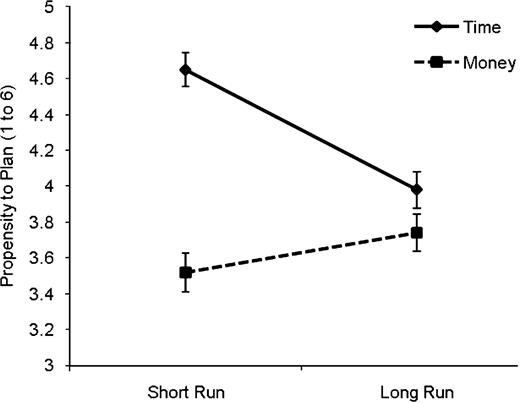
Abstract. Planning has pronounced effects on consumer behavior and intertemporal choice. We develop a six-item scale measuring individual differences in pr
Affording Disposal Control: The Effect of Circular Take-Back Programs on Psychological Ownership and Valuation
A circular economy is a “closed-loop” system designed so that products flow back into the production cycle after use. With many companies implementing take-back programs as part of their sustainability strategy, a fundamental shift in consumption has occurred, with consumers considering disposal during and even before purchase decision making. Eight experiments reveal that consumers indicate a greater willingness to pay for circular program products. An increase in psychological ownership underlies the difference in product valuation. Specifically, the additional disposal control uniquely afforded by circular products increases the capacity of circular take-back program products to evoke psychological ownership. The process explanation is directly tested through mediation. Experimentally manipulating antecedents of psychological ownership (i.e., disposal control and psychological ownership) provides further support for the conceptual framework.
Leave Home without it? The Effects of Credit Card Debt and Available Credit on Spending
This research examines how credit card debt affects consumer spending. In five experimental and field studies, the authors demonstrate that outstanding credit card debt increases spending for consumers with high self-control. They also show that this effect can be eliminated by increasing the available credit on the credit card. Thus, when the available credit is low, consumers with greater self-control increase spending, but when the available credit is high, they reduce spending. The results extend the literature on goal violation and self-control and offer insights into consumer decision making and consumption patterns under conditions of debt.
Restoring Consumer Sovereignty
For decades, there has been broad consensus within antitrust, intellectual property, and consumer law scholarship that consumers make decisions in their own best interests by consciously weighting the market’s relative prices, quantities, and qualities against each other. That consensus is unraveling in light of novel findings from cognitive and social psychology that explain how individuals’ concepts of what they prefer drive the global economy. At the same time, producers nowadays no longer merely satisfy consumers’ needs but also communicate their values, identities, and aspirations through the sale and marketing of products. As part of the growing interest in observations such as these, a wealth of psychological studies challenge the fundamental teaching of economics that the interplay of demand and supply of goods in a free market economy provides us with material wealth. This book provides a normative defense of that assumption and a theoretical framework for understanding its contradictions. It argues that the erosion of consumer sovereignty through the ability of product manufacturers and sellers to systematically take advantage of individuals’ psychological weaknesses demands a twenty-first-century reconceptualization of the consumer and a modern account of how the law should regulate the digital economy. Such an account is justified to ensure a diverse marketplace in which consumers can influence how our societies are structured and arranged. By examining the role that market manipulation plays, it offers ingredients for a realistic descriptive and normative market regulatory theory that is aware of its political economy, its behavioral suppositions, and its distributional consequences.