


When making purchasing decisions, consumers consider their available budget and determine what payment method they will use as well as how they will finance the purchase. Consumers must also plan for long-term consumption by considering short- and long-term savings objectives, taking into account how they will invest money saved, as well as how they will borrow needed money and repay outstanding loans. This issue of the Journal of Association of Consumer Research explores financial decision making, which we define as the accumulation and use of resources across time, as reflected by consumers’ behavior and choices.
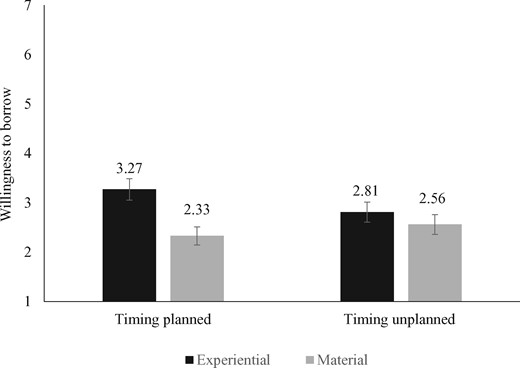
Context-Dependent Drivers of Discretionary Debt Decisions: Explaining Willingness to Borrow for Experiential Purchases
Abstract Mental accounting research suggests that consumers prefer borrowing for longer-lasting purchases in order to receive benefits from the purchases as they pay for them. In contrast, two sets of archival data and five lab studies show that consumers are more willing to borrow for experiential versus material purchases, even though experiential purchases tend to have a shorter physical duration. Further, framing the same purchase as more experiential than material increases willingness to borrow. This effect occurs because purchase timing is more important for experiential purchases—a function of consumers’ aversion to missing out on planned consumption. Thus, we moderate the proposed effect by varying whether the borrowing decision impacts planned consumption. Other differences between material and experiential purchases, such as scarcity or expected happiness, cannot similarly explain our results. Moreover, our conceptualization allows us to reconcile the apparent contradiction between the previous and current research by examining the relative impact of purchase-timing importance and payment-benefit duration matching in different contexts (i.e., “purchasing” and “source-of-funding” decisions).
Knowing When to Spend: Unintended Financial Consequences of Earmarking to Encourage Savings
Maintaining savings is an important financial goal. Yet there are times when savings should be spent, such as when people face unavoidable costs, and spending their savings allows them to avoid high interest rate debt. Existing behavioral research has focused on consumer decisions between savings and discretionary spending and has proposed interventions to promote savings in these contexts. However, when spending is not discretionary, such interventions could risk exacerbating a pattern found in economic research in which people borrow high interest rate debt while maintaining savings that earn low levels of interest. To examine how mental accounting interacts with considerations of personal responsibility and guilt to contribute to this pattern, this article explores whether people spend their savings when they need money most: during emergencies. Six studies reveal that people's tendency to preserve savings by borrowing from a high interest rate credit option varies as a function of the savings’ intended use. Paradoxically, people are most likely to turn to high interest rate credit with the belief that doing so is the responsible option.

The Effect of Credit on Spending Decisions: The Role of the Credit Limit and Credibility
The objective of the present research is to study consumer decisions to utilize a line of credit. The life-cycle hypothesis from economics argues that consumers should intertemporally reallocate their incomes over their life stream to maximize lifetime utility. One form of intertemporal allocation is to use past income (in the form of savings) in the future. A second form is the use of future income in the present. This can only be done if consumers have access to a temporary pool of money that they can draw from and replenish in the future—a function performed by consumer credit. However, our research reinforces prior findings that consumers are unable to correctly value their future incomes, and that they lack the cognitive capability to solve the intertemporal optimization problem required by the life-cycle hypothesis. Instead, we argue that consumers use information such as the credit limit as a signal of their future earnings potential. Specifically, if consumers have access to large amounts of credit, they are likely to infer that their lifetime income will be high and hence their willingness to use credit (and their spending) will also be high. Conversely, consumers who are granted lower amounts of credit are likely to infer that their lifetime income will be low and hence their spending will be lower. However, based on research in the area of consumer skepticism and inference making, we also argue for a moderating role of the credibility associated with the credit limit. Specifically, we argue that the above effect of credit availability would be particularly strong for consumers who believe that the credit limit credibly signals their future earnings potential (i.e., a naïve consumer who has limited experience with consumer credit). However, as consumers gain experience with credit, they start discounting credit availability as a predictor of their future and start questioning the validity of the process used to set the credit limit. Hence, with experience the effect of credit limit on the willingness to use credit should be attenuated. We test these predictions in five separate studies. In the first experimental study, we manipulate credit limit and credibility and pose subjects with a hypothetical purchase opportunity. Consistent with our prediction, credit limit impacted the propensity to spend, but only when the credibility was high. In the second experimental study, we replicate these findings even when subjects were given information about their expected future salaries, and also show that the credit limit influences their expectation of future earnings potential. In the third study, we show that the mere availability (and increase) of current liquidity cannot explain our findings. In the fourth study, we conduct a survey of consumers in which we measure a number of demographic characteristics and also ask them for their propensity to spend in a given purchase situation. In the fifth study we use the Survey of Consumer Finances (SCF) dataset, a triennial survey of U.S. families that is designed to provide detailed information on the use of financial services, spending behaviors, and selected demographic characteristics. Results from both studies 4 and 5 provide further support for our proposed framework—credit limits influence spending to a greater extent for consumers with lower credibility: younger consumers and less-educated consumers. Across all studies we achieved triangulation by using a variety of approaches (surveys and experiments), subjects types (young students and older consumers), nature of predictor variables (manipulated and measured), dependent measures (purchase likelihood, credit card balance, new charges), and methods of analysis (ANOVA and regression), and consistently found that increasing credit limits on a credit card increases spending, especially when the credibility of the limit is high. This paper joins a growing body of literature in marketing and behavioral decision theory that goes beyond the traditional domains of inquiry (e.g., product choice, effects of marketing mix variables) and focuses on consumer decisions relating to the appropriate use of income to finance consumption. Our framework differs from prior research on the effect of payment mechanisms on spending in two significant ways. First, we are interested in the effects of the availability of credit on spending, and not necessarily in the effect of the transaction format that is associated with each payment mechanism. Second, while prior research has studied the point-of-purchase and historic (i.e., prepurchase) effects of credit, the present research is concerned with the availability of credit in the future. Specifically, our framework is invariant to the current and prior usage of credit by the consumer.

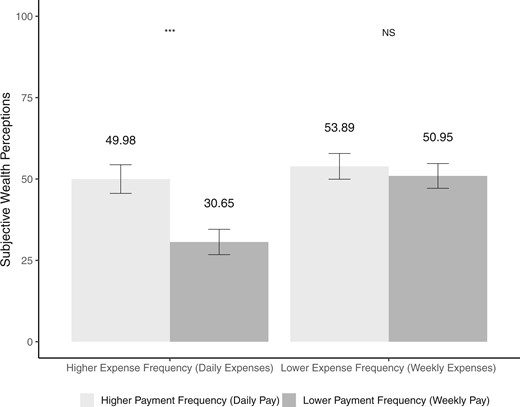
The Impact of Payment Frequency on Consumer Spending and Subjective Wealth Perceptions
Abstract Payment frequency is a fundamental yet underexplored feature of consumers’ finances. As higher payment frequencies are becoming more prevalent, consumers are receiving more frequent yet smaller paychecks. An analysis of income and expenditure data of over 30,000 consumers from a financial services provider demonstrates a naturally occurring relationship between higher payment frequencies and increased spending. A series of lab studies support this finding, providing causal evidence that higher (vs. lower) payment frequencies increase spending. The effect of payment frequency on spending is driven by changes in consumers’ subjective wealth perceptions. Specifically, higher payment frequencies reduce consumers’ uncertainty in predicting whether they will have enough resources throughout a period, increasing their subjective wealth perceptions. As such, situational factors that reduce prediction uncertainty for those paid less frequently (e.g., the timing of consumers’ expenses, income levels) moderate the impact of payment frequency. The effects of payment frequency on subjective wealth and spending can occur even when objective wealth favors those with lower payment frequencies. More broadly, the current work underscores a need to understand how timing variations in consumers’ income impact their perceptions, behaviors, and general well-being.
Cash versus Debit Card: The Role of Budget Control
Due to the financial crisis, an increasing number of households face financial problems. This may lead to an increasing need for monitoring spending and budgets. We demonstrate that both cash and the debit card are perceived as helpful in this respect. We show that, on average, consumers responsible for financial decision making within a household find cash and the debit card equally helpful for monitoring their household finances. Individuals differ in major respects, however. In particular, low earners and the liquidity‐constrained prefer cash as a budgeting tool. Finally, we present evidence that at an aggregated level, such preferences strongly affect consumer payment behavior. These findings suggest that the substitution of cash by cards may slow down because of the financial crisis.

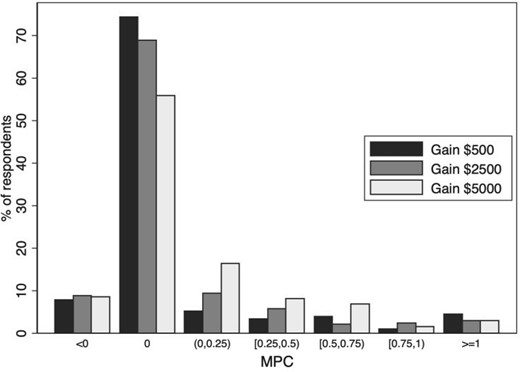
What Would You Do with $500? Spending Responses to Gains, Losses, News, and Loans
Abstract We use survey questions about spending in hypothetical scenarios to investigate features of propensities to consume that are useful for distinguishing between consumption theories. We find that (1) responses to unanticipated gains are vastly heterogeneous (either zero or substantially positive); (2) responses increase in the size of the gain, driven by the extensive margin of spending adjustments; (3) responses to losses are much larger and more widespread than responses to gains; and (4) even those with large responses to gains do not respond to news about future gains. These four findings suggest that limited access to disposable resources, and frictions in adjusting consumption, are important determinants of consumption behaviour. We also find that (5) households do not respond to the offer of a one-year interest-free loan, suggesting that this is not a consequence of short-term credit constraints; and (6) people do cut spending in response to news about future losses, suggesting that neither is this a consequence of myopia. A calibrated precautionary savings model with utility costs of changing consumption, and a sufficient fraction of low-wealth households, can account for these features of propensities to consume on both the extensive and intensive margins.
When Motivation is against Debtors' Best Interest: The Illusion of Goal Progress in Credit Card Debt Repayment
The authors explore the illusion of goal progress by consumers who own multiple credit cards and pay off their debt balances to facilitate the achievement of their subgoal rather than the superordinate goal of being debt-free. The first experiment shows that debtors use their savings toward the credit card debt they can pay off entirely or substantially, even if it is associated with the smallest balance and the lowest annual percentage rate rather than toward the debt with the highest annual percentage rate. The second experiment reveals that when the income available to pay down the debt is in the form of effortless money (i.e., windfall or reward money) as opposed to hard-earned savings, the tendency to allocate money toward the smallest credit card debt is exacerbated. However, people tend to pay their debt more rationally when the number of debt accounts increases. Finally, the third experiment shows that credit card debt repayment decisions depend on the nature of the debt (hedonic vs. utilitarian) and the timing of consumption benefits (past vs. future). The article concludes with a discussion of managerial and public policy implications.
Financial product sensitivity predicts financial health
Abstract Recent research has aimed to understand how people consider financial decisions because they have important consequences for well‐being. Yet existing research has largely failed to examine how attitudes and behaviors vary as a function of the specific financial product (e.g., debt type). We ask to what extent people differentiate between similarly categorized financial products (e.g., debt or investment) as a function of their terms (e.g., interest costs and expected returns) and whether such differentiation predicts financial health. Across four studies, we find not only that there are individual differences in attitudes toward similar financial products (e.g., two distinct loans), but also that the extent to which a consumer is averse to high‐cost versus low‐cost products predicts financial health. This relationship cannot be fully explained by financial literacy, numeracy, or intertemporal discounting. In addition, nudging people toward differentiating between financial products promotes decisions that are aligned with financial health.

Payment Rewards and Credit Card Debt: Experimental Evidence
We report on a controlled laboratory experiment in which participants make consumption, saving, and credit card repayment decisions when credit card purchases e

On shifting consumers from high‐interest to low‐interest debt
Abstract In the United States, many consumers are increasingly accumulating debt, much of which is harmful and expensive. Prior research has devoted a great deal of attention to understanding why consumers generally get into debt and the strategies they can use to repay existing debts. While this work has furthered the agenda of helping consumers reduce or eliminate their overall debt balances, it has failed to emphasize the fact that for many consumers, debt may be unavoidable. This article aims to promote research that addresses not only overall debt reduction but also the need for consumers to shift from more to less costly types of debt. By shedding light on the psychological reasons why consumers may naturally gravitate toward more costly forms of debt when less costly ones may be available, we offer a novel perspective on why consumers get into and stay in debt longer than they should. This new angle has the potential to spur on further research into the ways consumers can use debt more effectively and less expensively in service of the overarching goal of debt reduction.

Savers and Borrowers: Strategies of Personal Financial Management
Saving and borrowing are traditionally and stereotypically thought of as opposites, with different motivations and consequences. Through a questionnaire survey of economic position, practices, and attitudes, the present paper examined the relation between saving and borrowing among British respondents. While saving and borrowing were found to be determined by different economic, social, and psychological factors, they did not describe mutually exclusive strategies of financial management. Saving regularly could also be distinguished from having savings. In all, six strategies were identified (combining saving or not saving, borrowing or not borrowing, and having or not having savings). Each combination was found to have specific discriminating characteristics. Savers and borrowers were found to have different psychological motivations, seeing debt either as a failure or as a normal part of everyday life. Many people retained savings or carried on saving at the same time as having debts: they were found to feel more in control and optimistic about their financial position than those who had debts but no savings. A further group had neither debts nor savings: they adopted an inflexible approach to financial management. Each group of people with different financial management strategies was illustrated by a case study.
The Effects of Prior Spending on Future Spending Decisions: The Role of Acquisition Liabilities and Payments
Research in mental accounting shows that prior spending influences a consumer's decision to make a new spending decision (Heath and Soll 1996, Soman 2001). In particular, greater spending in a particular category reduces the likelihood of further spending in that category. In the present research, we decompose “spending” into two distinct episodes—the acquisition liability episode during which a purchase is made accompanied by a commitment to pay (e.g., using a credit card) and the payment episode during which the consumer's wealth actually gets depleted (e.g., paying the credit card bill). Using a controlled laboratory experiment and real world data from a group of consumers, we replicate earlier findings that prior spending influences a pending spending decision, but also show that the location of both the acquisition liability episode and the payment episode play a role. Our results contribute to an understanding of the dynamic mental accounting of acquisition liability and actual outflows.
Co-holding behaviour: unlocking the puzzle
This article seeks to explain why households decide to simultaneously hold both credit and savings products. Beyond the arguments of ignorance or behavioural biases commonly used in the literature,...

Payment Depreciation: the Behavioral Effects of Temporally Separating Payments From Consumption
Abstract. Research suggests that individuals mentally track the costs and benefits of a consumer transaction for the purpose of reconciling those costs and
“Repayment-by-Purchase” Increases Consumer Debt Repayment
This article tests the effect of a novel credit card payment format—repayment-by-purchase—on consumers’ payments toward credit card debt. In contrast to typical balance repayment, where consumers make repayments relative to a total amount owed, repayment-by-purchase prompts consumers to select items (e.g., a Starbucks coffee) or categories of purchase (e.g., restaurant and café purchases) and to make payments toward their related debt. A field experiment first suggests that customers who opted into repayment-by-purchase paid 12.18% more toward their statement balance than a control group. Subsequently, five lab experiments show that consumers repaying-by-purchase increase repayment by an average of 22.47% over typical balance repayment. Process evidence suggests that these differences may be driven by repayment-by-purchase's power to increase purchase salience, which in turns increases perceptions of progress toward reducing debt. Consistent with this theory, the effect of repayment-by-purchase on bill repayment emerges regardless of whether consumers repay durable versus nondurable goods, and for specific items or categories of purchases, as long as the bill uses labels that are concrete enough to raise past purchase salience.
Balancing Savings and Debt: Findings from an Online Experiment
Many consumers have savings and debt at the same time, and so are faced with a trade-off: how much debt to pay down versus how much savings to retain. This brie