

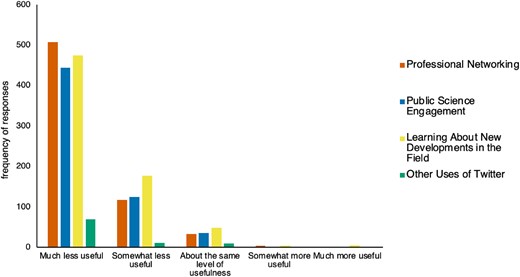
Synopsis Social media has become widely used by the scientific community for a variety of professional uses, including networking and public outreach. For the past decade, Twitter has been a primary home of scientists on social media. In recent years, new leadership at Twitter has made substantive changes that have resulted in increases in the prevalence of pseudoscience, conspiracy theory, and harassment on the platform, causing many scientists to seek alternatives. Bluesky has been suggested as a good alternative to Twitter, but the phenomenon of academics switching social media platforms has not previously been studied. Here we report on the results of a survey distributed to scientists on Twitter and Bluesky (n = 813). Results overwhelmingly confirm that changes to Twitter have made the social media platform no longer professionally useful or pleasant, and that many scientists have abandoned it in favor of Bluesky. Results show that for every reported professional benefit that scientists once gained from Twitter, scientists can now gain that benefit more effectively on Bluesky than on Twitter.
Scientists no Longer Find Twitter Professionally Useful, and have Switched to Bluesky
Synopsis. Social media has become widely used by the scientific community for a variety of professional uses, including networking and public outreach. For
Scientists no Longer Find Twitter Professionally Useful, and have Switched to Bluesky
Synopsis. Social media has become widely used by the scientific community for a variety of professional uses, including networking and public outreach. For
A new study suggests that scientists are leaving X (formerly known as Twitter) in significant numbers due to its declining professional value. Many now find Bluesky to be a more effective platform for networking, outreach, and staying updated on research.
36K votes, 1.1K comments. 34M subscribers in the science community. This community is a place to share and discuss new scientific research. Read…
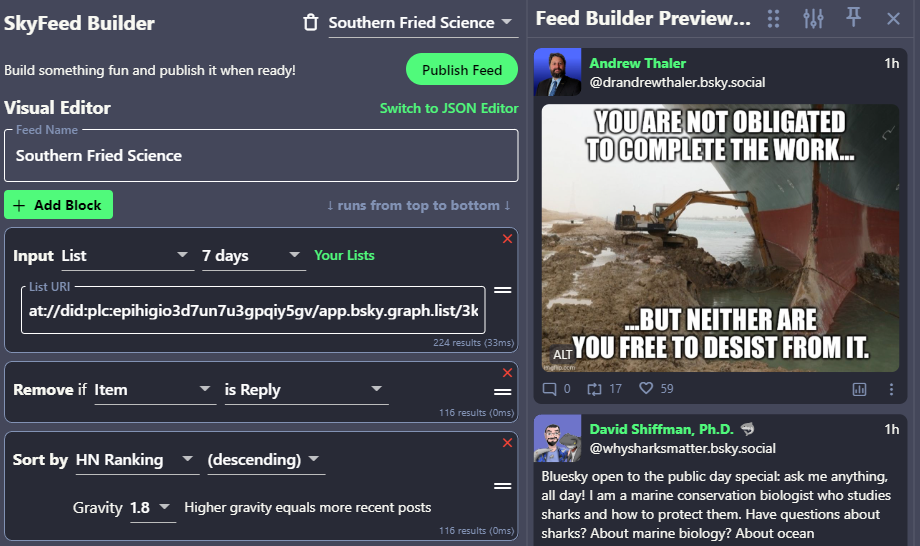
A quick and dirty guide to making custom feeds on Bluesky
So, you’ve made it! The remnants of science twitter have at last begun to coalesce around a new microblogging platformed owned by questionable individuals with inadequate content moderation t…
The Astrosky Ecosystem: An independent online platform for science communication and social networking
While almost everything that astronomers study occurs in the vacuum of space, astronomy itself does not `happen in a vacuum'. Interactions between scientists, as well as outreach to members of the public, improve extensively from access to good communication tools. Social media has become a key tool for communication in astronomy, being widely used by individuals and organizations alike for networking, outreach, and more. However, traditional social media is reliant on benevolent corporations providing a free service without compromising on quality, and the recent takeover and decline of Twitter has shown how vulnerable these platforms can be. In this proceeding, we present The Astrosky Ecosystem, which is an initiative to develop open-source tools and integrations for social media, principally the Bluesky social network. We explain how our project enables the astronomy community to operate its own social media infrastructure, independent of for-profit corporations. We also discuss some of the project's technical aspects, including its use of the AT Protocol for social networking, before concluding with ideas for the future.

How is science clicked on Twitter? Click metrics for Bitly short links to scientific publications
Abstract To provide some context for the potential engagement behavior of Twitter users around science, this article investigates how Bitly short links to scientific publications embedded in scholarly Twitter mentions are clicked on Twitter. Based on the click metrics of over 1.1 million Bitly short links referring to Web of Science (WoS) publications, our results show that around 49.5% of them were not clicked by Twitter users. For those Bitly short links with clicks from Twitter, the majority of their Twitter clicks accumulated within a short period of time after they were first tweeted. Bitly short links to the publications in the field of Social Sciences and Humanities tend to attract more clicks from Twitter over other subject fields. This article also assesses the extent to which Twitter clicks are correlated with some other impact indicators. Twitter clicks are weakly correlated with scholarly impact indicators (WoS citations and Mendeley readers), but moderately correlated to other Twitter engagement indicators (total retweets and total likes). In light of these results, we highlight the importance of paying more attention to the click metrics of URLs in scholarly Twitter mentions, to improve our understanding about the more effective dissemination and reception of science information on Twitter.

Do Science <i>Kardashians</i> Get Citation Premium? Self‐Fulfilling Effects of Social Media on Scientific Impact
ABSTRACT We analyze whether the visibility of scientists on social media affects the number of academic citations. We use the global COVID‐19 pandemic as a quasinatural experiment that exogenously increased public attention and the demand for expertise. Using publications on COVID‐related topics by social media stars and their coauthors prior to the outbreak of the pandemic, we find that social media stars' pre‐COVID‐era papers received about – more citations annually per paper after 2019. Quantitatively comparable results are obtained when we use scientists' Kardashian index (K‐index) as a benchmark for stardom, however we find no significant effects when using the intensive margin of scientists' K‐indexes. We provide a brief discussion of policy implications in light of these findings.

Social media promotion improves job market outcomes
Social media has transformed how academics disseminate research, but its effect on academic job outcomes remains unclear. Previous research has shown correlations between social media exposure and metrics like citation counts, but these relationships may be confounded by unobserved factors such as researcher quality or access to professional networks. We examine whether social media promotion causally affects job market outcomes in economics through a field experiment on Twitter (now X). We first collect tweets about job market papers from 519 candidates and post them from a dedicated account. We then randomize half of the posts to be quote-tweeted by established economists in the candidates’ fields, and measure the effects on both online visibility and hiring outcomes. We find that posts in the treatment group receive 441% more views and 303% more likes than those in the control group. Candidates whose posts were assigned to be quote-tweeted receive one additional flyout invitation compared to the control group average of 5.4 flyouts. Furthermore, women in the treatment group receive 0.9 more job offers than women in the control group, who receive 3 offers on average. Exploring mechanisms, we find that academic reputation drives these results, with stronger effects for quote-tweets from highly cited scholars and for candidates from top institutions. Our findings suggest social media promotion causally increases research visibility and improves academic job market outcomes.

My top Bluesky feature requests for 2024
In 2023 my social media consumption changed dramatically after I DM'd a random mufo on what-was-then-called Twitter for a Bluesky invite. At the time, I was floating between Twitter itself and Mastodon for my primary daily social media experience. On one hand, I loathed Twitter (and
Bluesky & Open Social Media Tech
Recently I’ve been thinking about a couple of... - Adam Wood
Recently I’ve been thinking about a couple of different tech-related things that sort of overlap. One is the (emerging) shape of the new social web; the other is a pull I’m feeling to try and lessen reliance on American companies. I’ve been interested in / concerned by what became of social media for some time.1 Since the sundering of Twitter in 2022, I’ve kept an eye on the various alternatives, with particular interest in Mastodon and Bluesky. Actually, to be more accurate, my interest has been in the protocols behind those platforms: ActivityPub and AT Protocol respectively. Both have their...

Looking AT the Blue Skies of Bluesky
The pitfalls of centralized social networks, such as Facebook and Twitter/X, have led to concerns about control, transparency, and accountability. Decentralized social networks have emerged as a result with the goal of empowering users. These decentralized approaches come with their own trade-offs, and therefore multiple architectures exist. In this paper, we conduct the first large-scale analysis of Bluesky, a prominent decentralized microblogging platform. In contrast to alternative approaches (e.g. Mastodon), Bluesky decomposes and opens the key functions of the platform into subcomponents that can be provided by third party stakeholders. We collect a comprehensive dataset covering all the key elements of Bluesky, study user activity and assess the diversity of providers for each sub-components.

The Astrosky Ecosystem
We're building social media tools for the astronomy & space science communities. From feeds to hosting, we're billionaire-proofing scientific discussion for good.
Frontiers In Research webinar on changes in science communication, the role of social media, and new infrastructure/tools - tomorrow (7/18) at 2 pm ET Looking forward to chatting with @ronentk.me & @joelchan86.bsky.social luma.com/7l18yyg4

Frontiers In Research: Open Science · Zoom · Luma
luma.com1. My new preprint has its own bluesky account. Why? The problems facing social media & scientific publishing are similar: both are dominated by powerful oligopolies. The @atproto.com tech underlying bluesky that aims to solve the social media prob might also help solve the scientific pub prob 🧪 🧵

Menopause evolution preprint
1. Preprint: Menopause averted a midlife energetic crisis with help from older children and parents: A simulation study. zenodo.org/records/18149332 Menopause is rare, known to occur only in humans and toothed whales: 🧵
One of the issues that has come up again and again in my reporting on misinformation and social media is the massive influence social media companies have on research in the field. Last night a preprint dropped that tries to get at this with some numbers. My piece in @science.org (and 🧪🧵 coming):

Nearly a third of social media research has undisclosed ties to industry, preprint claims
www.science.org

