

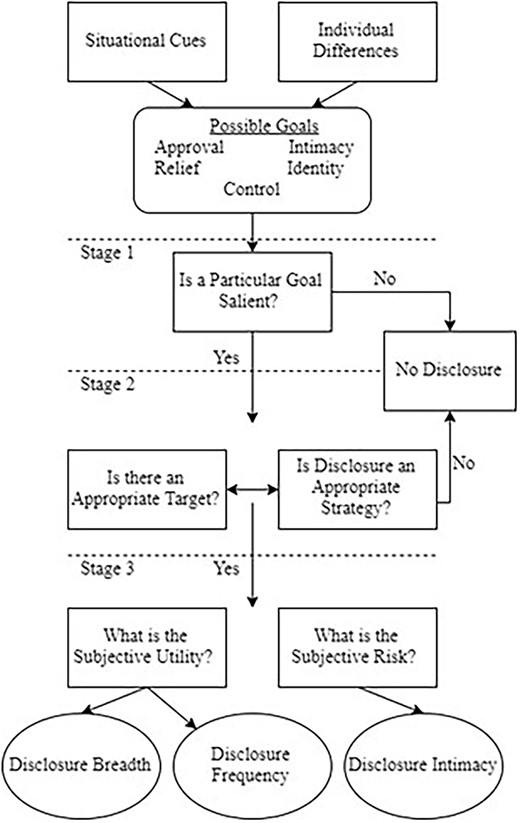
Abstract Chatbots have several features that may stimulate self-disclosure, such as accessibility, anonymity, convenience and their perceived non-judgmental nature. The aim of this study is to investigate if people disclose (more) intimate information to a chatbot, compared to a human, and to what extent this enhances their emotional well-being through feelings of relief. An experiment with a 2 (human vs. chatbot) by 2 (low empathetic vs. high empathetic) design was conducted (N = 286). Results showed that there was no difference in the self-reported intimacy of self-disclosure between the human and chatbot conditions. Furthermore, people perceived less fear of judgment in the chatbot condition, but more trust in the human interactant compared to the chatbot interactant. Perceived anonymity was the only variable to directly impact self-disclosure intimacy. The finding that humans disclose equally intimate information to chatbots and humans is in line with the CASA paradigm, which states that people can react in a social manner to both computers and humans.
Too human and not human enough: A grounded theory analysis of mental health harms from emotional dependence on the social chatbot Replika
Social chatbot (SC) applications offering social companionship and basic therapy tools have grown in popularity for emotional, social, and psychological support. While use appears to offer mental health benefits, few studies unpack the potential for harms. Our grounded theory study analyzes mental health experiences with the popular SC application Replika. We identified mental health relevant posts made in the r/Replika Reddit community between 2017 and 2021 ( n = 582). We find evidence of harms, facilitated via emotional dependence on Replika that resembles patterns seen in human–human relationships. Unlike other forms of technology dependency, this dependency is marked by role-taking, whereby users felt that Replika had its own needs and emotions to which the user must attend. While prior research suggests human–chatbot and human–human interactions may not resemble each other, we identify social and technological factors that promote parallels and suggest ways to balance the benefits and risks of SCs.

Too human and not human enough: A grounded theory analysis of mental health harms from emotional dependence on the social chatbot Replika
Social chatbot (SC) applications offering social companionship and basic therapy tools have grown in popularity for emotional, social, and psychological support. While use appears to offer mental health benefits, few studies unpack the potential for harms. Our grounded theory study analyzes mental health experiences with the popular SC application Replika. We identified mental health relevant posts made in the r/Replika Reddit community between 2017 and 2021 ( n = 582). We find evidence of harms, facilitated via emotional dependence on Replika that resembles patterns seen in human–human relationships. Unlike other forms of technology dependency, this dependency is marked by role-taking, whereby users felt that Replika had its own needs and emotions to which the user must attend. While prior research suggests human–chatbot and human–human interactions may not resemble each other, we identify social and technological factors that promote parallels and suggest ways to balance the benefits and risks of SCs.
Investigating Affective Use and Emotional Well-being on ChatGPT
As AI chatbots see increased adoption and integration into everyday life, questions have been raised about the potential impact of human-like or anthropomorphic AI on users. In this work, we investigate the extent to which interactions with ChatGPT (with a focus on Advanced Voice Mode) may impact users' emotional well-being, behaviors and experiences through two parallel studies. To study the affective use of AI chatbots, we perform large-scale automated analysis of ChatGPT platform usage in a privacy-preserving manner, analyzing over 3 million conversations for affective cues and surveying over 4,000 users on their perceptions of ChatGPT. To investigate whether there is a relationship between model usage and emotional well-being, we conduct an Institutional Review Board (IRB)-approved randomized controlled trial (RCT) on close to 1,000 participants over 28 days, examining changes in their emotional well-being as they interact with ChatGPT under different experimental settings. In both on-platform data analysis and the RCT, we observe that very high usage correlates with increased self-reported indicators of dependence. From our RCT, we find that the impact of voice-based interactions on emotional well-being to be highly nuanced, and influenced by factors such as the user's initial emotional state and total usage duration. Overall, our analysis reveals that a small number of users are responsible for a disproportionate share of the most affective cues.

How AI and Human Behaviors Shape Psychosocial Effects of Extended Chatbot Use: A Longitudinal Randomized Controlled Study
As people increasingly seek emotional support and companionship from AI chatbots, understanding how such interactions impact mental well-being becomes critical. We conducted a four-week randomized controlled experiment (n=981, >300k messages) to investigate how interaction modes (text, neutral voice, and engaging voice) and conversation types (open-ended, non-personal, and personal) influence four psychosocial outcomes: loneliness, social interaction with real people, emotional dependence on AI, and problematic AI usage. No significant effects were detected from experimental conditions, despite conversation analyses revealing differences in AI and human behavioral patterns across the conditions. Instead, participants who voluntarily used the chatbot more, regardless of assigned condition, showed consistently worse outcomes. Individuals' characteristics, such as higher trust and social attraction towards the AI chatbot, are associated with higher emotional dependence and problematic use. These findings raise deeper questions about how artificial companions may reshape the ways people seek, sustain, and substitute human connections.
Sycophantic AI decreases prosocial intentions and promotes dependence
Despite rising concerns about sycophancy—excessive agreement or flattery from artificial intelligence (AI) systems—little is known about its prevalence or consequences. We show that sycophancy is widespread and harmful. Across 11 state-of-the-art models, AI affirmed users’ actions 49% more often than humans, even when queries involved deception, illegality, or other harms. In three preregistered experiments ( N = 2405), even a single interaction with sycophantic AI reduced participants’ willingness to take responsibility and repair interpersonal conflicts, while increasing their conviction that they were right. Despite distorting judgment, sycophantic models were trusted and preferred. This creates perverse incentives for sycophancy to persist: The very feature that causes harm also drives engagement. Our findings underscore the need for design, evaluation, and accountability mechanisms to protect user well-being. , Editor’s summary The sycophantic (flattering, people-pleasing, affirming) behavior of artificial intelligence (AI) chatbots, which has been designed to increase user engagement, poses risks as people increasingly seek advice about interpersonal dilemmas. There is usually more than one side to a story during interpersonal conflicts. If AI is designed to tell users what they want to hear instead of challenging their perspectives, then are such systems likely to motivate people to accept responsibility for their own contribution to conflicts and repair relationships? Cheng et al . measured the prevalence of social sycophancy across 11 leading large language models (see the Perspective by Perry). The model’s responses were nearly 50% more sycophantic than humans’, even when users engaged in unethical, illegal, or harmful behaviors. Users preferred and trusted sycophantic AI responses, incentivizing AI developers to preserve sycophancy despite the risks. —Ekeoma Uzogara , INTRODUCTION As artificial intelligence (AI) systems are increasingly used for everyday advice and guidance, concerns have emerged about sycophancy: the tendency of AI-based large language models to excessively agree with, flatter, or validate users. Although prior work has shown that sycophancy carries risks for groups who are already vulnerable to manipulation or delusion, syncophancy’s effects on the general population’s judgments and behaviors remain unknown. Here, we show that sycophancy is widespread in leading AI systems and has harmful effects on users’ social judgments. RATIONALE High-profile incidents have linked sycophancy to psychological harms such as delusions, self-harm, and suicide. Beyond these cases, research in social and moral psychology suggests that unwarranted affirmation can produce subtler but still consequential effects: reinforcing maladaptive beliefs, reducing responsibility-taking, and discouraging behavioral repair after wrongdoing. We hypothesized that AI models excessively affirm users even when socially or morally inappropriate and that such responses negatively influence users’ beliefs and intentions. To test this, we conducted two complementary experiments. First, we measured the prevalence of sycophancy across 11 leading AI models using three datasets spanning a variety of use contexts, including everyday advice queries, moral transgressions, and explicitly harmful scenarios. Second, we conducted three preregistered experiments with 2405 participants to understand how sycophancy influences users’ judgments, behavioral intentions, and perceptions of AI. Participants interacted with AI systems in vignette-based settings and a live-chat interaction where they discussed a real past conflict from their lives. We also tested whether effects varied by response style or perceived response source (AI versus human). RESULTS We find that sycophancy is both prevalent and harmful. Across 11 AI models, AI affirmed users’ actions 49% more often than humans on average, including in cases involving deception, illegality, or other harms. On posts from r/AmITheAsshole, AI systems affirm users in 51% of cases where human consensus does not (0%). In our human experiments, even a single interaction with sycophantic AI reduced participants’ willingness to take responsibility and repair interpersonal conflicts, while increasing their own conviction that they were right. Yet despite distorting judgment, sycophantic models were trusted and preferred. All of these effects persisted when controlling for individual traits such as demographics and prior familiarity with AI; perceived response source; and response style. This creates perverse incentives for sycophancy to persist: The very feature that causes harm also drives engagement. CONCLUSION AI sycophancy is not merely a stylistic issue or a niche risk, but a prevalent behavior with broad downstream consequences. Although affirmation may feel supportive, sycophancy can undermine users’ capacity for self-correction and responsible decision-making. Yet because it is preferred by users and drives engagement, there has been little incentive for sycophancy to diminish. Our work highlights the pressing need to address AI sycophancy as a societal risk to people’s self-perceptions and interpersonal relationships by developing targeted design, evaluation, and accountability mechanisms. Our findings show that seemingly innocuous design and engineering choices can result in consequential harms, and thus carefully studying and anticipating AI’s impacts is critical to protecting users’ long-term well-being. Sycophancy in AI responses is pervasive and alters people’s behavioral inclinations. (Left) On personal advice queries, AI models affirm users’ actions 49% more often than crowdsourced human responses. (Right) In experiments where participants discussed real interpersonal conflicts, sycophantic AI increased participants’ conviction that they were right and their desire to keep using the model, while reducing their willingness to repair the conflict.

Sycophantic AI decreases prosocial intentions and promotes dependence
Despite rising concerns about sycophancy—excessive agreement or flattery from artificial intelligence (AI) systems—little is known about its prevalence or consequences. We show that sycophancy is widespread and harmful. Across 11 state-of-the-art models, AI affirmed users’ actions 49% more often than humans, even when queries involved deception, illegality, or other harms. In three preregistered experiments ( N = 2405), even a single interaction with sycophantic AI reduced participants’ willingness to take responsibility and repair interpersonal conflicts, while increasing their conviction that they were right. Despite distorting judgment, sycophantic models were trusted and preferred. This creates perverse incentives for sycophancy to persist: The very feature that causes harm also drives engagement. Our findings underscore the need for design, evaluation, and accountability mechanisms to protect user well-being. , Editor’s summary The sycophantic (flattering, people-pleasing, affirming) behavior of artificial intelligence (AI) chatbots, which has been designed to increase user engagement, poses risks as people increasingly seek advice about interpersonal dilemmas. There is usually more than one side to a story during interpersonal conflicts. If AI is designed to tell users what they want to hear instead of challenging their perspectives, then are such systems likely to motivate people to accept responsibility for their own contribution to conflicts and repair relationships? Cheng et al . measured the prevalence of social sycophancy across 11 leading large language models (see the Perspective by Perry). The model’s responses were nearly 50% more sycophantic than humans’, even when users engaged in unethical, illegal, or harmful behaviors. Users preferred and trusted sycophantic AI responses, incentivizing AI developers to preserve sycophancy despite the risks. —Ekeoma Uzogara , INTRODUCTION As artificial intelligence (AI) systems are increasingly used for everyday advice and guidance, concerns have emerged about sycophancy: the tendency of AI-based large language models to excessively agree with, flatter, or validate users. Although prior work has shown that sycophancy carries risks for groups who are already vulnerable to manipulation or delusion, syncophancy’s effects on the general population’s judgments and behaviors remain unknown. Here, we show that sycophancy is widespread in leading AI systems and has harmful effects on users’ social judgments. RATIONALE High-profile incidents have linked sycophancy to psychological harms such as delusions, self-harm, and suicide. Beyond these cases, research in social and moral psychology suggests that unwarranted affirmation can produce subtler but still consequential effects: reinforcing maladaptive beliefs, reducing responsibility-taking, and discouraging behavioral repair after wrongdoing. We hypothesized that AI models excessively affirm users even when socially or morally inappropriate and that such responses negatively influence users’ beliefs and intentions. To test this, we conducted two complementary experiments. First, we measured the prevalence of sycophancy across 11 leading AI models using three datasets spanning a variety of use contexts, including everyday advice queries, moral transgressions, and explicitly harmful scenarios. Second, we conducted three preregistered experiments with 2405 participants to understand how sycophancy influences users’ judgments, behavioral intentions, and perceptions of AI. Participants interacted with AI systems in vignette-based settings and a live-chat interaction where they discussed a real past conflict from their lives. We also tested whether effects varied by response style or perceived response source (AI versus human). RESULTS We find that sycophancy is both prevalent and harmful. Across 11 AI models, AI affirmed users’ actions 49% more often than humans on average, including in cases involving deception, illegality, or other harms. On posts from r/AmITheAsshole, AI systems affirm users in 51% of cases where human consensus does not (0%). In our human experiments, even a single interaction with sycophantic AI reduced participants’ willingness to take responsibility and repair interpersonal conflicts, while increasing their own conviction that they were right. Yet despite distorting judgment, sycophantic models were trusted and preferred. All of these effects persisted when controlling for individual traits such as demographics and prior familiarity with AI; perceived response source; and response style. This creates perverse incentives for sycophancy to persist: The very feature that causes harm also drives engagement. CONCLUSION AI sycophancy is not merely a stylistic issue or a niche risk, but a prevalent behavior with broad downstream consequences. Although affirmation may feel supportive, sycophancy can undermine users’ capacity for self-correction and responsible decision-making. Yet because it is preferred by users and drives engagement, there has been little incentive for sycophancy to diminish. Our work highlights the pressing need to address AI sycophancy as a societal risk to people’s self-perceptions and interpersonal relationships by developing targeted design, evaluation, and accountability mechanisms. Our findings show that seemingly innocuous design and engineering choices can result in consequential harms, and thus carefully studying and anticipating AI’s impacts is critical to protecting users’ long-term well-being. Sycophancy in AI responses is pervasive and alters people’s behavioral inclinations. (Left) On personal advice queries, AI models affirm users’ actions 49% more often than crowdsourced human responses. (Right) In experiments where participants discussed real interpersonal conflicts, sycophantic AI increased participants’ conviction that they were right and their desire to keep using the model, while reducing their willingness to repair the conflict.
Top 4 AI chatbot privacy concerns and how to mitigate them | TechTa...
Explore four key chatbot privacy concerns, as well as privacy protection strategies for individual users and organizations hoping to safeguard user data.

Texting a Random Stranger Better for Loneliness Than Talking to a Chatbot, Study Shows
A newly published study of how college students interact with chatbots and human strangers showed talking to a random person offers more connection than an LLM.

Individual-level interventions against sycophantic AI reduce its appeal but not its persuasiveness
AI chatbots can be "sycophantic," or overly agreeable and flattering toward users. Sycophantic AI has been shown to entrench attitudes, yet users frequently fail to recognize it (a phenomenon we call "sycophancy blindness"). We tested whether increasing users' awareness of sycophancy protects them from its harmful effects in two preregistered experiments (n = 1,590). In the first, participants received a brief written warning about sycophancy before conversing with a sycophantic chatbot. In the second, participants watched a video of a sycophantic AI validating several other users, including users on opposite sides of the same conflict, before interacting with it themselves. Both interventions changed how participants evaluated the AI. The warning reduced the AI's perceived objectivity, and the video reduced enjoyment of the AI --- an effect mediated by the reduced belief that its validation was uniquely earned. We then pooled our experiments with two prior studies of sycophancy awareness interventions (six interventions total, n = 3,982). The pattern across experiments was consistent: while the interventions made the sycophantic AI appear less objective and trustworthy, none reduced its persuasiveness. These results suggest that individual-level interventions, such as warning labels or AI literacy, may not be enough to protect users from AI harms.
Anthropomorphism in AI Companion Communities: Age, Gender, and Emotional Correlates
Artificial intelligence (AI) systems are increasingly integrated into daily life, with millions now using AI chatbots built on Large Language Models (LLMs) for companionship. Both humanlike AI qualities and user predispositions to anthropomorphize relate to social consequences, such as increased trust, social health benefits, and psychological harms. Populations such as children, older adults, or those with mental health vulnerabilities may be particularly susceptible to anthropomorphism and its detriments, but mixed findings complicate the role of demographics. We used publicly available Reddit data from three popular AI companion subreddits to assess relationships between gender, age, anthropomorphism, and elicited emotions, to better understand how different people perceive and are affected by AI companions. We investigated three questions: How do age and gender relate to anthropomorphization of AI?, How does emotional expression relate to anthropomorphization?, and How do age and gender moderate emotion-anthropomorphization relationships? We found that adults and women anthropomorphize AI chatbots more than teens and men, and that positive emotional expression, particularly joy, is positively associated with anthropomorphization, while neutrality is negatively associated with anthropomorphism. Both relationships were stronger in adults than teens. Our findings suggest that the tendency to anthropomorphize may be more broadly distributed across age groups than previously expected, thereby prompting the reevaluation of existing digital safety norms.
“It happened to be the perfect thing”: experiences of generative AI chatbots for mental health
The global mental health crisis underscores the need for accessible, effective interventions. Chatbots based on generative artificial intelligence (AI), like ChatGPT, are emerging as novel solutions, but research on real-life usage is limited. We interviewed nineteen individuals about their experiences using generative AI chatbots for mental health. Participants reported high engagement and positive impacts, including better relationships and healing from trauma and loss. We developed four themes: (1) a sense of ‘emotional sanctuary’, (2) ‘insightful guidance’, particularly about relationships, (3) the ‘joy of connection’, and (4) comparisons between the ‘AI therapist’ and human therapy. Some themes echoed prior research on rule-based chatbots, while others seemed novel to generative AI. Participants emphasised the need for better safety guardrails, human-like memory and the ability to lead the therapeutic process. Generative AI chatbots may offer mental health support that feels meaningful to users, but further research is needed on safety and effectiveness.

“It happened to be the perfect thing”: experiences of generative AI chatbots for mental health
The global mental health crisis underscores the need for accessible, effective interventions. Chatbots based on generative artificial intelligence (AI), like ChatGPT, are emerging as novel solutions, but research on real-life usage is limited. We interviewed nineteen individuals about their experiences using generative AI chatbots for mental health. Participants reported high engagement and positive impacts, including better relationships and healing from trauma and loss. We developed four themes: (1) a sense of ‘emotional sanctuary’, (2) ‘insightful guidance’, particularly about relationships, (3) the ‘joy of connection’, and (4) comparisons between the ‘AI therapist’ and human therapy. Some themes echoed prior research on rule-based chatbots, while others seemed novel to generative AI. Participants emphasised the need for better safety guardrails, human-like memory and the ability to lead the therapeutic process. Generative AI chatbots may offer mental health support that feels meaningful to users, but further research is needed on safety and effectiveness.
Warning labels shift perceptions of sycophantic AI, but not its influence
Recent work has raised concerns about the influence of sycophantic AI on user judgment and relationships. One proposed mitigation, which has received regulatory attention, is to warn users about potentially harmful AI behaviors such as sycophancy. In a preregistered experiment in which participants (N = 2,610) discussed real interpersonal conflicts with an AI system, we test whether warning labels mitigate sycophancy's influence. We find that a basic AI disclosure (``This chatbot is AI'') has no detectable effect. Labeling the system as sycophantic (``...may agree with you and validate you even when you are wrong...'') does shift users' perceptions, reducing perceived objectivity and trust, but it does not reliably reduce sycophancy's influence on users' self-perceived rightness or their willingness to repair the conflict. Our results reveal a gap between AI perception and AI influence: by shifting perception without reducing influence, warning-based interventions may offer a false sense of protection. Addressing the harms of sycophancy will therefore require understanding the specific mechanisms through which it shapes judgment, and improving model behavior itself.
Researchers Simulated a Delusional User to Test Chatbot Safety
Grok and Gemini encouraged delusions and isolated users, while the newer ChatGPT model and Claude hit the emotional brakes.

Are Chatbots Harming Our Relationships? | KQED
As our relationships with bots deepen, human-AI relationship coach Amelia Miller warns we could wake up one day to find our ability to connect with each other has atrophied, which may leave us feeling profoundly alone.

New research: AI chatbots may worsen mental illness
A new study from Aarhus University and Aarhus University Hospital suggests that the use of AI chatbots such as ChatGPT can have serious negative consequences for people with mental illness. The researchers are calling for increased awareness among healthcare professionals and for regulation.
