Abstract The use of generative AI (genAI) in consumer research is rapidly evolving, with applications including synthetic data generation, data analysis, and more. However, their role in creative ideation—a cornerstone of consumer research—remains underexplored. Drawing on the human creativity literature, we propose that ideation with genAI is facilitated by its productivity and semantic breadth, which are psychologically analogous to the dual pathways of persistence and flexibility in human ideation. Further, we distinguish between the utility of genAI as a key ideator versus humans as key ideator, conceptualized through the genAI ideation roles of Designer and Writer and of Interviewer and Actor. While genAI excels in generating incremental improvements, its potential for groundbreaking innovation could be unlocked by leveraging its ability to prompt human creativity. This article advances the theoretical and practical understanding of genAI in ideation for consumer research, offering numerous practical guidelines for integrating generative AI into research while emphasizing human–AI collaboration to achieve radical insights.
The GenAI Future of Consumer Research
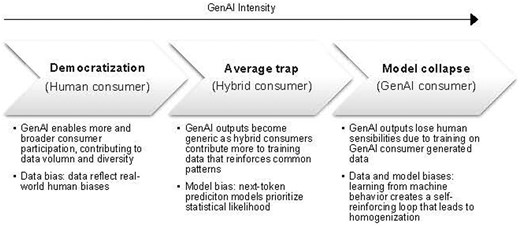
Abstract We develop a novel generative AI (GenAI) trajectory, “democratization-average trap-model collapse,” to identify data and model challenges posed by GenAI, from which we project the GenAI future of consumer research. This trajectory consists of three key phenomena: democratization broadens consumer participation, the average trap produces generic responses, and model collapse occurs when GenAI outputs lose human sensibilities. Data and model challenges arise as democratization enhances data representation while also embedding real-world biases. The average trap, caused by next-token prediction models, leads to generic outputs that lack individuality. Additionally, model collapse occurs when GenAI increasingly learns from its own outputs, amplifying machine bias and diverging from human behavior. To address these challenges, researchers can leverage democratization to study marginalized consumers and prioritize human-centered research over purely data-driven methods. The average trap can be mitigated by fine-tuning models with task-specific and marginalized consumption data while engineering responses for uniqueness. Preventing model collapse requires integrating human–machine hybrid data and applying theories of mind to realign AI with human-centric consumption. Finally, we outline three future research directions: preserving data distribution tails to support consumption democratization, countering the average trap in next-token prediction, and reversing the trajectory from democratization to model collapse.
Generative AI enhances individual creativity but reduces the collective diversity of novel content
Creativity is core to being human. Generative artificial intelligence (AI)—including powerful large language models (LLMs)—holds promise for humans to be more creative by offering new ideas, or less creative by anchoring on generative AI ideas. We study the causal impact of generative AI ideas on the production of short stories in an online experiment where some writers obtained story ideas from an LLM. We find that access to generative AI ideas causes stories to be evaluated as more creative, better written, and more enjoyable, especially among less creative writers. However, generative AI–enabled stories are more similar to each other than stories by humans alone. These results point to an increase in individual creativity at the risk of losing collective novelty. This dynamic resembles a social dilemma: With generative AI, writers are individually better off, but collectively a narrower scope of novel content is produced. Our results have implications for researchers, policy-makers, and practitioners interested in bolstering creativity. , Generative AI can enhance the creativity of short stories but may limit the variation in diverse outputs.

Generative AI enhances individual creativity but reduces the collective diversity of novel content
Creativity is core to being human. Generative artificial intelligence (AI)—including powerful large language models (LLMs)—holds promise for humans to be more creative by offering new ideas, or less creative by anchoring on generative AI ideas. We study the causal impact of generative AI ideas on the production of short stories in an online experiment where some writers obtained story ideas from an LLM. We find that access to generative AI ideas causes stories to be evaluated as more creative, better written, and more enjoyable, especially among less creative writers. However, generative AI–enabled stories are more similar to each other than stories by humans alone. These results point to an increase in individual creativity at the risk of losing collective novelty. This dynamic resembles a social dilemma: With generative AI, writers are individually better off, but collectively a narrower scope of novel content is produced. Our results have implications for researchers, policy-makers, and practitioners interested in bolstering creativity. , Generative AI can enhance the creativity of short stories but may limit the variation in diverse outputs.
The Myth of the Instant Cake Mix
How to think about creative tooling in the new world of generative AI

How Artificial Intelligence Constrains the Human Experience
AbstractArtificial intelligence (AI) and related technologies are transforming many consumption activities, powering breakthroughs that expand the human experience by enhancing human capabilities, performance, and creativity. While this explains the consumer enthusiasm and rapid adoption of these technologies, AI systems can also have the opposite effect: reducing and constraining the range of experiences that are available to consumers. This article examines the mechanisms through which AI can constrain the human experience, considering individual, interpersonal, and societal processes. Our analysis uncovers a complex interplay between the advantages of AI and its inadvertent negative repercussions, which potentially restrict human autonomy, self-identity, relational dynamics, and social behavior. In this article, we propose three different mechanisms at the core of these constraining forces: parametric reductionism, agency transference, and regulated expression. Our exploration of these mechanisms highlights the risks connected to system design and points to questions and implications for future researchers and policymakers.

Pinterest is Dead. I Built an Alternative
Combinatorial Creativity
Combinatorial creativity recombines existing ideas to spark novel, valuable innovations in cognition, AI, and design.

AI is turning research into a scientific monoculture
Generative AI deserves scientific attention. But the rush to study it is producing a feedback loop of topical and methodological convergence, flattening scientific imagination and crowding out the pluralism needed to keep research adaptive, resilient, and intellectually generative.

In spite of hype, many companies are moving cautiously when it comes to generative AI | TechCrunch
Companies are extremely interested in generative AI as vendors push potential benefits, but turning that desire from a proof of concept into a working product is proving much more challenging.

Thinking is not only writing
Generative artificial intelligence (AI) raises valid concerns about the loss of cognitive work embedded in scholarly writing. However, universally dismissing AI-assisted drafting mistakenly conflates writing with thinking itself and reinforces existing inequities in who can transform their ideas into polished text. Academic authorship should depend more on the depth and creativity of human intellectual engagement than on the medium through which first drafts are produced.
Guest Post - The Perils of Using Generative AI to Perform Research Tasks: Editors’ and Publishers’ Viewpoints - The Scholarly Kitchen
Today's guest post offers a review of a panel of publishers and editors discussing the pros and cons of using Generative AI, along with ethical and policy implications.

The Omg Lol Times · We have to talk about AI “art”
Note: In this post I’m going to use the term “AI” as a lazy shorthand for “generative content creation via large-scale pre-trained models” because time is tight and I’ve got arthritis. I know it’s not really “AI”, but please, let me give my typing fingers a break here.
TrendLife Study Shows AI Is Moving Fast, but Consumers and Families are Being Left Behind
New study of over 10,000 consumers across 9 countries reveals worry exceeds excitement about generative AI as most lack the tools and confidence to use it safely TOKYO, May 6, 2026 /PRNewswire/ --...

Lower Artificial Intelligence Literacy Predicts Greater AI Receptivity
As artificial intelligence (AI) transforms society, understanding factors that influence AI receptivity is increasingly important. The current research investigates which types of consumers have greater AI receptivity. Contrary to expectations revealed in four surveys, cross-country data and six additional studies find that people with lower AI literacy are typically more receptive to AI. This lower literacy–greater receptivity link is not explained by differences in perceptions of AI's capability, ethicality, or feared impact on humanity. Instead, this link occurs because people with lower AI literacy are more likely to perceive AI as magical and experience feelings of awe in the face of AI's execution of tasks that seem to require uniquely human attributes. In line with this theorizing, the lower literacy–higher receptivity link is mediated by perceptions of AI as magical and is moderated among tasks not assumed to require distinctly human attributes. These findings suggest that companies may benefit from shifting their marketing efforts and product development toward consumers with lower AI literacy. In addition, efforts to demystify AI may inadvertently reduce its appeal.

Lower Artificial Intelligence Literacy Predicts Greater AI Receptivity
As artificial intelligence (AI) transforms society, understanding factors that influence AI receptivity is increasingly important. The current research investigates which types of consumers have greater AI receptivity. Contrary to expectations revealed in four surveys, cross-country data and six additional studies find that people with lower AI literacy are typically more receptive to AI. This lower literacy–greater receptivity link is not explained by differences in perceptions of AI's capability, ethicality, or feared impact on humanity. Instead, this link occurs because people with lower AI literacy are more likely to perceive AI as magical and experience feelings of awe in the face of AI's execution of tasks that seem to require uniquely human attributes. In line with this theorizing, the lower literacy–higher receptivity link is mediated by perceptions of AI as magical and is moderated among tasks not assumed to require distinctly human attributes. These findings suggest that companies may benefit from shifting their marketing efforts and product development toward consumers with lower AI literacy. In addition, efforts to demystify AI may inadvertently reduce its appeal.
Where does the rigor go? Research software and the future of trustworthy science.
Generative AI now makes it dramatically easier to produce something that looks like research: analysis code, figures, literature reviews, even whole pap…