

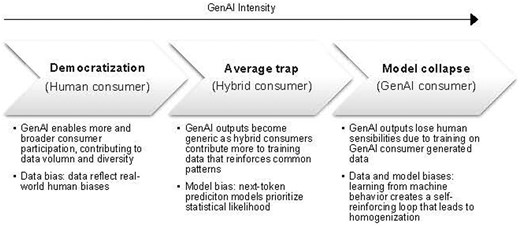
Abstract We develop a novel generative AI (GenAI) trajectory, “democratization-average trap-model collapse,” to identify data and model challenges posed by GenAI, from which we project the GenAI future of consumer research. This trajectory consists of three key phenomena: democratization broadens consumer participation, the average trap produces generic responses, and model collapse occurs when GenAI outputs lose human sensibilities. Data and model challenges arise as democratization enhances data representation while also embedding real-world biases. The average trap, caused by next-token prediction models, leads to generic outputs that lack individuality. Additionally, model collapse occurs when GenAI increasingly learns from its own outputs, amplifying machine bias and diverging from human behavior. To address these challenges, researchers can leverage democratization to study marginalized consumers and prioritize human-centered research over purely data-driven methods. The average trap can be mitigated by fine-tuning models with task-specific and marginalized consumption data while engineering responses for uniqueness. Preventing model collapse requires integrating human–machine hybrid data and applying theories of mind to realign AI with human-centric consumption. Finally, we outline three future research directions: preserving data distribution tails to support consumption democratization, countering the average trap in next-token prediction, and reversing the trajectory from democratization to model collapse.
Ideation with Generative AI—in Consumer Research and Beyond
Abstract The use of generative AI (genAI) in consumer research is rapidly evolving, with applications including synthetic data generation, data analysis, and more. However, their role in creative ideation—a cornerstone of consumer research—remains underexplored. Drawing on the human creativity literature, we propose that ideation with genAI is facilitated by its productivity and semantic breadth, which are psychologically analogous to the dual pathways of persistence and flexibility in human ideation. Further, we distinguish between the utility of genAI as a key ideator versus humans as key ideator, conceptualized through the genAI ideation roles of Designer and Writer and of Interviewer and Actor. While genAI excels in generating incremental improvements, its potential for groundbreaking innovation could be unlocked by leveraging its ability to prompt human creativity. This article advances the theoretical and practical understanding of genAI in ideation for consumer research, offering numerous practical guidelines for integrating generative AI into research while emphasizing human–AI collaboration to achieve radical insights.

How Artificial Intelligence Constrains the Human Experience
AbstractArtificial intelligence (AI) and related technologies are transforming many consumption activities, powering breakthroughs that expand the human experience by enhancing human capabilities, performance, and creativity. While this explains the consumer enthusiasm and rapid adoption of these technologies, AI systems can also have the opposite effect: reducing and constraining the range of experiences that are available to consumers. This article examines the mechanisms through which AI can constrain the human experience, considering individual, interpersonal, and societal processes. Our analysis uncovers a complex interplay between the advantages of AI and its inadvertent negative repercussions, which potentially restrict human autonomy, self-identity, relational dynamics, and social behavior. In this article, we propose three different mechanisms at the core of these constraining forces: parametric reductionism, agency transference, and regulated expression. Our exploration of these mechanisms highlights the risks connected to system design and points to questions and implications for future researchers and policymakers.

AI Behavioral Science
We outline a foundation for a new field of ``AI Behavioral Science,'' covering three perspectives. First, as AI becomes ubiquitous and is increasingly proprietary and opaque, it becomes vital to develop techniques for assessing AI behavior. We outline how tools developed to assess people's behaviors by social scientists can be used to assess and infer AI's behaviors biases, tendencies, and heuristics. Second, we also discuss how AI can change the ways in which we learn about human behavior. Beyond its computational power, AI offers new techniques for simulating, inferring, and predicting human behaviors that we outline and discuss. Third, as humans and AI are interacting in increasingly complex and intertwined systems, we need to understand the implications for the resulting economic and political outcomes. We outline issues that are increasingly pressing concerning the future of human-AI interactions and potential changes and disruptions that can ensue.

Promoting User Data Autonomy During the Dissolution of a Monopolistic Firm
The deployment of AI in consumer products is currently focused on the use of so-called foundation models, large neural networks pre-trained on massive corpora of digital records. This emphasis on scaling up datasets and pre-training computation raises the risk of further consolidating the industry, and enabling monopolistic (or oligopolistic) behavior. Judges and regulators seeking to improve market competition may employ various remedies. This paper explores dissolution -- the breaking up of a monopolistic entity into smaller firms -- as one such remedy, focusing in particular on the technical challenges and opportunities involved in the breaking up of large models and datasets. We show how the framework of Conscious Data Contribution can enable user autonomy during under dissolution. Through a simulation study, we explore how fine-tuning and the phenomenon of "catastrophic forgetting" could actually prove beneficial as a type of machine unlearning that allows users to specify which data they want used for what purposes.
Social Choice Foundations for Simulation-Augmented Generation
Users increasingly turn to AI systems for normative assistance—guidance on what one ought to do or think—yet models are often opaque about whose viewpoints they represent. A promising approach is simulation-augmented generation (SAGE), which involves querying generative simulations of individuals in a target population at inference time, soliciting their open-ended judgments, and synthesizing them into a response while transparently reporting whose viewpoints are reflected. However, inference-time simulation raises acute scalability constraints. Since the key benefit of simulation is improved representativeness, the core challenge is scaling simulation without sacrificing representation. We introduce the first formalization of this problem, grounded in proportional clustering concepts from social choice theory. We prove that to represent a population of m humans, we need only create n << m simulations of them, and need only dynamically query k << n of those simulations at inference time, while still maintaining approximate proportional representation guarantees for the full population. We empirically investigate how the guarantees achieved by our method are affected by the fidelity between the simulation and the human.
TasteVal: Measuring the Experimental Research Taste of AI Systems Against Human Experts
We introduce TasteVal, a benchmark to evaluate the experimental research taste of frontier models. We define research taste as the ability to pick interesting problems to solve, design experiments, and interpret experimental results. TasteVal measures the experimental component of research taste; given a fixed research problem, we measure how well a model iteratively designs experiments and draws conclusions from their outcomes. We operationalize experimental research taste as compute efficiency; a Researcher who reaches the same score as an expert human using half the serial experimental compute has twice the experimental taste. Experimental taste thus acts as a multiplier on experimental compute, making it a key input to forecasts of AI progress. TasteVal consists of 8 novel, challenging, open-ended tasks representative of frontier AI R&D. To isolate taste from coding ability, the model under evaluation acts as a Researcher that iteratively designs experiments while a fixed Coder agent implements them and reports their results. The Researcher executes until either the 40 H100 hour or 120 wall-clock hour budgets are exhausted. We recruit 24 human experts, at least 2 per task, and take the best expert attempt per task as the expert baseline. We evaluate 20 models released between 2023 and 2026. The best-performing model, Opus 5.5, exceeds our expert baseline, with a compute multiplier of 2.3x (95% CI 1.15-4.37), at roughly 1/30 of our baseliners' average per-run cost. On TasteVal, the compute multiplier of frontier models has doubled approximately every 3.0 months since December 2025 (95% CI 1.7-5.0), up from every 14 months between 2023 and December 2025. Measured by final normalized performance, frontier models show no trend break, doubling every 14.6 months. To keep TasteVal uncontaminated, we do not release the tasks.
AI Behavioral Science: A Framework and Agenda
We discuss the challenges and opportunities present in the rapidly emerging area of “AI Behavioral Science.” We frame it via three subfields. First, as AI becomes ubiquitous and is increasingly proprietary and opaque, it becomes vital to develop models of AI and methods for assessing AI behavior. We outline how tools developed to assess people’s behaviors by social scientists can be used to model, assess and infer AI’s behaviors biases, tendencies, and heuristics. Second, we also discuss how AI can change the ways in which we learn about human behavior. Beyond its computational power, AI offers new techniques for simulating, inferring, predicting, and analyzing human behaviors. Third, as humans and AI are interacting in increasingly complex and intertwined systems, we need to analyze and model human-AI interactions including how human and AI behaviors depend on interactions at the individual level, how interacting systems of humans and AI behave, and ultimately how AI’s integration into society affects economic and political outcomes. We discuss current research, questions, agendas, and goals in each of these three subfields and how they depend upon each other.
EXPRESS: Evaluating Novel Unstructured Treatments with Generative AI: A Causal Prediction Framework
Modern marketing increasingly requires managers to deploy new content at scale, often with limited opportunity for prior testing. As a result, decisions about what to launch become strategic managerial choices under uncertainty rather than purely creative exercises. While generative AI makes the creation of new content fast and highly scalable, it simultaneously expands the set of options managers must evaluate, making reliable content selection increasingly difficult. We develop a framework for causal prediction that enables managers to evaluate and deploy novel marketing content generated by AI. The framework uses pretrained large language models to represent previously deployed content and learn how its features causally relate to outcomes. Using a rejection-sampling procedure, the framework screens new content proposed by generative AI to avoid extrapolation beyond what historical data can reliably support. In a large-scale email marketing application (3.3 million observations across 34 campaigns), the framework improves out-of-sample prediction and real-world deployment performance relative to standard approaches, enabling outcome-guided generation of higher-performing AI-generated content. The framework establishes a threshold based on how closely new content resembles past campaigns, separating cases where causal prediction is reliable from cases where direct experimentation is warranted. The framework has important implications for marketing decision making in a rapidly evolving environment where generative AI is transforming content creation and deployment.

The governance & behavioral challenges of generative artificial intelligence’s hypercustomization capabilities
Generative artificial intelligence (GenAI) is changing human–machine interactions and the broader information ecosystem. Much as social media algorithms personalize online experiences, GenAI applications can align with user preferences to customize the way individuals interact with information. However, through training, fine-tuning, and prompting, GenAI applications can introduce a new level of customization: hypercustomization. By dynamically tailoring responses to an individual’s explicit and implicit preferences, hypercustomization can reinforce biases, false beliefs, or misconceptions. As a result, it can heighten significant societal challenges, such as the spread of misinformation and political and social polarization. In this article, we explore the risks associated with hypercustomization and the governance and behavioral challenges that might impede effective risk mitigation. These challenges include a lack of transparency in GenAI applications, opacity of the nature of their interactions with users, users’ overreliance on these systems, and the inefficacy of warning messages. We also provide recommendations for overcoming these challenges.
AI Models Exceed Individual Human Accuracy in Predicting Everyday Social Norms
A fundamental question in cognitive science concerns how social norms are acquired and represented. While humans typically learn norms through embodied social experience, we investigated whether large language models can achieve sophisticated norm understanding through statistical learning alone. Across two studies, we systematically evaluated multiple AI systems' ability to predict human social appropriateness judgments for 555 everyday scenarios by examining how closely they predicted the average judgment compared to each human participant. In Study 1, GPT-4.5's accuracy in predicting the collective judgment on a continuous scale exceeded that of every human participant (100th percentile). Study 2 replicated this, with Gemini 2.5 Pro outperforming 98.7% of humans, GPT-5 97.8%, and Claude Sonnet 4 96.0%. Despite this predictive power, all models showed systematic, correlated errors. These findings demonstrate that sophisticated models of social cognition can emerge from statistical learning over linguistic data alone, challenging strong versions of theories emphasizing the exclusive necessity of embodied experience for cultural competence. The systematic nature of AI limitations across different architectures indicates potential boundaries of pattern-based social understanding, while the models' ability to outperform nearly all individual humans in this predictive task suggests that language serves as a remarkably rich repository for cultural knowledge transmission.
TrendLife Study Shows AI Is Moving Fast, but Consumers and Families are Being Left Behind
New study of over 10,000 consumers across 9 countries reveals worry exceeds excitement about generative AI as most lack the tools and confidence to use it safely TOKYO, May 6, 2026 /PRNewswire/ --...

Is Model Collapse Inevitable? Breaking the Curse of Recursion by Accumulating Real and Synthetic Data
The proliferation of generative models, combined with pretraining on web-scale data, raises a timely question: what happens when these models are trained on their own generated outputs? Recent investigations into model-data feedback loops proposed that such loops would lead to a phenomenon termed model collapse, under which performance progressively degrades with each model-data feedback iteration until fitted models become useless. However, those studies largely assumed that new data replace old data over time, where an arguably more realistic assumption is that data accumulate over time. In this paper, we ask: what effect does accumulating data have on model collapse? We empirically study this question by pretraining sequences of language models on text corpora. We confirm that replacing the original real data by each generation's synthetic data does indeed tend towards model collapse, then demonstrate that accumulating the successive generations of synthetic data alongside the original real data avoids model collapse; these results hold across a range of model sizes, architectures, and hyperparameters. We obtain similar results for deep generative models on other types of real data: diffusion models for molecule conformation generation and variational autoencoders for image generation. To understand why accumulating data can avoid model collapse, we use an analytically tractable framework introduced by prior work in which a sequence of linear models are fit to the previous models' outputs. Previous work used this framework to show that if data are replaced, the test error increases with the number of model-fitting iterations; we extend this argument to prove that if data instead accumulate, the test error has a finite upper bound independent of the number of iterations, meaning model collapse no longer occurs.
Is Model Collapse Inevitable? Breaking the Curse of Recursion by Accumulating Real and Synthetic Data
The proliferation of generative models, combined with pretraining on web-scale data, raises a timely question: what happens when these models are trained on their own generated outputs? Recent investigations into model-data feedback loops proposed that such loops would lead to a phenomenon termed model collapse, under which performance progressively degrades with each model-data feedback iteration until fitted models become useless. However, those studies largely assumed that new data replace old data over time, where an arguably more realistic assumption is that data accumulate over time. In this paper, we ask: what effect does accumulating data have on model collapse? We empirically study this question by pretraining sequences of language models on text corpora. We confirm that replacing the original real data by each generation's synthetic data does indeed tend towards model collapse, then demonstrate that accumulating the successive generations of synthetic data alongside the original real data avoids model collapse; these results hold across a range of model sizes, architectures, and hyperparameters. We obtain similar results for deep generative models on other types of real data: diffusion models for molecule conformation generation and variational autoencoders for image generation. To understand why accumulating data can avoid model collapse, we use an analytically tractable framework introduced by prior work in which a sequence of linear models are fit to the previous models' outputs. Previous work used this framework to show that if data are replaced, the test error increases with the number of model-fitting iterations; we extend this argument to prove that if data instead accumulate, the test error has a finite upper bound independent of the number of iterations, meaning model collapse no longer occurs.
Deep mechanism design: Learning social and economic policies for human benefit
Human society is coordinated by mechanisms that control how prices are agreed, taxes are set, and electoral votes are tallied. The design of robust and effective mechanisms for human benefit is a core problem in the social, economic, and political sciences. Here, we discuss the recent application of modern tools from AI research, including deep neural networks trained with reinforcement learning (RL), to create more desirable mechanisms for people. We review the application of machine learning to design effective auctions, learn optimal tax policies, and discover redistribution policies that win the popular vote among human users. We discuss the challenge of accurately modeling human preferences and the problem of aligning a mechanism to the wishes of a potentially diverse group. We highlight the importance of ensuring that research into “deep mechanism design” is conducted safely and ethically.

For Questions of Ought, AI Could Use Some SAGE Advice
AI models are increasingly used for normative assistance, guidance on what people ought to do or think. However, in open-ended contexts, models have a tendency to collapse to only a homogeneous set of considerations, inadvertently creating epistemic bubbles where other relevant voices and perspectives are left out. We propose simulation-augmented generation (SAGE) as an alternative paradigm that directly brings society-in-the-loop. At inference time, a model selects an appropriate reference population for the prompt at hand (optionally adjustable by the user), queries generative simulations of individuals from that population for their open-ended perspectives, and uses these inputs to return a final response for the user. By helping users access the landscape of societal perspectives—rather than serving as an opaque arbiter of judgment—SAGE assists users in normative choices while upholding their agency.
AI, Human Cognition and Knowledge Collapse
We study how generative AI, and in particular agentic AI, shapes human learning incentives and the long-run evolution of society’s information ecosystem. We bui
