Abstract Consumers routinely make decisions about short time periods, such as waiting for a table or deciding whether to pay for faster delivery. Such periods are often expressed by either a duration or a clock time (e.g., if it is 6:00 PM now, “Your table will be ready in 30 minutes” vs. “Your table will be ready at 6:30 PM”). Eight experiments (N = 16,604) show that these logically equivalent frames change how long a period feels, with downstream consequences for consumer decisions. Relatively short time periods feel longer when framed by duration rather than by start and end time (i.e., clock times or calendar dates), but this pattern reverses as periods get longer. We refer to this phenomenon as time-duration asymmetry: framing an interval by its start and end time versus its duration changes how long it feels, with the direction of the effect depending on the interval’s length. We propose that this occurs because duration frames evoke compressive scalar representations shaped by diminishing sensitivity, whereas start-end frames situate time within structured categorical systems that attenuate compression. This research offers a unified framework for understanding how subtle differences in temporal framing shape perceptions of time and subsequent decisions.
The Impact of Payment Frequency on Consumer Spending and Subjective Wealth Perceptions
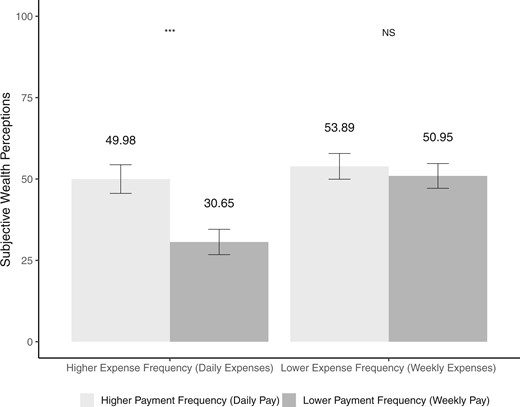
Abstract Payment frequency is a fundamental yet underexplored feature of consumers’ finances. As higher payment frequencies are becoming more prevalent, consumers are receiving more frequent yet smaller paychecks. An analysis of income and expenditure data of over 30,000 consumers from a financial services provider demonstrates a naturally occurring relationship between higher payment frequencies and increased spending. A series of lab studies support this finding, providing causal evidence that higher (vs. lower) payment frequencies increase spending. The effect of payment frequency on spending is driven by changes in consumers’ subjective wealth perceptions. Specifically, higher payment frequencies reduce consumers’ uncertainty in predicting whether they will have enough resources throughout a period, increasing their subjective wealth perceptions. As such, situational factors that reduce prediction uncertainty for those paid less frequently (e.g., the timing of consumers’ expenses, income levels) moderate the impact of payment frequency. The effects of payment frequency on subjective wealth and spending can occur even when objective wealth favors those with lower payment frequencies. More broadly, the current work underscores a need to understand how timing variations in consumers’ income impact their perceptions, behaviors, and general well-being.
Context-Dependent Drivers of Discretionary Debt Decisions: Explaining Willingness to Borrow for Experiential Purchases
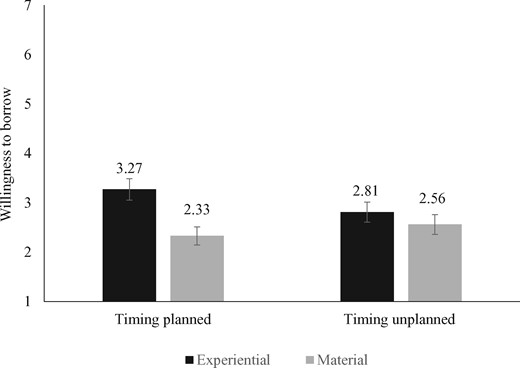
Abstract Mental accounting research suggests that consumers prefer borrowing for longer-lasting purchases in order to receive benefits from the purchases as they pay for them. In contrast, two sets of archival data and five lab studies show that consumers are more willing to borrow for experiential versus material purchases, even though experiential purchases tend to have a shorter physical duration. Further, framing the same purchase as more experiential than material increases willingness to borrow. This effect occurs because purchase timing is more important for experiential purchases—a function of consumers’ aversion to missing out on planned consumption. Thus, we moderate the proposed effect by varying whether the borrowing decision impacts planned consumption. Other differences between material and experiential purchases, such as scarcity or expected happiness, cannot similarly explain our results. Moreover, our conceptualization allows us to reconcile the apparent contradiction between the previous and current research by examining the relative impact of purchase-timing importance and payment-benefit duration matching in different contexts (i.e., “purchasing” and “source-of-funding” decisions).
Time-inconsistent Preferences and Consumer Self-Control
Abstract Why do consumers sometimes act against their own better judgment, engaging in behavior that is often regretted after the fact and that would have been rejected with adequate forethought? More generally, how do consumers attempt to maintain self-control in the face of time-inconsistent preferences? This article addresses consumer impatience by developing a decision-theoretic model based on reference points. The model explains how and why consumers experience sudden increases in desire for a product, increases that can result in the temporary overriding of long-term preferences. Tactics that consumers use to control their own behavior are also discussed. Consumer self-control is framed as a struggle between two psychological forces, desire and willpower. Finally, two general classes of self-control strategies are described: those that directly reduce desire, and those that overcome desire through will power.
Anticipation and Choice Heuristics in the Dynamic Consumption of Pain Relief
Humans frequently need to allocate resources across multiple time-steps. Economic theory proposes that subjects do so according to a stable set of intertemporal preferences, but the computational demands of such decisions encourage the use of formally less competent heuristics. Few empirical studies have examined dynamic resource allocation decisions systematically. Here we conducted an experiment involving the dynamic consumption over approximately 15 minutes of a limited budget of relief from moderately painful stimuli. We had previously elicited the participants’ time preferences for the same painful stimuli in one-off choices, allowing us to assess self-consistency. Participants exhibited three characteristic behaviors: saving relief until the end, spreading relief across time, and early spending, of which the last was markedly less prominent. The likelihood that behavior was heuristic rather than normative is suggested by the weak correspondence between one-off and dynamic choices. We show that the consumption choices are consistent with a combination of simple heuristics involving early-spending, spreading or saving of relief until the end, with subjects predominantly exhibiting the last two.
Does Your Brain Think Accurately About Time?
Chicago Booth’s Kristin Donnelly talks about her research on time-duration asymmetry.

Consumers’ Mental Representation of Expenditures: Implications for Spending and Savings Decisions
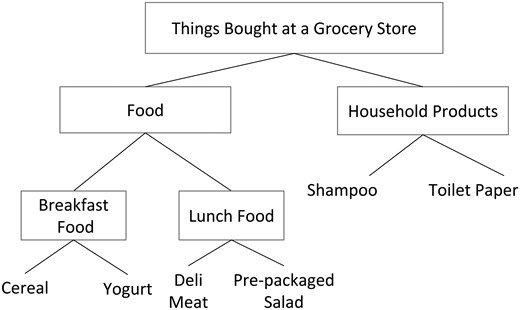
Abstract People’s mental representation of expenditures is crucial to their budgeting. This article proposes that much like how they represent natural kinds (e.g., animals and plants), people represent expenditures in a hierarchical taxonomy. Seven studies, supported by six norming studies and three pilots, revealed that expenditures are represented hierarchically. We first recover people’s mental representations using a successive pile-sort method that asks people to form hierarchies of categories with common expenditures (e.g., rent, dining out, etc.). The pile-sort reveals consensus in people’s representations of expenditures and that these representations are relatively stable over time. Further, people’s adjustment in their spending behavior can be predicted by the distance between items in their representation. Specifically, when people overspent on an item, they spontaneously adjust spending more on taxonomically closer items. We examine this spontaneous adjustment behavior using both laboratory studies and field data with 6.5 million grocery shopping trips over 12 years. The findings highlight the connection between mental representation and consumer behavior, and they emphasize the importance of studying concepts and categories in the context of consumption.
Small Probabilistic Discounts Stimulate Spending: Pain of Paying in Price Promotions
AbstractWe find that small probabilistic price promotions effectively stimulate demand, even more so than comparable fixed price promotions (e.g., “1% chance it’s free” vs. “1% off,” respectively), because they more effectively reduce the pain of paying. In three field experiments at a grocer, we exogenously and endogenously manipulated the salience of pain of paying via elicitation timing (e.g., at entrance or checkout) and payment method (i.e., cash/debit cards or credit cards). This modulated the attractiveness of probabilistic discounts and their ability to stimulate spending. Shoppers paying with cash or debit cards, for example, spent 54% more if they received a 1% probabilistic discount than a 1% fixed discount (experiment 2). A fourth experiment showed that consumers’ sensitivity to pain of paying modulates the greater comparative efficacy of small probabilistic than fixed discounts. More broadly, the results elucidate a novel affective route through which price promotions stimulate demand––pain of paying.

In-Store Spending Dynamics: How Budgets Invert Relative-Spending Patterns
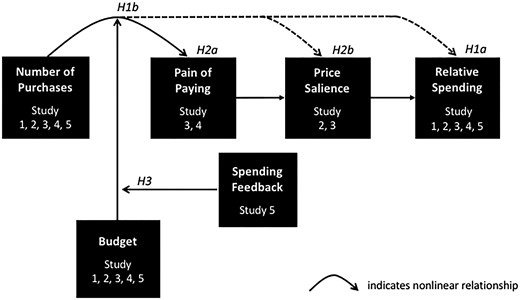
Abstract The authors conduct four controlled lab experiments and one field study in a brick-and-mortar grocery store to demonstrate that relative spending—the price of the purchased item relative to the mean price of the product category—evolves nonlinearly and distinctly for budget and nonbudget shoppers. While the relative spending of budget shoppers evolves in a concave manner, the relative spending of nonbudget shoppers evolves inversely in a convex manner. Thus, budget (nonbudget) shoppers spend relatively more (less) in the middle than at the beginning and toward the end of their shopping trip. Mediation analyses confirm that the pain of paying experienced while shopping drives price salience, which then drives relative spending. Moreover, manipulating shoppers’ pain of paying, by altering the opportunity costs associated with their spending or drawing shoppers’ attention to their spending via real-time spending feedback, is shown to influence these spending patterns. The research offers theoretical contributions to the in-store decision-making, budgeting, and pain-of-paying literature and has important implications for marketing and promotion strategies in retail and mobile technology environments, as it suggests when a shopper may be more sensitive to price-related factors.
Consumer Financial Decision Making: Where We’ve Been and Where We’re Going
When making purchasing decisions, consumers consider their available budget and determine what payment method they will use as well as how they will finance the purchase. Consumers must also plan for long-term consumption by considering short- and long-term savings objectives, taking into account how they will invest money saved, as well as how they will borrow needed money and repay outstanding loans. This issue of the Journal of Association of Consumer Research explores financial decision making, which we define as the accumulation and use of resources across time, as reflected by consumers’ behavior and choices.

The Hedonics of Debt
Psychologists and economists often discuss the “pain” of paying for our purchases. Four experiments examine how people evaluate prospective debt payments, analyzing how different features of a loan (down payment, final payment, duration, monthly payments) affect willingness to accept the loan. Akin to previous findings on physical pain, participants exhibited duration neglect and over-weighted final moments. However, participants also focused heavily on the monthly or average payment (unlike in retrospective studies of physical pain where only peak-end moments seem to count). In Experiment 2, participants’ willingness to accept the loan was not significantly diminished by making it more expensive through keeping the same monthly payment but extending the length of the loan by 40 percent (evincing duration neglect). Further, in Experiments 3 and 4, we show that participants increased their willingness to buy if loans were made longer and more expensive by adding smaller, less “painful” payments to the end.

Timing to the Statement: Understanding Fluctuations in Consumer Credit Use
We show that consumers spend 15% more per day in the first week following the receipt of a credit card statement than in the days just prior to the statement. This increase in spending includes both an increase in the likelihood that they use the credit card in the first weeks following their statement and an increase in transaction amount on days they use the credit card. In contrast to the effect on credit card spending, debit card spending is unaffected by credit card statement issuance, suggesting that consumers are not simply switching among modes of payment. Our estimates are based on exogenous variation from bank-assigned statement dates. We propose and test several alternative explanations to this spending puzzle: optimization of the free float, salience effect of the credit card statement, mental accounting, liquidity constraints, and automatic payments. We find that the consumers most apt to spend early in the credit card cycle tend to be those who do not revolve balances and are not close to their credit limit. Thus, this paper documents a puzzle with mixed support for several alternative explanations. This paper was accepted by David Simchi-Levi, finance.

The Interplay among Category Characteristics, Customer Characteristics, and Customer Activities on in-Store Decision Making
The authors explore product category and customer characteristics that affect consumers’ likelihood of engaging in unplanned purchases. In addition, they examine consumer activities that can exacerbate or limit these effects. The authors employ a hierarchical modeling approach to test their hypotheses using a data set of in-store intercept interviews conducted with 2300 consumers across 28 stores. The results show that category characteristics, such as purchase frequency and displays, and customer characteristics, such as household size and gender, affect in-store decision making. Moreover, although the analysis reveals that the baseline probability of an unplanned purchase is 46%, the contextual factors can drive this probability as high as 93%. The results support the predictions that list use, more frequent trips, limiting the aisles visited, limiting time spent in the store, and paying by cash are effective strategies for decreasing the likelihood of making unplanned purchases.

The Red and the Black: Mental Accounting of Savings and Debt
In the standard economic account of consumer behavior the cost of a purchase takes the form of a reduction in future utility when expenditures that otherwise could have been made are forgone. The reality of consumer hedonics is different. When people make purchases, they often experience an immediate pain of paying, which can undermine the pleasure derived from consumption. The ticking of the taxi meter, for example, reduces one's pleasure from the ride. We propose a “double-entry” mental accounting theory that describes the nature of these reciprocal interactions between the pleasure of consumption and the pain of paying and draws out their implications for consumer behavior and hedonics. A central assumption of the model, which we call prospective accounting, is that consumption that has already been paid for can be enjoyed as if it were free and that the pain associated with payments made prior to consumption (but not after) is buffered by thoughts of the benefits that the payments will finance. Another important concept is coupling, which refers to the degree to which consumption calls to mind thoughts of payment, and vice versa. Some financing methods, such as credit cards, tend to weaken coupling, whereas others, such as cash payment, produce tight coupling. Our model makes a variety of predictions that are at variance with economic formulations. Contrary to the standard prediction that people will finance purchases to minimize the present value of payments, our model predicts strong debt aversion—that they should prefer to prepay for consumption or to get paid for work after it is performed. Such pay-before sequences confer hedonic benefits because consumption can be enjoyed without thinking about the need to pay for it in the future. Likewise, when paying beforehand, the pain of paying is mitigated by thoughts of future consumption benefits. Contrary to the economic prediction that consumers should prefer to pay, at the margin, for what they consume, our model predicts that consumers will find it less painful to pay for, and hence will prefer, flat-rate pricing schemes such as unlimited Internet access at a fixed monthly price, even if it involves paying more for the same usage. Other predictions concern spending patterns with cash, charge, or credit cards, and preferences for the earmarking of purchases. We test these predictions in a series of surveys and in a conjoint-like analysis that pitted our double-entry mental accounting model against a standard discounting formulation and another benchmark that did not incorporate hedonic interactions between consumption and payments. Our model provides a better fit of the data for 60% of the subjects; the discounting formulation provides a better fit for only 29% of the subjects (even when allowing for positive and negative discount rates). The pain of paying, we argue, plays an important role in consumer self-regulation, but is hedonically costly. From a hedonic perspective the ideal situation is one in which payments are tightly coupled to consumption (so that paying evokes thoughts about the benefits being financed) but consumption is decoupled from payments (so that consumption does not evoke thoughts about payment). From an efficiency perspective, however, it is important for consumers to be aware of what they are paying for consumption. This creates a tension between hedonic efficiency and what we call decision efficiency. Various institutional arrangements, such as financing of public parks through taxes or usage fees, play into this tradeoff. A producer developing a pricing structure for their product or service should be aware of these two conflicting objectives, and should try to devise a structure that reconciles them.

Save More Today or Tomorrow: The Role of Urgency in Precommitment Design
To encourage farsighted behaviors, previous research suggests that marketers should invite consumers to precommit to adopting these behaviors “later.” However, the authors propose that people will draw different inferences from different types of precommitment offers, and that these inferences can help explain when precommitment is (and is not) effective at increasing adoption of farsighted behaviors. Specifically, the authors theorize that simultaneously offering consumers the opportunity to adopt a farsighted behavior now or later (i.e., offering “simultaneous precommitment”) may signal that the behavior is not urgently recommended; however, offering consumers the opportunity to adopt that behavior immediately and then, only if they decline, inviting them to adopt it later (i.e., offering “sequential precommitment”) may signal just the opposite. In a multisite field experiment (N = 5,196), the authors find that simultaneously giving consumers the chance to increase their savings now or later reduced retirement savings. Two preregistered lab studies (N = 5,080) show that simultaneous precommitment leads people to infer that taking action is not urgently recommended, and such inferences predict less adoption of recommended behaviors. Importantly, offering sequential precommitment increases inferred urgency, predicting greater adoption. Together, this research advances knowledge about the limits and potential of precommitment.
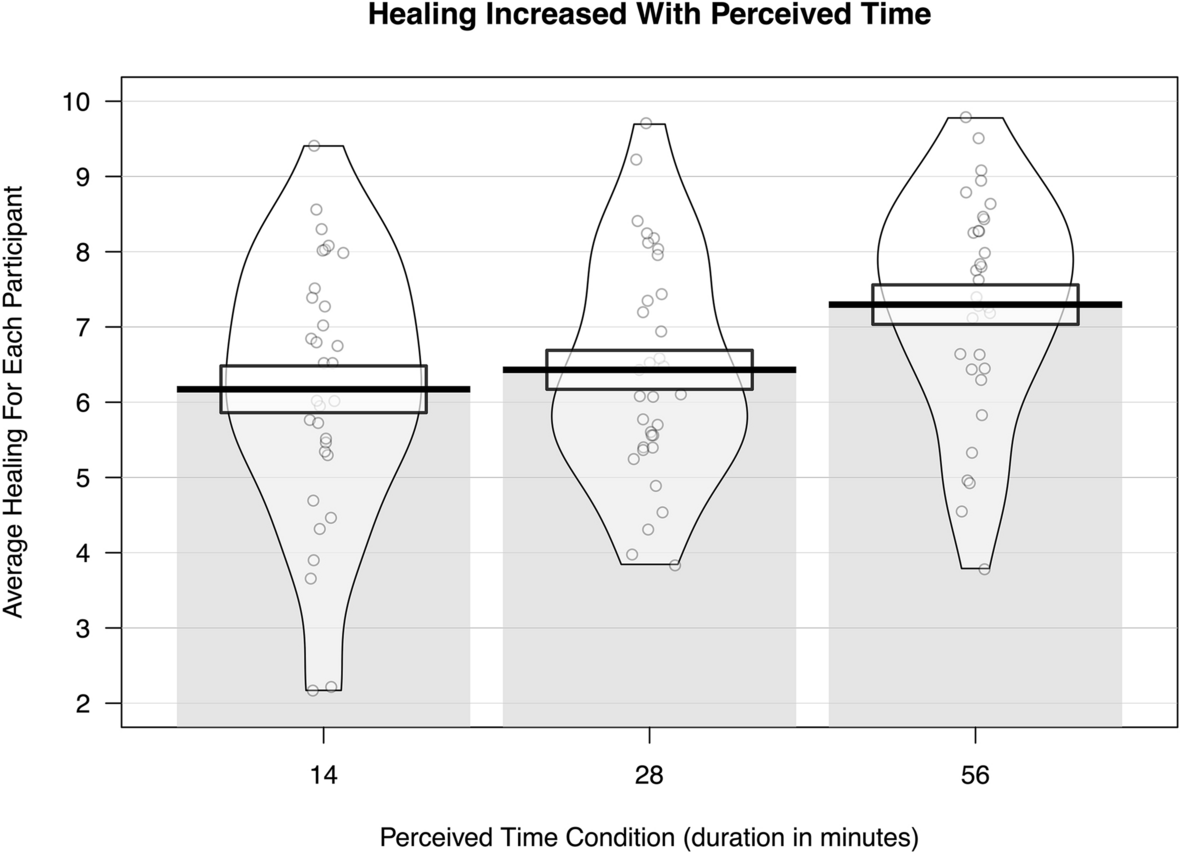
Physical healing as a function of perceived time
In this study we wounded study participants following a standardized procedure and manipulated perceived time to test whether perceived time affected the rate of healing. We measured the amount of healing that occurred across three conditions using a within-subjects design: Slow Time (half as fast as clock time), Normal Time (clock time), and Fast Time (twice as fast as clock time). Based on the theory of mind–body unity—which posits simultaneous and bidirectional influences of mind on body and body on mind—we hypothesized that wounds would heal faster or slower when perceived time was manipulated to be experienced as longer or shorter respectively. Although the actual elapsed time was 28 min in all three conditions, significantly more healing was observed in the Normal Time condition compared to the Slow Time condition, in the Fast Time condition compared to the Normal Time condition, and in the Fast Time condition compared to the Slow Time condition. These results support the hypothesis that the effect of time on physical healing is directly affected by one’s psychological experience of time, independent of the actual elapsed time.