


Abstract The Dispersion of Power is an urgent call to rethink centuries of conventional wisdom about what democracy is, why it matters, and how to make it better. Drawing from history, social science, psychology, and critical theory, it explains why elections do not and cannot realize the classic ideal of popular rule, and why prevailing strategies of democratic reform often make things worse. Instead, Bagg argues, we should see democracy as a way of protecting public power from capture—an alternative vision that is at once more realistic and more inspiring. Despite their many shortcomings, real-world elections do prevent the most extreme forms of tyranny, and are therefore indispensable. In dealing with the vast inequalities that remain, however, we cannot rely on standard solutions such as electoral reform, direct democracy, deliberation, and participatory governance. Instead, Bagg shows, protecting and enriching democracy requires addressing underlying inequalities of power directly. In part, this entails substantive policies attacking the advantages of wealthy elites. Even more crucially, deepening democracy requires the organization of oppositional, countervailing power among ordinary people. Neither task is easy, but historical precedents exist in both cases—and if democracy is to survive contemporary crises, leaders and citizens alike must find ways to revive and reinvent these essential democratic practices for the twenty-first century.
We Need To Rethink Democracy
Time and the Neo-Monarchist Turn
One of the classical arguments against democracy concerns its supposed short-termism. Early-modern political thought contrasted the pitfalls of elected authority, whose timebound character was seen to invite inconstancy, instability and plunder, with the merits of indefinite rule on the model of kingship. Such reasoning has seen two revivals in recent years, first in a neo-liberal form as an argument for technocracy (see independent central banking), second in a neo-reactionary form as an argument for an all-powerful executive or ‘monarch’ (see the contemporary international far Right). This article looks at the structure of these political arguments and the work they do. Having reconstructed their historical background, it charts how the neo-monarchist turn marks a radicalisation in democracy-scepticism, guided by a patrimonial logic of authority as property ownership. The article goes on to examine the political-economic factors to which this responds, as well as the contradictions to which neo-monarchism is prone. As the article concludes, temporal arguments for authoritarian politics may be dubious in substance but merit careful observation in a context of widespread disaffection with existing institutions.

Analytical Democratic Theory: A Microfoundational Approach
A prominent and publicly influential literature challenges the quality of democratic decision making, drawing on political science findings with specific claims about the ubiquity of cognitive bias to lament citizens’ incompetence. A competing literature in democratic theory defends the wisdom of crowds, drawing on a cluster of models in support of the capacity of ordinary citizens to produce correct outcomes. In this Letter, we draw on recent findings in psychology to demonstrate that the former literature is based on outdated and erroneous claims and that the latter is overly sanguine about the circumstances that yield reliable collective decision making. By contrast, “interactionist” scholarship shows how individual-level biases are not devastating for group problem solving, given appropriate conditions. This provides possible microfoundations for a broader research agenda similar to that implemented by Elinor Ostrom and her colleagues on common-good provision, investigating how different group structures are associated with both success and failure in democratic decision making. This agenda would have implications for both democratic theory and democratic practice.

Legitimacy, Authority, and Democratic Duties of Explanation
Abstract Increasingly secret, complex, and inscrutable computational systems are being used to intensify existing power relations and to create new ones; in particular, they are being used to govern. To be all-things-considered morally permissible new, or newly intense, power relations must meet standards of procedural legitimacy and proper authority. This is necessary for them to protect and realise democratic values of individual liberty, relational equality, and collective self-determination. For governing power in particular to be legitimate and have proper authority, it must meet a publicity requirement: reasonably competent members of the governed community must be able to determine that they are being governed legitimately and with proper authority. The publicity requirement can be satisfied only if the powerful can explain their decision-making to members of their political community. At least some duties of explanation are therefore democratic duties. This chapter first sets out the foregoing argument, then applies it to opaque computational systems, and clarifies precisely what kinds of explanations are necessary to fulfil these democratic values.

Conclave Democracy
What divine authority can teach us about democratic principles.

Disrupting Democracy | TechCrunch
You have to grudgingly admire the black-hat political hackers who have pwned the American electoral system. First, entrench a two-party system; second, gerrymander districts into tortuous shapes; third, cultivate an electorate so polarized that no matter how much voters dislike their incumbent, they hate the alternative worse; fourth, profit! It's elegant, horrifying brilliance.

Democratic AI is Possible. The Democracy Levels Framework Shows How It Might Work
This position paper argues that effectively "democratizing AI" requires democratic governance and alignment of AI, and that this is particularly valuable for decisions with systemic societal impacts. Initial steps -- such as Meta's Community Forums and Anthropic's Collective Constitutional AI -- have illustrated a promising direction, where democratic processes could be used to meaningfully improve public involvement and trust in critical decisions. To more concretely explore what increasingly democratic AI might look like, we provide a "Democracy Levels" framework and associated tools that: (i) define milestones toward meaningfully democratic AI, which is also crucial for substantively pluralistic, human-centered, participatory, and public-interest AI, (ii) can help guide organizations seeking to increase the legitimacy of their decisions on difficult AI governance and alignment questions, and (iii) support the evaluation of such efforts.

General elections are a travesty of democracy – let’s give the people a real voice | George Monbiot
Our system is designed for the powerful to retain control. Participatory democracy and a lottery vote are just two ways to gain real representation, says Guardian columnist George Monbiot

Billionaires Gone Wild
Understanding the oligarchs’ power grab and the dire threat to American democracy

The Global State of Democracy 2026: Democracy in an Age of Conflict
In the face of increasing political and societal fragmentation, the Global State of Democracy 2026 explains the patterns that define the direction of democratization around the world. Drawing on the latest data from the Global State of Democracy Indices, the report documents both democratic stagnation and key declines in indicators that measure the credibility of elections, the effectiveness of legislatures, respect for freedoms of expression and the press, and access to justice. These phenomena affect countries across thespectrum of democratic performance.
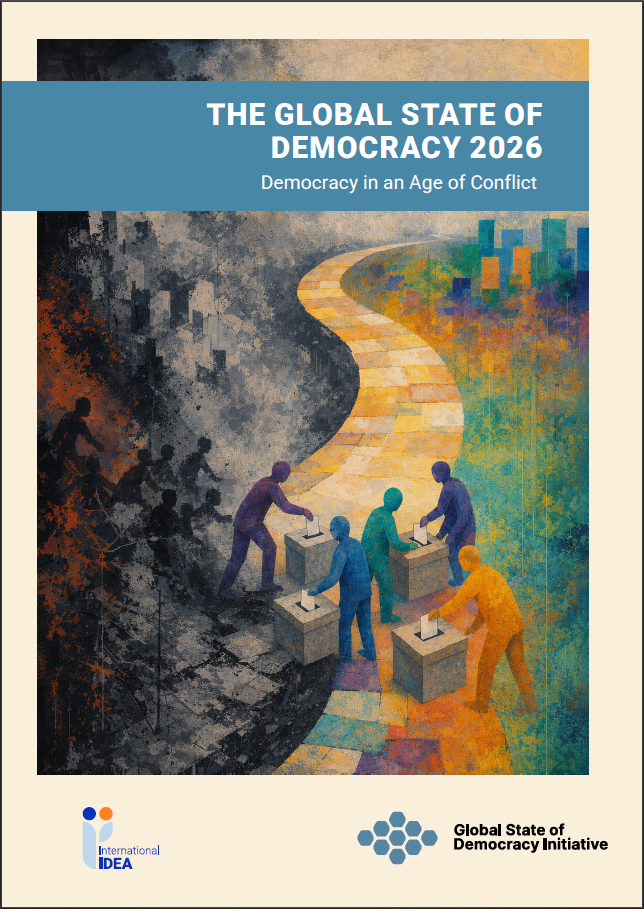
The Global State of Democracy 2026: Democracy in an Age of Conflict
In the face of increasing political and societal fragmentation, the Global State of Democracy 2026 explains the patterns that define the direction of democratization around the world. Drawing on the latest data from the Global State of Democracy Indices, the report documents both democratic stagnation and key declines in indicators that measure the credibility of elections, the effectiveness of legislatures, respect for freedoms of expression and the press, and access to justice. These phenomena affect countries across thespectrum of democratic performance.
Unfixable: Several nations have tried to restore democracy after populist strongmen. It was never the same.
Several nations have tried to restore democracy after populist strongmen. It was never the same. Leaders like Trump do lasting damage to their political systems.

It’s Not Polarization; It’s the Radicalization of the Political Right
Polarization has become the master concept for diagnosing contemporary democratic crises. The notion denotes three features: symmetry between parties, politics as an opinion space where positions diverge, and mutual repulsion between opposing camps. Yet none of these capture current realities. Across democracies, the central dynamic is not two poles drifting apart but the transformation of the political right into authoritarianism, norm breaking, and openness to political violence. Social democratic and center-right parties tend to respond in the opposite way from what “polarization” implies: by accommodating rightward. Attempts to salvage the polarization frame with modifiers (“asymmetric,” “affective,” “sectarian,” “pernicious”) concede these realities but risk hollowing out the concept’s definitional core. These limitations reveal a deeper misdiagnosis: when one party turns antidemocratic and illiberal, incivility and conflict are inevitable—but they are symptoms, not the root problem. Misdiagnosing them as the central issue leads to viewing civility and compromise as remedies, thereby risking the legitimation of authoritarian actors. This article proposes an alternative lens: the radicalization of the political right. Developed in the study of extremism, the radicalization framework better captures asymmetric change, identity-driven politics, and the mainstreaming of illiberalism. It foregrounds identity fusion, threat narratives, elite entrepreneurship, and escalation. Concepts are never politically innocent and persisting with “polarization” risks both misdiagnosing and normalizing authoritarian threats.
It’s Not Polarization; It’s the Radicalization of the Political Right
Polarization has become the master concept for diagnosing contemporary democratic crises. The notion denotes three features: symmetry between parties, politics as an opinion space where positions diverge, and mutual repulsion between opposing camps. Yet none of these capture current realities. Across democracies, the central dynamic is not two poles drifting apart but the transformation of the political right into authoritarianism, norm breaking, and openness to political violence. Social democratic and center-right parties tend to respond in the opposite way from what “polarization” implies: by accommodating rightward. Attempts to salvage the polarization frame with modifiers (“asymmetric,” “affective,” “sectarian,” “pernicious”) concede these realities but risk hollowing out the concept’s definitional core. These limitations reveal a deeper misdiagnosis: when one party turns antidemocratic and illiberal, incivility and conflict are inevitable—but they are symptoms, not the root problem. Misdiagnosing them as the central issue leads to viewing civility and compromise as remedies, thereby risking the legitimation of authoritarian actors. This article proposes an alternative lens: the radicalization of the political right. Developed in the study of extremism, the radicalization framework better captures asymmetric change, identity-driven politics, and the mainstreaming of illiberalism. It foregrounds identity fusion, threat narratives, elite entrepreneurship, and escalation. Concepts are never politically innocent and persisting with “polarization” risks both misdiagnosing and normalizing authoritarian threats.
Democracy is an epistemic discipline, it only works if truth can constrain power. Without a faster, more transparent architecture for shared reality, the arc of democracy bends away from substance, through simulation, and toward authoritarianism. Without major action, it's the inevitable end state.
