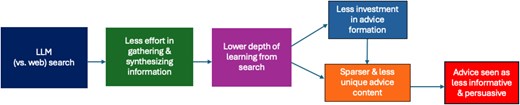
Abstract The effects of using large language models (LLMs) versus traditional web search on depth of learning are explored. A theory is proposed that when individuals learn about a topic from LLM syntheses, they risk developing shallower knowledge than when they learn through standard web search, even when the core facts in the results are the same. This shallower knowledge accrues from an inherent feature of LLMs—the presentation of results as summaries of vast arrays of information rather than individual search links—which inhibits users from actively discovering and synthesizing information sources themselves, as in traditional web search. Thus, when subsequently forming advice on the topic based on their search, those who learn from LLM syntheses (vs. traditional web links) feel less invested in forming their advice, and, more importantly, create advice that is sparser, less original, and ultimately less likely to be adopted by recipients. Results from seven online and laboratory experiments (n = 10,462) lend support for these predictions, and confirm, for example, that participants reported developing shallower knowledge from LLM summaries even when the results were augmented by real-time web links. Implications of the findings for recent research on the benefits and risks of LLMs, as well as limitations of the work, are discussed.
Experimental evidence of the effects of large language models versus web search on depth of learning
Abstract. The effects of using large language models (LLMs) versus traditional web search on depth of learning are explored. A theory is proposed that when
Illusion of knowledge through Facebook news? Effects of snack news in a news feed on perceived knowledge, attitude strength, and willingness for discussions
Research indicates that using social network sites as a source for news increases perceived knowledge even if, objectively, people fail to acquire knowledge. This might result from the frequent repetition of topics in news posts caused by multiple news outlets posting about the same news topics and the algorithm that favors similar postings. These repeated encounters can have a positive effect on the perception of knowing more, even if actual learning hardly occurs. An experiment (N = 810, representative of German Internet users) tested these assumptions. Participants were assigned to one of four groups and received a news feed with no information, few news posts, many news posts, or a full-length news article. Results indicate that many news posts increased perceived knowledge that is not paralleled by a gain in factual knowledge. Perceived knowledge mediates effects of reading many news posts on more extreme attitudes and the willingness for discussions. Even if participants who read the news article gained factual knowledge, they did not feel more knowledgeable than participants who were exposed to a news feed containing news posts. The results emphasize the meaning of engaging with full news articles, both for learning facts and for more accurate knowledge assessments.
Curated retrieval versus open web search in public AI information...
Public institutions increasingly use large language models (LLMs) to answer citizens' questions, often pairing a curated knowledge base with live web search, yet whether the sources behind these...

Searching for explanations: How the Internet inflates estimates of internal knowledge.
Augmenting Research Ideation with Data: An Empirical Investigation...
Recent advancements in large language models (LLMs) demonstrate strong potential for generating novel research ideas, yet such ideas often struggle with feasibility and effectiveness. In this...
The enshittification of online search? Privacy and quality of Google, Bing and Apple in coding advice
Even though currently being challenged by ChatGPT and other large-language models (LLMs), Google Search remains one of the primary means for many individuals to find information on the internet. Interestingly, the way that we retrieve information on the web has hardly changed ever since Google was established in 1998, raising concerns as to Google's dominance in search and lack of competition. If the market for search was sufficiently competitive, then we should probably see a steady increase in search quality over time as well as alternative approaches to the Google's approach to search. However, hardly any research has so far looked at search quality, which is a key facet of a competitive market, especially not over time. In this report, we conducted a relatively large-scale quantitative comparison of search quality of 1,467 search queries relating to coding advice in October 2023. We focus on coding advice because the study of general search quality is difficult, with the aim of learning more about the assessment of search quality and motivating follow-up research into this important topic. We evaluate the search quality of Google Search, Microsoft Bing, and Apple Search, with a special emphasis on Apple Search, a widely used search engine that has never been explored in previous research. For the assessment of search quality, we use two independent metrics of search quality: 1) the number of trackers on the first search result, as a measure of privacy in web search, and 2) the average rank of the first Stack Overflow search result, under the assumption that Stack Overflow gives the best coding advice. Our results suggest that the privacy of search results is higher on Bing than on Google and Apple. Similarly, the quality of coding advice -- as measured by the average rank of Stack Overflow -- was highest on Bing.
How cognitive elaboration fosters knowledge acquisition on social media—a field experiment
Abstract. Social media technologies have been criticized as ineffective sources of information because users seem to increase their subjective but not thei
The unintended consequences of large language models as a labor-augmenting technology in science
As a labor-augmenting technology, large language models (LLMs) have the potential to accelerate scientific activity across the research pipeline. But even if LLMs perform on par with human experts at selected tasks, their use will bring unintended consequences as they alter the balance of frictions and inducements that steer the allocation of research effort across projects. Here we develop a simple mathematical model to illustrate. In fields where LLMs are useful primarily as tools for discovering promising projects, researchers will become more selective about what they publish; where they facilitate the process of publishing existing data, researchers will become less selective. By allowing scientists to work more quickly, LLMs raise the opportunity cost of researcher time, creating incentives to refine papers less thoroughly before moving on. Enticing as it is to imagine that, by saving us time on mundane tasks, LLMs will provide us with more time to think deeply and develop projects completely, our results temper such hopes.
The unintended consequences of large language models as a labor-augmenting technology in science
As a labor-augmenting technology, large language models (LLMs) have the potential to accelerate scientific activity across the research pipeline. But even if LLMs perform on par with human experts at selected tasks, their use will bring unintended consequences as they alter the balance of frictions and inducements that steer the allocation of research effort across projects. Here we develop a simple mathematical model to illustrate. In fields where LLMs are useful primarily as tools for discovering promising projects, researchers will become more selective about what they publish; where they facilitate the process of publishing existing data, researchers will become less selective. By allowing scientists to work more quickly, LLMs raise the opportunity cost of researcher time, creating incentives to refine papers less thoroughly before moving on. Enticing as it is to imagine that, by saving us time on mundane tasks, LLMs will provide us with more time to think deeply and develop projects completely, our results temper such hopes.
Learning by Chatting? Investigating the Impact of Generative AI on Information Seeking and Learning
Generative AI (GenAI) tools offer increasing opportunities for augmenting human cognitive tasks. Among these tasks, information seeking is being rapidly reshaped by GenAI tools, with potentially profound implications for learning and knowledge acquisition. To investigate these implications, we conducted a between-subjects field experiment in which participants pursued informal learning by seeking information through either ChatGPT or Google Search over a span of 8 days. Using a daily diary protocol, we gathered in-situ data on their information-seeking processes. Our findings show that participants in the ChatGPT group experienced diminished agency in their information-seeking processes, as they offloaded much of the information selection to AI, and consequently experienced greater meta-cognitive load arising from this reduced sense of control. We further highlight two sources of distortion in information access when using ChatGPT: biases in ChatGPT outputs, particularly towards providing solution-oriented artifacts over principled knowledge; and systematic shifts in users' information-seeking behaviors, whereby the conversational and socially-oriented interaction paradigm of current GenAI tools may inadvertently reduce exploration of the broader knowledge space. As a result, on average, participants in the ChatGPT group had worse learning outcomes than those using Google, especially for higher-order critical learning. Our work suggests inherent tensions between offloading information seeking to AI and meaningful learning, and provides broader implications for understanding AI's risks to human cognition.
Learning by Chatting? Investigating the Impact of Generative AI on Information Seeking and Learning
Generative AI (GenAI) tools offer increasing opportunities for augmenting human cognitive tasks. Among these tasks, information seeking is being rapidly reshaped by GenAI tools, with potentially profound implications for learning and knowledge acquisition. To investigate these implications, we conducted a between-subjects field experiment in which participants pursued informal learning by seeking information through either ChatGPT or Google Search over a span of 8 days. Using a daily diary protocol, we gathered in-situ data on their information-seeking processes. Our findings show that participants in the ChatGPT group experienced diminished agency in their information-seeking processes, as they offloaded much of the information selection to AI, and consequently experienced greater meta-cognitive load arising from this reduced sense of control. We further highlight two sources of distortion in information access when using ChatGPT: biases in ChatGPT outputs, particularly towards providing solution-oriented artifacts over principled knowledge; and systematic shifts in users' information-seeking behaviors, whereby the conversational and socially-oriented interaction paradigm of current GenAI tools may inadvertently reduce exploration of the broader knowledge space. As a result, on average, participants in the ChatGPT group had worse learning outcomes than those using Google, especially for higher-order critical learning. Our work suggests inherent tensions between offloading information seeking to AI and meaningful learning, and provides broader implications for understanding AI's risks to human cognition.
Generative Search: Evidence from a Large-Scale Field Experiment
Generative search is an emerging search paradigm that integrates Generative AI (GenAI) into traditional search engines by presenting users with AI-generated responses before conventional search results. Whereas keyword-based search requires consumers to translate their underlying needs into effective keyword queries, generative search lets users express those intentions directly in natural language, a shift made possible by GenAI’s new mode of information presentation. This shift moves the consumer-search engine interaction upstream to the stage of problem formulation, rendering empirically observable a previously hidden phase of search behavior: the mapping from problem formulation to keyword articulation. Yet, it remains empirically unknown whether generative search increases consumer purchases and how search behavior changes when it can begin from expressed intent rather than keywords. Using a large-scale field experiment conducted on Meituan, a leading Chinese technology platform, this paper provides empirical evidence on the effectiveness of generative search. We find that generative search significantly increases consumer purchases. Further analysis reveals that generative search facilitates more effective and diverse keyword queries and reduces exploratory browsing and clicking, while concentrating evaluation within relevant categories and merchants. The empirical evidence is most consistent with a mechanism in which AI-generated answers provide information about consumers’ underlying needs, while also expanding awareness of relevant attributes and shifting attention toward more relevant categories. These findings provide empirical insights for future consumer search models that allow search to originate at the intention-expressing stage. This paper was accepted by Raphael Thomadsen, marketing. Funding: Financial support from the Ministry of Education – Singapore [Grant A-8001730-00-00] is gratefully acknowledged. Supplemental Material: The online appendix and data files are available at https://doi.org/10.1287/mnsc.2025.02458 .

Inducing Sustained Creativity and Diversity in Large Language Models
We address a not-widely-recognized subset of exploratory search, where a user sets out on a typically long "search quest" for the perfect wedding dress, overlooked research topic, killer company idea, etc. The first few outputs of current large language models (LLMs) may be helpful but only as a start, since the quest requires learning the search space and evaluating many diverse and creative alternatives along the way. Although LLMs encode an impressive fraction of the world's knowledge, common decoding methods are narrowly optimized for prompts with correct answers and thus return mostly homogeneous and conventional results. Other approaches, including those designed to increase diversity across a small set of answers, start to repeat themselves long before search quest users learn enough to make final choices, or offer a uniform type of "creativity" to every user asking similar questions. We develop a novel, easy-to-implement decoding scheme that induces sustained creativity and diversity in LLMs, producing as many conceptually unique results as desired, even without access to the inner workings of an LLM's vector space. The algorithm unlocks an LLM's vast knowledge, both orthodox and heterodox, well beyond modal decoding paths. With this approach, search quest users can more quickly explore the search space and find satisfying answers.
Learning with AI falls short compared to old-fashioned web search
Doing the mental work of connecting the dots across multiple web queries appears to help people understand the material better compared to an AI summary.

Learning with AI falls short compared to old-fashioned web search
Doing the mental work of connecting the dots across multiple web queries appears to help people understand the material better compared to an AI summary.
Large language models reduce public knowledge sharing on online Q&A platforms
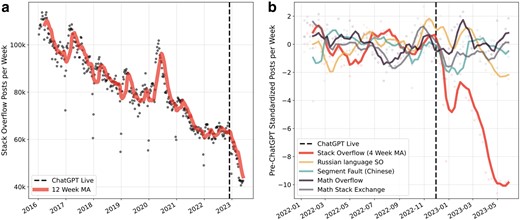
Abstract. Large language models (LLMs) are a potential substitute for human-generated data and knowledge resources. This substitution, however, can present