

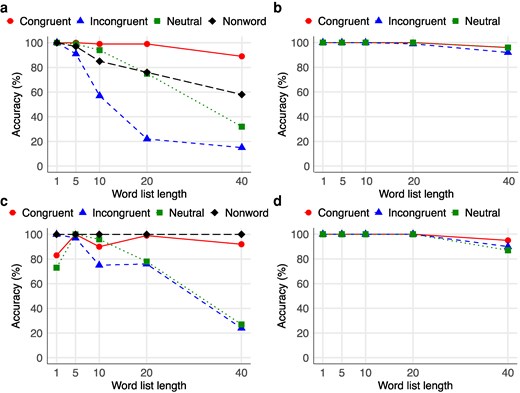
Abstract Although transformers in large language models (LLMs) effectively implement a self-attention mechanism that has revolutionized natural language processing, they lack an explicit architecture for the executive control of attention found in humans, which is essential for resolving conflicts and selecting relevant information in the presence of competing computations and is critical for adaptive behavior. To investigate the impact of this limitation in LLMs, we employed the classic color Stroop task, widely regarded as the gold standard, to test the executive control of attention in these models. Our results revealed a typical conflict effect of underperformance in terms of accuracy in the incongruent condition (e.g. naming the color of the word RED in blue) compared with the congruent condition (e.g. naming the color of the word RED in red), in short word lists, similar to human performance. However, as the length of the word lists increased, performance on the incongruent condition degraded toward near-total performance collapse, even as accuracy in the congruent condition remained excellent, and word reading (e.g. reading the word RED [in red] or RED [in blue], ignoring the color) was near-perfect. These findings demonstrate that transformer attention mechanisms are fundamentally limited in their capacity for conflict resolution across extended contexts, and a failure to up-regulate control adaptively under rising interference. We suggest that incorporating executive control mechanisms akin to those in biological attention is crucial for achieving artificial general intelligence.
Deficient executive control in transformer attention
Abstract. Although transformers in large language models (LLMs) effectively implement a self-attention mechanism that has revolutionized natural language p
Why Do Large Language Models (LLMs) Struggle to Count Letters?
Large Language Models (LLMs) have achieved unprecedented performance on many complex tasks, being able, for example, to answer questions on almost any topic. However, they struggle with other simple tasks, such as counting the occurrences of letters in a word, as illustrated by the inability of many LLMs to count the number of "r" letters in "strawberry". Several works have studied this problem and linked it to the tokenization used by LLMs, to the intrinsic limitations of the attention mechanism, or to the lack of character-level training data. In this paper, we conduct an experimental study to evaluate the relations between the LLM errors when counting letters with 1) the frequency of the word and its components in the training dataset and 2) the complexity of the counting operation. We present a comprehensive analysis of the errors of LLMs when counting letter occurrences by evaluating a representative group of models over a large number of words. The results show a number of consistent trends in the models evaluated: 1) models are capable of recognizing the letters but not counting them; 2) the frequency of the word and tokens in the word does not have a significant impact on the LLM errors; 3) there is a positive correlation of letter frequency with errors, more frequent letters tend to have more counting errors, 4) the errors show a strong correlation with the number of letters or tokens in a word and 5) the strongest correlation occurs with the number of letters with counts larger than one, with most models being unable to correctly count words in which letters appear more than twice.

Why Do Large Language Models (LLMs) Struggle to Count Letters?
Large Language Models (LLMs) have achieved unprecedented performance on many complex tasks, being able, for example, to answer questions on almost any topic. However, they struggle with other simple tasks, such as counting the occurrences of letters in a word, as illustrated by the inability of many LLMs to count the number of "r" letters in "strawberry". Several works have studied this problem and linked it to the tokenization used by LLMs, to the intrinsic limitations of the attention mechanism, or to the lack of character-level training data. In this paper, we conduct an experimental study to evaluate the relations between the LLM errors when counting letters with 1) the frequency of the word and its components in the training dataset and 2) the complexity of the counting operation. We present a comprehensive analysis of the errors of LLMs when counting letter occurrences by evaluating a representative group of models over a large number of words. The results show a number of consistent trends in the models evaluated: 1) models are capable of recognizing the letters but not counting them; 2) the frequency of the word and tokens in the word does not have a significant impact on the LLM errors; 3) there is a positive correlation of letter frequency with errors, more frequent letters tend to have more counting errors, 4) the errors show a strong correlation with the number of letters or tokens in a word and 5) the strongest correlation occurs with the number of letters with counts larger than one, with most models being unable to correctly count words in which letters appear more than twice.
A computational account of conflict processing during mental imagery
Previous studies examining conflict processing within the context of a color-word Stroop task have focused on both stimulus and response conflicts. However, it has been unclear whether conflict can emerge independently of stimulus conflict. In this study, a novel arrow-gaze mental-rotation Stroop task was introduced to explore the interplay between conflict processing and mental rotation. A modelling approach was utilized to provide a process-level account of the findings. The results of our Stroop task indicate that conflict can emerge from mental rotation in the absence of stimulus conflict. The strength of this imagery conflict effect decreases and even reverses as mental rotation angles increase. Additionally, it was observed that participants responded more quickly and with greater accuracy to small rather than large face orientations. A comparison of three conflict diffusion models—the diffusion model for conflict tasks (DMC), the dual-stage two-phase model (DSTP), and the shrinking spotlight model (SSP)—yielded consistent support for the DSTP over the DMC and SSP in the majority of instances. The DSTP account of the experimental results revealed an increased nondecision time with increasing mental rotation, a reduction in interference from incompatible stimuli, and an improved drift rate in response selection phase, which suggests enhanced cognitive control. The findings from the model-based analysis provide evidence for a novel interaction between cognitive control and mental rotation.

A Controlled Study of Attention-Only Transformers
Feed-forward networks hold two thirds of a transformer's non-embedding parameters, yet the architecture has not received a necessity test that controls parameters, compute, and depth at once. We pretrain attention-only decoder transformers (Simple Attention Networks, SANs) against standard transformers matched separately for parameter count, training FLOPs, and depth (2 to 48 layers), for up to 105B tokens at 6M to 87M parameters. Deleting feed-forward layers in place is costly: the standard transformer leads by 0.47 nats at matched depth and 0.26 nats at matched FLOPs. Reallocating the freed budget into attention depth closes the gap: at matched parameters the difference is 0.006 nats (0.27 percent of loss), reproducible to one part in ten thousand across seed pairs, shrinking across 5B, 30B, and 105B budgets, and holding near 0.02 nats across a 29x size range. Three measurements localize the remaining gap to parametric recall: attention-only models are better on context-grounded answers and worse where knowledge must come from weights. Weight spectra show why: routing matrices (Q/K) crystallize early, content matrices accumulate rank slowly, and removing feed-forward layers relocates this accumulation to the attention output projection. QK-normalization, not feed-forward layers or residual gating, keeps 48-layer attention-only stacks trainable. The deficit concentrates on low-context query prediction and localizes there entirely by the largest budget. A pre-registered test confirms the account: it predicts a 0.02 to 0.05 nat gap on knowledge-dense web text; a matched pair trained on fineweb-edu measures 0.040. Within the tested regime, attention does the rest.
Sycophancy Suppression Can Impair Rational Updating: Anti-Sycophancy Should Preserve the Ability to Update
Large language models often exhibit sycophancy, revising their answers to align with users when users push back. Such answer flips, however, can arise from different causes. One possibility is that the model simply aligns with the user's feedback in order to satisfy them. Another is that the feedback genuinely contains useful evidence, prompting the model to update its answer in a rational way. We distinguish them as Unsupported-Yielding and Rational-Updating. Prior work focuses primarily on suppressing Unsupported-Yielding, while overlooking its effect on Rational-Updating. We address this gap with a two-turn evaluation framework that measures the two behaviors separately. Across representative training-time and inference-time interventions, we find that anti-sycophancy methods often encounter a trade-off in which reducing Unsupported-Yielding can sacrifice Rational-Updating, and vice versa, even when the two objectives are optimized jointly. Mechanistic analysis suggests that the two behaviors share an internal substrate: the MLP neurons and attention heads driving them overlap substantially, and their associated steering directions are positively aligned. We further conduct a preliminary orthogonalized steering exploration, which yields modest, backbone-dependent selectivity gains. Overall, our results suggest that anti-sycophancy should be treated not as a simple suppression problem, but as a selectivity problem, where effective interventions should preserve Rational-Updating while reducing Unsupported-Yielding.
Greedy or not, here I come: Language production under vocabulary constraints in humans and resource-rational models
Communicating using only a limited vocabulary is a common but challenging cognitive phenomenon, requiring an ideal communicator to plan carefully to optimize for intelligibility while circumventing a constrained lexicon. In this work, we investigate how humans respond to a broad array of questions under variable vocabulary limitations, consisting of only 250 highly frequent words at the most restrictive. We provide theoretically motivated comparisons to greedy and globally optimal sampling algorithms using Sequential Monte Carlo inference with large language models. Humans generally resemble greedy sampling more than globally optimal sampling, though more skilled humans are more likely to backtrack and revise -- a non-greedy behavior. An observed human pattern of leaning on semantically light words in high-constraint settings falls out of both greedy and globally optimal sampling. We discuss the results and their broader implications for resource-rational cognition, psycholinguistics, L2 communication, and language impairments.
The Illustrated Transformer
Discussions: Hacker News (65 points, 4 comments), Reddit r/MachineLearning (29 points, 3 comments) Translations: Arabic, Chinese (Simplified) 1, Chinese (Simplified) 2, French 1, French 2, Italian, Japanese, Korean, Persian, Russian, Spanish 1, Spanish 2, Vietnamese Watch: MIT’s Deep Learning State of the Art lecture referencing this post Featured in courses at Stanford, Harvard, MIT, Princeton, CMU and others Update: This post has now become a book! Check out LLM-book.com which contains (Chapter 3) an updated and expanded version of this post speaking about the latest Transformer models and how they've evolved in the seven years since the original Transformer (like Multi-Query Attention and RoPE Positional embeddings). In the previous post, we looked at Attention – a ubiquitous method in modern deep learning models. Attention is a concept that helped improve the performance of neural machine translation applications. In this post, we will look at The Transformer – a model that uses attention to boost the speed with which these models can be trained. The Transformer outperforms the Google Neural Machine Translation model in specific tasks. The biggest benefit, however, comes from how The Transformer lends itself to parallelization. It is in fact Google Cloud’s recommendation to use The Transformer as a reference model to use their Cloud TPU offering. So let’s try to break the model apart and look at how it functions. The Transformer was proposed in the paper Attention is All You Need. A TensorFlow implementation of it is available as a part of the Tensor2Tensor package. Harvard’s NLP group created a guide annotating the paper with PyTorch implementation. In this post, we will attempt to oversimplify things a bit and introduce the concepts one by one to hopefully make it easier to understand to people without in-depth knowledge of the subject matter. 2025 Update: We’ve built a free short course that brings the contents of this post up-to-date with animations: A High-Level Look Let’s begin by looking at the model as a single black box. In a machine translation application, it would take a sentence in one language, and output its translation in another.
Why Does ChatGPT "Delve" So Much? Exploring the Sources of Lexical Overrepresentation in Large Language Models
Scientific English is currently undergoing rapid change, with words like "delve," "intricate," and "underscore" appearing far more frequently than just a few years ago. It is widely assumed that scientists' use of large language models (LLMs) is responsible for such trends. We develop a formal, transferable method to characterize these linguistic changes. Application of our method yields 21 focal words whose increased occurrence in scientific abstracts is likely the result of LLM usage. We then pose "the puzzle of lexical overrepresentation": WHY are such words overused by LLMs? We fail to find evidence that lexical overrepresentation is caused by model architecture, algorithm choices, or training data. To assess whether reinforcement learning from human feedback (RLHF) contributes to the overuse of focal words, we undertake comparative model testing and conduct an exploratory online study. While the model testing is consistent with RLHF playing a role, our experimental results suggest that participants may be reacting differently to "delve" than to other focal words. With LLMs quickly becoming a driver of global language change, investigating these potential sources of lexical overrepresentation is important. We note that while insights into the workings of LLMs are within reach, a lack of transparency surrounding model development remains an obstacle to such research.
Why Does ChatGPT "Delve" So Much? Exploring the Sources of Lexical Overrepresentation in Large Language Models
Scientific English is currently undergoing rapid change, with words like "delve," "intricate," and "underscore" appearing far more frequently than just a few years ago. It is widely assumed that scientists' use of large language models (LLMs) is responsible for such trends. We develop a formal, transferable method to characterize these linguistic changes. Application of our method yields 21 focal words whose increased occurrence in scientific abstracts is likely the result of LLM usage. We then pose "the puzzle of lexical overrepresentation": WHY are such words overused by LLMs? We fail to find evidence that lexical overrepresentation is caused by model architecture, algorithm choices, or training data. To assess whether reinforcement learning from human feedback (RLHF) contributes to the overuse of focal words, we undertake comparative model testing and conduct an exploratory online study. While the model testing is consistent with RLHF playing a role, our experimental results suggest that participants may be reacting differently to "delve" than to other focal words. With LLMs quickly becoming a driver of global language change, investigating these potential sources of lexical overrepresentation is important. We note that while insights into the workings of LLMs are within reach, a lack of transparency surrounding model development remains an obstacle to such research.
Performative Thinking? The Brittle Correlation Between CoT Length and Problem Complexity
Intermediate token generation (ITG), where a model produces output before the solution, has been proposed as a method to improve the performance of language models on reasoning tasks. While these reasoning traces or Chain of Thoughts (CoTs) are correlated with performance gains, the mechanisms underlying them remain unclear. A prevailing assumption in the community has been to anthropomorphize these tokens as "thinking", treating longer traces as evidence of higher problem-adaptive computation. In this work, we critically examine whether intermediate token sequence length reflects or correlates with problem difficulty. To do so, we train transformer models from scratch on derivational traces of the A* search algorithm, where the number of operations required to solve a maze problem provides a precise and verifiable measure of problem complexity. We first evaluate the models on trivial free-space problems, finding that even for the simplest tasks, they often produce excessively long reasoning traces and sometimes fail to generate a solution. We then systematically evaluate the model on out-of-distribution problems and find that the intermediate token length and ground truth A* trace length only loosely correlate. We notice that the few cases where correlation appears are those where the problems are closer to the training distribution, suggesting that the effect arises from approximate recall rather than genuine problem-adaptive computation. This suggests that the inherent computational complexity of the problem instance is not a significant factor, but rather its distributional distance from the training data. These results challenge the assumption that intermediate trace generation is adaptive to problem difficulty and caution against interpreting longer sequences in systems like R1 as automatically indicative of "thinking effort".
Performative Thinking? The Brittle Correlation Between CoT Length and Problem Complexity
Intermediate token generation (ITG), where a model produces output before the solution, has been proposed as a method to improve the performance of language models on reasoning tasks. While these reasoning traces or Chain of Thoughts (CoTs) are correlated with performance gains, the mechanisms underlying them remain unclear. A prevailing assumption in the community has been to anthropomorphize these tokens as "thinking", treating longer traces as evidence of higher problem-adaptive computation. In this work, we critically examine whether intermediate token sequence length reflects or correlates with problem difficulty. To do so, we train transformer models from scratch on derivational traces of the A* search algorithm, where the number of operations required to solve a maze problem provides a precise and verifiable measure of problem complexity. We first evaluate the models on trivial free-space problems, finding that even for the simplest tasks, they often produce excessively long reasoning traces and sometimes fail to generate a solution. We then systematically evaluate the model on out-of-distribution problems and find that the intermediate token length and ground truth A* trace length only loosely correlate. We notice that the few cases where correlation appears are those where the problems are closer to the training distribution, suggesting that the effect arises from approximate recall rather than genuine problem-adaptive computation. This suggests that the inherent computational complexity of the problem instance is not a significant factor, but rather its distributional distance from the training data. These results challenge the assumption that intermediate trace generation is adaptive to problem difficulty and caution against interpreting longer sequences in systems like R1 as automatically indicative of "thinking effort".
Understanding the Limits of Vision Language Models Through the Lens of the Binding Problem
Recent work has documented striking heterogeneity in the performance of state-of-the-art vision language models (VLMs), including both multimodal language models and text-to-image models. These models are able to describe and generate a diverse array of complex, naturalistic images, yet they exhibit surprising failures on basic multi-object reasoning tasks -- such as counting, localization, and simple forms of visual analogy -- that humans perform with near perfect accuracy. To better understand this puzzling pattern of successes and failures, we turn to theoretical accounts of the binding problem in cognitive science and neuroscience, a fundamental problem that arises when a shared set of representational resources must be used to represent distinct entities (e.g., to represent multiple objects in an image), necessitating the use of serial processing to avoid interference. We find that many of the puzzling failures of state-of-the-art VLMs can be explained as arising due to the binding problem, and that these failure modes are strikingly similar to the limitations exhibited by rapid, feedforward processing in the human brain.
Do LLMs write like humans? Variation in grammatical and rhetorical styles
As large language models (LLMs) have grown in power and become more widely available, research has focused on their ability to complete various tasks and the biases they exhibit when doing so. In this study, we instead examine their writing style in detail. We show that instruction-tuned models, which are trained to answer questions and solve problems, have a distinct noun-heavy, informationally dense writing style, even when prompted to match the style of informal speech and writing. These findings suggest that instruction-tuned models generate text that does not align with genre conventions familiar to human audiences, and demonstrate the value of linguistic variables in evaluating the output of LLMs., Large language models (LLMs) are capable of writing grammatical text that follows instructions, answers questions, and solves problems. As they have advanced, it has become difficult to distinguish their output from human-written text. While past research has found some differences in features such as word choice and punctuation and developed classifiers to detect LLM output, none has studied the rhetorical styles of LLMs. Using several variants of Llama 3 and GPT-4o, we construct two parallel corpora of human- and LLM-written texts from common prompts. Using Douglas Biber’s set of lexical, grammatical, and rhetorical features, we identify systematic differences between LLMs and humans and between different LLMs. These differences persist when moving from smaller models to larger ones and are larger for instruction-tuned models than base models. This observation of differences demonstrates that despite their advanced abilities, LLMs struggle to match human stylistic variation. Attention to more advanced linguistic features can hence detect patterns in their behavior not previously recognized.

Overcoming information overload with circular attention economies - Cosmik Labs
Sycophancy Claims about Language Models: The Missing Human-in-the-Loop
Sycophantic response patterns in Large Language Models (LLMs) have been increasingly claimed in the literature. We review methodological challenges in measuring LLM sycophancy and identify five core operationalizations. Despite sycophancy being inherently human-centric, current research does not evaluate human perception. Our analysis highlights the difficulties in distinguishing sycophantic responses from related concepts in AI alignment and offers actionable recommendations for future research.