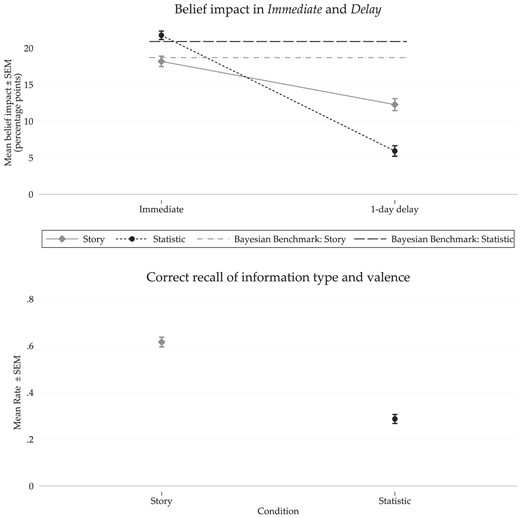
Abstract For many decisions, we encounter relevant information over the course of days, months, or years. We consume such information in various forms, including stories (qualitative content about individual instances) and statistics (quantitative data about collections of observations). This article proposes that information type—story versus statistic—shapes selective memory. In controlled experiments, we document a pronounced story-statistic gap in memory: the average impact of statistics on beliefs fades by 73% over the course of a day, but the impact of a story fades by only 32%. Guided by a model of selective memory, we disentangle different mechanisms and document that similarity relationships drive this gap. Recall of a story increases when its qualitative content is more similar to a memory prompt. Irrelevant information in memory that is similar to the prompt, on the other hand, competes for retrieval with relevant information, impeding successful recall.

The Wisdom of Individuals: Exploring People's Knowledge About Everyday Events Using Iterated Learning
Abstract Determining the knowledge that guides human judgments is fundamental to understanding how people reason, make decisions, and form predictions. We use an experimental procedure called ‘‘iterated learning,’’ in which the responses that people give on one trial are used to generate the data they see on the next, to pinpoint the knowledge that informs people's predictions about everyday events (e.g., predicting the total box office gross of a movie from its current take). In particular, we use this method to discriminate between two models of human judgments: a simple Bayesian model ( Griffiths & Tenenbaum, 2006 ) and a recently proposed alternative model that assumes people store only a few instances of each type of event in memory (Min K ; Mozer, Pashler, & Homaei, 2008 ). Although testing these models using standard experimental procedures is difficult due to differences in the number of free parameters and the need to make assumptions about the knowledge of individual learners, we show that the two models make very different predictions about the outcome of iterated learning. The results of an experiment using this methodology provide a rich picture of how much people know about the distributions of everyday quantities, and they are inconsistent with the predictions of the Min K model. The results suggest that accurate predictions about everyday events reflect relatively sophisticated knowledge on the part of individuals.

People are not friction
The Gell-Mann Amnesia Effect of AI is a pretty well documented phenomenon: The Gell-Mann amnesia effect is a cognitive bias describing the tendency of individuals to critically assess media reports in a domain they are knowledgeable about, yet continue to trust reporting in other areas despite recognizing similar potential inaccuracies.
ChatGPT acts as a "cognitive crutch" that weakens memory, new research suggests
A recent experiment provides evidence that relying on artificial intelligence to study tends to reduce how much information students remember weeks later.

Scrolling Past Public Health Campaigns: Information Context Collapse on Social Media and Its Effects on Tobacco Information Recall
Although traditional media usually present content separated by topic, social media feeds are usually unsorted, shifting topics from post to post, a feature called “information context collapse.” Public health groups have often failed to consider how the presentation context of their campaigns may influence message reception. This study uses a mock social media feed that presents content across six topics in a sorted or unsorted fashion to see how presentation order of content influences recall of information about a novel tobacco product. The moderating impact of topic relevance and source congruency are also tested. Results show that for some measures of recall unsorted presentation reduced recall. Impacts of source congruency and topic relevance are reduced when the content is unsorted. The application of these findings for both scholarship and digital health campaigns is discussed.
Guessing reveals internal models of perceptual precision
When observers lack sufficient information to support a confident response, they often guess. Guessing plays a pervasive role in visual cognition and working memory, yet the mechanisms that govern how observers generate guesses remain poorly understood. Standard models traditionally assume that responses produced in the absence of information are either uniformly distributed over feature space or are perhaps weighted towards prevailing environmental statistics. In contrast, here we consider an intriguing alternative: that guesses incorporate observers’ knowledge of their own perceptual capacities. We empirically measured guessing by eliciting responses under extreme target uncertainty (Experiment 1) as well as a novel “0ms presentation” approach in which no stimulus appeared but subjects believed one had (Experiment 2). We evaluated three accounts of guesses under these conditions: unsystematic (lapse) responding, biases toward environmental statistics, and a self-representational account in which guesses reflect observers’ knowledge of their own feature-dependent precision (e.g., preferring to guess feature values they believe they would be likely to miss). Guess responses were non-uniform and systematically biased toward feature values typically encoded with the least precision (e.g., oblique orientations) — a counterintuitive bias away from high-frequency, high-fidelity feature values (e.g., cardinal orientations). This complementary relationship between guessing and perceptual fidelity held within individuals and across paradigms, and was recoverable via an empirical-guess mixture model that replaced the standard uniform assumption with empirically measured guess distributions. Our findings challenge prevailing views that guesses reflect random noise, and suggest instead that guessing behavior reflects metacognitive knowledge of internal precision. Rather than defaulting to environmental priors, observers appear to model their own sensory limitations and leverage these representations to inform decisions in the absence of evidence. These results reframe guessing as a theoretically informative behavior that expresses observers’ own beliefs about their perceptual capacities. Significance Guessing is commonly treated as random noise in models of perception and memory, assumed to reflect lapses or uninformed responses. Instead, we show that human guesses are systematically structured across feature space: observers preferentially guess values they typically encode with the least precision, revealing a consistent, strategic bias away from high-fidelity representations. By directly measuring guess behavior on stimulus-absent trials and integrating these empirical distributions into a mixture model, we find that guesses on stimulus-present trials can be systematically recovered, and that they too form the complement of perceptual precision. These findings challenge foundational psychophysical modeling assumptions and position guessing as a strategic, informative behavior that engages self-representation.

False Memories Can Form Within Seconds, Study Finds - Slashdot
In a new study, scientists found that it's possible for people to form false memories of an event within seconds of it occurring. This almost-immediate misremembering seems to be shaped by our expectations of what should happen, the team says. Gizmodo reports: "This study is unique in two ways, in ...

The Dynamics of Distortion: How Successive Summarization Alters the Retelling of News
This work advances and tests a theory of how news information evolves as it is successively retold by consumers. Drawing on data from over 11,000 participants across ten experiments, the authors offer evidence that when news is repeatedly retold, it undergoes a stylistic transformation termed “disagreeable personalization,” wherein original facts are increasingly supplanted by opinions and interpretations with a slant toward negativity. The central thesis is that when retellers believe they are more (vs. less) knowledgeable than their recipient about the information they are relaying, they feel more compelled to provide guidance on its meaning and to do so in a persuasive manner. This enhanced motivation to guide persuasively, in turn, leads retellers to not only select the subset of facts they deem most essential but, critically, to provide their interpretations and opinions on those facts, with negativity being used as a means of grabbing their audience’s attention. Implications of this work for research on retelling and consumer information diffusion are explored.
Is the Memory Shortage Intentional? | Contrary Research
A deep dive from Contrary Research.

Resource-rational belief revision can mitigate as well as amplify polarization
People's beliefs sometimes diverge after observing the same information, which has been interpreted as evidence of irrationality. This behaviour has been proposed to result from people's limited cognitive resources and motivated reasoning, but how belief revision differs across these explanations has not been formalized or compared to a rational norm. Further, while people may be biased relative to a normative ideal, they may still make optimal choices given their limited cognitive resources, or rationally balance the utility of holding accurate beliefs with the belief's intrinsic utility. Across two studies, we develop and test a unified computational account of belief polarization under these proposed mechanisms, showing that people's performance on a belief updating task best fits a limited-resource Bayesian model; external motivations may contribute to divergence (or convergence) by determining what pre-existing information people consider relevant to a situation, rather than by changing how people evaluate new information in isolation.
Exploring Psychology in the Field: Steps and Examples From the Used‐Car Market
Abstract The growing availability of large datasets in a variety of domains presents an opportunity for researchers to use field data to better understand psychological concepts. I discuss, from an empirical economics point of view, steps for how to study cognition in large datasets. I use two recent papers that explore psychology in the used‐car market as motivating examples. These examples help illustrate the potential importance of big data as a way to explore human psychology and cognition. , The growing availability of large datasets in a variety of domains presents an opportunity for researchers to use field data to better understand psychological concepts. I discuss from an empirical economics point of view, steps for how to study cognition in large datasets and illustrate these steps with recent empirical papers.

Reality Monitoring in Large Language Models: Self-Knowledge That Transforms with Conversation Memory
A conversational AI that cannot tell its own output from what a user said will treat its own mistakes as user-provided facts. In humans, this capacity is called reality monitoring, and its failures are linked to hallucinations, delusions, and confabulation, yet whether LLMs possess it remains untested. Here we show, across two experiments and six LLMs, that source attribution depends on how conversational memory is structured: ceiling accuracy for self-generated content under minimal memory demands reverses to a fragile external-item advantage once episodic delay removes that shortcut. Feedback exposes two failures: in some models, internal and external judgments swap; in others, accuracy improves while confidence decouples from correctness, dissociations invisible to existing benchmarks. Across models, this pattern implicates active, not aggregate, parameter count. This suggests that as AI systems take on autonomous, multi-turn roles, evaluating what they know is not enough: tracking where that knowledge came from may matter equally.

False Memories Can Form Within Seconds, Study Finds
It's not just distant recollections that can fool you.

Food, foragers, and folklore: the role of narrative in human subsistence
Narrative is a species-typical, reliably developing, complex cognitive process whose design is unlikely to have emerged by chance. Moreover, the folklore record indicates that narrative content is consistent across widely divergent cultures. I have argued elsewhere that a storyteller may use narrative to manipulate an audience's representations of the social and/or physical environment to serve his or her own fitness ends. However, my subsequent research suggests that such manipulation results from a broader selection pressure which narrative effectively alleviates: information acquisition. By substituting verbal representations for potentially costly first-hand experience, narrative enables an individual to safely and efficiently acquire information pertinent to the pursuit of fitness in local habitats. If this hypothesis is true, narrative should be rich with information useful to the pursuit of fitness. One class of information integral to the accomplishment of this task is foraging knowledge. In this paper, then, I present evidence that foraging peoples use narrative to transmit subsistence information: specifically, I demonstrate how various narrative devices (e.g., setting, description, mimicry, anthropomorphism) are used to communicate foraging knowledge.
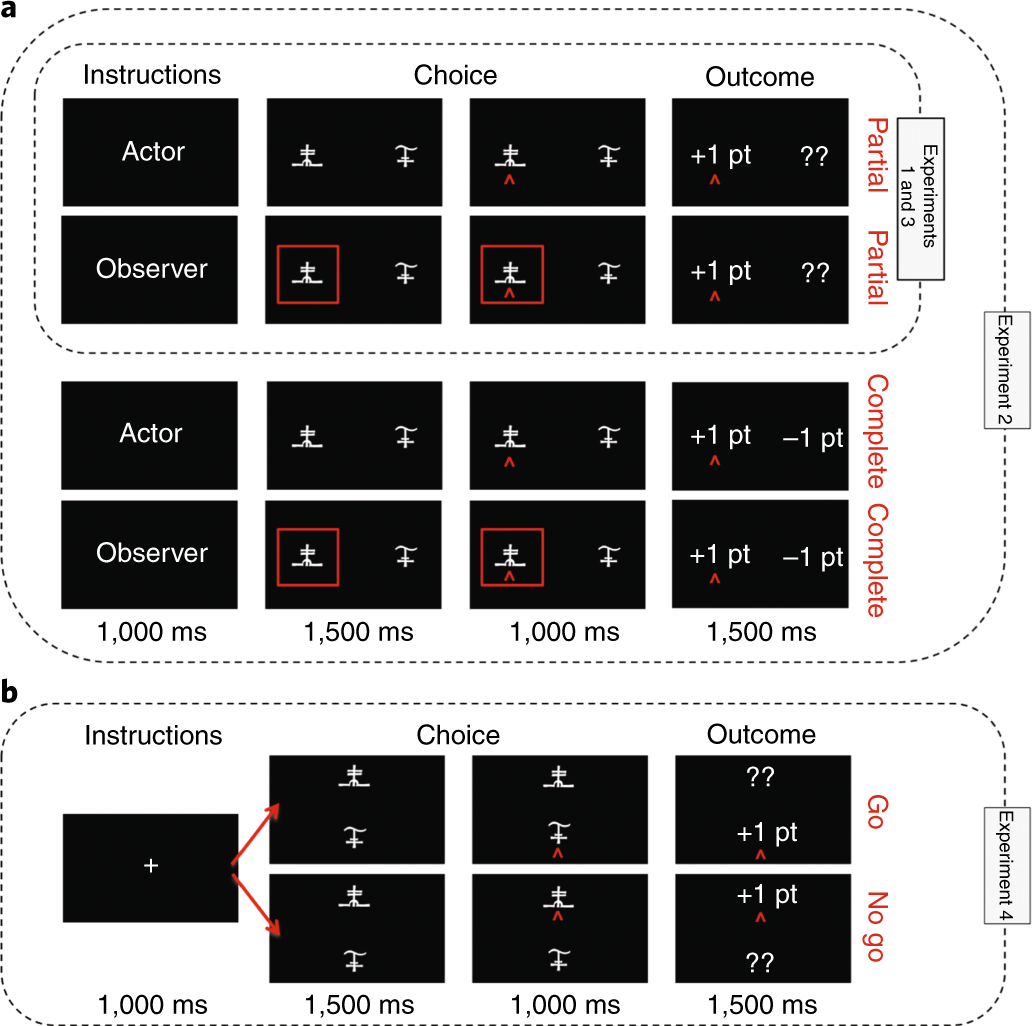
Information about action outcomes differentially affects learning from self-determined versus imposed choices
The valence of new information influences learning rates in humans: good news tends to receive more weight than bad news. We investigated this learning bias in four experiments, by systematically manipulating the source of required action (free versus forced choices), outcome contingencies (low versus high reward) and motor requirements (go versus no-go choices). Analysis of model-estimated learning rates showed that the confirmation bias in learning rates was specific to free choices, but was independent of outcome contingencies. The bias was also unaffected by the motor requirements, thus suggesting that it operates in the representational space of decisions, rather than motoric actions. Finally, model simulations revealed that learning rates estimated from the choice-confirmation model had the effect of maximizing performance across low- and high-reward environments. We therefore suggest that choice-confirmation bias may be adaptive for efficient learning of action–outcome contingencies, above and beyond fostering person-level dispositions such as self-esteem.