

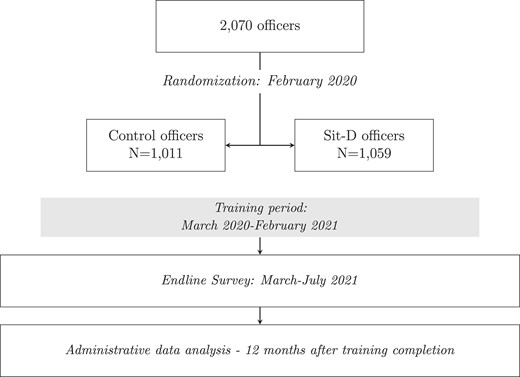
Abstract What causes adverse policing outcomes, such as excessive uses of force and unnecessary arrests? Prevailing explanations focus on problematic officers or deficient regulations and oversight. We introduce an overlooked perspective. We suggest that the cognitive demands inherent in policing can undermine officer decision making. Unless officers are prepared for these demands, they may jump to conclusions too quickly without fully considering alternative ways of seeing a situation. This can lead to adverse policing outcomes. To test this perspective, we created a new training that teaches officers to consider different ways of interpreting the situations they encounter. We evaluated this training using a randomized controlled trial with 2,070 officers from the Chicago Police Department. In a series of lab assessments, we find that treated officers were significantly more likely to consider a wider range of evidence and develop more explanations for subjects’ actions. Critically, we also find that training affected officer performance in the field, leading to reductions in uses of force, discretionary arrests, and arrests of Black civilians. Meanwhile, officer activity levels remained unchanged, and trained officers were less likely to be injured on duty. Our results highlight the value of considering the cognitive aspects of policing and demonstrate the power of using behaviorally informed approaches to improve officer decision making and policing outcomes.
[122] Arresting Flexibility: A QJE field experiment on police behavior with about 40 outcome variables
A forthcoming paper in the Quarterly Journal of Economics (QJE), “A Cognitive View of Policing” (htm), reports results from a field experiment showing that teaching police officers to &…

Does Predictive Policing Lead to Biased Arrests? Results From a Randomized Controlled Trial
Racial bias in predictive policing algorithms has been the focus of a number of recent news articles, statements of concern by several national organizations (e.g., the ACLU and NAACP), and simulat...
Does Predictive Policing Lead to Biased Arrests? Results From a Randomized Controlled Trial
Racial bias in predictive policing algorithms has been the focus of a number of recent news articles, statements of concern by several national organizations (e.g., the ACLU and NAACP), and simulat...
Artificial Intelligence, Predictive Policing, and Risk Assessment for Law Enforcement
There are widespread concerns about the use of artificial intelligence in law enforcement. Predictive policing and risk assessment are salient examples. Worries include the accuracy of forecasts that guide both activities, the prospect of bias, and an apparent lack of operational transparency. Nearly breathless media coverage of artificial intelligence helps shape the narrative. In this review, we address these issues by first unpacking depictions of artificial intelligence. Its use in predictive policing to forecast crimes in time and space is largely an exercise in spatial statistics that in principle can make policing more effective and more surgical. Its use in criminal justice risk assessment to forecast who will commit crimes is largely an exercise in adaptive, nonparametric regression. It can in principle allow law enforcement agencies to better provide for public safety with the least restrictive means necessary, which can mean far less use of incarceration. None of this is mysterious. Nevertheless, concerns about accuracy, fairness, and transparency are real, and there are tradeoffs between them for which there can be no technical fix. You can't have it all. Solutions will be found through political and legislative processes achieving an acceptable balance between competing priorities.

Artificial Intelligence, Predictive Policing, and Risk Assessment for Law Enforcement
There are widespread concerns about the use of artificial intelligence in law enforcement. Predictive policing and risk assessment are salient examples. Worries include the accuracy of forecasts that guide both activities, the prospect of bias, and an apparent lack of operational transparency. Nearly breathless media coverage of artificial intelligence helps shape the narrative. In this review, we address these issues by first unpacking depictions of artificial intelligence. Its use in predictive policing to forecast crimes in time and space is largely an exercise in spatial statistics that in principle can make policing more effective and more surgical. Its use in criminal justice risk assessment to forecast who will commit crimes is largely an exercise in adaptive, nonparametric regression. It can in principle allow law enforcement agencies to better provide for public safety with the least restrictive means necessary, which can mean far less use of incarceration. None of this is mysterious. Nevertheless, concerns about accuracy, fairness, and transparency are real, and there are tradeoffs between them for which there can be no technical fix. You can't have it all. Solutions will be found through political and legislative processes achieving an acceptable balance between competing priorities.
Predictive Policing Explained
Attempts to forecast crime with algorithmic techniques could reinforce existing racial biases in the criminal justice system.

A Digitized New Haven Police: Investigating Axon’s Draft One
Interviews have been lightly edited for clarity. The first image of a police officer that comes to mind is probably of one in action. Few imagine the cop spending hours behind their desk, writing r…

Social cognition and interpersonal violence
Why do some people resort to violence while others in similar circumstances do not? Drawing on 99 in-depth interviews with men from high-violence Chicago neighborhoods who participated in a community violence intervention, we examine how past exposure to violence shapes the social cognitions that influence future involvement in violence—through the schemas and scripts people use to interpret social situations and guide behavior. We identify three specific social cognitions that respondents associated with violence: misconstruing ambiguous cues as threats, defaulting to a narrow set of behavioral responses, and attributing violent behavior to fixed personal traits rather than situational factors. Respondents reported that participation in the program’s cognitive behavioral component shifted these social cognitions in ways they associated with reduced violence involvement. The consistency of these self-reports combined with the program’s experimental impacts suggest the hypothesis that these specific social cognitions could play an important role in violence and may be modifiable through intervention.

When police pull back: Neighborhood‐level effects of de‐policing on violent and property crime, a research note
Abstract Many U.S. cities witnessed both de‐policing and increased crime in 2020, yet whether the former contributed to the latter remains unclear. Indeed, much of what is known about the effects of proactive policing on crime comes from studies that evaluated highly focused interventions atypical of day‐to‐day policing, used cities as the unit of analysis, or could not rule out endogeneity. This study addresses each of these issues, thereby advancing the evidence base concerning the effects of policing on crime. Leveraging two exogenous shocks presented by the onset of the coronavirus 2019 (COVID‐19) pandemic and social unrest after the murder of George Floyd, we evaluated the effects of sudden and sustained reductions in high‐discretion policing on crime at the neighborhood level in Denver, Colorado. Multilevel models accounting for trends in prior police activity, neighborhood structure, seasonality, and population mobility revealed mixed results. On the one hand, large‐scale reductions in stops and drug‐related arrests were associated with significant increases in violent and property crimes, respectively. On the other hand, fewer disorder arrests did not affect crime. These results were not universal across neighborhoods. We discuss the implications of these findings in light of debates concerning the appropriate role of policing in the 21st century.

Predictive Policing and the Politics of Patterns
Abstract Patterns are the epistemological core of predictive policing. With the move towards digital prediction tools, the authority of the pattern is rearticulated and reinforced in police work. Based on empirical research about predictive policing software and practices, this article puts the authority of patterns into perspective. Introducing four ideal-typical styles of pattern identification, we illustrate that patterns are not based on a singular logic, but on varying rationalities that give form to and formalize different understandings about crime. Yet, patterns render such different modes of reasoning about crime, and the way in which they feed back into policing cultures, opaque. Ultimately, this invites a stronger reflection about the political nature of patterns.

How AI can lead to false arrests and wrongful convictions
Danger arises when law enforcement believes that AI models are retrieving certainties rather than generating likelihoods.
How AI can lead to false arrests and wrongful convictions
Danger arises when law enforcement believes that AI models are retrieving certainties rather than generating likelihoods.
How Much Do We Need The Police?
For many Americans, it goes without saying that the police help maintain public safety. But many others — especially black Americans — see the police as more of a threat than a protective force.
Predictive policing AI is on the rise − making it accountable to the public could curb its harmful effects
AI that anticipates where crimes are likely to occur and who might commit them has a troubling track record. Democratic accountability could shine a light on the technology and how it’s used.
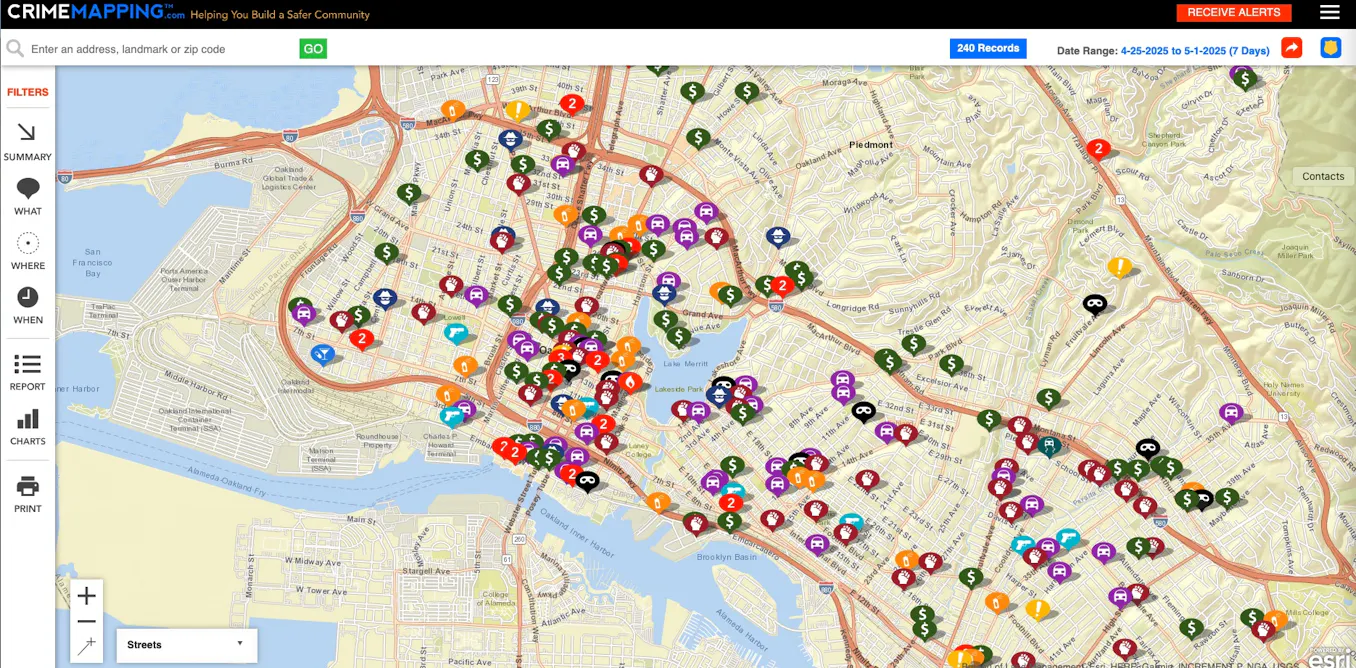
Predictive policing AI is on the rise − making it accountable to the public could curb its harmful effects
AI that anticipates where crimes are likely to occur and who might commit them has a troubling track record. Democratic accountability could shine a light on the technology and how it’s used.
Prediction as extraction of discretion
I argue that prediction is not primarily a technological means for knowing future outcomes, but a social model for extracting and concentrating discretionary power. Prediction is a ‘relational grammar’ that governs this allocation of discretion: the everyday ability to define one's situation. This extractive dynamic extends a long historical pattern, in which new methods for producing knowledge entail a redistribution of decision-making power. I focus on two contemporary domains: (1) crime and policing are emblematic of how predictive systems are extractive by design, with pre-existing interests governing what is measured and what persistently goes unmeasured. (2) The prediction of productivity demonstrates the long tradition of extracting discretion as a means to extract labour power. Time after time, making human behaviour more predictable for the client of prediction (the manager, the police officer) often means making life and work more unpredictable for the target of prediction (the employee, the urban citizen).
