Abstract. We show that the effects of taxes on labor supply are shaped by interactions between adjustment costs for workers and hours constraints set by fi
Wage Compression Drives Nordic Income Equality
Income inequality in the Nordic countries — Denmark, Finland, Norway, and Sweden — is substantially lower than in the United States or the United Kingdom despite similar levels of per capita income. The Gini coefficient for disposable income in Nordic countries averages 0.27, compared to 0.39 in the US and 0.36 in the UK. In Income Equality in the Nordic Countries: Myths, Facts, and Lessons (NBER Working Paper 33444), Magne Mogstad, Kjell G. Salvanes, and Gaute Torsvik analyze the underlying source of these disparities. They employ detailed microeconomic data and statistical decomposition techniques and consider distributional statistics on income, wages, working hours, education, and skills across these countries.

Do Employers Have More Monopsony Power in Slack Labor Markets?
This article confronts monopsony theory’s predictions regarding workers’ wages with observed wage patterns over the business cycle. Using German administrative data for the years 1985 to 2010 and an estimation framework based on duration models, the authors construct a time series of the labor supply elasticity to the firm and estimate its relationship to the unemployment rate. They find that firms possess more monopsony power during economic downturns. Half of this cyclicality stems from workers’ job separations being less wage driven when unemployment rises, and the other half mirrors that firms find it relatively easier to poach workers. Results show that the cyclicality is more pronounced in tight labor markets with low unemployment, and that the findings are robust to controlling for time-invariant unobserved worker or plant heterogeneity. The authors further document that cyclical changes in workers’ entry wages are of similar magnitude as those predicted under pure monopsonistic wage setting.

Handbook of Labor Economics
What new tools and models are enriching labor economics?Developments in Research Methods and their Application, Volume 4A summarizes recent advances in the ways economists study wages, employment, and labor markets. Mixing conceptual models and empirical work, contributors cover subjects as diverse as field and laboratory experiments, program evaluation, and behavioral models. The combinations of these improved empirical findings with new models reveal how labor economists are developing new and innovative ways to measure key parameters and test important hypotheses. - Investigates recent advances in methods and models used in labor economics - Demonstrates what these new tools and techniques can accomplish - Documents how conceptual models and empirical work explain important practical issues
Labor Market Adaptation | Windfall Policy Atlas
How can workers, firms, and education systems adapt to an AI-transformed economy?

Analytique des déficits commerciaux et de l'emploi manufacturier
traduction française du billet de blog "Analytics of trade deficits and manufacturing employment" de Paul Krugman

Une note sur les déficits commerciaux et l’industrie
Traduction française du billet de blog "A note on trade deficits and manufacturing. Some perspective on the eve of trade war" de Paul Krugman

Are new technologies fuelling wage inequality? Evidence from Spain
New research shows the net effect of technological change (incl. artificial intelligence) on wages in Spain has been to fuel rising wage inequalities

Household Debt: Facts, Puzzles, Theories, and Policies
Borrowing decisions affect most households, with large stakes and implications for research subfields as varied as macroeconomics and industrial organization. I review theoretical and empirical work on household debt: its prevalence, level, growth, and composition, as well as various measures of consumer choice and market (in)efficiency, elasticities, and prices, including new evidence on how borrowing heterogeneity affects the distribution of the opportunity cost of consumption. I also discuss opportunities and challenges in policy evaluation. A key takeaway is that puzzles abound, and I highlight numerous avenues for further research.

CMV: The labor theory of value is flawed
72 votes, 407 comments. This might be an obscure topic, however, in some—largely Marxist circles— the approach seems to motivate much of the dialogue…
Labor Market Adaptation to Rising Import Competition
In Places versus People: The Ins and Outs of Labor Market Adjustment to Globalization (NBER Working Paper 33424), David Autor, David Dorn, Gordon H. Hanson, Maggie R. Jones, and Bradley Setzler examine how local labor markets and the workers in these markets adjusted to increased Chinese import competition in the first two decades of this century. They analyze comprehensive employer-employee data from the Census Bureau’s Longitudinal Employer-Household Dynamics program over the 2000–19 period. Their analysis exploits location-specific variation in the impact of growing imports from China following China’s accession to the World Trade Organization (WTO) in 2001, which is due to the heterogeneity in industry composition across local labor markets.
Mind the Gap: AI Adoption in Europe and the U.S.
This paper combines international evidence from worker and firm surveys conducted in 2025 and 2026 to document large gaps in AI adoption, both between the US and Europe and across European countries. Cross-country differences in worker demographics and firm composition account for an important share of these gaps. AI adoption, within and across countries, is also closely linked to firm personnel management practices and whether firms actively encourage AI use by workers. Micro-level evidence suggests that AI generates meaningful time savings for many workers. At the macro level, in recent years industries with higher AI adoption rates have experienced faster productivity growth. While we do not establish causality, this relationship is statistically significant and similar in magnitude in Europe and the US. We do not find clear evidence that industry-level AI adoption is associated with employment changes. We discuss limitations of existing data and outline priorities for future data collection to better assess the productivity and labor market effects of AI.
Extractive taxation and the French Revolution
Extractive taxation is considered one of the main causes of the French Revolution. This column exploits regional variations in the French salt tax, which accounted for 22% of royal revenues in 1780, to document that areas of France burdened by a higher tax rate experienced more revolts in the years leading up to the Revolution. These effects were amplified by droughts that increased food prices and activated latent discontent. It suggests that when taxation is imposed without representation, it can become a catalyst for popular unrest, especially after negative economic shocks.

The Marginal Productivity Theory of Distribution : A Critical History
The Marginal Productivity Theory of Distribution (MPTD) claims that in a free-market economy the demand for a factor of production will depend upon its marginal product – where "marginal product" is defined as the change in total product that is caused by, or that follows, the addition or subtraction of the marginal unit of the factor used in the production process, with all other inputs held constant. From its inception in the early nineteenth century the MPTD has been claimed by some economists to be a solution to the ethical problem of distributive justice, i.e. to be a means of determining fairness in wages, profits, interest and rent. Other economists have rejected this ethical claim, but have seen the MPTD as a valid demand-side criterion in the determination of equilibrium and efficiency. This book argues that the MPTD is valid, neither as a normative theory of social justice, nor as a positive law of economics. It suggests that economics is yet to develop a satisfactory theory of distribution that is scientific in the quantitative or mathematical sense. Through a survey of the origin and subsequent evolution of the MPTD in the writings of over 50 contributors over 150 years, John Pullen presents a critical history of the concept. The book begins by examining the conceptual tools that have been deployed to facilitate this analysis of past contributions to the MPTD and then looks at various economists and their contribution to the debate including its supporters such as Wicksteed, Marshall, Wicksell and Stigler, and its critics such as Pareto, Hobson, Edgeworth, Adriance and Cassel.
Still Waters, Rapid Currents: Early Labor Market Transformation under Generative AI
We study the early labor market impacts of AI chatbots by linking large-scale adoption surveys to administrative labor market records in Denmark. We document rapid currents: most employers in exposed occupations have adopted chatbot initiatives, workers report productivity benefits, and new AI-related tasks are widespread. Yet these currents have not broken the surface: using difference-indifferences, we estimate precise null effects on earnings and recorded hours at both the worker and workplace levels, ruling out effects larger than 2% two years after the launch of ChatGPT. What moves is the structure of work: employers absorb AI through task reorganization—including new tasks in content generation, AI oversight, and AI integration—and adopters transition into higher-paying occupations where AI chatbots are more relevant, though still too few to move average earnings. Technological change reshapes work well before it surfaces in earnings or hours.
Fungibility and Consumer Choice: Evidence from Commodity Price Shocks*
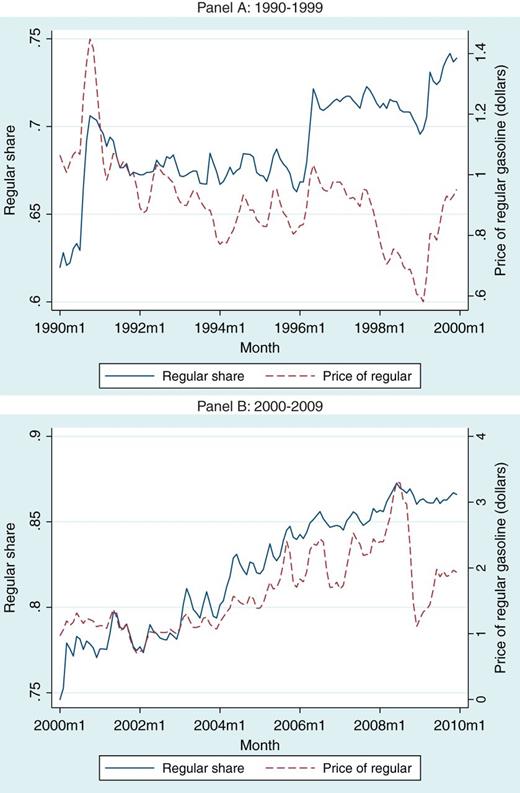
Abstract We formulate a test of the fungibility of money based on parallel shifts in the prices of different quality grades of a commodity. We embed the test in a discrete-choice model of product quality choice and estimate the model using panel microdata on gasoline purchases. We find that when gasoline prices rise, consumers substitute to lower octane gasoline, to an extent that cannot be explained by income effects. Across a wide range of specifications, we consistently reject the null hypothesis that households treat “gas money” as fungible with other income. We compare the empirical fit of three psychological models of decision making. A simple model of category budgeting fits the data well, with models of loss aversion and salience both capturing important features of the time series.
Sweden Wants To Fight Our Disposable Culture With Tax Breaks For Repairing Old Stuff - Fast Company
A proposed new law takes aim at wasteful consumerism.