

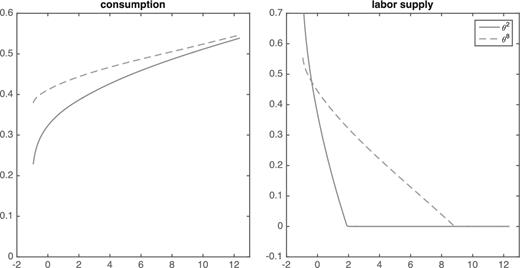
Abstract We study the effects of a credit crunch on consumer spending in a heterogeneous-agent incomplete-market model. After an unexpected permanent tightening in consumers’ borrowing capacity, constrained consumers are forced to repay their debt, and unconstrained consumers increase their precautionary savings. This depresses interest rates, especially in the short run, and generates an output drop, even with flexible prices. The output drop is larger with sticky prices, if the zero lower bound prevents the interest rate from adjusting downward. Adding durable goods to the model, households take larger debt positions and the output response can be larger.
Consumption Response to Credit Expansions: Evidence from Experimental Assignment of 45,307 Credit Lines
In a field experiment that constructs a randomized credit limit shock, participants borrow to spend 11 cents on the dollar in the first quarter and 28 cents by the third year. Effects extend to those far from the limit, those who had the new limits as available credit, and those with a liquid asset buffer. In the short-run, flexible and installment contracts are used in tandem, with unconstrained using installments more. Long-run borrowing is predominantly using installments. Near limits, participants borrow when credit expands but save out of constraints when limits are tight. Findings support a buffer-stock interpretation emphasizing precautionary saving.
Liquidity versus Wealth in Household Debt Obligations: Evidence from Housing Policy in the Great Recession
We exploit variation in mortgage modifications to disentangle the impact of reducing long-term obligations with no change in short-term payments ("wealth"), and reducing short-term payments with no change in long-term obligations ("liquidity"). Using regression discontinuity and difference-in-differences research designs with administrative data measuring default and consumption, we find that principal reductions that increase wealth without affecting liquidity have no effect, while maturity extensions that increase only liquidity have large effects. This suggests that liquidity drives default and consumption decisions for borrowers in our sample and that distressed debt restructurings can be redesigned with substantial gains to borrowers, lenders, and taxpayers.
Demand for emergency savings is higher for low-income households, but so is the cost of shocks
This paper examines how the precautionary motive varies with income. I first develop a theoretical benchmark of how we would expect precaution to vary with income starting from a basic version of the buffer-stock model. Emergency savings provide a way for households to smooth over shocks and so give insight into the precautionary motive. Using data from the Survey of Consumer Finances in the USA, I show that as income declines, the desired emergency savings relative to income increase, suggesting that low-income households are more precautionary. Observable differences, such as income uncertainty, do not explain the rise. Instead, I propose and estimate a model with a minimum subsistence level and unexpected expenses. The model implies that low-income households are increasingly exposed to shocks, explaining the increase in precaution. Supporting the approach, I show that expenses on repairs are a larger fraction of the spending of low-income households.
Consumption and Debt Response to Unanticipated Income Shocks: Evidence from a Natural Experiment in Singapore
This paper uses a unique panel dataset of consumer financial transactions to study how consumers respond to an exogenous unanticipated income shock. Consumption rose significantly after the fiscal policy announcement: during the ten subsequent months, for each $1 received, consumers on average spent $0.80. We find a strong announcement effect—19 percent of the response occurs during the first two-month announcement period via credit cards. Subsequently, consumers switched to debit cards after disbursement before finally increasing spending on credit cards in the later months. Consumers with low liquid assets or with low credit card limit experienced stronger consumption responses. (JEL D12, D14, E21)
Do Liquidity Constraints and Interest Rates Matter for Consumer Behavior? Evidence from Credit Card Data
Abstract. This paper utilizes a unique data set of credit card accounts to analyze how people respond to credit supply. Increases in credit limits generate
A Debt Puzzle
Over 60% of US households with credit cards are currently borrowing – i.e., paying interest – on those cards. We attempt to reconcile the high rate of credit card borrowing with observed levels of life cycle wealth accumulation. We simulate a lifecycle model with five properties that create demand for credit card borrowing. First, the calibrated labor income path slopes upward early in life. Second, income has transitory shocks. Third, consumers invest actively in an illiquid asset, which is sufficiently illiquid that it can not be used to smooth transitory income shocks. Fourth, consumers may declare bankruptcy, reducing the effective cost of credit card borrowing. Fifth, households have relatively more dependents early in the life-cycle. Our calibrated model predicts that 20% of the population will borrow on their credit card at any point in time, far less than the observed rate of over 60%. We identify a resolution to this puzzle: hyperbolic time preferences. Simulated hyperbolic consumers borrow actively in the revolving credit card market and accumulate relatively large stocks of illiquid wealth, matching observed data.

Does Saving Cause Borrowing? Implications for the Co-Holding Puzzle
Using an experiment in which 3.1 million bank customers were encouraged to save, we explore the mechanisms behind co-holding liquid savings and credit card debt. Theoretically, we first show that the joint responses of spending, saving, and borrowing to the nudge differ for different economic models of co-holding. Using machine learning techniques, we then find that the most responsive individuals reduce spending and increase their savings by 4.9% (206 USD PPP per month) while their credit card debt remains unchanged. For them, the marginal responses to the nudge are consistent with our model of co-holding for the purpose of self- or partner control.
Credit card debt puzzle: liquid assets to pay household bills
Using transaction data from a US consumer payments diary, we revisit the credit card debt puzzle—a scenario in which households revolve credit card debt while also keeping liquid assets as bank account deposits. This scenario is very common: 42 percent of consumers in our sample were borrower-savers in 2019. We explain the puzzle by showing that consumers need their liquid assets to pay household bills and other necessary expenses, including mortgage or rent. More than 80 percent of bills by value were paid out of bank accounts and could not be charged to credit cards, so bank account balances were needed to cover those basic expenses. On average, borrower-savers’ credit card debt exceeded their liquid assets. The average borrower-saver carried almost $6,400 in unpaid credit card debt and had $5,400 in liquid assets. On average, the value of their liquid assets could cover only about 60 percent of their unpaid debt plus monthly bills. In almost every category of assets or debts, borrower-savers were worse off financially than savers. Thus, the differences between borrower-savers and savers are much broader than just their credit card debt and bank account balances; they extend to mortgage debt and home equity. Carrying a mortgage or other debt (such as auto or educational loans) is associated with a higher probability of revolving on a credit card, suggesting that various types of household debt might be complements rather than substitutes. We do not find evidence that either financial literacy scores or the “Big 5” personality traits predict whether a consumer is a borrower-saver. During the COVID-19 pandemic in 2020, bor-savs’ behavior was consistent with what we would expect under our explanation for the credit card puzzle. However, consumers’ unpaid credit card debt decreased, and their liquid assets increased, so the fraction of borrower-savers dropped to 35 percent of the sample.

The Co-Holding Puzzle: New Evidence from Transaction-Level Data
The tendency of consumers to hold low-yield liquid savings while simultaneously holding high-cost unsecured credit on revolving credit lines is a long standing

A Theory of the Consumption Function, with and without Liquidity Constraints
This paper argues that the modern stochastic consumption model, in which impatient consumers face uninsurable labor income risk, matches Milton Friedman's (1957) original description of the Permanent Income Hypothesis much better than the perfect foresight or certainty equivalent models did. The model can explain the high marginal propensity to consume, the high discount rate on future income, and the important role for precautionary behavior that were all part of Friedman's original framework. The paper also explains the relationship of these questions to the Euler equation literature, and argues that the effects of precautionary saving and liquidity constraints are often virtually indistinguishable.
Household Debt: Facts, Puzzles, Theories, and Policies
Borrowing decisions affect most households, with large stakes and implications for research subfields as varied as macroeconomics and industrial organization. I review theoretical and empirical work on household debt: its prevalence, level, growth, and composition, as well as various measures of consumer choice and market (in)efficiency, elasticities, and prices, including new evidence on how borrowing heterogeneity affects the distribution of the opportunity cost of consumption. I also discuss opportunities and challenges in policy evaluation. A key takeaway is that puzzles abound, and I highlight numerous avenues for further research.

Borrowing on the Wrong Credit Card? Evidence from Mexico
We establish new facts about the way consumers allocate debt among their credit cards using data for a representative sample of cardholders in Mexico. We find that relative prices are weak predictors of the allocation of debt, purchases, and payments. Consumers allocate a large fraction of their debt to high-interest cards, incurring a cost of 31 percent above the minimum. Using an experiment, we find that consumers do not substitute in the price margin, although they respond to salient temporary low-interest offers. We conclude that limited attention and mental accounting best rationalize our results and discuss implications for the market.
Consumer Spending during Unemployment: Positive and Normative Implications
Using de-identified bank account data, we show that spending drops sharply at the large and predictable decrease in income arising from the exhaustion of unemployment insurance (UI) benefits. We use the high-frequency response to a predictable income decline as a new test to distinguish between alternative consumption models. The sensitivity of spending to income we document is inconsistent with rational models of liquidity-constrained households, but is consistent with behavioral models with present-biased or myopic households. Depressed spending after exhaustion also implies that the consumption-smoothing gains from extending UI benefits are four times larger than from raising UI benefit levels. (JEL D14, D91, E21, E24, E70, J65)
Household Need for Liquidity and the Credit Card Debt Puzzle
Abstract. In the 2001 U.S. Survey of Consumer Finances, 27% of households report simultaneously revolving significant credit card debt and holding sizeable
Asymmetric Consumption Smoothing
Analyzing account-level data from an account aggregator, we find that households increase consumption when they receive expected tax refunds, as if they face liquidity constraints. However, these same households smooth consumption when making payments in other years, primarily by transferring funds among liquid accounts. Even households carrying credit card debt smooth consumption when making payments, and even highly liquid households spend out of refunds. This behavior is inconsistent with pure liquidity constraints or hand-to-mouth behavior and is most consistent with a mental accounting life-cycle model.
Does Saving Cause Borrowing? Implications for the Coholding Puzzle
ABSTRACT Using an experiment in which 3.1 million bank customers were encouraged to save, we explore the mechanisms behind coholding liquid savings and credit card debt. Theoretically, we show that the joint responses of spending, saving, and borrowing to the nudge differ across economic models of coholding. Using machine learning techniques, we find that the most responsive individuals reduce spending and increase savings by 4.9% (206 USD PPP per month) while their credit card debt remains unchanged. These individuals' marginal responses to the nudge are consistent with our model of coholding for the purpose of self‐ or partner‐control.
