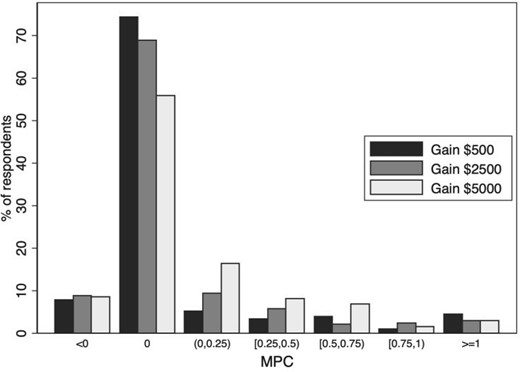
Abstract We use survey questions about spending in hypothetical scenarios to investigate features of propensities to consume that are useful for distinguishing between consumption theories. We find that (1) responses to unanticipated gains are vastly heterogeneous (either zero or substantially positive); (2) responses increase in the size of the gain, driven by the extensive margin of spending adjustments; (3) responses to losses are much larger and more widespread than responses to gains; and (4) even those with large responses to gains do not respond to news about future gains. These four findings suggest that limited access to disposable resources, and frictions in adjusting consumption, are important determinants of consumption behaviour. We also find that (5) households do not respond to the offer of a one-year interest-free loan, suggesting that this is not a consequence of short-term credit constraints; and (6) people do cut spending in response to news about future losses, suggesting that neither is this a consequence of myopia. A calibrated precautionary savings model with utility costs of changing consumption, and a sufficient fraction of low-wealth households, can account for these features of propensities to consume on both the extensive and intensive margins.
Knowing When to Spend: Unintended Financial Consequences of Earmarking to Encourage Savings
Maintaining savings is an important financial goal. Yet there are times when savings should be spent, such as when people face unavoidable costs, and spending their savings allows them to avoid high interest rate debt. Existing behavioral research has focused on consumer decisions between savings and discretionary spending and has proposed interventions to promote savings in these contexts. However, when spending is not discretionary, such interventions could risk exacerbating a pattern found in economic research in which people borrow high interest rate debt while maintaining savings that earn low levels of interest. To examine how mental accounting interacts with considerations of personal responsibility and guilt to contribute to this pattern, this article explores whether people spend their savings when they need money most: during emergencies. Six studies reveal that people's tendency to preserve savings by borrowing from a high interest rate credit option varies as a function of the savings’ intended use. Paradoxically, people are most likely to turn to high interest rate credit with the belief that doing so is the responsible option.

The Effect of Credit on Spending Decisions: The Role of the Credit Limit and Credibility
The objective of the present research is to study consumer decisions to utilize a line of credit. The life-cycle hypothesis from economics argues that consumers should intertemporally reallocate their incomes over their life stream to maximize lifetime utility. One form of intertemporal allocation is to use past income (in the form of savings) in the future. A second form is the use of future income in the present. This can only be done if consumers have access to a temporary pool of money that they can draw from and replenish in the future—a function performed by consumer credit. However, our research reinforces prior findings that consumers are unable to correctly value their future incomes, and that they lack the cognitive capability to solve the intertemporal optimization problem required by the life-cycle hypothesis. Instead, we argue that consumers use information such as the credit limit as a signal of their future earnings potential. Specifically, if consumers have access to large amounts of credit, they are likely to infer that their lifetime income will be high and hence their willingness to use credit (and their spending) will also be high. Conversely, consumers who are granted lower amounts of credit are likely to infer that their lifetime income will be low and hence their spending will be lower. However, based on research in the area of consumer skepticism and inference making, we also argue for a moderating role of the credibility associated with the credit limit. Specifically, we argue that the above effect of credit availability would be particularly strong for consumers who believe that the credit limit credibly signals their future earnings potential (i.e., a naïve consumer who has limited experience with consumer credit). However, as consumers gain experience with credit, they start discounting credit availability as a predictor of their future and start questioning the validity of the process used to set the credit limit. Hence, with experience the effect of credit limit on the willingness to use credit should be attenuated. We test these predictions in five separate studies. In the first experimental study, we manipulate credit limit and credibility and pose subjects with a hypothetical purchase opportunity. Consistent with our prediction, credit limit impacted the propensity to spend, but only when the credibility was high. In the second experimental study, we replicate these findings even when subjects were given information about their expected future salaries, and also show that the credit limit influences their expectation of future earnings potential. In the third study, we show that the mere availability (and increase) of current liquidity cannot explain our findings. In the fourth study, we conduct a survey of consumers in which we measure a number of demographic characteristics and also ask them for their propensity to spend in a given purchase situation. In the fifth study we use the Survey of Consumer Finances (SCF) dataset, a triennial survey of U.S. families that is designed to provide detailed information on the use of financial services, spending behaviors, and selected demographic characteristics. Results from both studies 4 and 5 provide further support for our proposed framework—credit limits influence spending to a greater extent for consumers with lower credibility: younger consumers and less-educated consumers. Across all studies we achieved triangulation by using a variety of approaches (surveys and experiments), subjects types (young students and older consumers), nature of predictor variables (manipulated and measured), dependent measures (purchase likelihood, credit card balance, new charges), and methods of analysis (ANOVA and regression), and consistently found that increasing credit limits on a credit card increases spending, especially when the credibility of the limit is high. This paper joins a growing body of literature in marketing and behavioral decision theory that goes beyond the traditional domains of inquiry (e.g., product choice, effects of marketing mix variables) and focuses on consumer decisions relating to the appropriate use of income to finance consumption. Our framework differs from prior research on the effect of payment mechanisms on spending in two significant ways. First, we are interested in the effects of the availability of credit on spending, and not necessarily in the effect of the transaction format that is associated with each payment mechanism. Second, while prior research has studied the point-of-purchase and historic (i.e., prepurchase) effects of credit, the present research is concerned with the availability of credit in the future. Specifically, our framework is invariant to the current and prior usage of credit by the consumer.

Context-Dependent Drivers of Discretionary Debt Decisions: Explaining Willingness to Borrow for Experiential Purchases
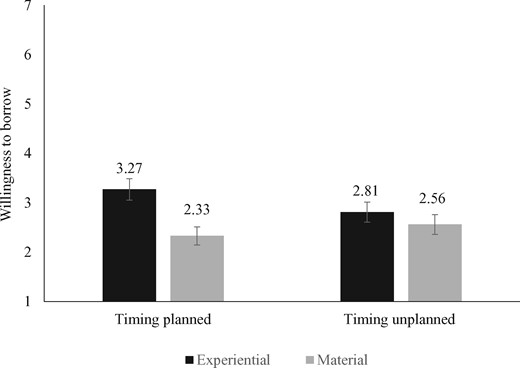
Abstract Mental accounting research suggests that consumers prefer borrowing for longer-lasting purchases in order to receive benefits from the purchases as they pay for them. In contrast, two sets of archival data and five lab studies show that consumers are more willing to borrow for experiential versus material purchases, even though experiential purchases tend to have a shorter physical duration. Further, framing the same purchase as more experiential than material increases willingness to borrow. This effect occurs because purchase timing is more important for experiential purchases—a function of consumers’ aversion to missing out on planned consumption. Thus, we moderate the proposed effect by varying whether the borrowing decision impacts planned consumption. Other differences between material and experiential purchases, such as scarcity or expected happiness, cannot similarly explain our results. Moreover, our conceptualization allows us to reconcile the apparent contradiction between the previous and current research by examining the relative impact of purchase-timing importance and payment-benefit duration matching in different contexts (i.e., “purchasing” and “source-of-funding” decisions).
The Impact of Payment Frequency on Consumer Spending and Subjective Wealth Perceptions
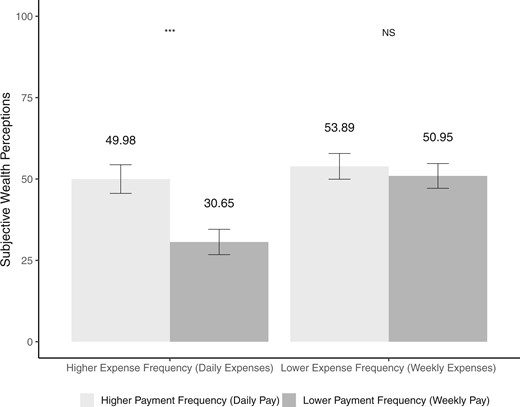
Abstract Payment frequency is a fundamental yet underexplored feature of consumers’ finances. As higher payment frequencies are becoming more prevalent, consumers are receiving more frequent yet smaller paychecks. An analysis of income and expenditure data of over 30,000 consumers from a financial services provider demonstrates a naturally occurring relationship between higher payment frequencies and increased spending. A series of lab studies support this finding, providing causal evidence that higher (vs. lower) payment frequencies increase spending. The effect of payment frequency on spending is driven by changes in consumers’ subjective wealth perceptions. Specifically, higher payment frequencies reduce consumers’ uncertainty in predicting whether they will have enough resources throughout a period, increasing their subjective wealth perceptions. As such, situational factors that reduce prediction uncertainty for those paid less frequently (e.g., the timing of consumers’ expenses, income levels) moderate the impact of payment frequency. The effects of payment frequency on subjective wealth and spending can occur even when objective wealth favors those with lower payment frequencies. More broadly, the current work underscores a need to understand how timing variations in consumers’ income impact their perceptions, behaviors, and general well-being.
Consumption Response to Credit Expansions: Evidence from Experimental Assignment of 45,307 Credit Lines
In a field experiment that constructs a randomized credit limit shock, participants borrow to spend 11 cents on the dollar in the first quarter and 28 cents by the third year. Effects extend to those far from the limit, those who had the new limits as available credit, and those with a liquid asset buffer. In the short-run, flexible and installment contracts are used in tandem, with unconstrained using installments more. Long-run borrowing is predominantly using installments. Near limits, participants borrow when credit expands but save out of constraints when limits are tight. Findings support a buffer-stock interpretation emphasizing precautionary saving.
Cash versus Debit Card: The Role of Budget Control
Due to the financial crisis, an increasing number of households face financial problems. This may lead to an increasing need for monitoring spending and budgets. We demonstrate that both cash and the debit card are perceived as helpful in this respect. We show that, on average, consumers responsible for financial decision making within a household find cash and the debit card equally helpful for monitoring their household finances. Individuals differ in major respects, however. In particular, low earners and the liquidity‐constrained prefer cash as a budgeting tool. Finally, we present evidence that at an aggregated level, such preferences strongly affect consumer payment behavior. These findings suggest that the substitution of cash by cards may slow down because of the financial crisis.

Consumer Financial Decision Making: Where We’ve Been and Where We’re Going
When making purchasing decisions, consumers consider their available budget and determine what payment method they will use as well as how they will finance the purchase. Consumers must also plan for long-term consumption by considering short- and long-term savings objectives, taking into account how they will invest money saved, as well as how they will borrow needed money and repay outstanding loans. This issue of the Journal of Association of Consumer Research explores financial decision making, which we define as the accumulation and use of resources across time, as reflected by consumers’ behavior and choices.

Demand for emergency savings is higher for low-income households, but so is the cost of shocks
This paper examines how the precautionary motive varies with income. I first develop a theoretical benchmark of how we would expect precaution to vary with income starting from a basic version of the buffer-stock model. Emergency savings provide a way for households to smooth over shocks and so give insight into the precautionary motive. Using data from the Survey of Consumer Finances in the USA, I show that as income declines, the desired emergency savings relative to income increase, suggesting that low-income households are more precautionary. Observable differences, such as income uncertainty, do not explain the rise. Instead, I propose and estimate a model with a minimum subsistence level and unexpected expenses. The model implies that low-income households are increasingly exposed to shocks, explaining the increase in precaution. Supporting the approach, I show that expenses on repairs are a larger fraction of the spending of low-income households.
When Motivation is against Debtors' Best Interest: The Illusion of Goal Progress in Credit Card Debt Repayment
The authors explore the illusion of goal progress by consumers who own multiple credit cards and pay off their debt balances to facilitate the achievement of their subgoal rather than the superordinate goal of being debt-free. The first experiment shows that debtors use their savings toward the credit card debt they can pay off entirely or substantially, even if it is associated with the smallest balance and the lowest annual percentage rate rather than toward the debt with the highest annual percentage rate. The second experiment reveals that when the income available to pay down the debt is in the form of effortless money (i.e., windfall or reward money) as opposed to hard-earned savings, the tendency to allocate money toward the smallest credit card debt is exacerbated. However, people tend to pay their debt more rationally when the number of debt accounts increases. Finally, the third experiment shows that credit card debt repayment decisions depend on the nature of the debt (hedonic vs. utilitarian) and the timing of consumption benefits (past vs. future). The article concludes with a discussion of managerial and public policy implications.
Temporal Reframing and Participation in a Savings Program: A Field Experiment
This study explores whether framing savings in more or less granular formats can increase sign-ups for a recurring deposit program in a FinTech environment. , A growing number of American workers are now freelancers and thus, responsible for their own retirement savings, yet they face psychological hurdles that hamper them from saving enough money for the long term. Although prior theory-derived interventions have been successful in addressing some of these obstacles, encouraging participation in saving programs is a challenging endeavor for policy makers and consumers alike. In a field setting, we test whether framing savings in more or less granular formats (for example, saving daily versus monthly) can encourage continued saving behavior through increasing the take up of a recurring deposit program. Among thousands of new users of a financial technology app, we find that framing deposits in daily amounts as opposed to monthly amounts quadruples the number of consumers who enroll. Furthermore, framing deposits in more granular terms reduced the participation gap between lower- and higher-income consumers: three times as many consumers in the highest rather than lowest income bracket participated in the program when it was framed as a $150 monthly deposit, but this difference in participation was eliminated when deposits were framed as $5 per day.
Earmarking and Partitioning: Increasing Saving by Low-Income Households
This research examines the effects of earmarking money on savings by low-income consumers. In particular, the authors test two interventions that are designed to enhance the effects of earmarking: (1) using a visual reminder of the savings goal and (2) dividing the earmarked money into two parts. Consistent with prior research suggesting that partitioning increases self-control, people save more when earmarked money is partitioned into two accounts than when it is pooled into one account. In addition, the presence of the visual reminder increases the savings rate. The authors conclude with implications for consumer welfare and directions for further research.
The Red and the Black: Mental Accounting of Savings and Debt
In the standard economic account of consumer behavior the cost of a purchase takes the form of a reduction in future utility when expenditures that otherwise could have been made are forgone. The reality of consumer hedonics is different. When people make purchases, they often experience an immediate pain of paying, which can undermine the pleasure derived from consumption. The ticking of the taxi meter, for example, reduces one's pleasure from the ride. We propose a “double-entry” mental accounting theory that describes the nature of these reciprocal interactions between the pleasure of consumption and the pain of paying and draws out their implications for consumer behavior and hedonics. A central assumption of the model, which we call prospective accounting, is that consumption that has already been paid for can be enjoyed as if it were free and that the pain associated with payments made prior to consumption (but not after) is buffered by thoughts of the benefits that the payments will finance. Another important concept is coupling, which refers to the degree to which consumption calls to mind thoughts of payment, and vice versa. Some financing methods, such as credit cards, tend to weaken coupling, whereas others, such as cash payment, produce tight coupling. Our model makes a variety of predictions that are at variance with economic formulations. Contrary to the standard prediction that people will finance purchases to minimize the present value of payments, our model predicts strong debt aversion—that they should prefer to prepay for consumption or to get paid for work after it is performed. Such pay-before sequences confer hedonic benefits because consumption can be enjoyed without thinking about the need to pay for it in the future. Likewise, when paying beforehand, the pain of paying is mitigated by thoughts of future consumption benefits. Contrary to the economic prediction that consumers should prefer to pay, at the margin, for what they consume, our model predicts that consumers will find it less painful to pay for, and hence will prefer, flat-rate pricing schemes such as unlimited Internet access at a fixed monthly price, even if it involves paying more for the same usage. Other predictions concern spending patterns with cash, charge, or credit cards, and preferences for the earmarking of purchases. We test these predictions in a series of surveys and in a conjoint-like analysis that pitted our double-entry mental accounting model against a standard discounting formulation and another benchmark that did not incorporate hedonic interactions between consumption and payments. Our model provides a better fit of the data for 60% of the subjects; the discounting formulation provides a better fit for only 29% of the subjects (even when allowing for positive and negative discount rates). The pain of paying, we argue, plays an important role in consumer self-regulation, but is hedonically costly. From a hedonic perspective the ideal situation is one in which payments are tightly coupled to consumption (so that paying evokes thoughts about the benefits being financed) but consumption is decoupled from payments (so that consumption does not evoke thoughts about payment). From an efficiency perspective, however, it is important for consumers to be aware of what they are paying for consumption. This creates a tension between hedonic efficiency and what we call decision efficiency. Various institutional arrangements, such as financing of public parks through taxes or usage fees, play into this tradeoff. A producer developing a pricing structure for their product or service should be aware of these two conflicting objectives, and should try to devise a structure that reconciles them.
Household Debt: Facts, Puzzles, Theories, and Policies
Borrowing decisions affect most households, with large stakes and implications for research subfields as varied as macroeconomics and industrial organization. I review theoretical and empirical work on household debt: its prevalence, level, growth, and composition, as well as various measures of consumer choice and market (in)efficiency, elasticities, and prices, including new evidence on how borrowing heterogeneity affects the distribution of the opportunity cost of consumption. I also discuss opportunities and challenges in policy evaluation. A key takeaway is that puzzles abound, and I highlight numerous avenues for further research.

Anomalies: Saving, Fungibility, and Mental Accounts
Last New Year's day, after a long evening of rooting the right team to victory in the Orange Bowl, I was lucky enough to win $300 in a college football betting pool. I then turned to the important matter of splurging the proceeds wisely. Would a case of champagne be better than dinner and a play in New York? At this point my son Greg came in and congratulated me. He said, "Gee Dad, you should be pretty happy. With that win you can increase your lifetime consumption by $20 a year!" Greg, it seems, had studied the life-cycle theory of savings. The theory is simple, elegant, and rational—qualities valued by economists. Unfortunately, as Courant, Gramlich, and Laitner observe "for all its elegance and rationality, the life-cycle model has not tested out very well." In this column, however, I focus on an assumption of the life-cycle model that has not received very much attention, but which, if modified, can allow the theory to explain many of the savings anomalies that have been observed. The key assumption is fungibility. This column will review a small portion of the empirical savings literature, with the objective of showing how violations of fungibility, and more generally the role of self-control, strongly influences saving behavior.
On shifting consumers from high‐interest to low‐interest debt
Abstract In the United States, many consumers are increasingly accumulating debt, much of which is harmful and expensive. Prior research has devoted a great deal of attention to understanding why consumers generally get into debt and the strategies they can use to repay existing debts. While this work has furthered the agenda of helping consumers reduce or eliminate their overall debt balances, it has failed to emphasize the fact that for many consumers, debt may be unavoidable. This article aims to promote research that addresses not only overall debt reduction but also the need for consumers to shift from more to less costly types of debt. By shedding light on the psychological reasons why consumers may naturally gravitate toward more costly forms of debt when less costly ones may be available, we offer a novel perspective on why consumers get into and stay in debt longer than they should. This new angle has the potential to spur on further research into the ways consumers can use debt more effectively and less expensively in service of the overarching goal of debt reduction.

Does Saving Cause Borrowing? Implications for the Co-Holding Puzzle
Using an experiment in which 3.1 million bank customers were encouraged to save, we explore the mechanisms behind co-holding liquid savings and credit card debt. Theoretically, we first show that the joint responses of spending, saving, and borrowing to the nudge differ for different economic models of co-holding. Using machine learning techniques, we then find that the most responsive individuals reduce spending and increase their savings by 4.9% (206 USD PPP per month) while their credit card debt remains unchanged. For them, the marginal responses to the nudge are consistent with our model of co-holding for the purpose of self- or partner control.