

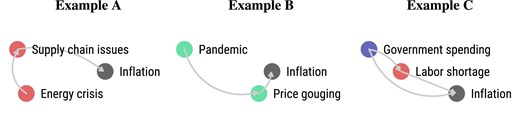
Abstract We study narratives about the macroeconomy—the stories people tell to explain macroeconomic phenomena—in the context of a historic surge in inflation. In our empirical analysis, we field surveys with more than 10,000 U.S. households and 100 academic experts, measure economic narratives in open-ended questions, and represent them as directed acyclic graphs. Households’ narratives are strongly heterogeneous, coarser than experts’ narratives, focus more on the supply than the demand side, and often feature politically charged explanations. Moreover, narratives shape how households form inflation expectations and interpret new information, which we demonstrate in a series of experiments. Informed by these findings, our theoretical analysis incorporates narratives into an otherwise conventional New Keynesian model and demonstrates their importance for aggregate outcomes through their effect on agents’ expectations.
Macroeconomics, money and post-Brexit recovery, all in one Twitter thread
This Twitter thread, published this morning, took about four hours and 40 years of thinking to write... I keep hearing people complain that the ‘mainstream media’ does not understand economics and that we’re talked down to as if everything must be explained as if the economy is a household. In this...

Thoughts on narratives and the role of AI and validators going forward
I wanted to quickly share some reflections and connect some dots around ongoing work with Prashant on causal claims and language in Economics. We have extended

Understanding Economic Behavior Using Open-Ended Survey Data
We survey the recent literature in economics using open-ended survey data to uncover mechanisms behind economic beliefs and behaviors. We first provide an overview of different applications, including the measurement of motives, mental models, narratives, attention, information transmission, and recall. We next describe different ways of eliciting open-ended responses, including single-item open-ended questions, speech recordings, and artificial intelligence–powered qualitative interviews. Subsequently, we discuss methods to annotate and analyze such data with a focus on recent advances in large language models. Our review concludes with a discussion of promising avenues for future research.
Nobody Really Knows How the Economy Works. A Fed Paper Is the Latest Sign.
Many experts are rethinking longstanding core ideas, including the importance of inflation expectations.

Understanding Economic Behavior Using Open-Ended Survey Data
We survey the recent literature in economics using open-ended survey data to uncover mechanisms behind economic beliefs and behaviors. We first provide an overview of different applications, including the measurement of motives, mental models, narratives, attention, information transmission, and recall. We next describe different ways of eliciting open-ended responses, including single-item open-ended questions, speech recordings, and artificial intelligence–powered qualitative interviews. Subsequently, we discuss methods to annotate and analyze such data with a focus on recent advances in large language models. Our review concludes with a discussion of promising avenues for future research. (JEL C83, C90, D83, D91)
annotations: Six croyances que j'ai à propos de l’inflation
Blog de sciences économiques et sociales de Martin Anota. Traductions, revues de presse.
annotations: L’inflation est un problème politique
Blog de sciences économiques et sociales de Martin Anota. Traductions, revues de presse.
annotations: Quelles leçons pouvons-nous tirer de la bulle inflationniste de 2021-2023 ?
Blog de sciences économiques et sociales de Martin Anota. Traductions, revues de presse.
What if We’re Thinking About Inflation All Wrong?
Isabella Weber’s heterodox ideas about government price controls are transforming policy in the United States and across Europe.

Le rôle des politiques non monétaires dans la lutte contre l’inflation
Blog de sciences économiques et sociales de Martin Anota. Traductions, revues de presse.

Comment expliquer l’énigme de l’inflation ?
Blog de sciences économiques et sociales de Martin Anota. Traductions, revues de presse.

AI and inflation: how worried should central bankers be?
Relative price shifts can affect the overall price level

AI agents are self-enacting storybooks of human culture
(republished from the Economist)

The Simple Macroeconomics of AI
This paper evaluates claims about large macroeconomic implications of new advances in AI. It starts from a task-based model of AI’s effects, working through aut

Fungibility and Consumer Choice: Evidence from Commodity Price Shocks*
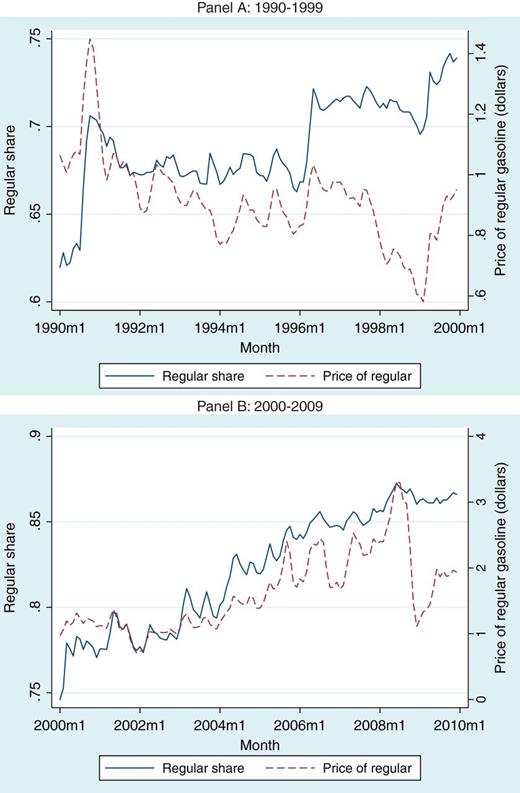
Abstract We formulate a test of the fungibility of money based on parallel shifts in the prices of different quality grades of a commodity. We embed the test in a discrete-choice model of product quality choice and estimate the model using panel microdata on gasoline purchases. We find that when gasoline prices rise, consumers substitute to lower octane gasoline, to an extent that cannot be explained by income effects. Across a wide range of specifications, we consistently reject the null hypothesis that households treat “gas money” as fungible with other income. We compare the empirical fit of three psychological models of decision making. A simple model of category budgeting fits the data well, with models of loss aversion and salience both capturing important features of the time series.
L’inflation, les anticipations d’inflation et la politique monétaire : qu’a-t-on appris depuis la pandémie ?
Les anticipations d’inflation tiennent une place de premier plan dans la macroéconomie moderne [Kose et alii, 2019]. Les modèles monétaristes, nouveaux classiques, puis nouveaux keynésiens, leur font jouer un rôle clé dans la mécanique de l’inflation....