Abstract. In the 2001 U.S. Survey of Consumer Finances, 27% of households report simultaneously revolving significant credit card debt and holding sizeable
Intra-Household Frictions, Anchoring, and the Credit Card Debt Puzzle
Abstract I study how intra-household frictions and anchoring contribute to the credit card debt puzzle, the co-holding of high-cost debt, and low-yield liquid assets. First, I find couples co-hold 42% more as units than as individuals relative to income. Moreover, in a natural experiment, couples do not cooperate to reduce high-cost debt, suggesting that intra-household frictions contribute to co-holding. Second, I find individuals who regularly make credit card debt payments equal to or near the minimum account for 59% of individual co-holding. The evidence suggests anchoring to the minimum payment contributes to co-holding via these low payments.
Credit card debt puzzle: liquid assets to pay household bills
Using transaction data from a US consumer payments diary, we revisit the credit card debt puzzle—a scenario in which households revolve credit card debt while also keeping liquid assets as bank account deposits. This scenario is very common: 42 percent of consumers in our sample were borrower-savers in 2019. We explain the puzzle by showing that consumers need their liquid assets to pay household bills and other necessary expenses, including mortgage or rent. More than 80 percent of bills by value were paid out of bank accounts and could not be charged to credit cards, so bank account balances were needed to cover those basic expenses. On average, borrower-savers’ credit card debt exceeded their liquid assets. The average borrower-saver carried almost $6,400 in unpaid credit card debt and had $5,400 in liquid assets. On average, the value of their liquid assets could cover only about 60 percent of their unpaid debt plus monthly bills. In almost every category of assets or debts, borrower-savers were worse off financially than savers. Thus, the differences between borrower-savers and savers are much broader than just their credit card debt and bank account balances; they extend to mortgage debt and home equity. Carrying a mortgage or other debt (such as auto or educational loans) is associated with a higher probability of revolving on a credit card, suggesting that various types of household debt might be complements rather than substitutes. We do not find evidence that either financial literacy scores or the “Big 5” personality traits predict whether a consumer is a borrower-saver. During the COVID-19 pandemic in 2020, bor-savs’ behavior was consistent with what we would expect under our explanation for the credit card puzzle. However, consumers’ unpaid credit card debt decreased, and their liquid assets increased, so the fraction of borrower-savers dropped to 35 percent of the sample.

Credit Card Debt Puzzle: Liquid Assets to Pay Bills
Using transaction data from a US consumer payments diary, we revisit the credit card debt puzzle—a scenario in which consumers revolve credit card debt while al

Do Liquidity Constraints and Interest Rates Matter for Consumer Behavior? Evidence from Credit Card Data
Abstract. This paper utilizes a unique data set of credit card accounts to analyze how people respond to credit supply. Increases in credit limits generate
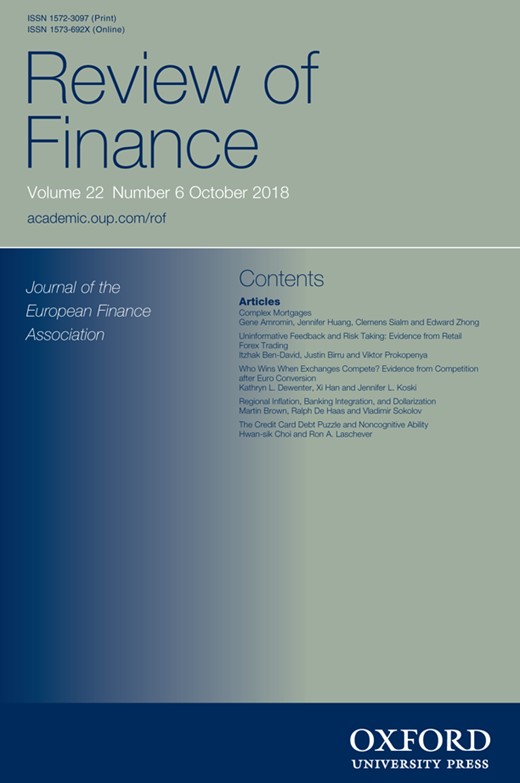
The Credit Card Debt Puzzle and Noncognitive Ability
Abstract Many households concurrently hold low-yield liquid assets while incurring costly credit card debt. In our sample, more than 80% of households with credit card debt also have low-yield liquid assets. Using data from the Health and Retirement Study (N = 30,517), we examine the role of noncognitive skills as well as the economic, financial, and demographic factors that affect the likelihood of co-holding. We find that the “Big Five” personality traits have a statistically significant and economically important effect: households with a more agreeable, introvert, and less conscientious head of household are more likely to co-hold. We also examine the role of intra-household dynamics.
Overconfidence and the Credit Card Debt Puzzle
This article investigates the credit card debt puzzle. Simultaneously holding credit card debt and liquid assets is puzzling given the sizeable difference between interest rates of debt and assets. However, this behavior is common—about 31% of households in the 2016 Survey of Consumer Finances. The cost of co-holding may be justified if consumers anticipate future restrictions in credit or if they need to maintain liquidity. Other existing explanations for co-holding include impulsive spending and low financial literacy. This research reveals a new explanation for the credit card debt puzzle: consumers’ overconfidence of their financial knowledge. Using a Coarsened Exact Matching method, we found that overconfident consumers were 20%–40% more likely to co-hold credit card debt and liquid assets.
The Co-Holding Puzzle: New Evidence from Transaction-Level Data
The tendency of consumers to hold low-yield liquid savings while simultaneously holding high-cost unsecured credit on revolving credit lines is a long standing
The Credit Card Debt Puzzle: The Role of Preferences, Credit Access Risk, and Financial Literacy
Abstract. We use the 1979 National Longitudinal Survey of Youth to revisit what is termed the credit card debt puzzle: why consumers simultaneously co-hold high-interest credit card debt and low-interest assets that could be used to pay down this debt. Relative to individuals with no credit card debt but positive liquid assets, borrower-savers have very different perceptions of future credit access risk and use credit cards for precautionary motives. Moreover, changing perceptions about credit access risk are essential for predicting transitions among the two groups. Preferences and the composition of financial portfolios also play a role in these transitions.
The Co-holding Puzzle: New Evidence from Transaction-Level Data
Using detailed and highly disaggregated data on household finances, we examine the<br>tendency of consumers to “co-hold” savings and debt simultaneously. The di
Debt and the Response to Household Income Shocks: Validation and Application of Linked Financial Account Data
The increasing availability of data derived from linked consumer financial accounts has the potential to dramatically expand the potential for research. Examining the most comprehensive existing set of linked-account data, consisting of transaction and balance sheet data for millions of Americans, I demonstrate the power and versatility of such sources. I discuss advantages and concerns arising from this type of data and match a range of distributional moments to external sources. As one application, I test consumption elasticities across households with varying levels, and types, of debt. I find that heterogeneity in consumption elasticity can be explained entirely by credit and liquidity.

Household Debt: Facts, Puzzles, Theories, and Policies
Borrowing decisions affect most households, with large stakes and implications for research subfields as varied as macroeconomics and industrial organization. I review theoretical and empirical work on household debt: its prevalence, level, growth, and composition, as well as various measures of consumer choice and market (in)efficiency, elasticities, and prices, including new evidence on how borrowing heterogeneity affects the distribution of the opportunity cost of consumption. I also discuss opportunities and challenges in policy evaluation. A key takeaway is that puzzles abound, and I highlight numerous avenues for further research.

Keeping Cash and Revolving Debt: How Consumers' Preference for Spending on Debit versus Credit Influences their Decision to Co-Hold
This paper investigates "co-holding'"–whereby consumers simultaneously maintain low-yield liquid assets and high-interest revolving debt–through the l
Cash versus Debit Card: The Role of Budget Control
Due to the financial crisis, an increasing number of households face financial problems. This may lead to an increasing need for monitoring spending and budgets. We demonstrate that both cash and the debit card are perceived as helpful in this respect. We show that, on average, consumers responsible for financial decision making within a household find cash and the debit card equally helpful for monitoring their household finances. Individuals differ in major respects, however. In particular, low earners and the liquidity‐constrained prefer cash as a budgeting tool. Finally, we present evidence that at an aggregated level, such preferences strongly affect consumer payment behavior. These findings suggest that the substitution of cash by cards may slow down because of the financial crisis.

Revolving versus Convenience Use of Credit Cards: Evidence from U.S. Credit Bureau Data
Credit card payments and revolving debt are important for consumer theory but a key data source — credit bureau records — does not distinguish between current charges and revolving debt from the previous month. We develop a theory-based econometric methodology informed by survey evidence to estimate the likelihood a consumer is revolving each quarter. We validate our approach using a new survey linked to credit bureau data. For likely revolvers: (1) 100 percent of an increase in credit becomes an increase in debt eventually; (2) credit limit changes are half as salient as debt changes; and (3) revolving status is extremely persistent.
Does Saving Cause Borrowing? Implications for the Co-Holding Puzzle
Using an experiment in which 3.1 million bank customers were encouraged to save, we explore the mechanisms behind co-holding liquid savings and credit card debt. Theoretically, we first show that the joint responses of spending, saving, and borrowing to the nudge differ for different economic models of co-holding. Using machine learning techniques, we then find that the most responsive individuals reduce spending and increase their savings by 4.9% (206 USD PPP per month) while their credit card debt remains unchanged. For them, the marginal responses to the nudge are consistent with our model of co-holding for the purpose of self- or partner control.

A Model of Money and Credit, with Application to the Credit Card Debt Puzzle
Abstract. Many individuals simultaneously have significant credit card debt and money in the bank. The credit card debt puzzle is as follows: given high in