

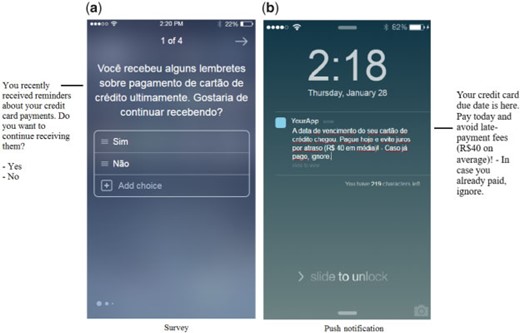
Abstract This paper studies the direct and indirect effects of nudging, by means of a field experiment with a financial management platform in Brazil. Reminders for upcoming credit card payments reduced credit card late-payment fees by 14%, but increased overdraft fees in checking accounts by 9%. The unintended effect is concentrated in users with a history of overdraft use. These users experienced a net increase of 5% in total fees, while the rest experienced savings of 15%. The results provide clear insights for nudge design: like any policy action, nudges can have side effects, and one size may not fit all.
Do Nudges Reduce Borrowing and Consumer Confusion in the Credit Card Market?
We study nudges that turn out to have precise null effects in reducing long‐run credit card debt. We test nudges across two field experiments covering 183,441 UK cardholders. Our first experiment studies nudges added to monthly credit card statements. Our second experiment studies letters and email nudges (separate from monthly statements) sent to cardholders who signed up to automatically pay the minimum required payment. In a follow‐up survey to our second experiment, we find that 96% of respondents underestimate the time it would take to fully repay a debt if the cardholder made only the minimum required payment. The nudges reduce this confusion, but underestimation remains overwhelmingly common.

How Do Consumers Avoid Penalty Fees? Evidence from Credit Cards
Using data from multiple card issuers, we show that the most common penalty fee type incurred by credit card holders, late payment fees, declines sharply over the first few months of card life. This phenomenon is wholly due to some consumers adopting automatic payments after a late payment event, thereby insuring themselves against future late payment fees. Nonadopters, who remain on manual-only payments, experience an unchanged high likelihood of future fees, despite exhibiting ample levels of available liquidity. Our results show that heterogeneity in adopting account management features of financial products, such as automatic payments, is important for understanding who avoids financial mistakes. This paper was accepted by Gustavo Manso, finance.

Using AI and Behavioral Finance to Cope with Limited Attention and Reduce Overdraft Fees
<p><span>We test how effective a human-algorithm interaction is at stopping users from overdrawing their bank accounts. We use a randomized field experiment and

Limited and Varying Consumer Attention: Evidence from Shocks to the Salience of Bank Overdraft Fees
Abstract. We explore dynamics of limited attention in the $35 billion market for checking overdrafts, using survey content as shocks to the salience of ove
Default Effects of Credit Card Minimum Payments
Credit card minimum payments are designed to ensure that individuals pay down their debt over time, and scheduling minimum automatic repayments helps people avoid forgetting to repay. Yet minimum payments have additional, unintended psychological default effects by drawing attention away from the card balance due. First, once individuals set the minimum automatic repayment as the default, they then neglect to make the occasional larger repayments they made previously. As a result, individuals incur considerably more credit card interest than late payment fees avoided. Using detailed transaction data, the authors show that approximately 8% of all of the interest ever paid is due to this effect. Second, manual credit card payments are lower when individuals are prompted with minimum payment information. In an experiment, the authors test two new interventions to mitigate this effect—a prompt for full repayment and a prompt asking those repaying little to pay more—yielding large counter effects. Thus, shrouding the minimum payment option for automatic and manual payments and directing attention to the full balance may remedy the unintended effects of default minimum payments.

Time to Act: A Field Experiment on Overdraft Alerts
Despite the growth of digital banking and the rapidly expanding offering of money management applications, a substantial proportion of banking customers still i
Purchase Justifiability Drives Payment Choice: Consumers Pay with Card to Remember and Cash to Forget
AbstractAlthough consumers often have multiple payment methods at their fingertips, such as cash and credit/debit cards, prior research is silent on how consumers choose between them. We home in on a key element of purchase—purchase justifiability—that affects how consumers choose to pay. Analysis of 118,042 real-world purchases and six experiments reveals that when consumers are motivated to forget (vs. remember) a purchase because they see it as difficult (vs. easy) to justify, they have an increased preference to pay with cash (vs. card) because cards create a “paper/electronic trail” that aids memory retrieval. These payment preferences are strongest among consumers most likely to recall/track their card spending, and manifest only when card expenses are trackable. We reconcile our results with the classic effect of payment method on pain of paying and discuss implications for merchants and for financial institutions designing payment methods of the future.

Sending Out an SMS: Automatic Enrollment Experiments for Overdraft Alerts
ABSTRACT At‐scale field experiments at major U.K. banks show that automatic enrollment into “just‐in‐time” text alerts reduces unarranged overdraft and unpaid item charges 17% to 19% and arranged overdraft charges 4% to 8%, implying annual market‐wide savings of £170 million to £240 million. Incremental benefits from “early‐warning” alerts are statistically insignificant, although economically significant effects are not ruled out. Prior to the experiments, over half of overdrafts could have been avoided by using lower‐cost liquidity available in savings and credit card accounts. Alerts help consumers achieve less than half of these potential savings.

Managing Mental Accounts: Payment Cards and Consumption Expenditures
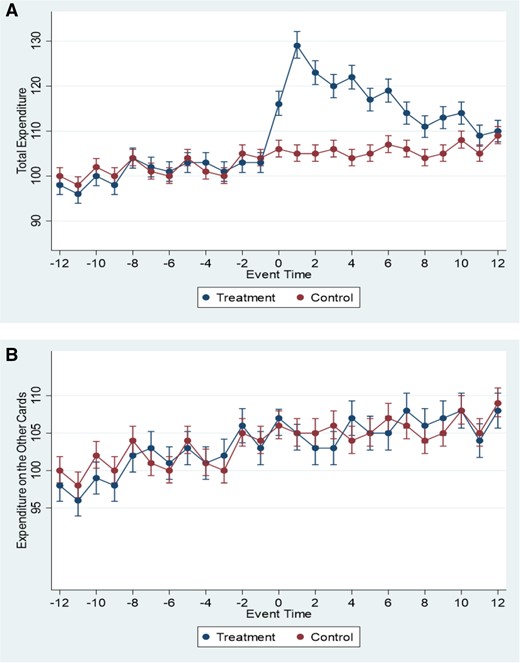
Does mental accounting matter for total consumption expenditures? We exploit a unique setting in which individuals exogenously received a new credit card, without requesting one. Using random variation in the time of receipt we show that individuals temporarily increase total consumption expenditure by making purchases with the new card without reducing spending on the others. We do not observe a corresponding increase in indebtedness. Total consumption expenditure rises even for the least liquidity-constrained individuals. The evidence is consistent with consumers treating methods of payment as nonfungible budget categories, as suggested by models of mental accounting and narrow bracketing.

Do Liquidity Constraints and Interest Rates Matter for Consumer Behavior? Evidence from Credit Card Data
Abstract. This paper utilizes a unique data set of credit card accounts to analyze how people respond to credit supply. Increases in credit limits generate
Timing to the Statement: Understanding Fluctuations in Consumer Credit Use
We show that consumers spend 15% more per day in the first week following the receipt of a credit card statement than in the days just prior to the statement. This increase in spending includes both an increase in the likelihood that they use the credit card in the first weeks following their statement and an increase in transaction amount on days they use the credit card. In contrast to the effect on credit card spending, debit card spending is unaffected by credit card statement issuance, suggesting that consumers are not simply switching among modes of payment. Our estimates are based on exogenous variation from bank-assigned statement dates. We propose and test several alternative explanations to this spending puzzle: optimization of the free float, salience effect of the credit card statement, mental accounting, liquidity constraints, and automatic payments. We find that the consumers most apt to spend early in the credit card cycle tend to be those who do not revolve balances and are not close to their credit limit. Thus, this paper documents a puzzle with mixed support for several alternative explanations. This paper was accepted by David Simchi-Levi, finance.
Time to Cut Up Those Debit Cards? Effect of Payment Mode on Willingness to Spend
Financial industry data indicate that consumers increasingly prefer debit cards over credit cards, especially as a means of enforcing financial self-discipline. Given prior research suggesting that credit cards act as spending facilitating stimuli, this move toward reduced credit card use would appear to be in the right direction. Ironically, however, the same logos that were implicated in facilitating spending with credit cards are the logos that appear on debit cards. In what should serve as an eye-opener to consumers, it is found that exposure to debit card logos does result in an increased willingness to spend, similar to credit cards.
Managing Mental Accounts: Payment Cards and Consumption Expenditures
Abstract Does mental accounting matter for total consumption expenditures? We exploit a unique setting in which individuals exogenously receive a new payment card, without requesting one. Using random variation in the time of receipt, we show that individuals temporarily increase total consumption expenditure by making purchases with the new card without reducing spending on the others. We do not observe a corresponding increase in indebtedness. Total consumption expenditure rises even for the least liquidity-constrained individuals. The evidence is consistent with consumers treating methods of payment as nonfungible budget categories, as suggested by models of mental accounting and narrow bracketing.
The Hidden Role of Contract Terms: The Case of Credit Card Minimum Payments in Mexico
This paper argues that thresholds in financial contracts act as implicit nudges in consumers’ decisions. Exploiting a regulatory change to credit card minimum payments in Mexico, we find that a 1-percentage point change in minimum payments leads to a 0.87-percentage point change in actual payments, both expressed as a percentage of total balances. We decompose the effect of minimum payments into a constraining effect and a reference effect. The former captures the effect of minimum payments as a binding constraint and accounts for 59% of its total effect. The latter captures any remaining impact of changes in minimum payments beyond their constraining effect and represents 41% of the total. In turn, 67% of the reference effect is explained by the multiple heuristic: the tendency of consumers to pay whole-number multiples of the minimum payment. This paper was accepted by Kay Giesecke, finance.
Reading the Fine Print: Information Disclosure in the Brazilian Credit Card Market
Consumer credit regulations usually require that lenders disclose interest rates. However, in the absence of specific prominence requirements, lenders can conceal the interest rate in the fine print while still complying with the law. I examine the effect of such a strategy using a field experiment in Brazil in which a credit card company offered their clients payment plans to pay off their balances. Using randomized contract interest rates and the degree of rate disclosure, I show that most clients are rate sensitive, whether or not rates are prominently disclosed. The elasticity of payment plan enrollment with respect to the interest rate ranges from −0.711 to −0.880. High-risk clients are an exception; these clients are rate sensitive only when disclosure is prominent. I also show that clients are influenced by nudges that favor longer-term contracts. Conditional on enrollment, the proportion of clients who choose a longer-term contract is 40 percentage points higher when a longer-term contract is featured in the advertisement layout. This effect, however, is weaker when stakes are higher. Data, as supplemental material, are available at http://dx.doi.org/10.1287/mnsc.2015.2281 . This paper was accepted by Wei Jiang, finance.
Analyzing Bank Overdraft Fees with Big Data
In 2012, consumers paid $32 billion in overdraft fees, representing the single largest source of revenue for banks from demand deposit accounts during this period. Owing to consumer attrition caused by overdraft fees and potential government regulations to reform these fees, financial institutions have become motivated to investigate their overdraft fee structures. Banks need to balance the revenue generated from overdraft fees with consumer dissatisfaction and potential churn caused by these fees. However, no empirical research has been conducted to explain consumer responses to overdraft fees or to evaluate alternative pricing strategies associated with these fees. In this research, we propose a dynamic structural model with consumer monitoring costs and dissatisfaction associated with overdraft fees. We apply the model to an enterprise-level data set of more than 500,000 accounts with a history of 450 days, providing a total of 200 million transactions. We find that consumers heavily discount the future and potentially overdraw because of impulsive spending. However, we also find that high monitoring costs hinder consumers’ effort to track their balance accurately; consequently, consumers may overdraw because of rational inattention. The large data set is necessary because of the infrequent nature of overdrafts; however, it also engenders computational challenges, which we address by using parallel computing techniques. Our policy simulations show that alternative pricing strategies may increase bank revenue and improve consumer welfare. Fixed bill schedules and overdraft waiver programs may also enhance social welfare. This paper explains consumer responses to overdraft fees and evaluates alternative pricing strategies associated with these fees. The online appendices are available at https://doi.org/10.1287/mksc.2018.1106 .
