

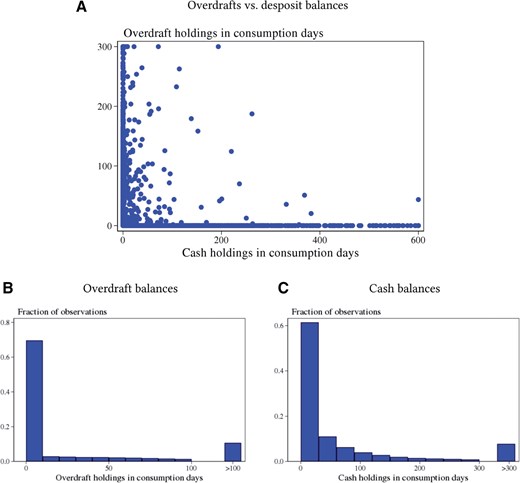
Abstract Why do individuals pay debt interest when they could use their savings to pay down the debt? We explore why individuals “cohold” debt and savings using detailed and highly disaggregated daily-level data on household finances. We find that coholding mostly occurs in short spells within the month and the level of coholding is typically modest. Periods of coholding are not associated with shocks at the individual level. We show that mental accounting has a role to play in explaining coholding, in particular how individuals allocate different categories of expenditure to accounts in credit and debit.
The Co-holding Puzzle: New Evidence from Transaction-Level Data
Using detailed and highly disaggregated data on household finances, we examine the<br>tendency of consumers to “co-hold” savings and debt simultaneously. The di

Does Saving Cause Borrowing? Implications for the Coholding Puzzle
ABSTRACT Using an experiment in which 3.1 million bank customers were encouraged to save, we explore the mechanisms behind coholding liquid savings and credit card debt. Theoretically, we show that the joint responses of spending, saving, and borrowing to the nudge differ across economic models of coholding. Using machine learning techniques, we find that the most responsive individuals reduce spending and increase savings by 4.9% (206 USD PPP per month) while their credit card debt remains unchanged. These individuals' marginal responses to the nudge are consistent with our model of coholding for the purpose of self‐ or partner‐control.

Does Saving Cause Borrowing? Implications for the Co-Holding Puzzle
Using an experiment in which 3.1 million bank customers were encouraged to save, we explore the mechanisms behind co-holding liquid savings and credit card debt. Theoretically, we first show that the joint responses of spending, saving, and borrowing to the nudge differ for different economic models of co-holding. Using machine learning techniques, we then find that the most responsive individuals reduce spending and increase their savings by 4.9% (206 USD PPP per month) while their credit card debt remains unchanged. For them, the marginal responses to the nudge are consistent with our model of co-holding for the purpose of self- or partner control.

Asymmetric Consumption Smoothing
Analyzing account-level data from an account aggregator, we find that households increase consumption when they receive expected tax refunds, as if they face liquidity constraints. However, these same households smooth consumption when making payments in other years, primarily by transferring funds among liquid accounts. Even households carrying credit card debt smooth consumption when making payments, and even highly liquid households spend out of refunds. This behavior is inconsistent with pure liquidity constraints or hand-to-mouth behavior and is most consistent with a mental accounting life-cycle model.
Timing to the Statement: Understanding Fluctuations in Consumer Credit Use
We show that consumers spend 15% more per day in the first week following the receipt of a credit card statement than in the days just prior to the statement. This increase in spending includes both an increase in the likelihood that they use the credit card in the first weeks following their statement and an increase in transaction amount on days they use the credit card. In contrast to the effect on credit card spending, debit card spending is unaffected by credit card statement issuance, suggesting that consumers are not simply switching among modes of payment. Our estimates are based on exogenous variation from bank-assigned statement dates. We propose and test several alternative explanations to this spending puzzle: optimization of the free float, salience effect of the credit card statement, mental accounting, liquidity constraints, and automatic payments. We find that the consumers most apt to spend early in the credit card cycle tend to be those who do not revolve balances and are not close to their credit limit. Thus, this paper documents a puzzle with mixed support for several alternative explanations. This paper was accepted by David Simchi-Levi, finance.

Knowing When to Spend: Unintended Financial Consequences of Earmarking to Encourage Savings
Maintaining savings is an important financial goal. Yet there are times when savings should be spent, such as when people face unavoidable costs, and spending their savings allows them to avoid high interest rate debt. Existing behavioral research has focused on consumer decisions between savings and discretionary spending and has proposed interventions to promote savings in these contexts. However, when spending is not discretionary, such interventions could risk exacerbating a pattern found in economic research in which people borrow high interest rate debt while maintaining savings that earn low levels of interest. To examine how mental accounting interacts with considerations of personal responsibility and guilt to contribute to this pattern, this article explores whether people spend their savings when they need money most: during emergencies. Six studies reveal that people's tendency to preserve savings by borrowing from a high interest rate credit option varies as a function of the savings’ intended use. Paradoxically, people are most likely to turn to high interest rate credit with the belief that doing so is the responsible option.

Disclosing the costs of co-holding liquid assets and high-interest debt has limited impact on behavior
Abstract Why do consumers simultaneously maintain low-yield liquid assets and high-interest revolving debt? This behavior, known as ``co-holding,'' affects 23\% of credit card users in our sample from a major international bank and costs the typical co-holder hundreds of dollars annually in unnecessary interest charges. Our analysis of 38 months of detailed banking records reveals that co-holding is remarkably persistent, with typical co-holders maintaining this behavior for most months observed. Our analysis also reveals that co-holding is not a static financial position: co-holders regularly deposit and withdraw from asset accounts while simultaneously making new credit card purchases. To test whether co-holding could be addressed through information disclosure, we conducted a large-scale field experiment (n = 125,328), providing clear information about co-holding behavior and its costs. Customers received targeted messages through their bank's mobile app, where they could easily transfer money from assets to pay down debt. Despite sufficient power to detect economically small effects, we found no meaningful changes in debt repayment amount, though customers did respond in other ways---making more frequent repayments and paying above required minimums. These results challenge explanations based on limited attention or information gaps and suggest that simple information disclosure, even when carefully designed and delivered through trusted channels, may not effectively address costly financial behaviors.

Managing Mental Accounts: Payment Cards and Consumption Expenditures
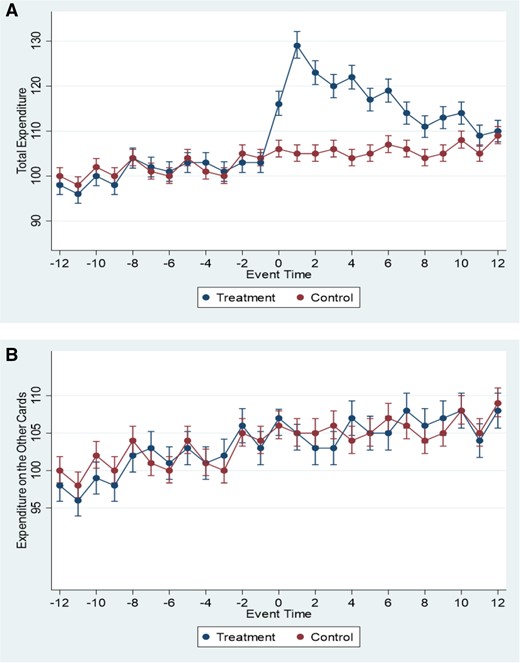
Abstract Does mental accounting matter for total consumption expenditures? We exploit a unique setting in which individuals exogenously receive a new payment card, without requesting one. Using random variation in the time of receipt, we show that individuals temporarily increase total consumption expenditure by making purchases with the new card without reducing spending on the others. We do not observe a corresponding increase in indebtedness. Total consumption expenditure rises even for the least liquidity-constrained individuals. The evidence is consistent with consumers treating methods of payment as nonfungible budget categories, as suggested by models of mental accounting and narrow bracketing.
The Co-Holding Puzzle: New Evidence from Transaction-Level Data
The tendency of consumers to hold low-yield liquid savings while simultaneously holding high-cost unsecured credit on revolving credit lines is a long standing
Cash versus Debit Card: The Role of Budget Control
Due to the financial crisis, an increasing number of households face financial problems. This may lead to an increasing need for monitoring spending and budgets. We demonstrate that both cash and the debit card are perceived as helpful in this respect. We show that, on average, consumers responsible for financial decision making within a household find cash and the debit card equally helpful for monitoring their household finances. Individuals differ in major respects, however. In particular, low earners and the liquidity‐constrained prefer cash as a budgeting tool. Finally, we present evidence that at an aggregated level, such preferences strongly affect consumer payment behavior. These findings suggest that the substitution of cash by cards may slow down because of the financial crisis.

Managing Mental Accounts: Payment Cards and Consumption Expenditures
Does mental accounting matter for total consumption expenditures? We exploit a unique setting in which individuals exogenously received a new credit card, without requesting one. Using random variation in the time of receipt we show that individuals temporarily increase total consumption expenditure by making purchases with the new card without reducing spending on the others. We do not observe a corresponding increase in indebtedness. Total consumption expenditure rises even for the least liquidity-constrained individuals. The evidence is consistent with consumers treating methods of payment as nonfungible budget categories, as suggested by models of mental accounting and narrow bracketing.
Consumption Response to Credit Expansions: Evidence from Experimental Assignment of 45,307 Credit Lines
In a field experiment that constructs a randomized credit limit shock, participants borrow to spend 11 cents on the dollar in the first quarter and 28 cents by the third year. Effects extend to those far from the limit, those who had the new limits as available credit, and those with a liquid asset buffer. In the short-run, flexible and installment contracts are used in tandem, with unconstrained using installments more. Long-run borrowing is predominantly using installments. Near limits, participants borrow when credit expands but save out of constraints when limits are tight. Findings support a buffer-stock interpretation emphasizing precautionary saving.
Intra-Household Frictions, Anchoring, and the Credit Card Debt Puzzle
Abstract I study how intra-household frictions and anchoring contribute to the credit card debt puzzle, the co-holding of high-cost debt, and low-yield liquid assets. First, I find couples co-hold 42% more as units than as individuals relative to income. Moreover, in a natural experiment, couples do not cooperate to reduce high-cost debt, suggesting that intra-household frictions contribute to co-holding. Second, I find individuals who regularly make credit card debt payments equal to or near the minimum account for 59% of individual co-holding. The evidence suggests anchoring to the minimum payment contributes to co-holding via these low payments.
Debt and the Response to Household Income Shocks: Validation and Application of Linked Financial Account Data
The increasing availability of data derived from linked consumer financial accounts has the potential to dramatically expand the potential for research. Examining the most comprehensive existing set of linked-account data, consisting of transaction and balance sheet data for millions of Americans, I demonstrate the power and versatility of such sources. I discuss advantages and concerns arising from this type of data and match a range of distributional moments to external sources. As one application, I test consumption elasticities across households with varying levels, and types, of debt. I find that heterogeneity in consumption elasticity can be explained entirely by credit and liquidity.

Co-holding behaviour: unlocking the puzzle
This article seeks to explain why households decide to simultaneously hold both credit and savings products. Beyond the arguments of ignorance or behavioural biases commonly used in the literature,...

Keeping Cash and Revolving Debt: How Consumers' Preference for Spending on Debit versus Credit Influences their Decision to Co-Hold
This paper investigates "co-holding'"–whereby consumers simultaneously maintain low-yield liquid assets and high-interest revolving debt–through the l