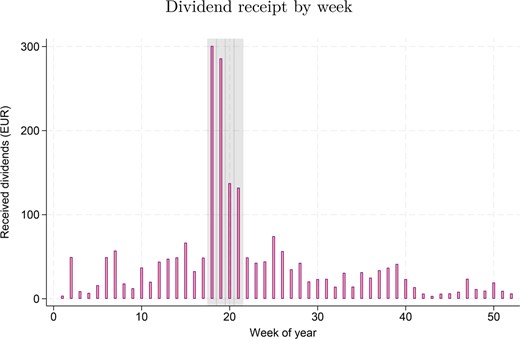
Abstract We educate investors about the benefits of dividend reinvestment and costs of misperceiving dividends as free income. The intervention increases planned dividend reinvestment in survey responses. Using trading records, we observe a causal increase in dividend reinvestment in the field of roughly 50 cents for every euro received. This holds relative to investors’ prior behavior and various control samples. Investors who learned the most from the intervention update their trading the most. The results suggest the free dividends fallacy is a significant source of dividend demand. Our study demonstrates that simple, targeted, and focused educational interventions can affect investment behavior.
The Dividend Disconnect
ABSTRACT Many individual investors, mutual funds, and institutions trade as if dividends and capital gains are disconnected attributes, not fully appreciating that dividends result in price decreases. Behavioral trading patterns (e.g., the disposition effect) are driven by price changes instead of total returns. Investors rarely reinvest dividends, and trade as if dividends are a separate, stable income stream. Analysts fail to account for the effect of dividends on price, leading to optimistic price forecasts for dividend‐paying stocks. Demand for dividends is systematically higher in periods of low interest rates and poor market performance, leading to lower returns for dividend‐paying stocks.

Mapping the Potential and Pitfalls of "Data Dividends" as a Means of Sharing the Profits of Artificial Intelligence
Identifying strategies to more broadly distribute the economic winnings of AI technologies is a growing priority in HCI and other fields. One idea gaining prominence centers on "data dividends", or sharing the profits of AI technologies with the people who generated the data on which these technologies rely. Despite the rapidly growing discussion around data dividends - including backing by prominent politicians - there exists little guidance about how data dividends might be designed and little information about if they will work. In this paper, we begin the process of developing a concrete design space for data dividends. We additionally simulate the effects of a variety of important design decisions using well-known datasets and algorithms. We find that seemingly innocuous decisions can create counterproductive effects, e.g. severely concentrated dividends and demographic disparities. Overall, the outcomes we observe -- both desirable and undesirable -- highlight the need for dividend implementers to make design decisions cautiously.

5: Behavioural biases in personal finance
Behavioural economics merges psychology and economics to explore systematic deviations in financial decision-making from traditional economic models. This chapter examines key biases such as mental accounting, present bias, planning fallacy, and misunderstanding of risk, which influence spending, saving, investing, and insuring decisions. Demonstrating the interplay of cognitive biases and heuristics highlights why individuals make suboptimal choices despite financial literacy and resource capacity. Strategies like goal-setting, commitment devices, and education interventions are evaluated, focusing on their limitations and potential for addressing these biases. The chapter concludes by emphasising the need for systemic changes, such as policy-level interventions and financial regulation, to complement behavioural interventions and address structural barriers to better financial decisions. Future research directions are suggested, including tailoring interventions, exploring technology's role, and integrating systemic solutions to support sustainable financial well-being.
Does Saving Cause Borrowing? Implications for the Coholding Puzzle
ABSTRACT Using an experiment in which 3.1 million bank customers were encouraged to save, we explore the mechanisms behind coholding liquid savings and credit card debt. Theoretically, we show that the joint responses of spending, saving, and borrowing to the nudge differ across economic models of coholding. Using machine learning techniques, we find that the most responsive individuals reduce spending and increase savings by 4.9% (206 USD PPP per month) while their credit card debt remains unchanged. These individuals' marginal responses to the nudge are consistent with our model of coholding for the purpose of self‐ or partner‐control.

Rational Inattention: A Review
We review the recent literature on rational inattention, identify the main theoretical mechanisms, and explain how it helps us understand a variety of phenomena across fields of economics. The theory of rational inattention assumes that agents cannot process all available information, but they can choose which exact pieces of information to attend to. Several important results in economics have been built around imperfect information. Nowadays, many more forms of information than ever before are available due to new technologies, and yet we are able to digest little of it. Which form of imperfect information we possess and act upon is thus largely determined by which information we choose to pay attention to. These choices are driven by current economic conditions and imply behavior that features numerous empirically supported departures from standard models. Combining these insights about human limitations with the optimizing approach of neoclassical economics yields a new, generally applicable model.
The ABCs of Financial Education: Experimental Evidence on Attitudes, Behavior, and Cognitive Biases
This paper uses a large-scale field experiment in India to study attitudinal, behavioral, and cognitive constraints that can stymie the link between financial education and financial outcomes. The study complements financial education with (i) financial incentives on a financial literacy test to affect participant motivation, (ii) financial goal setting to provide a psychological nudge, and (iii) personalized financial counseling to enhance the intensity of treatment. The analysis finds no impact of financial incentives on learning but significant effects of both goal setting and counseling on real financial outcomes. These results identify important complements to financial education that can bridge the gap between financial knowledge and behavior change. Data and the online appendix are available at https://doi.org/10.1287/mnsc.2017.2819 . This paper was accepted by Amit Seru, finance.

Getting to the Top of Mind: How Reminders Increase Saving
We provide evidence from field experiments with three different banks that reminder messages increase commitment attainment for clients who recently opened commitment savings accounts. Messages that mention both savings goals and financial incentives are particularly effective, whereas other content variations such as gain versus loss framing do not have significantly different effects. Nor do we find evidence that receiving additional late reminders has an additive effect. These empirical results do not map neatly into existing models, so we provide a simple model where limited attention to exceptional expenses can generate undersaving that is in turn mitigated by reminders. Data, as supplemental material, are available at http://dx.doi.org/10.1287/mnsc.2015.2296 . This paper was accepted by Teck-Hua Ho, behavioral economics.
Financial Literacy, Financial Education, and Downstream Financial Behaviors
Policy makers have embraced financial education as a necessary antidote to the increasing complexity of consumers' financial decisions over the last generation. We conduct a meta-analysis of the relationship of financial literacy and of financial education to financial behaviors in 168 papers covering 201 prior studies. We find that interventions to improve financial literacy explain only 0.1% of the variance in financial behaviors studied, with weaker effects in low-income samples. Like other education, financial education decays over time; even large interventions with many hours of instruction have negligible effects on behavior 20 months or more from the time of intervention. Correlational studies that measure financial literacy find stronger associations with financial behaviors. We conduct three empirical studies, and we find that the partial effects of financial literacy diminish dramatically when one controls for psychological traits that have been omitted in prior research or when one uses an instrument for financial literacy to control for omitted variables. Financial education as studied to date has serious limitations that have been masked by the apparently larger effects in correlational studies. We envisage a reduced role for financial education that is not elaborated or acted upon soon afterward. We suggest a real but narrower role for “just-in-time” financial education tied to specific behaviors it intends to help. We conclude with a discussion of the characteristics of behaviors that might affect the policy maker's mix of financial education, choice architecture, and regulation as tools to help consumer financial behavior. This paper was accepted by Uri Gneezy, behavioral economics.
Behaviorally Informed Policies for Household Financial Decisionmaking
Low incomes, limited financial literacy, fraud, and deception are just a few of the many intractable economic and social factors that contribute to the financial difficulties that households face today. Addressing these issues directly is difficult and costly. But poor financial outcomes also result from systematic psychological tendencies, including imperfect optimization, biased judgments and preferences, and susceptibility to influence by the actions and opinions of others. Some of these psychological tendencies and the problems they cause may be countered by policies and interventions that are both low cost and scalable. We detail the ways that these behavioral factors contribute to consumers’ fiancial mistakes and suggest a set of interventions that the federal government, in its dual roles as regulator and employer, could feasibly test or implement to improve household financial outcomes in a variety of domains: retirement, short-term savings, debt management, the take-up of government benefits, and tax optimization.

Persuasion: Empirical Evidence
We provide a selective survey of empirical evidence on the effects as well as the drivers of persuasive communication. We consider persuasion directed at consumers, voters, donors, and investors. We organize our review around four questions. First, to what extent does persuasion affect the behavior of each of these groups? Second, what models best capture the response to persuasive communication? Third, what are persuaders' incentives, and what limits their ability to distort communications? Finally, what evidence exists on the way persuasion affects equilibrium outcomes in economics and politics?

Knowing When to Spend: Unintended Financial Consequences of Earmarking to Encourage Savings
Maintaining savings is an important financial goal. Yet there are times when savings should be spent, such as when people face unavoidable costs, and spending their savings allows them to avoid high interest rate debt. Existing behavioral research has focused on consumer decisions between savings and discretionary spending and has proposed interventions to promote savings in these contexts. However, when spending is not discretionary, such interventions could risk exacerbating a pattern found in economic research in which people borrow high interest rate debt while maintaining savings that earn low levels of interest. To examine how mental accounting interacts with considerations of personal responsibility and guilt to contribute to this pattern, this article explores whether people spend their savings when they need money most: during emergencies. Six studies reveal that people's tendency to preserve savings by borrowing from a high interest rate credit option varies as a function of the savings’ intended use. Paradoxically, people are most likely to turn to high interest rate credit with the belief that doing so is the responsible option.
Information Disclosure, Cognitive Biases, and Payday Borrowing
ABSTRACT Can psychology‐guided information disclosure induce borrowers to lower their use of high‐cost debt? In a field experiment at payday stores, we find that information that makes people think less narrowly (over time) about finance costs results in less borrowing. In particular, reinforcing the adding‐up dollar fees incurred when rolling over loans reduces the take‐up of future payday loans by 11% in the subsequent 4 months. Although we remain agnostic as to the overall sufficiency of better disclosure policy to “remedy” payday borrowing, we cast the 11% reduction in borrowing in light of the relative low cost of this policy.

Can Self-Control Explain Avoiding Free Money? Evidence from Interest-Free Student Loans
Abstract This paper uses insights from behavioral economics to explain a particularly surprising borrowing phenomenon: one in six undergraduate students offered interest-free loans turns them down. Models of impulse control predict that students may optimally reject subsidized loans to avoid excessive consumption during school. Using the National Postsecondary Student Aid Study, we investigate students' take-up decisions and identify a group of students for whom the loans create an especially tempting liquidity increase. Students who would receive the loan in cash are significantly more likely to turn it down, suggesting that consumers choose to limit their liquidity in economically meaningful situations.
Payment Rewards and Credit Card Debt: Experimental Evidence
We report on a controlled laboratory experiment in which participants make consumption, saving, and credit card repayment decisions when credit card purchases e

Does Saving Cause Borrowing? Implications for the Co-Holding Puzzle
Using an experiment in which 3.1 million bank customers were encouraged to save, we explore the mechanisms behind co-holding liquid savings and credit card debt. Theoretically, we first show that the joint responses of spending, saving, and borrowing to the nudge differ for different economic models of co-holding. Using machine learning techniques, we then find that the most responsive individuals reduce spending and increase their savings by 4.9% (206 USD PPP per month) while their credit card debt remains unchanged. For them, the marginal responses to the nudge are consistent with our model of co-holding for the purpose of self- or partner control.

Behavioral Impediments to Valuing Annuities: Complexity and Choice Bracketing
Abstract This paper examines two behavioral factors that diminish people's ability to value a lifetime income stream or annuity, drawing on a randomized experiment with about 4,000 adults in a U.S. nationally representative sample. We find that increasing the complexity of the annuity choice reduces respondents' ability to value the annuity, measured by the difference between the sell and buy values they assign to the annuity. When we limit narrow choice bracketing by inducing people to think first about how quickly or slowly to spend down assets in retirement, their ability to value an annuity increases.