Human niche construction encompasses both purely biological phenomena, such as the evolution of lactose tolerance, and dual inheritance theory, which investigates the transmission of cultural information. But does niche construction help to explain phenomena in which conscious intention also plays a role? The creation of the engineered landscape of Balinese rice terraces offers a test case. Population genetic analysis and archaeological evidence are used to investigate whether this phenomenon emerged historically from trial and error by generations of farmers, or alternatively was designed by Bali's rulers. In light of strong support for the former hypothesis, two models are developed to explore the emergence of functional structure at both local and global scales. As time goes forward and selected patterns of irrigation schedules are implemented, local variation in rice harvests influences future decisions by the farmers, creating a coupled human–natural system governed by feedback from the environment. This mathematical analysis received a measure of empirical support when government agricultural policies severed the local feedback channels, resulting in the almost instantaneous collapse of rice harvests. The historical process of niche construction may also have included an evolution of religious consciousness, reflected in the beliefs and practices of the water temple cult.
Emergent Properties of Balinese Water Temple Networks: Coadaptation on a Rugged Fitness Landscape
For over a thousand years, generations of Balinese farmers have gradually transformed the landscape of their island, clearing forests, digging irrigation canals, and terracing hillsides to enable themselves and their descendants to grow irrigated rice. Paralleling the physical system of terraces and irrigation works, the Balinese have also constructed intricate networks of shrines and temples dedicated to agricultural deities. Ecological modeling shows that water temple networks can have macroscopic effects on the topography of the adaptive landscape, and may be representative of a class of complex adaptive systems that have evolved to manage agroecosystems.

Balinese “Water Temples” and the Management of Irrigation
Bali has figured prominently in debates on the question of whether irrigation centralizes state power. New evidence shows that irrigation is actually organized by networks of “water temples” that constitute an institutional system separate from the state. Earlier attempts to identify a discrete system of irrigation management misconceived the problem. For most crops, irrigation simply provides water for the plant's roots. But in a Balinese rice terrace, water is used to construct a complex, pulsed artificial ecosystem. Water temples manipulate the states of the system, at ascending levels in regional hierarchies. The permanence of water temple networks contrasts sharply with the instability of the traditional Balinese states. Since the water temples are real, perhaps it is the Balinese “state” that is chimerical.

A social-ecological framework for analyzing and designing integrated crop–livestock systems from farm to territory levels
Integrated crop–livestock systems are often considered a promising way to address agricultural sustainability issues. Many authors claim that complementarities and synergies between crops and livestock can improve nutrient cycling and delivery of ecosystem services (ES) in agricultural systems. They have analyzed effects of interactions at the farm level and affirmed the potential advantage of developing crop–livestock interactions at the territory level. However, potential benefits of developing synergies beyond the farm level have not been clearly identified. Thus, we developed a conceptual framework that can be used to analyze, design and perform integrated assessment of crop–livestock systems at the territory level. To address crop–livestock interaction issues, we define it as a social-ecological system called the territorial crop–livestock system (TCLS). The ecological system is represented as three interacting components, crops, grasslands and animals, allowing description of various land uses and their potential effects on nutrient cycling and ES. The social system, represented as farmers interacting with natural-resource managers and agro-food chain actors, determines land use and the nature and intensity of ES delivered. We highlight the importance of coordination and learning among actors to support implementation of complex adaptive systems such as TCLSs. We illustrate the expressive power of our conceptual framework through development of a generic typology of crop–livestock systems. Then we show how our conceptual framework can be used as an intermediary object with stakeholders in participatory design approaches. We illustrate this process by representing four archetypal TCLSs. We provide an example of the design approach implemented in Southwestern France to address severe recurrent water shortages, which includes analysis of land use in the current crop–livestock system and the associated key metabolic and ES issues, identification of options for change and multi-criteria analysis of these options. We conclude that this framework shows great potential to support development of sustainable farming systems at the territory level.
The evolution of cultural adaptations: Fijian food taboos protect against dangerous marine toxins
The application of evolutionary theory to understanding the origins of our species' capacities for social learning has generated key insights into cultural evolution. By focusing on how our psychology has evolved to adaptively extract beliefs and practices by observing others, theorists have hypothesized how social learning can, over generations, give rise to culturally evolved adaptations. While much field research documents the subtle ways in which culturally transmitted beliefs and practices adapt people to their local environments, and much experimental work reveals the predicted patterns of social learning, little research connects real-world adaptive cultural traits to the patterns of transmission predicted by these theories. Addressing this gap, we show how food taboos for pregnant and lactating women in Fiji selectively target the most toxic marine species, effectively reducing a woman's chances of fish poisoning by 30 per cent during pregnancy and 60 per cent during breastfeeding. We further analyse how these taboos are transmitted, showing support for cultural evolutionary models that combine familial transmission with selective learning from locally prestigious individuals. In addition, we explore how particular aspects of human cognitive processes increase the frequency of some non-adaptive taboos. This case demonstrates how evolutionary theory can be deployed to explain both adaptive and non-adaptive behavioural patterns.

The ultrasocial origin of the Anthropocene
The current geological epoch has been dubbed the Anthropocene—the age of humans. We argue that the roots of the Anthropocene lie in the agricultural revolution that began some 8000years ago. Unique human psychological and cultural characteristics were present in our distant hunter–gatherer past, but in terms of the biophysical impact of our species, agricultural represented an unequivocal and decisive evolutionary break. With the transition to agriculture human society began to function as a superorganism functioning as a single unit designed by social natural selection to produce economic surplus. Where environmental conditions were permitted, early human agricultural societies followed the same pattern as a few social insects and exhibited explosive population growth, complex and detailed division of labor, intensive resource exploitation, territorial expansion, and a social organization favoring the survival and growth of the supergroup over the well-being of individuals within the group. Similar economic forces lie behind ultrasociality in social insects and humans—increased productivity from the division of labor, increasing returns to scale, and the exploitation of stocks of productive resources. Exploring the evolutionary mechanisms behind ultrasociality offers insights into the growth imperative that threatens the stability of the earth's life support systems.

Systems of Global Governance in the Era of Human-Machine Convergence
Technology is increasingly shaping our social structures and is becoming a driving force in altering human biology. Besides, human activities already proved to have a significant impact on the Earth system which in turn generates complex feedback loops between social and ecological systems. Furthermore, since our species evolved relatively fast from small groups of hunter-gatherers to large and technology-intensive urban agglomerations, it is not a surprise that the major institutions of human society are no longer fit to cope with the present complexity. In this note we draw foundational parallelisms between neurophysiological systems and ICT-enabled social systems, discussing how frameworks rooted in biology and physics could provide heuristic value in the design of evolutionary systems relevant to politics and economics. In this regard we highlight how the governance of emerging technology (i.e. nanotechnology, biotechnology, information technology, and cognitive science), and the one of climate change both presently confront us with a number of connected challenges. In particular: historically high level of inequality; the co-existence of growing multipolar cultural systems in an unprecedentedly connected world; the unlikely reaching of the institutional agreements required to deviate abnormal trajectories of development. We argue that wise general solutions to such interrelated issues should embed the deep understanding of how to elicit mutual incentives in the socio-economic subsystems of Earth system in order to jointly concur to a global utility function (e.g. avoiding the reach of planetary boundaries and widespread social unrest). We leave some open questions on how techno-social systems can effectively learn and adapt with respect to our understanding of geopolitical complexity.

Farming is Why Humanity is Fucked
A mind-shattering concept from a first-year university class that upended how I think about humanity. Daniel Quinn's Ishmael trilogy argues that totalitari…
The Matrix of Convivial Technology – Assessing technologies for degrowth
This article introduces the notion of convivial technology as a conceptual framework for technologies suitable for degrowth societies. This paper is i…
Can Religions Be Reborn? | Over The Mountains to Civilizational Renewal #9
Differences Between Tight and Loose Cultures: A 33-Nation Study
The differences across cultures in the enforcement of conformity may reflect their specific histories. , With data from 33 nations, we illustrate the differences between cultures that are tight (have many strong norms and a low tolerance of deviant behavior) versus loose (have weak social norms and a high tolerance of deviant behavior). Tightness-looseness is part of a complex, loosely integrated multilevel system that comprises distal ecological and historical threats (e.g., high population density, resource scarcity, a history of territorial conflict, and disease and environmental threats), broad versus narrow socialization in societal institutions (e.g., autocracy, media regulations), the strength of everyday recurring situations, and micro-level psychological affordances (e.g., prevention self-guides, high regulatory strength, need for structure). This research advances knowledge that can foster cross-cultural understanding in a world of increasing global interdependence and has implications for modeling cultural change.
mata.garden
The garden is where we grow seeds of ideas. Either coming through a creative thought or a technological development we consider these live, multi-dimensional, interactive sketches or maquettes. It's important to have ideas that have no specific functional end but are there only to evolve and mutate into others. This is our place to do that.
A varied ecosystem and terminology. - Nel Ramblings
Richard McElreath 🐈⬛ (@rmcelreath.bsky.social)
Anthropologist - Bayesian modeling - science reform - cat and cooking content too - Director @ MPI for evolutionary anthropology https://www.eva.mpg.de/ecology/staff/richard-mcelreath/

Sapiens [Tenth Anniversary Edition]: A Brief History of Humankind
New York Times Readers’ Pick: Top 100 Books of the 21st CenturyThe tenth anniversary edition of the internationally bestselling phenomenon that cemented Yuval Noah Harari as one of the most prominent historians of our time—featuring a new afterword from the author.One hundred thousand years ago, at least six human species inhabited the earth. Today there is just one. Us. Homo sapiens. How did our species succeed in the battle for dominance? Why did our foraging ancestors come together to create cities and kingdoms? How did we come to believe in gods, nations, and human rights; to trust money, books, and laws; and to be enslaved by bureaucracy, timetables, and consumerism? And what will our world be like in the millennia to come?In Sapiens, Professor Yuval Noah Harari spans the whole of human history, from the very first humans to walk the earth to the radical—and sometimes devastating—breakthroughs of the Cognitive, Agricultural, and Scientific Revolutions. Drawing on insights from biology, anthropology, paleontology, and economics, and incorporating full-color illustrations throughout the text, he explores how the currents of history have shaped our human societies, the animals and plants around us, and even our personalities. Can we ever free our behavior from the legacy of our ancestors? And what, if anything, can we do to influence the course of the centuries to come?Bold, wide-ranging, and provocative, Sapiens integrates history and science to challenge everything we thought we knew about being human: our thoughts, our actions, our heritage...and our future.
Supernatural explanations across 114 societies are more common for natural than social phenomena
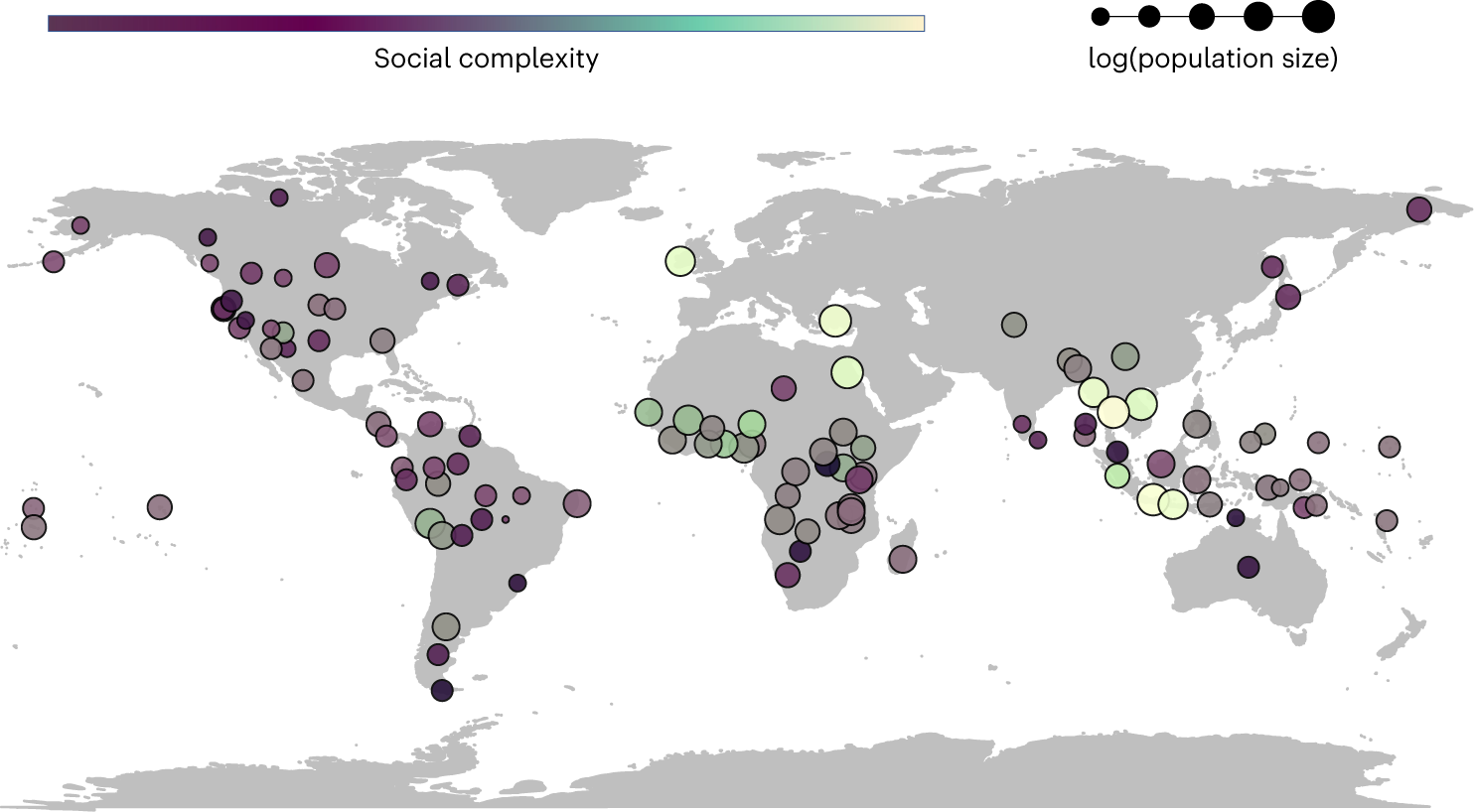
Humans across the globe use supernatural beliefs to explain the world around them. This article explores whether cultural groups invoke the supernatural more to explain natural phenomena (for example, storms, disease outbreaks) or social phenomena (for example, murder, warfare). Quantitative analysis of ethnographic text across 114 geographically and culturally diverse societies found that supernatural explanations are more prevalent for natural than for social phenomena, consistent with theories that ground the origin of religious belief in a human tendency to perceive intent and agency in the natural world. Despite the dominance of supernatural explanations of natural phenomena, supernatural explanations of social phenomena were especially prevalent in urbanized societies with more socially complex and anonymous groups. Our results show how people use supernatural beliefs as explanatory tools in non-industrial societies, and how these applications vary across small-scale communities versus large and urbanized groups.