

DakNet provides extraordinarily low-cost digital communication, letting remote villages leapfrog past the expense of traditional connectivity solutions and begin development of a full-coverage broadband wireless infrastructure. What is the basis for a progressive, market-driven migration from e-governance to universal broadband connectivity that local users will pay for? DakNet, an ad hoc network that uses wireless technology to provide asynchronous digital connectivity, is evidence that the marriage of wireless and asynchronous service may indeed be the beginning of a road to universal broadband connectivity. DakNet has been successfully deployed in remote parts of both India and Cambodia at a cost two orders of magnitude less than that of traditional landline solutions.
Community Networks: Critical Infrastructure For Rural Connectivity In India
As India goes digital-first, millions remain offline. Locally run networks show how connectivity can be built where markets fall short.

Omidyar Network
Omidyar Network is a philanthropy whose mission is to bend the arc of the digital revolution toward shared power, prosperity, and possibility.

The Internet Transition
The Internet is allowing us to build a richer, more complex society but the way in which we Internet today is failing to support the governance systems that a more complex world requires. I take a look at why these issues are related, try to develop an intuition for a way forward, and point at the emerging field that is coming together to build that future.

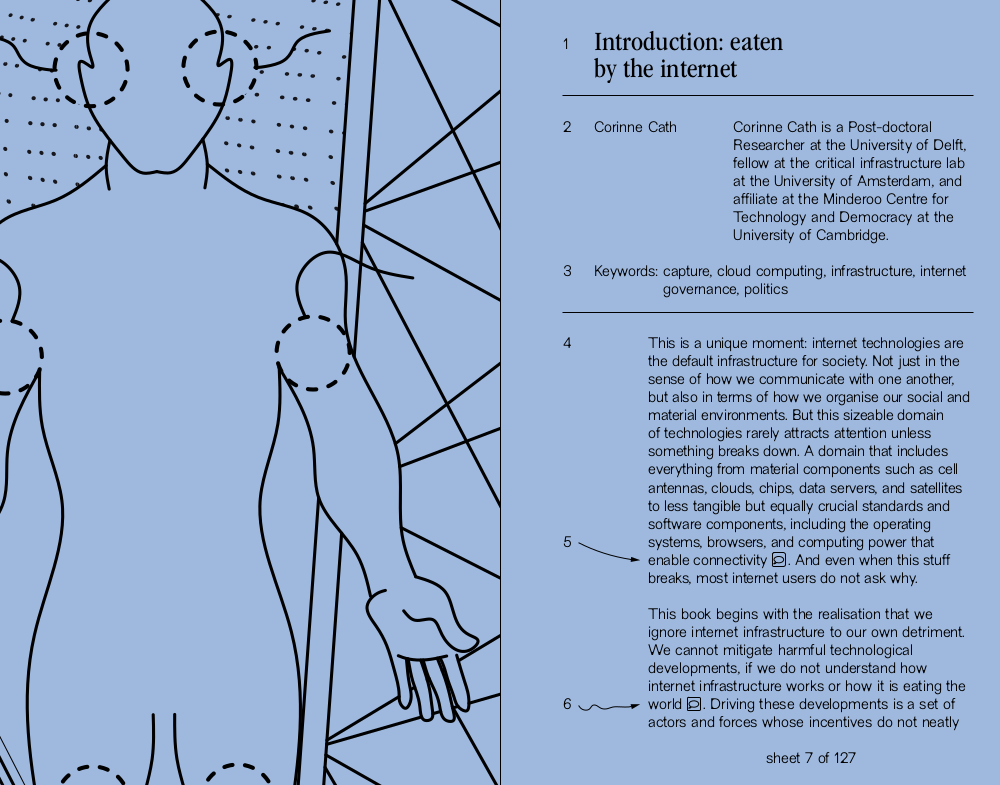
Eaten by the Internet
This book makes internet infrastructure visible as a force of political power, which is transforming the social world, from the bottom up—through fifteen chapters contributed by a global set of researchers, activists, and techies. We are living a unique moment: internet technologies are the default infrastructure for society, not just how we communicate but also how we organise our social life, politics, and economy, all the way down to our material environments, like cities. Our world is eaten by the internet. This means that those who control the internet control the bounds of public speech, economic production, social cohesion, and politics, making its infrastructure a core political terrain in the networked age. The book’s chapters cover a wide set of topics, spanning from the global politics of content moderation by internet infrastructure to the colonialism inherent in the race to plug the moon, from the harms wrought by blockchain companies in rural America to the particularities of online censorship across Asia. The chapters take on thorny topics, discussing power consolidation in the advertisement and cloud industry, the role of internet infrastructure in the war in Ukraine, and tech’s environmental impact—amongst others. In doing so, this book roots contemporary technology debates in the politics of internet infrastructure and urges us to ask how can we ensure our infrastructures sustain us, rather than consume us?
How We Built an Offline-First Data Pipeline for Rural Cooperatives | HackerNoon
Learn how an offline-first data pipeline using edge computing and SQLite enabled reliable synchronization in low-connectivity regions.

Minimum Viable Infrastructure
Minimum Viable Infrastructure Innovation often emerges not solely from brilliant ideas but from the infrastructure readiness that makes those ideas viable. Consider the progression of mobile consumer internet applications over the past two decades: Twitter, Instagram, Snapchat, TikTok. Their lau...

NEXT GENERATION INTERNET - NGI
NGI fosters a vibrant, open Internet that links research, policy and technology for the benefit of society.
Why Internet Infrastructure Decisions Rarely Stay Localized - Internet Society
Even narrow policy choices can have ripple effects that shape what people can access, how information moves, and who can participate online.

Press Release
Achieving universal, meaningful Internet connectivity by 2030 could require an investment of USD 2.6 trillion to USD 2.8 trillion at current prices, according to the Connecting Humanity Action Blueprint released today by the International Telecommunication Union (ITU) – the UN agency for digital technologies – and the Communications, Space & Technology Commission (CST) of the Kingdom of Saudi Arabia.

The Case for Open Sovereignty in a Fragmenting Internet
Once, the Internet promised to dissolve borders. It was humanity’s great experiment in connection — a place where ideas, innovation, and communities could move freely, unburdened by geography or...

Should we design for iffy internet?
Around 97% of US households have internet access, but bandwidth and latency are likely worse than you expect.
The one and future internet
The internet has become inextricably entangled into our economies, cultural and social lives. We stand on the brink of the next technological revolution, in which the internet of things transforms ...

NLnet; Welcome to NLnet Foundation
We support organisations and people who contribute to an open internet for all. We fund projects that help fix the internet through open hardware, open software, open standards, open science and open data. After its historical contribution to the early internet in Europe in the 1980's, NLnet has been financially supporting the open internet since 1997.
Adam Fish - Why Local First matters to businesses
An Explanation of DAOstack in Fairly Simple Terms
DAOstack is an open-source software stack designed to support a global collaborative network.
Politics is the defining aspect of networked technology. AT corresponds best to the kind of institutional structure that is key to large scale democracy. AP is a better match for smaller, village-style governance, which is very valid but not the problem I care about.

Ronen Tamari
Can everyone building on atproto please answer this question? 😇
