


ABSTRACT Exponential growth bias is the pervasive tendency to linearize exponential functions when assessing them intuitively. We show that exponential growth bias can explain two stylized facts in household finance: the tendency to underestimate an interest rate given other loan terms, and the tendency to underestimate a future value given other investment terms. Bias matters empirically: More‐biased households borrow more, save less, favor shorter maturities, and use and benefit more from financial advice, conditional on a rich set of household characteristics. There is little evidence that our measure of exponential growth bias merely proxies for broader financial sophistication.
Household Debt: Facts, Puzzles, Theories, and Policies
Borrowing decisions affect most households, with large stakes and implications for research subfields as varied as macroeconomics and industrial organization. I review theoretical and empirical work on household debt: its prevalence, level, growth, and composition, as well as various measures of consumer choice and market (in)efficiency, elasticities, and prices, including new evidence on how borrowing heterogeneity affects the distribution of the opportunity cost of consumption. I also discuss opportunities and challenges in policy evaluation. A key takeaway is that puzzles abound, and I highlight numerous avenues for further research.

Household Finance
Household financial decisions are complex, interdependent, and heterogeneous, and central to the functioning of the financial system. We present an overview of the rapidly expanding literature on household finance (with some important exceptions) and suggest directions for future research. We begin with the theory and empirics of asset market participation and asset allocation over the life cycle. We then discuss household choices in insurance markets, trading behavior, decisions on retirement saving, and financial choices by retirees. We survey research on liabilities, including mortgage choice, refinancing, and default, and household behavior in unsecured credit markets, including credit cards and payday lending. We then connect the household to its social environment, including peer effects, cultural and hereditary factors, intra-household financial decision-making, financial literacy, cognition, and educational interventions. We also discuss literature on the provision and consumption of financial advice.
Misunderstanding Savings Growth: Implications for Retirement Savings Behavior
People systematically underestimate exponential growth. This article illustrates this phenomenon, its implications, and some potential interventions in the context of saving for retirement, where savings grow exponentially over long periods of time. Experiment 1 shows that a majority of participants expect savings over 40 years to grow linearly rather than exponentially, leading them to grossly underestimate their account balance at retirement. Experiment 2 demonstrates that this misunderstanding leads to underestimates of the cost of waiting to save, which makes putting off saving more attractive than it should be. Finally, Experiments 3–5 show that highlighting the exponential growth of savings motivates both college students and employees to save more for retirement. Making clear to employees the exponential growth of savings before they make crucial decisions about how much to save may be a simple and effective means of increasing retirement savings.

What Would You Do with $500? Spending Responses to Gains, Losses, News, and Loans
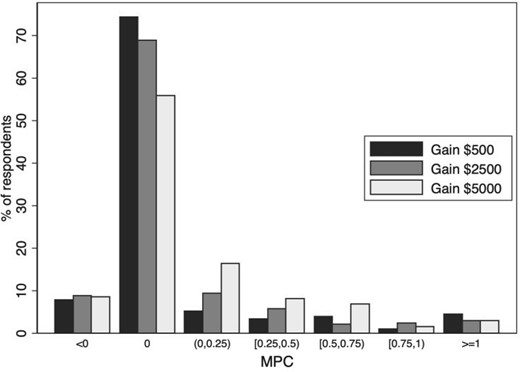
Abstract We use survey questions about spending in hypothetical scenarios to investigate features of propensities to consume that are useful for distinguishing between consumption theories. We find that (1) responses to unanticipated gains are vastly heterogeneous (either zero or substantially positive); (2) responses increase in the size of the gain, driven by the extensive margin of spending adjustments; (3) responses to losses are much larger and more widespread than responses to gains; and (4) even those with large responses to gains do not respond to news about future gains. These four findings suggest that limited access to disposable resources, and frictions in adjusting consumption, are important determinants of consumption behaviour. We also find that (5) households do not respond to the offer of a one-year interest-free loan, suggesting that this is not a consequence of short-term credit constraints; and (6) people do cut spending in response to news about future losses, suggesting that neither is this a consequence of myopia. A calibrated precautionary savings model with utility costs of changing consumption, and a sufficient fraction of low-wealth households, can account for these features of propensities to consume on both the extensive and intensive margins.
A Debt Puzzle
Over 60% of US households with credit cards are currently borrowing – i.e., paying interest – on those cards. We attempt to reconcile the high rate of credit card borrowing with observed levels of life cycle wealth accumulation. We simulate a lifecycle model with five properties that create demand for credit card borrowing. First, the calibrated labor income path slopes upward early in life. Second, income has transitory shocks. Third, consumers invest actively in an illiquid asset, which is sufficiently illiquid that it can not be used to smooth transitory income shocks. Fourth, consumers may declare bankruptcy, reducing the effective cost of credit card borrowing. Fifth, households have relatively more dependents early in the life-cycle. Our calibrated model predicts that 20% of the population will borrow on their credit card at any point in time, far less than the observed rate of over 60%. We identify a resolution to this puzzle: hyperbolic time preferences. Simulated hyperbolic consumers borrow actively in the revolving credit card market and accumulate relatively large stocks of illiquid wealth, matching observed data.

Behavioral Impediments to Valuing Annuities: Complexity and Choice Bracketing
Abstract This paper examines two behavioral factors that diminish people's ability to value a lifetime income stream or annuity, drawing on a randomized experiment with about 4,000 adults in a U.S. nationally representative sample. We find that increasing the complexity of the annuity choice reduces respondents' ability to value the annuity, measured by the difference between the sell and buy values they assign to the annuity. When we limit narrow choice bracketing by inducing people to think first about how quickly or slowly to spend down assets in retirement, their ability to value an annuity increases.
The Co-holding Puzzle: New Evidence from Transaction-Level Data
Using detailed and highly disaggregated data on household finances, we examine the<br>tendency of consumers to “co-hold” savings and debt simultaneously. The di

Present-Biased Preferences and Credit Card Borrowing
Some individuals borrow extensively on their credit cards. This paper tests whether present-biased time preferences correlate with credit card borrowing. In a field study, we elicit individual time preferences with incentivized choice experiments, and match resulting time preference measures to individual credit reports and annual tax returns. The results indicate that present-biased individuals are more likely to have credit card debt, and to have significantly higher amounts of credit card debt, controlling for disposable income, other socio-demographics, and credit constraints. (JEL D12, D14, D91)
Credit Card Debt and Consumer Payment Choice: What Can We Learn from Credit Bureau Data?
We estimate a two-stage Heckman selection model of credit card adoption and use with a unique dataset that combines administrative data from the Equifax credit bureau and self-reported data from a representative survey of consumers. Higher-income consumers carry higher credit card balances, but they tend to repay those balances each month. Credit card revolvers have lower income and are less educated. Revolvers are twice as likely to use debit cards as credit cards for payments, but they carry much higher balances on their credit cards. The high cost of paying off credit card debt likely exacerbates existing inequalities in disposable income. Unlike the mortgage market, we find no evidence for lenders’ cutoff between subprime and prime consumers in the credit card market.
The Coholding Puzzle: New Evidence from Transaction-Level Data
Abstract Why do individuals pay debt interest when they could use their savings to pay down the debt? We explore why individuals “cohold” debt and savings using detailed and highly disaggregated daily-level data on household finances. We find that coholding mostly occurs in short spells within the month and the level of coholding is typically modest. Periods of coholding are not associated with shocks at the individual level. We show that mental accounting has a role to play in explaining coholding, in particular how individuals allocate different categories of expenditure to accounts in credit and debit.
Misperception of Exponential Growth: Are People Aware of Their Errors?
Previous research shows that individuals make systematic errors when judging exponential growth, which has harmful effects for their financial well-being. This study analyzes how far individuals are aware of their errors and how these errors are shaped by arithmetic and conceptual problems. Whereas arithmetic problems could be overcome using computational assistance like a pocket calculator, this is not the case for conceptual problems, a term we use to subsume other error drivers like a general misunderstanding of exponential growth or overwhelming task complexity. In an incentivized experiment, we find that participants strongly overestimate the accuracy of their intuitive judgment. At the same time, their willingness to pay for arithmetic assistance is too high on average, often much above the actual benefits a calculator provides. Using a multitier system of task complexity we can show that the willingness to pay for arithmetic assistance is hardly related to its benefits, indicating that participants do not really understand how the interplay of arithmetic and conceptual problems shape their errors in exponential growth tasks. Our findings are relevant for policymaking and financial advisory practice and can help to design effective approaches to mitigate the detrimental effects of misperceived exponential growth.

Rules of Thumb in Household Savings Decisions: Estimation Using Threshold Regression
The rules of thumb offered by financial advisors regarding how much to hold in liquid reserves vary widely and usually imply far greater sums than low-income ho
Does Pension Automatic Enrollment Increase Debt? Evidence from a Large-Scale Natural Experiment
Does automatic enrollment into retirement saving increase household debt? We study the randomized roll-out of automatic enrollment pensions to 160,000 employers in the United Kingdom with 2-29 employees. We find that the additional savings generated through automatic enrollment are partially offset by increases in unsecured debt. Over the first 41 months after enrollment, each additional month increases the average automatically enrolled employee’s pension savings by £33-£39, unsecured debt (such as personal loans and bank overdrafts) by £7, the likelihood of having a mortgage by 0.05 percentage points, and mortgage balances by £120. Automatic enrollment causes loan defaults to fall and credit scores to rise modestly.
Behaviorally Informed Policies for Household Financial Decisionmaking
Low incomes, limited financial literacy, fraud, and deception are just a few of the many intractable economic and social factors that contribute to the financial difficulties that households face today. Addressing these issues directly is difficult and costly. But poor financial outcomes also result from systematic psychological tendencies, including imperfect optimization, biased judgments and preferences, and susceptibility to influence by the actions and opinions of others. Some of these psychological tendencies and the problems they cause may be countered by policies and interventions that are both low cost and scalable. We detail the ways that these behavioral factors contribute to consumers’ fiancial mistakes and suggest a set of interventions that the federal government, in its dual roles as regulator and employer, could feasibly test or implement to improve household financial outcomes in a variety of domains: retirement, short-term savings, debt management, the take-up of government benefits, and tax optimization.
Does Saving Cause Borrowing? Implications for the Coholding Puzzle
ABSTRACT Using an experiment in which 3.1 million bank customers were encouraged to save, we explore the mechanisms behind coholding liquid savings and credit card debt. Theoretically, we show that the joint responses of spending, saving, and borrowing to the nudge differ across economic models of coholding. Using machine learning techniques, we find that the most responsive individuals reduce spending and increase savings by 4.9% (206 USD PPP per month) while their credit card debt remains unchanged. These individuals' marginal responses to the nudge are consistent with our model of coholding for the purpose of self‐ or partner‐control.

The Effect of Credit on Spending Decisions: The Role of the Credit Limit and Credibility
The objective of the present research is to study consumer decisions to utilize a line of credit. The life-cycle hypothesis from economics argues that consumers should intertemporally reallocate their incomes over their life stream to maximize lifetime utility. One form of intertemporal allocation is to use past income (in the form of savings) in the future. A second form is the use of future income in the present. This can only be done if consumers have access to a temporary pool of money that they can draw from and replenish in the future—a function performed by consumer credit. However, our research reinforces prior findings that consumers are unable to correctly value their future incomes, and that they lack the cognitive capability to solve the intertemporal optimization problem required by the life-cycle hypothesis. Instead, we argue that consumers use information such as the credit limit as a signal of their future earnings potential. Specifically, if consumers have access to large amounts of credit, they are likely to infer that their lifetime income will be high and hence their willingness to use credit (and their spending) will also be high. Conversely, consumers who are granted lower amounts of credit are likely to infer that their lifetime income will be low and hence their spending will be lower. However, based on research in the area of consumer skepticism and inference making, we also argue for a moderating role of the credibility associated with the credit limit. Specifically, we argue that the above effect of credit availability would be particularly strong for consumers who believe that the credit limit credibly signals their future earnings potential (i.e., a naïve consumer who has limited experience with consumer credit). However, as consumers gain experience with credit, they start discounting credit availability as a predictor of their future and start questioning the validity of the process used to set the credit limit. Hence, with experience the effect of credit limit on the willingness to use credit should be attenuated. We test these predictions in five separate studies. In the first experimental study, we manipulate credit limit and credibility and pose subjects with a hypothetical purchase opportunity. Consistent with our prediction, credit limit impacted the propensity to spend, but only when the credibility was high. In the second experimental study, we replicate these findings even when subjects were given information about their expected future salaries, and also show that the credit limit influences their expectation of future earnings potential. In the third study, we show that the mere availability (and increase) of current liquidity cannot explain our findings. In the fourth study, we conduct a survey of consumers in which we measure a number of demographic characteristics and also ask them for their propensity to spend in a given purchase situation. In the fifth study we use the Survey of Consumer Finances (SCF) dataset, a triennial survey of U.S. families that is designed to provide detailed information on the use of financial services, spending behaviors, and selected demographic characteristics. Results from both studies 4 and 5 provide further support for our proposed framework—credit limits influence spending to a greater extent for consumers with lower credibility: younger consumers and less-educated consumers. Across all studies we achieved triangulation by using a variety of approaches (surveys and experiments), subjects types (young students and older consumers), nature of predictor variables (manipulated and measured), dependent measures (purchase likelihood, credit card balance, new charges), and methods of analysis (ANOVA and regression), and consistently found that increasing credit limits on a credit card increases spending, especially when the credibility of the limit is high. This paper joins a growing body of literature in marketing and behavioral decision theory that goes beyond the traditional domains of inquiry (e.g., product choice, effects of marketing mix variables) and focuses on consumer decisions relating to the appropriate use of income to finance consumption. Our framework differs from prior research on the effect of payment mechanisms on spending in two significant ways. First, we are interested in the effects of the availability of credit on spending, and not necessarily in the effect of the transaction format that is associated with each payment mechanism. Second, while prior research has studied the point-of-purchase and historic (i.e., prepurchase) effects of credit, the present research is concerned with the availability of credit in the future. Specifically, our framework is invariant to the current and prior usage of credit by the consumer.
