Due to the financial crisis, an increasing number of households face financial problems. This may lead to an increasing need for monitoring spending and budgets. We demonstrate that both cash and the debit card are perceived as helpful in this respect. We show that, on average, consumers responsible for financial decision making within a household find cash and the debit card equally helpful for monitoring their household finances. Individuals differ in major respects, however. In particular, low earners and the liquidity‐constrained prefer cash as a budgeting tool. Finally, we present evidence that at an aggregated level, such preferences strongly affect consumer payment behavior. These findings suggest that the substitution of cash by cards may slow down because of the financial crisis.
Managing Mental Accounts: Payment Cards and Consumption Expenditures
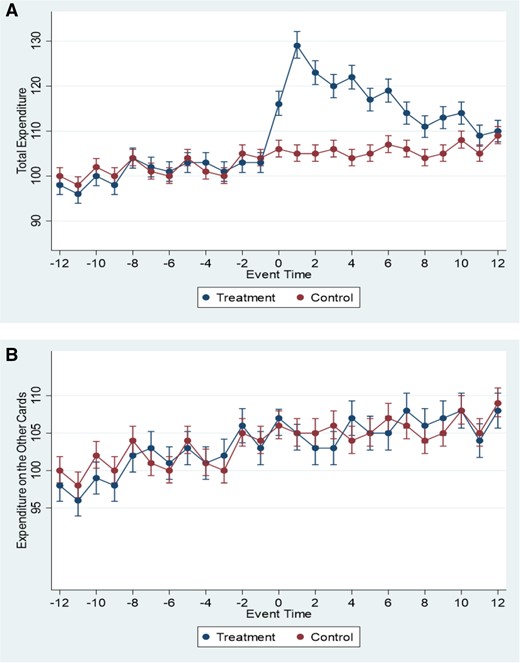
Does mental accounting matter for total consumption expenditures? We exploit a unique setting in which individuals exogenously received a new credit card, without requesting one. Using random variation in the time of receipt we show that individuals temporarily increase total consumption expenditure by making purchases with the new card without reducing spending on the others. We do not observe a corresponding increase in indebtedness. Total consumption expenditure rises even for the least liquidity-constrained individuals. The evidence is consistent with consumers treating methods of payment as nonfungible budget categories, as suggested by models of mental accounting and narrow bracketing.

Managing Mental Accounts: Payment Cards and Consumption Expenditures
Abstract Does mental accounting matter for total consumption expenditures? We exploit a unique setting in which individuals exogenously receive a new payment card, without requesting one. Using random variation in the time of receipt, we show that individuals temporarily increase total consumption expenditure by making purchases with the new card without reducing spending on the others. We do not observe a corresponding increase in indebtedness. Total consumption expenditure rises even for the least liquidity-constrained individuals. The evidence is consistent with consumers treating methods of payment as nonfungible budget categories, as suggested by models of mental accounting and narrow bracketing.
Timing to the Statement: Understanding Fluctuations in Consumer Credit Use
We show that consumers spend 15% more per day in the first week following the receipt of a credit card statement than in the days just prior to the statement. This increase in spending includes both an increase in the likelihood that they use the credit card in the first weeks following their statement and an increase in transaction amount on days they use the credit card. In contrast to the effect on credit card spending, debit card spending is unaffected by credit card statement issuance, suggesting that consumers are not simply switching among modes of payment. Our estimates are based on exogenous variation from bank-assigned statement dates. We propose and test several alternative explanations to this spending puzzle: optimization of the free float, salience effect of the credit card statement, mental accounting, liquidity constraints, and automatic payments. We find that the consumers most apt to spend early in the credit card cycle tend to be those who do not revolve balances and are not close to their credit limit. Thus, this paper documents a puzzle with mixed support for several alternative explanations. This paper was accepted by David Simchi-Levi, finance.

Knowing When to Spend: Unintended Financial Consequences of Earmarking to Encourage Savings
Maintaining savings is an important financial goal. Yet there are times when savings should be spent, such as when people face unavoidable costs, and spending their savings allows them to avoid high interest rate debt. Existing behavioral research has focused on consumer decisions between savings and discretionary spending and has proposed interventions to promote savings in these contexts. However, when spending is not discretionary, such interventions could risk exacerbating a pattern found in economic research in which people borrow high interest rate debt while maintaining savings that earn low levels of interest. To examine how mental accounting interacts with considerations of personal responsibility and guilt to contribute to this pattern, this article explores whether people spend their savings when they need money most: during emergencies. Six studies reveal that people's tendency to preserve savings by borrowing from a high interest rate credit option varies as a function of the savings’ intended use. Paradoxically, people are most likely to turn to high interest rate credit with the belief that doing so is the responsible option.

Why Do Shoppers Use Cash? Evidence from Shopping Diary Data
Recent studies find that cash remains the dominant payment choice for small‐value transactions despite the prevalence of alternative payment methods such as debit and credit cards. An important policy question is whether consumers truly prefer using cash or merchants restrict card usage. Using unique shopping diary data, we estimate a payment choice model with individual heterogeneity, controlling for merchants' acceptance of cards. Based on a policy simulation imposing universal card acceptance among merchants, we find that overall cash usage would decrease by only 8.0 percentage points, implying that cash usage in small‐value transactions is driven mainly by consumer preferences.

Credit Cards as Spending Facilitating Stimuli: A Conditioning Interpretation
Abstract. Four experiments and one study were conducted to test the hypothesis that stimuli associated with spending can elicit spending responses. In all
Purchase Justifiability Drives Payment Choice: Consumers Pay with Card to Remember and Cash to Forget
AbstractAlthough consumers often have multiple payment methods at their fingertips, such as cash and credit/debit cards, prior research is silent on how consumers choose between them. We home in on a key element of purchase—purchase justifiability—that affects how consumers choose to pay. Analysis of 118,042 real-world purchases and six experiments reveals that when consumers are motivated to forget (vs. remember) a purchase because they see it as difficult (vs. easy) to justify, they have an increased preference to pay with cash (vs. card) because cards create a “paper/electronic trail” that aids memory retrieval. These payment preferences are strongest among consumers most likely to recall/track their card spending, and manifest only when card expenses are trackable. We reconcile our results with the classic effect of payment method on pain of paying and discuss implications for merchants and for financial institutions designing payment methods of the future.

The Impact of Payment Frequency on Consumer Spending and Subjective Wealth Perceptions
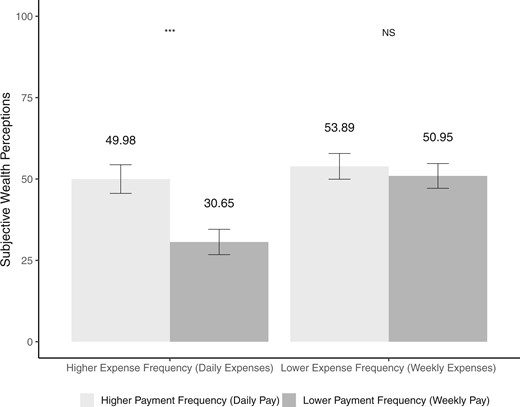
Abstract Payment frequency is a fundamental yet underexplored feature of consumers’ finances. As higher payment frequencies are becoming more prevalent, consumers are receiving more frequent yet smaller paychecks. An analysis of income and expenditure data of over 30,000 consumers from a financial services provider demonstrates a naturally occurring relationship between higher payment frequencies and increased spending. A series of lab studies support this finding, providing causal evidence that higher (vs. lower) payment frequencies increase spending. The effect of payment frequency on spending is driven by changes in consumers’ subjective wealth perceptions. Specifically, higher payment frequencies reduce consumers’ uncertainty in predicting whether they will have enough resources throughout a period, increasing their subjective wealth perceptions. As such, situational factors that reduce prediction uncertainty for those paid less frequently (e.g., the timing of consumers’ expenses, income levels) moderate the impact of payment frequency. The effects of payment frequency on subjective wealth and spending can occur even when objective wealth favors those with lower payment frequencies. More broadly, the current work underscores a need to understand how timing variations in consumers’ income impact their perceptions, behaviors, and general well-being.
Minimum Payments Alter Debt Repayment Strategies Across Multiple Cards
U.S. households currently hold $770 billion in credit card debt, often managing repayments across multiple accounts. The authors investigate how minimum payment requirements (i.e., the requirement to allocate at least some money to each account with a balance) alter consumers’ allocation strategies across multiple accounts. Across four experiments, they find that minimum payment requirements cause consumers to increase dispersion (i.e., spread their repayments more evenly) across accounts. The authors term this change in strategy “the dispersion effect of minimum payments” and provide evidence that it can be costly for consumers. They find that the effect is partially driven by the tendency for consumers to interpret minimum payment requirements as recommendations to pay more than the minimum amount. While the presence of the minimum payment requirement is unlikely to change, the authors propose that marketers and policy makers can influence the effects of minimum payments on dispersion by altering the way that information is displayed to consumers. Specifically, they investigate five distinct information displays and find that choice of display can either exaggerate or minimize dispersion and corresponding costs. They discuss implications for consumers, policy makers, and firms, with a particular focus on ways to improve consumer financial well-being.
Time to Cut Up Those Debit Cards? Effect of Payment Mode on Willingness to Spend
Financial industry data indicate that consumers increasingly prefer debit cards over credit cards, especially as a means of enforcing financial self-discipline. Given prior research suggesting that credit cards act as spending facilitating stimuli, this move toward reduced credit card use would appear to be in the right direction. Ironically, however, the same logos that were implicated in facilitating spending with credit cards are the logos that appear on debit cards. In what should serve as an eye-opener to consumers, it is found that exposure to debit card logos does result in an increased willingness to spend, similar to credit cards.
Does Saving Cause Borrowing? Implications for the Coholding Puzzle
ABSTRACT Using an experiment in which 3.1 million bank customers were encouraged to save, we explore the mechanisms behind coholding liquid savings and credit card debt. Theoretically, we show that the joint responses of spending, saving, and borrowing to the nudge differ across economic models of coholding. Using machine learning techniques, we find that the most responsive individuals reduce spending and increase savings by 4.9% (206 USD PPP per month) while their credit card debt remains unchanged. These individuals' marginal responses to the nudge are consistent with our model of coholding for the purpose of self‐ or partner‐control.

Always Leave Home Without It: A Further Investigation of the Credit-Card Effect on Willingness to Pay
In studies involving genuine transactions of potentially high value we show that willingness-to-pay can be increased when customers are instructed to use a credit card rather than cash. The effect may be large (up to 100%) and it appears unlikely that it arises due solely to liquidity constraints. In addition to demonstrating the effect, we provide a methodology for detecting it, and our findings suggest a source of variance to test alternative explanations.
Consumer Financial Decision Making: Where We’ve Been and Where We’re Going
When making purchasing decisions, consumers consider their available budget and determine what payment method they will use as well as how they will finance the purchase. Consumers must also plan for long-term consumption by considering short- and long-term savings objectives, taking into account how they will invest money saved, as well as how they will borrow needed money and repay outstanding loans. This issue of the Journal of Association of Consumer Research explores financial decision making, which we define as the accumulation and use of resources across time, as reflected by consumers’ behavior and choices.
Credit card debt puzzle: liquid assets to pay household bills
Using transaction data from a US consumer payments diary, we revisit the credit card debt puzzle—a scenario in which households revolve credit card debt while also keeping liquid assets as bank account deposits. This scenario is very common: 42 percent of consumers in our sample were borrower-savers in 2019. We explain the puzzle by showing that consumers need their liquid assets to pay household bills and other necessary expenses, including mortgage or rent. More than 80 percent of bills by value were paid out of bank accounts and could not be charged to credit cards, so bank account balances were needed to cover those basic expenses. On average, borrower-savers’ credit card debt exceeded their liquid assets. The average borrower-saver carried almost $6,400 in unpaid credit card debt and had $5,400 in liquid assets. On average, the value of their liquid assets could cover only about 60 percent of their unpaid debt plus monthly bills. In almost every category of assets or debts, borrower-savers were worse off financially than savers. Thus, the differences between borrower-savers and savers are much broader than just their credit card debt and bank account balances; they extend to mortgage debt and home equity. Carrying a mortgage or other debt (such as auto or educational loans) is associated with a higher probability of revolving on a credit card, suggesting that various types of household debt might be complements rather than substitutes. We do not find evidence that either financial literacy scores or the “Big 5” personality traits predict whether a consumer is a borrower-saver. During the COVID-19 pandemic in 2020, bor-savs’ behavior was consistent with what we would expect under our explanation for the credit card puzzle. However, consumers’ unpaid credit card debt decreased, and their liquid assets increased, so the fraction of borrower-savers dropped to 35 percent of the sample.

Asymmetric Consumption Smoothing
Analyzing account-level data from an account aggregator, we find that households increase consumption when they receive expected tax refunds, as if they face liquidity constraints. However, these same households smooth consumption when making payments in other years, primarily by transferring funds among liquid accounts. Even households carrying credit card debt smooth consumption when making payments, and even highly liquid households spend out of refunds. This behavior is inconsistent with pure liquidity constraints or hand-to-mouth behavior and is most consistent with a mental accounting life-cycle model.
Household Need for Liquidity and the Credit Card Debt Puzzle
Abstract. In the 2001 U.S. Survey of Consumer Finances, 27% of households report simultaneously revolving significant credit card debt and holding sizeable