ABSTRACT This article investigates legitimacy perceptions of automated decision‐making (ADM) among public administrators and citizens. Views of public administrators, who exercise discretion over policy implementation, reflect readiness to integrate AI into decision‐making. Governing by AI ought also to be responsive to the view of citizens, whose support democratic governing ultimately rests on. As AI use in governing grows, understanding the elite‐mass opinion congruence is crucial, and incongruence suggest misalignment between citizen preferences and policy implementation. Using randomized survey experiments conducted among Finnish toplevel public administrators ( N = 842) and a representative sample of citizens ( N = 3245), we compare the legitimacy effects of algorithmic transparency and human discretion over decision‐making in the context of child protection services. Transparency and human discretion enhance perceived legitimacy, with larger treatment effects among administrators. The study concludes that ADM legitimacy theories extend to a Nordic welfare context.
From Democracies to Autocracies: How AI Systems Enable Authoritarianism by Design
AI-enabled authoritarianism is not confined to autocracies. In this paper, we provide greater transparency by investigating and mapping the lifecycles of six AI systems deployed in different political regimes, ranging from the US to China. By drawing on an extensive range of sources (academic publications, investigative research reports, third-party evaluations, media interviews, government procurement notices), we conduct a systematic, qualitative comparison across systems to identify the critical technical and operational features that enable authoritarianism within their respective political contexts. We find that enabling features include the centralization and co-optation of administrative data for law enforcement and political punishment, regulatory gaps that fail to deter misuse, weak user compliance that nullifies human oversight mechanisms, and the encoding of protected group traits that identify members of vulnerable populations. We find that these features are present across systems deployed in autocratic and democratic regimes, albeit in varying configurations. We also find that both centralized and fragmented AI systems can contribute to authoritarianism by exploiting governance gaps: centralized systems directed by executive authorities, particularly within security and military institutions, are often not subjected to formal oversight mechanisms, while fragmented systems diffuse accountability between stakeholders, paving the way for entrenchment. These findings reveal that AI-enabled authoritarianism is distributed, resulting from design and operational choices made by developers, administrators, and users alike. We conclude with recommendations for developers and policymakers to mitigate these risks.
Democratic AI is Possible. The Democracy Levels Framework Shows How It Might Work
This position paper argues that effectively "democratizing AI" requires democratic governance and alignment of AI, and that this is particularly valuable for decisions with systemic societal impacts. Initial steps -- such as Meta's Community Forums and Anthropic's Collective Constitutional AI -- have illustrated a promising direction, where democratic processes could be used to meaningfully improve public involvement and trust in critical decisions. To more concretely explore what increasingly democratic AI might look like, we provide a "Democracy Levels" framework and associated tools that: (i) define milestones toward meaningfully democratic AI, which is also crucial for substantively pluralistic, human-centered, participatory, and public-interest AI, (ii) can help guide organizations seeking to increase the legitimacy of their decisions on difficult AI governance and alignment questions, and (iii) support the evaluation of such efforts.
Governing AI Agents with Democratic ‘Algorithmic Institutions’
Virgilio Almeida, Fernando Filgueiras and Ricardo Fabrino Mendonça explore potential governance structures and forms of oversight for AI agents.

Against “Democratizing AI”
This paper argues against the call to democratize artificial intelligence (AI). Several authors demand to reap purported benefits that rest in direct and broad participation: In the governance of AI, more people should be more involved in more decisions about AI—from development and design to deployment. This paper opposes this call. The paper presents five objections against broadening and deepening public participation in the governance of AI. The paper begins by reviewing the literature and carving out a set of claims that are associated with the call to “democratize AI”. It then argues that such a democratization of AI (1) rests on weak grounds, because it does not answer to a demand of legitimization, (2) is redundant in that it overlaps with existing governance structures, (3) is resource intensive, which leads to injustices, (4) is morally myopic and thereby creates popular oversights and moral problems of its own, and finally, (5) is neither theoretically nor practically the right kind of response to the injustices that animate the call. The paper concludes by suggesting that AI should be democratized not by broadening and deepening participation but by increasing the democratic quality of the administrative and executive elements of collective decision making. In a slogan: The question is not so much whether AI should be democratized but how.

Communication Bias in Large Language Models: A Regulatory Perspective
Large language models (LLMs) have become integral to numerous applications, raising concerns about bias, fairness, and compliance with emerging regulatory frameworks. This article provides a review of some of the most significant risks associated with biased LLM outputs and their broader societal implications. We discuss how regulatory initiatives such as the European Union’s (EU’s) Artificial Intelligence Act (AI Act) and the Digital Services Act (DSA) seek to address these challenges by introducing legal requirements for transparency, accountability, and harm mitigation. In addition, we explore various approaches for assessing and mitigating bias, along with the limitations of current methods. While regulatory frameworks play a crucial role in governing artificial intelligence (AI), they also present challenges in balancing innovation with legal compliance. As oversight mechanisms continue to evolve, we emphasize the fact that LLMs are increasingly regarded as a distinct subset of AI systems and that LLMs are particularly noteworthy due to their immediate interaction with consumers, functioning as the primary interface between users and AI. This distinguishes LLMs from many other AI applications operating behind the scenes and renders them unique in the sense that they are becoming integral tools for personal decision making, offering validation, guidance, and support across various aspects of everyday life, including healthcare, finance, and even choices made in relation to politics. While the current landscape of AI-generated content is addressed by several new regulatory frameworks, none of them have been devised with the possibility in mind that LLMs may affect citizens’ fundamental worldviews and social perspectives, including their individual and collective voting decisions. Our analysis highlights the need for a greater focus on both competition and technology design governance as a complement to value chain and content-based regulation, in order to foster fair and trustworthy AI systems. , While new regulatory frameworks address fairness, accountability, and safety in AI systems, they often fail to directly mitigate the subtle "communication bias" in LLMs that can distort public discourse and democratic processes.
Psychological Perspectives on Legitimacy and Legitimation
Legitimacy is a psychological property of an authority, institution, or social arrangement that leads those connected to it to believe that it is appropriate, proper, and just. Because of legitimacy, people feel that they ought to defer to decisions and rules, following them voluntarily out of obligation rather than out of fear of punishment or anticipation of reward. Being legitimate is important to the success of authorities, institutions, and institutional arrangements since it is difficult to exert influence over others based solely upon the possession and use of power. Being able to gain voluntary acquiescence from most people, most of the time, due to their sense of obligation increases effectiveness during periods of scarcity, crisis, and conflict. The concept of legitimacy has a long history within social thought and social psychology, and it has emerged as increasingly important within recent research on the dynamics of political, legal, and social systems.

Agentic AI Governance: Securing Autonomous AI Agents in Enterprise
When AI agents start making decisions, calling tools, and coordinating with other agents without waiting for human approval, the governance playbook most...

AI Agent Governance: Access and Accountability
AI agent governance requires clear ownership. Learn how IT leaders can manage sensitive data access, preserve audit trails, and test shutdown controls.

The Psychology of Legitimacy: A Relational Perspective on Voluntary Deference to Authorities
People within organized groups often internalize their feelings of obligation to obey group rules and the decisions of group authorities. They believe that group authorities and rules are legitimate and, hence, entitled to be obeyed. Because of this belief, group members voluntarily accept and obey rules and decisions from group authorities. This review draws on evidence from studies of authorities in political, legal, managerial, educational, and family settings to explore why people view as legitimate and voluntarily defer to group authorities. Two theories about legitimacy are contrasted: resource-based theories, represented by instrumental models, and identification based theories, represented by the relational model. The findings provide strong support for the existence of a relational component of legitimacy, suggesting that authorities draw an important part of their legitimacy from their social relationship with group members. The findings also show that there is an instrumental component to legitimacy. Hence, the psychology of legitimacy involves both instrumental and relational elements.

Artificial intelligence in government: why people feel they lose control
The use of Artificial Intelligence (AI) in public administration is expanding rapidly. While AI promises greater efficiency and responsiveness, its integration into government and administration ra...

Governments Can’t Agree on What AI Actually Is
Without clear definitions, governance is impossible.

The Unaccountability Machine: Why Big Systems Make Terrible Decisions—and How the World Lost Its Mind
Longlisted for the 2024 Financial Times Book of the Year. How life and the economy became a black box—a collection of systems no one understands, producing outcomes no one likes. Passengers get bumped from flights. Phone menus disconnect. Automated financial trades produce market collapse. Of all the challenges in modern life, some of the most vexing come from our relationships with automation: a large system does us wrong, and there’s nothing we can do about it. The problem, economist Dan Davies shows, is accountability sinks: systems in which decisions are delegated to a complex rule book or set of standard procedures, making it impossible to identify the source of mistakes when they happen. In our increasingly unhuman world—lives dominated by algorithms, artificial intelligence, and large organizations—these accountability sinks produce more than just aggravation. They make life and economy unknowable—a black box for no reason. In The Unaccountability Machine, Davies lays bare how markets, institutions, and even governments systematically generate outcomes that no one—not even those involved in making them—seems to want. Since the earliest days of the computer age, theorists have foreseen the dangers of complex systems without personal accountability. In response, British business scholar Stafford Beer developed an accountability-first approach to management called “cybernetics,” which might have taken off had his biggest client (the Chilean government) not fallen to a bloody coup in 1973. With his signature blend of economic and journalistic rigor, Davies examines what’s gone wrong since Beer, including what might have been had the world embraced cybernetics when it had the chance. The Unaccountability Machine is a revelatory and resonant account of how modern life became predisposed to dysfunction.
In Pursuit of Ideal Data: Epistemic Enchantment and the Unintended Consequences of Datafying for Artificial Intelligence
The increasing datafication of work has become a pervasive theme within organizations, particularly with the rise of artificial intelligence (AI) technologies that rely on data and machine learning to generate insights and decisions. Prior research has shown that datafication practices aimed at administrative control and accountability can transform organizations in profound and often unintended ways. Our research moves beyond investigating datafication for administrative purposes to explore how it unfolds when actors intend to extract knowledge through AI predictive modeling. Drawing on a three-year ethnography of a human resources (HR) department introducing AI for candidate screening, we find that datafication expanded far beyond the technology’s initially envisioned scope. We explain this scope expansion by introducing the concept of epistemic enchantment : a collective process through which organizational members become captivated and mobilized by AI’s promise to generate predictive, objective, and continuously improving insights from data, while overlooking the costs and risks involved. Our study reveals how datafication practices can expand endlessly as organizational members, enchanted by AI’s epistemic promises, pursue the notion of ideal data as an ever-desired but never reachable goal.
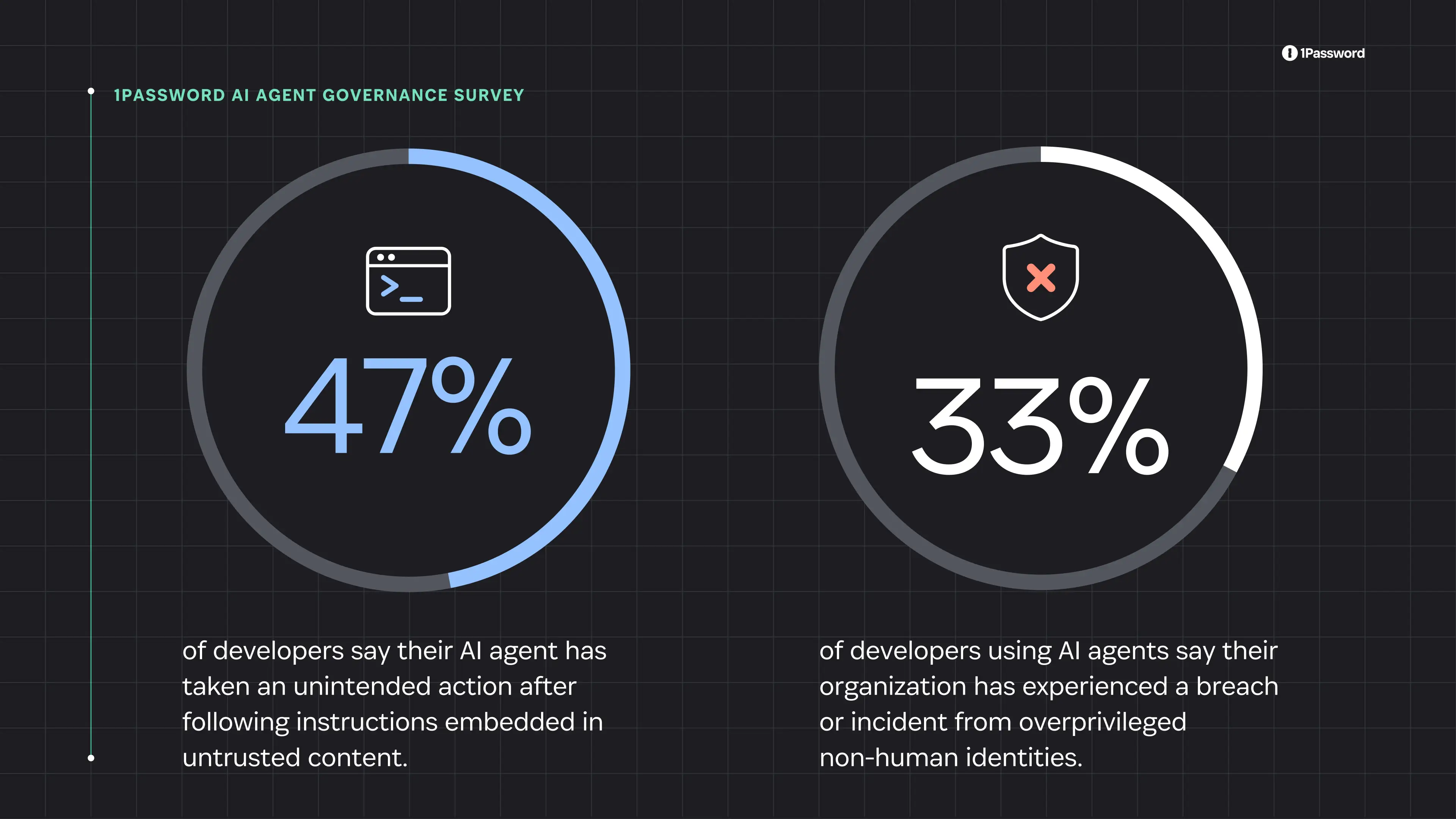
1Password's research finds AI agent adoption is outpacing governance | 1Password
1Password's AI agent governance survey reveals widespread security, visibility, governance, and accountability challenges as AI agents move into production.