


Click on the article title to read more.
A City Is Not a Computer
This seems an obvious truth, but we need to say it loud and clear. Urban intelligence is more than information processing.

Computational Public Space
City AI: a strategic framework for urban artificial intelligence application and development
Given the potentially large economic and social impact of AI technological advancement like LLMs, further in-depth thinking is demanded about the ways in which AI exists in cities. In addition to discussions on ethical regulation, there are relatively few cross-cutting studies on how to realize the synergistic development of AI innovation and city, especially taking AI as a complete industry and governance object, under a broader urban and social context. Based on the policy practice of AI development in Shenzhen, this paper proposes a comprehensive framework for the integrated development of AI and the city, which involves the comprehensive consideration of technology systems, application scenarios, educational literacy and governance schemes. Meanwhile, the transformative trend of urban governance triggered by potential general artificial intelligence at a deeper level is further discussed in terms of planning concepts, digital architecture and governance decision-makings. By city AI integration, AI is expected to be better spread into general social activities and, through the driving effect of industrial economy, contribute to the competitiveness and sustainable development of cities.
Alpaca – Algorithmic Pattern Catalogue
The Alpaca 2025 festival and conference on algorithmic patterns in the creative arts is happening this September 2025. Please see…
Metagov Short Talks (June 14, 2023) : Metagovernance Seminar
Nick Kaufmann and Matt Crittenden present Spectra: the virtual city that builds real cities, a talk discussing how to combine multi-scale cooperative...


AI’s Imperial Agenda
“Empire of AI” author Karen Hao on how Silicon Valley’s young AI companies parallel colonial empires of old.

Vernissage - Home timeline
It's ad-free and focused on community and creativity, not algorithms.
The Algorithm, Singular
A new European ruling on algorithmic amplification determines if an operator controls how content spreads on a platform. But applying it to open social networks turns out to be a problem.

How Google Maps quietly allocates survival across London’s restaurants - and how I built a dashboard to see through it
I wanted a dinner recommendation and got a research agenda instead. Using 13000+ restaurants, I rebuild its ratings with machine learning and map how algorithmic visibility actually distributes power.
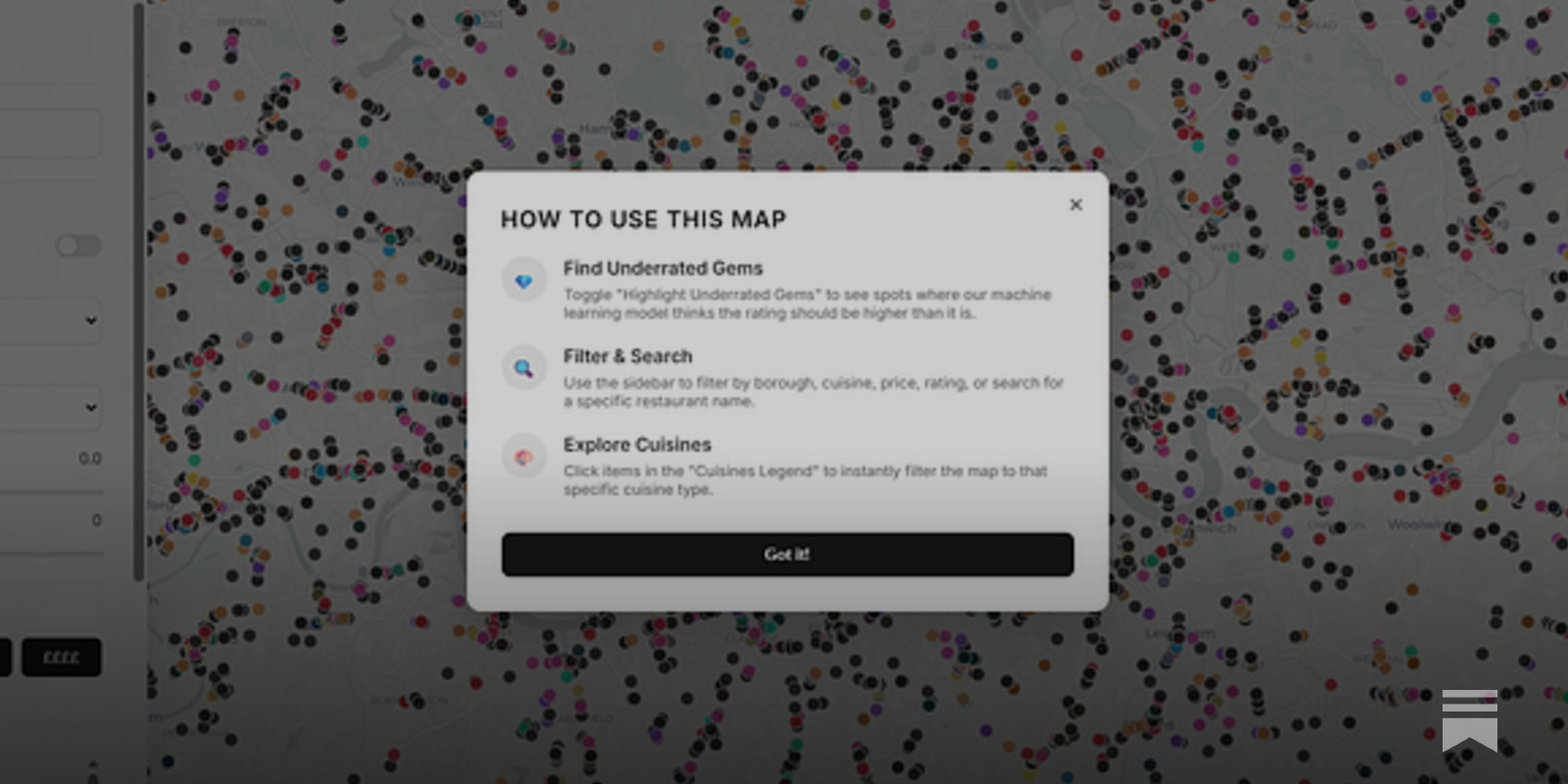
How Google Maps quietly allocates survival across London’s restaurants - and how I built a dashboard to see through it
I wanted a dinner recommendation and got a research agenda instead. Using 13000+ restaurants, I rebuild its ratings with machine learning and map how algorithmic visibility actually distributes power.
How Google Maps quietly allocates survival across London’s restaurants - and how I built a dashboard to see through it
I wanted a dinner recommendation and got a research agenda instead. Using 13000+ restaurants, I rebuild its ratings with machine learning and map how algorithmic visibility actually distributes power.
How Google Maps quietly allocates survival across London’s restaurants - and how I built a dashboard to see through it
I wanted a dinner recommendation and got a research agenda instead. Using 13000+ restaurants, I rebuild its ratings with machine learning and map how algorithmic visibility actually distributes power.
I read the new EU Court ruling on algorithms and social platforms so you don't have to. Turns out to be the most consequential thing a European court has said about recommendation algorithms, and also it just breaks when you apply it to the atmosphere connectedplaces.online/the-algorithm-singular/

The Algorithm, Singular
connectedplaces.online