


Abstract This article explores the evolution of debate quality in the Swiss parliament. Focusing on immigration debates, we employ a psychological construct—cognitive complexity (CC)—which captures both epistemic and accommodative dimensions of political argumentation. We find a decrease in CC in parliamentary immigration debates over time, but this decrease was driven by the rise of the SVP (Swiss People's Party). However, there was almost no “spillover” of this new communication style to other parties. Moreover, we also find a constant difference between the Ständerat and the Nationalrat, with the former scoring higher on CC and thus asserting its role as a “chambre de réflexion” in immigration debates. Our diachronic focus on the quality of political debate takes a novel perspective on the dynamics of consensus democracy as well as on elite political culture. While our results indicate that the rise of the SVP has transformed the traditional consensual and deliberative pattern of Swiss policy‐making style into one which is geared towards less accommodation and a higher simplicity of political talk, there is still remarkable resilience against this new style of political interaction.
A Decline in the Quality of Debate? The Evolution of Cognitive Complexity in Swiss Parliamentary Debates on Immigration (1968–2014)
Abstract This article explores the evolution of debate quality in the Swiss parliament. Focusing on immigration debates, we employ a psychological construct—cognitive complexity (CC)—which captures both epistemic and accommodative dimensions of political argumentation. We find a decrease in CC in parliamentary immigration debates over time, but this decrease was driven by the rise of the SVP (Swiss People's Party). However, there was almost no “spillover” of this new communication style to other parties. Moreover, we also find a constant difference between the Ständerat and the Nationalrat, with the former scoring higher on CC and thus asserting its role as a “chambre de réflexion” in immigration debates. Our diachronic focus on the quality of political debate takes a novel perspective on the dynamics of consensus democracy as well as on elite political culture. While our results indicate that the rise of the SVP has transformed the traditional consensual and deliberative pattern of Swiss policy‐making style into one which is geared towards less accommodation and a higher simplicity of political talk, there is still remarkable resilience against this new style of political interaction.

Misplaced Divides? Discussing Political Disagreement With Strangers Can Be Unexpectedly Positive
Differences of opinion between people are common in everyday life, but discussing those differences openly in conversation may be unnecessarily rare. We report three experiments ( N = 1,264 U.S.-based adults) demonstrating that people’s interest in discussing important but potentially divisive topics is guided by their expectations about how positively the conversation will unfold, leaving them more interested in having a conversation with someone who agrees versus disagrees with them. People’s expectations about their conversations, however, were systematically miscalibrated such that people underestimated how positive these conversations would be—especially in cases of disagreement. Miscalibrated expectations stemmed from underestimating the degree of common ground that would emerge in conversation and from failing to appreciate the power of social forces in conversation that create social connection. Misunderstanding the outcomes of conversation could lead people to avoid discussing disagreements more often, creating a misplaced barrier to learning, social connection, free inquiry, and free expression.

The social media discourse of engaged partisans is toxic even when politics are irrelevant
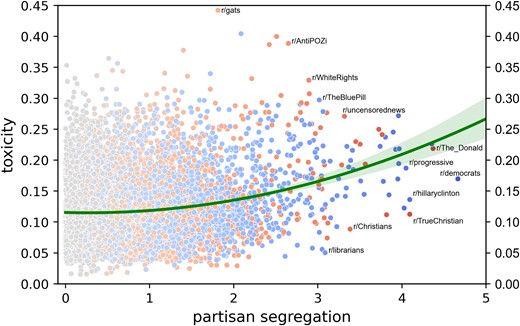
Abstract Prevailing theories of partisan incivility on social media suggest that it derives from disagreement about political issues or from status competition between groups. This study—which analyzes the commenting behavior of Reddit users across diverse cultural contexts (subreddits)—tests the alternative hypothesis that such incivility derives in large part from a selection effect: Toxic people are especially likely to opt into discourse in partisan contexts. First, we examined commenting behavior across over 9,000 unique cultural contexts (subreddits) and confirmed that discourse is indeed more toxic in partisan (e.g. r/progressive, r/conservatives) than in nonpartisan contexts (e.g. r/movies, r/programming). Next, we analyzed hundreds of millions of comments from over 6.3 million users and found robust evidence that: (i) the discourse of people whose behavior is especially toxic in partisan contexts is also especially toxic in nonpartisan contexts (i.e. people are not politics-only toxicity specialists); and (ii) when considering only nonpartisan contexts, the discourse of people who also comment in partisan contexts is more toxic than the discourse of people who do not. These effects were not driven by socialization processes whereby people overgeneralized toxic behavioral norms they had learned in partisan contexts. In contrast to speculation about the need for partisans to engage beyond their echo chambers, toxicity in nonpartisan contexts was higher among people who also comment in both left-wing and right-wing contexts (bilaterally engaged users) than among people who also comment in only left-wing or right-wing contexts (unilaterally engaged users). The discussion considers implications for democratic functioning and theories of polarization.
The sound of inevitability
Have you ever argued with someone who is seriously good at debating? I have. It sucks. You’re constantly thrown off-balance, responding to a point you didn’t expect to. You find yourself defending the weak edges of your argument, while the main thrust gets left behind in the back-and-forth, and you end up losing momentum, confidence, and ultimately, the argument. One of my close friends won international debate competitions for fun while we were at university (he’s now a successful criminal barrister), and he told me that the only trick in the book, once you boil it all down, is to make sure the conversation is framed in your terms. Once that happens, it’s all over bar the shouting.
GermanPartiesQA: Benchmarking Commercial Large Language Models and AI Companions for Political Alignment and Sycophancy
Large language models (LLMs) are increasingly shaping citizens’ information ecosystems. Products incorporating LLMs, such as chatbots and AI Companions, are now widely used for decision support and information retrieval, including in sensitive domains, raising concerns about hidden biases and growing potential to shape individual decisions and public opinion. This paper introduces GermanPartiesQA, a benchmark of 418 political statements from German Voting Advice Applications across 11 elections to evaluate six commercial LLMs. We evaluate their political alignment based on role-playing experiments with political personas. Our evaluation reveals three specific findings: (1) Factual limitations: LLMs show limited ability to accurately generate factual party positions, particularly for centrist parties. (2) Model-specific ideological alignment: We identify consistent alignment patterns and degree of political steerability for each model across temperature settings and experiments. (3) Claim of sycophancy: While models adjust to political personas during role-play, we find this reflects persona-based steerability rather than the increasingly popular, yet contested concept of sycophancy. Our study contributes to evaluating the political alignment of closed-source LLMs that are increasingly embedded in electoral decision support tools and AI Companion chatbots.
GermanPartiesQA: Benchmarking Commercial Large Language Models and AI Companions for Political Alignment and Sycophancy
Large language models (LLMs) are increasingly shaping citizens’ information ecosystems. Products incorporating LLMs, such as chatbots and AI Companions, are now widely used for decision support and information retrieval, including in sensitive domains, raising concerns about hidden biases and growing potential to shape individual decisions and public opinion. This paper introduces GermanPartiesQA, a benchmark of 418 political statements from German Voting Advice Applications across 11 elections to evaluate six commercial LLMs. We evaluate their political alignment based on role-playing experiments with political personas. Our evaluation reveals three specific findings: (1) Factual limitations: LLMs show limited ability to accurately generate factual party positions, particularly for centrist parties. (2) Model-specific ideological alignment: We identify consistent alignment patterns and degree of political steerability for each model across temperature settings and experiments. (3) Claim of sycophancy: While models adjust to political personas during role-play, we find this reflects persona-based steerability rather than the increasingly popular, yet contested concept of sycophancy. Our study contributes to evaluating the political alignment of closed-source LLMs that are increasingly embedded in electoral decision support tools and AI Companion chatbots.
Metaphor and the Political War
Metaphor and the Political War
Individuals, institutions, and innovation in the debates of the French Revolution
Significance How do democracies make decisions? We can read transcripts from parliament houses and legislative halls to see how particular ideas are introduced and debated, but we understand very little about the general principles of how these systems deal with information, or the origins of those principles. Here we study the parliamentary assembly of the first 2 years of the French Revolution, a model for democracies and revolutions across the globe, and show how patterns of speaking are created, picked up, and ignored or propagated. Political ideology, top–down rules, and individual charisma all affect how word patterns survive and thrive or, conversely, disappear and drop away. , The French Revolution brought principles of “liberty, equality, fraternity” to bear on the day-to-day challenges of governing what was then the largest country in Europe. Its experiments provided a model for future revolutions and democracies across the globe, but this first modern revolution had no model to follow. Using reconstructed transcripts of debates held in the Revolution’s first parliament, we present a quantitative analysis of how this body managed innovation. We use information theory to track the creation, transmission, and destruction of word-use patterns across over 40,000 speeches and a thousand speakers. The parliament as a whole was biased toward the adoption of new patterns, but speakers’ individual qualities could break these overall trends. Speakers on the left innovated at higher rates, while speakers on the right acted to preserve prior patterns. Key players such as Robespierre (on the left) and Abbé Maury (on the right) played information-processing roles emblematic of their politics. Newly created organizational functions—such as the Assembly president and committee chairs—had significant effects on debate outcomes, and a distinct transition appears midway through the parliament when committees, external to the debate process, gained new powers to “propose and dispose.” Taken together, these quantitative results align with existing qualitative interpretations, but also reveal crucial information-processing dynamics that have hitherto been overlooked. Great orators had the public’s attention, but deputies (mostly on the political left) who mastered the committee system gained new powers to shape revolutionary legislation.

AI can help humans find common ground in democratic deliberation
Finding agreement through a free exchange of views is often difficult. Collective deliberation can be slow, difficult to scale, and unequally attentive to different voices. In this study, we trained an artificial intelligence (AI) to mediate human deliberation. Using participants’ personal opinions and critiques, the AI mediator iteratively generates and refines statements that express common ground among the group on social or political issues. Participants ( N = 5734) preferred AI-generated statements to those written by human mediators, rating them as more informative, clear, and unbiased. Discussants often updated their views after the deliberation, converging on a shared perspective. Text embeddings revealed that successful group statements incorporated dissenting voices while respecting the majority position. These findings were replicated in a virtual citizens’ assembly involving a demographically representative sample of the UK population. , Editor’s summary To act collectively, groups must reach agreement; however, this can be challenging when discussants present very different but valid opinions. Tessler et al . investigated whether artificial intelligence (AI) can help groups reach a consensus during democratic debate (see the Policy Forum by Nyhan and Titiunik). The authors trained a large language model called the Habermas Machine to serve as an AI mediator that helped small UK groups find common ground while discussing divisive political issues such as Brexit, immigration, the minimum wage, climate change, and universal childcare. Compared with human mediators, AI mediators produced more palatable statements that generated wide agreement and left groups less divided. The AI’s statements were more clear, logical, and informative without alienating minority perspectives. This work carries policy implications for AI’s potential to unify deeply divided groups. —Ekeoma Uzogara , INTRODUCTION Democracy, at its best, rests upon the free and equal exchange of views among people with diverse perspectives. Collective deliberation can be effectively supported by structured events, such as citizens’ assemblies, but such events are expensive, are difficult to scale, and can result in voices being heard unequally. This study investigates the potential of artificial intelligence (AI) to overcome these limitations, using AI mediation to help people find common ground on complex social and political issues. RATIONALE We asked whether an AI system based on large language models (LLMs) could successfully capture the underlying shared perspectives of a group of human discussants by writing a “group statement” that the discussants would collectively endorse. Inspired by Jürgen Habermas’s theory of communicative action, we designed the “Habermas Machine” to iteratively generate group statements that were based on the personal opinions and critiques from individual users, with the goal of maximizing group approval ratings. Through successive rounds of human data collection, we used supervised fine-tuning and reward modeling to progressively enhance the Habermas Machine’s ability to capture shared perspectives. To evaluate the efficacy of AI-mediated deliberation, we conducted a series of experiments with over 5000 participants from the United Kingdom. These experiments investigated the impact of AI mediation on finding common ground, how the views of discussants changed across the process, the balance between minority and majority perspectives in group statements, and potential biases present in those statements. Lastly, we used the Habermas Machine for a virtual citizens’ assembly, assessing its ability to support deliberation on controversial issues within a demographically representative sample of UK residents. RESULTS Group opinion statements generated by the Habermas Machine were consistently preferred by group members over those written by human mediators and received higher ratings from external judges for quality, clarity, informativeness, and perceived fairness. AI-mediated deliberation also reduced division within groups, with participants’ reported stances converging toward a common position on the issue after deliberation; this result did not occur when discussants directly exchanged views, unmediated. Although support for the majority position increased after deliberation, the Habermas Machine demonstrably incorporated minority critiques into revised statements. We replicated these results in a virtual citizens’ assembly, additionally finding that during AI-mediated deliberation, the views of groups of discussants tended to move in a similar direction on controversial issues. These shifts were not attributable to biases in the AI, suggesting that the deliberation process genuinely aided the emergence of shared perspectives on potentially polarizing social and political issues. CONCLUSION This research demonstrates the potential of AI to enhance collective deliberation by finding common ground among discussants with diverse views. The AI-mediated approach is time-efficient, fair, scalable, and outperforms human mediators on key dimensions. Rather than simply appealing to the majority, the Habermas Machine prominently incorporated dissenting voices into the group statements. AI-assisted deliberation is not without its risks, however; to ensure fair and inclusive debate, steps must be taken to ensure users are representative of the target population and are prepared to contribute in good faith. Under such conditions, AI may be leveraged to improve collective decision-making across various domains, from contract negotiations and conflict resolution to political discussions and citizens’ assemblies. The Habermas Machine offers a promising tool for finding agreement and promoting collective action in an increasingly divided world. AI helps people find common ground in collective deliberation. (Left) The AI mediator uses participants’ opinions to generate group statements and iteratively refines those statements through participants’ critiques. (Middle) Statements from the AI mediator (purple) garner stronger endorsement than those written by a human mediator (orange). (Right) AI mediation leaves groups less divided after deliberation, whereas simply sharing opinions with others does not.

The social media discourse of engaged partisans is toxic even when politics are irrelevant
Abstract. Prevailing theories of partisan incivility on social media suggest that it derives from disagreement about political issues or from status compet
The social media discourse of engaged partisans is toxic even when politics are irrelevant
Abstract. Prevailing theories of partisan incivility on social media suggest that it derives from disagreement about political issues or from status compet
Debate Maps — The Society Library
While The Society Library is dedicated to enabling access to information through our libraries, we recognize the difficult and tricky work of organizing that content into formal deliberation. There are hundreds of cognitive biases and logical pitfalls that can get in our way as human beings. Therefore, as a part of our service, The Society Library endeavors to map the knowledge we collect into “debate maps,” which essentially means we are organizing the arguments, claims, evidence, and opinions from all points of view into a formal debate - and effectively enabling “societal-scale debate.” A feat which may be otherwise impossible to organize in comparable levels of comprehensiveness with the existing limits of media, language, and human bandwidth to which we are confined.

Political Quizzes | The Paper Pilot
The Paper Pilot's digital garden of thoughts on philosophy, politics, and sociology
Political Sorting Can Drive AI Models Apart Through User Feedback
Large language models are rapidly becoming an important source of political information. This raises a fundamental question: will AI systems support a shared basis for political knowledge, or lead different political groups to rely on increasingly different models? Political sorting can drive model fragmentation if three conditions hold: politically different users select into different models, learning from user feedback pushes those models apart politically, and the resulting differences shape subsequent model choices. We call this self-reinforcing process the Centrifugal Alignment Spiral. We study its components in three steps. First, we draw on a human experiment showing that political identity predicts model choice. Second, we fine-tune language models on synthetic feedback reflecting predominantly Democratic or Republican preferences. Across five independent runs per model family, paired models diverged on 12-41% of unseen survey questions with large partisan gaps, and in every run the differences moved in the expected political direction; for some models, differentiation extended even to issue areas excluded from training. Pooling feedback across groups instead suppressed divergence. Third, an empirically anchored agent-based model shows what follows when political sorting and model adaptation operate together: models attract politically distinct audiences, learn from them, and diverge further. User feedback can therefore turn political sorting among AI users into durable differences between the models on which they rely for political information.

Les motifs de la confiance (et de la défiance ) politique : intérêt, connaissance et conviction dans les formes du raisonnement politique
Le rapport de confiance ou de défiance unissant les citoyens à la politique se nourrit d’une variété de facteurs relatifs à la position sociale des citoyens, à la mise en cause de leurs intérêts par les politiques publiques comme à leur perception normative de l’univers politiques. En se fondant sur un matériel qualitatif composé de groupes de discussion réunissant des citoyens français faiblement politisés, cette contribution vise à cerner les motifs argumentatifs de la confiance et de la défiance politique. Leurs propos expriment un rapport au politique construit de façon endogène, à dimension fortement normative et manifestant une capacité argumentative fondée sur différents types de principes.