


Today, social media platforms hold the sole power to study the effects of feed-ranking algorithms. We developed a platform-independent method that reranks participants’ feeds in real time and used this method to conduct a preregistered 10-day field experiment with 1256 participants on X during the 2024 US presidential campaign. Our experiment used a large language model to rerank posts that expressed antidemocratic attitudes and partisan animosity (AAPA). Decreasing or increasing AAPA exposure shifted out-party partisan animosity by more than 2 points on a 100-point feeling thermometer, with no detectable differences across party lines, providing causal evidence that exposure to AAPA content alters affective polarization. This work establishes a method to study feed algorithms without requiring platform cooperation, enabling independent evaluation of ranking interventions in naturalistic settings. , Editor’s summary Social media platforms’ opaque feed-ranking algorithms, which are designed to maximize engagement, may contribute to political polarization, body image, mental health, and other social issues. However, the evidence has rarely enabled conclusions about causality because external researchers need platforms’ permission to experimentally intervene. Collaborations with platforms also involve trade-offs that undermine researchers’ intellectual autonomy. Piccardi et al . circumvented this problem with a browser extension that intercepted feeds on X/Twitter in real time using a large language model (LLM) (see the Perspective by Allen and Tucker). Liberals and conservatives were randomly assigned to conditions where the LLM re-ranked feeds to up-rank or down-rank the visibility of hostile political content. Up-ranking increased political polarization, whereas down-ranking decreased it. This LLM tool enabled independent scholars to pull back the curtain on unresolved research questions without the platform’s permission. —Ekeoma Uzogara , INTRODUCTION Social media algorithms profoundly impact our lives, yet our understanding of these algorithms’ impact has been limited to interventions that the platforms themselves are willing to test and publish. In this article, we demonstrate a method for independent algorithmic reranking experiments in naturalistic settings and at scale. We leverage this method to demonstrate that algorithmic ranking can both raise and lower levels of affective political polarization in the United States, with no detectable differences across party lines. RATIONALE We built a browser extension that intercepted and reranked web-based social media feeds in real time. The extension used a large language model (LLM) to score content and then applied these scores to reorder the feed, all without requiring platform cooperation. Our approach identified content expressing antidemocratic attitudes and partisan animosity (AAPA) and controlled users’ exposure to such content through reranking. We conducted a preregistered field experiment with 1256 participants on X, the most widely used social media platform for political discourse in the United States, during the weeks leading up to the 2024 presidential election. Participants were randomly assigned to two parallel experiments in which their feeds were dynamically reranked for 1 week to either up- or down-rank AAPA posts. We measured the effects of these interventions on affective polarization (participants’ feelings toward the political outgroup) and emotional experience (anger, sadness, excitement, or calm) by using both in-feed and post-experiment surveys. Results were compared to those of participants in control conditions whose feeds were not reranked. RESULTS Reranking to change levels of exposure to AAPA content significantly influenced affective polarization. Increased AAPA exposure led to colder feelings toward the political outgroup, whereas decreased AAPA exposure led to warmer feelings. Both shifts amounted to more than 2 degrees on a 0- to 100- degree “feeling thermometer.” The impact on affective polarization was consistently detected in both in-feed and post-experiment surveys, with no evidence of partisan asymmetry. Changes to the feed algorithm caused in-feed but not post-experiment changes to participants’ negative emotions. CONCLUSION This work demonstrates a new method for reranking social media feeds that enables testing interventions without platform collaboration. We found that increasing exposure to AAPA posts significantly increases affective polarization and negative emotions, whereas decreasing exposure reduces them. These changes were comparable in size to 3 years of change in United States affective polarization. As political polarization and societal division become increasingly linked to social media activity, our findings provide a potential pathway for platforms to address these challenges through algorithmic interventions. Together, these interventions may result in algorithms that not only reduce partisan animosity but also promote greater social trust and healthier democratic discourse across party lines. A platform-independent field experiment demonstrates that reranking content expressing antidemocratic attitudes and partisan animosity in social media feeds alters affective polarization. A browser extension reranked participants’ social media feeds by reducing or increasing exposure to posts expressing AAPA, which in turn led to corresponding decreases or increases in affective polarization.
Reranking partisan animosity in algorithmic social media feeds alters affective polarization
Today, social media platforms hold the sole power to study the effects of feed-ranking algorithms. We developed a platform-independent method that reranks participants’ feeds in real time and used this method to conduct a preregistered 10-day field experiment with 1256 participants on X during the 2024 US presidential campaign. Our experiment used a large language model to rerank posts that expressed antidemocratic attitudes and partisan animosity (AAPA). Decreasing or increasing AAPA exposure shifted out-party partisan animosity by more than 2 points on a 100-point feeling thermometer, with no detectable differences across party lines, providing causal evidence that exposure to AAPA content alters affective polarization. This work establishes a method to study feed algorithms without requiring platform cooperation, enabling independent evaluation of ranking interventions in naturalistic settings. , Editor’s summary Social media platforms’ opaque feed-ranking algorithms, which are designed to maximize engagement, may contribute to political polarization, body image, mental health, and other social issues. However, the evidence has rarely enabled conclusions about causality because external researchers need platforms’ permission to experimentally intervene. Collaborations with platforms also involve trade-offs that undermine researchers’ intellectual autonomy. Piccardi et al . circumvented this problem with a browser extension that intercepted feeds on X/Twitter in real time using a large language model (LLM) (see the Perspective by Allen and Tucker). Liberals and conservatives were randomly assigned to conditions where the LLM re-ranked feeds to up-rank or down-rank the visibility of hostile political content. Up-ranking increased political polarization, whereas down-ranking decreased it. This LLM tool enabled independent scholars to pull back the curtain on unresolved research questions without the platform’s permission. —Ekeoma Uzogara , INTRODUCTION Social media algorithms profoundly impact our lives, yet our understanding of these algorithms’ impact has been limited to interventions that the platforms themselves are willing to test and publish. In this article, we demonstrate a method for independent algorithmic reranking experiments in naturalistic settings and at scale. We leverage this method to demonstrate that algorithmic ranking can both raise and lower levels of affective political polarization in the United States, with no detectable differences across party lines. RATIONALE We built a browser extension that intercepted and reranked web-based social media feeds in real time. The extension used a large language model (LLM) to score content and then applied these scores to reorder the feed, all without requiring platform cooperation. Our approach identified content expressing antidemocratic attitudes and partisan animosity (AAPA) and controlled users’ exposure to such content through reranking. We conducted a preregistered field experiment with 1256 participants on X, the most widely used social media platform for political discourse in the United States, during the weeks leading up to the 2024 presidential election. Participants were randomly assigned to two parallel experiments in which their feeds were dynamically reranked for 1 week to either up- or down-rank AAPA posts. We measured the effects of these interventions on affective polarization (participants’ feelings toward the political outgroup) and emotional experience (anger, sadness, excitement, or calm) by using both in-feed and post-experiment surveys. Results were compared to those of participants in control conditions whose feeds were not reranked. RESULTS Reranking to change levels of exposure to AAPA content significantly influenced affective polarization. Increased AAPA exposure led to colder feelings toward the political outgroup, whereas decreased AAPA exposure led to warmer feelings. Both shifts amounted to more than 2 degrees on a 0- to 100- degree “feeling thermometer.” The impact on affective polarization was consistently detected in both in-feed and post-experiment surveys, with no evidence of partisan asymmetry. Changes to the feed algorithm caused in-feed but not post-experiment changes to participants’ negative emotions. CONCLUSION This work demonstrates a new method for reranking social media feeds that enables testing interventions without platform collaboration. We found that increasing exposure to AAPA posts significantly increases affective polarization and negative emotions, whereas decreasing exposure reduces them. These changes were comparable in size to 3 years of change in United States affective polarization. As political polarization and societal division become increasingly linked to social media activity, our findings provide a potential pathway for platforms to address these challenges through algorithmic interventions. Together, these interventions may result in algorithms that not only reduce partisan animosity but also promote greater social trust and healthier democratic discourse across party lines. A platform-independent field experiment demonstrates that reranking content expressing antidemocratic attitudes and partisan animosity in social media feeds alters affective polarization. A browser extension reranked participants’ social media feeds by reducing or increasing exposure to posts expressing AAPA, which in turn led to corresponding decreases or increases in affective polarization.
Redesigning algorithms to intervene on social norm misperceptions during a national election
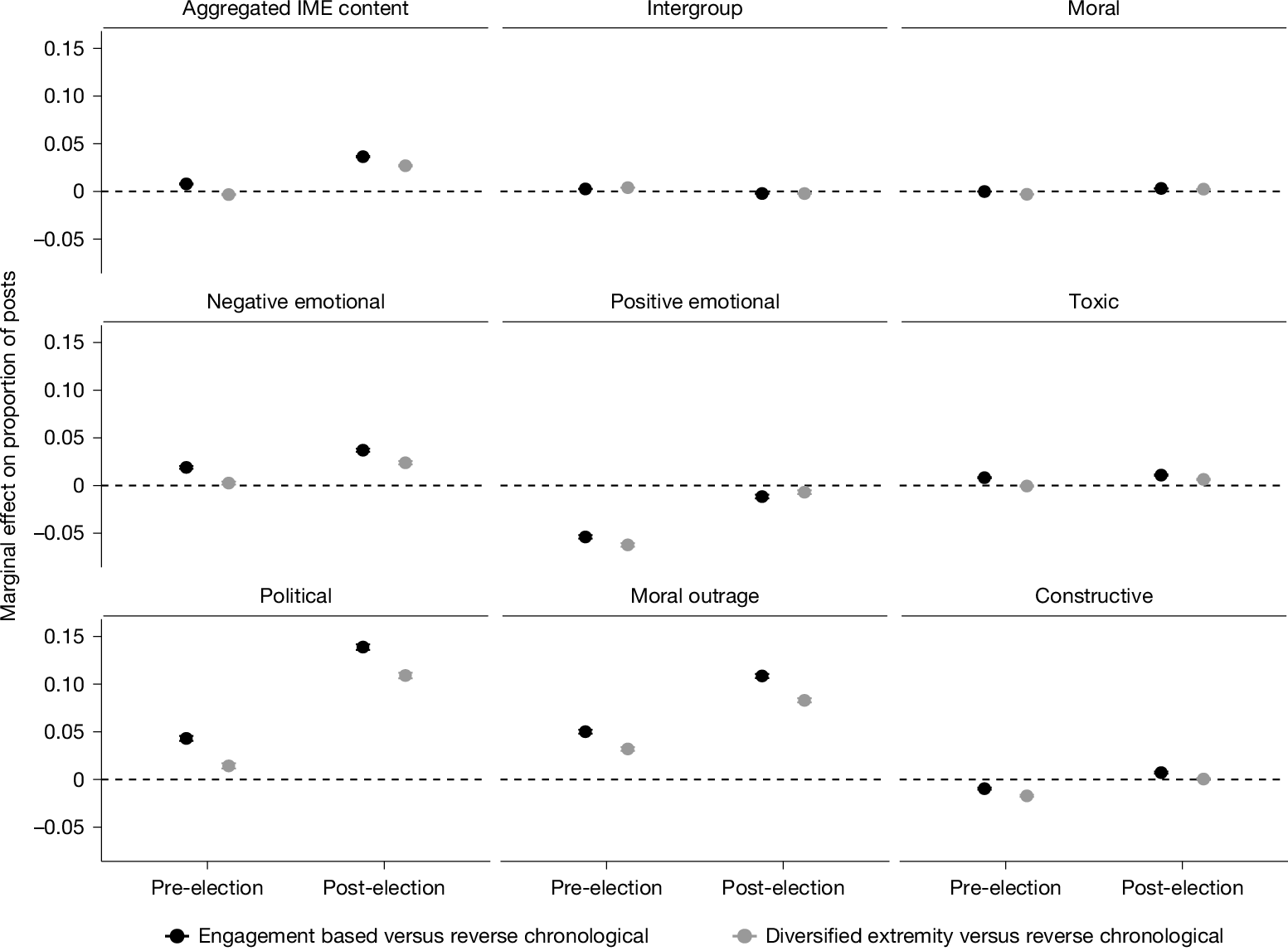
For the first time in history, civic discourse commonly occurs in digital environments in which algorithms influence exposure to social information1,2. It is increasingly important to understand whether and how these algorithms affect political discourse3–5. Here we built custom feed-ranking algorithms with full control over their features, and randomly assigned 2,000 participants to use them for 8 weeks (before and after the 2024 US presidential election). We tested whether an engagement-based algorithm (used on major social media platforms6,7) amplifies intergroup, moralized and emotional (IME) information in ways that skew perceptions of social norms around political dialogue5,8, and whether it increased engagement with IME content and perceptions of partisan animosity (compared with a reverse-chronological feed9,10). We also developed and tested a ‘diversified extremity’ algorithm to reduce the influence of extreme users11–13 to improve the accuracy of social norm perception14–16 and reduce perceptions of partisan animosity. We found that engagement-based feeds amplified IME and toxic content relative to reverse-chronological feeds, with the largest increases in moral outrage and political content. Engagement-based feeds also reduced prescriptive norm perception accuracy (albeit in an unexpected direction) and increased perceived partisan animosity. However, they did not significantly alter users’ own engagement behaviours. The diversified extremity algorithm reduced IME and toxic content exposure, improved prescriptive norm accuracy, yet maintained comparable platform enjoyment—suggesting that reducing the influence of extreme users can curb algorithmic distortions without diminishing user experience.
Redesigning algorithms to intervene on social norm misperceptions during a national election
For the first time in history, civic discourse commonly occurs in digital environments in which algorithms influence exposure to social information1,2. It is increasingly important to understand whether and how these algorithms affect political discourse3–5. Here we built custom feed-ranking algorithms with full control over their features, and randomly assigned 2,000 participants to use them for 8 weeks (before and after the 2024 US presidential election). We tested whether an engagement-based algorithm (used on major social media platforms6,7) amplifies intergroup, moralized and emotional (IME) information in ways that skew perceptions of social norms around political dialogue5,8, and whether it increased engagement with IME content and perceptions of partisan animosity (compared with a reverse-chronological feed9,10). We also developed and tested a ‘diversified extremity’ algorithm to reduce the influence of extreme users11–13 to improve the accuracy of social norm perception14–16 and reduce perceptions of partisan animosity. We found that engagement-based feeds amplified IME and toxic content relative to reverse-chronological feeds, with the largest increases in moral outrage and political content. Engagement-based feeds also reduced prescriptive norm perception accuracy (albeit in an unexpected direction) and increased perceived partisan animosity. However, they did not significantly alter users’ own engagement behaviours. The diversified extremity algorithm reduced IME and toxic content exposure, improved prescriptive norm accuracy, yet maintained comparable platform enjoyment—suggesting that reducing the influence of extreme users can curb algorithmic distortions without diminishing user experience.
How do social media feed algorithms affect attitudes and behavior in an election campaign?
We investigated the effects of Facebook’s and Instagram’s feed algorithms during the 2020 US election. We assigned a sample of consenting users to reverse-chronologically-ordered feeds instead of the default algorithms. Moving users out of algorithmic feeds substantially decreased the time they spent on the platforms and their activity. The chronological feed also affected exposure to content: The amount of political and untrustworthy content they saw increased on both platforms, the amount of content classified as uncivil or containing slur words they saw decreased on Facebook, and the amount of content from moderate friends and sources with ideologically mixed audiences they saw increased on Facebook. Despite these substantial changes in users’ on-platform experience, the chronological feed did not significantly alter levels of issue polarization, affective polarization, political knowledge, or other key attitudes during the 3-month study period.

The political effects of X’s feed algorithm
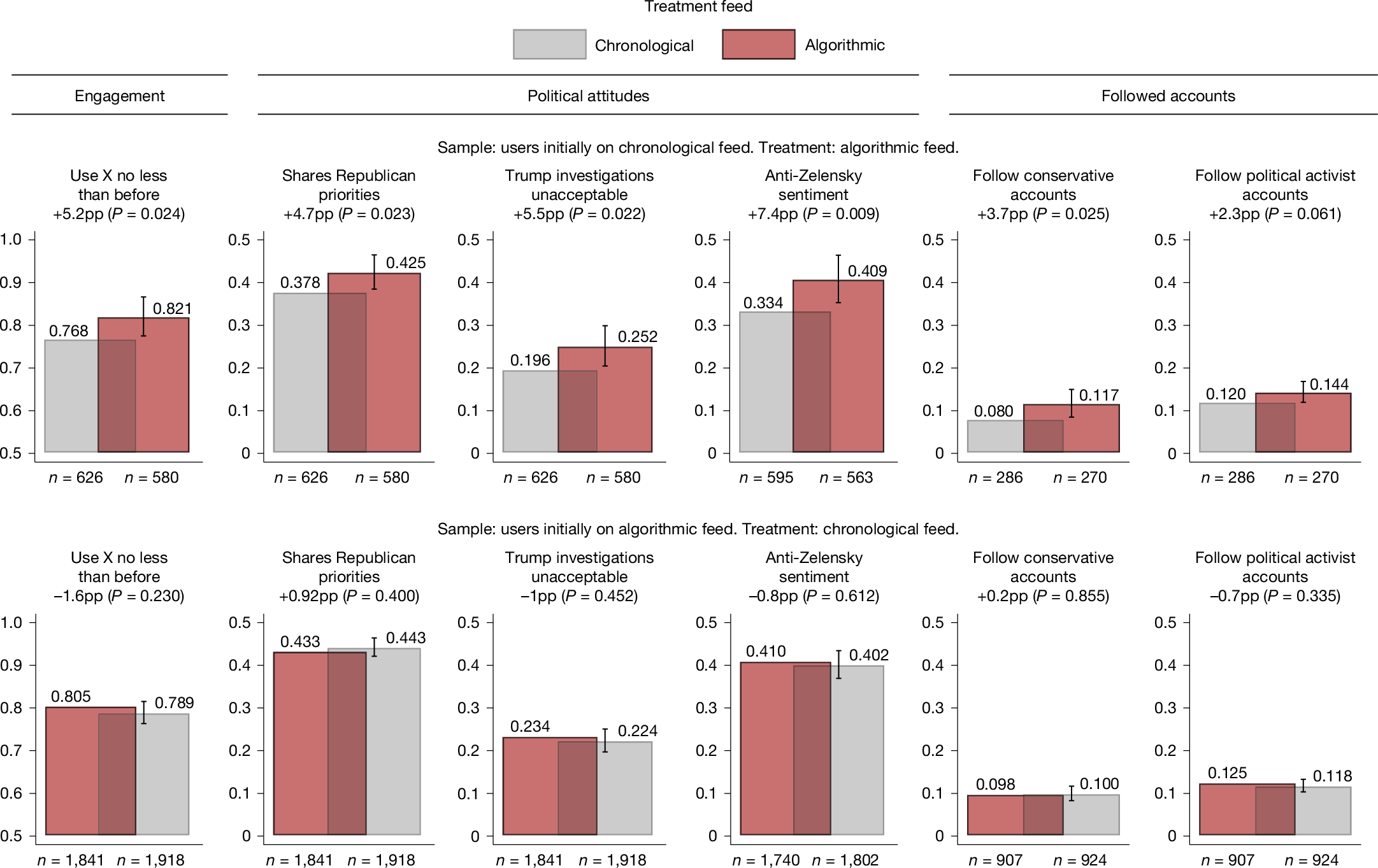
Feed algorithms are widely suspected to influence political attitudes. However, previous evidence from switching off the algorithm on Meta platforms found no political effects1. Here we present results from a 2023 field experiment on Elon Musk’s platform X shedding light on this puzzle. We assigned active US-based users randomly to either an algorithmic or a chronological feed for 7 weeks, measuring political attitudes and online behaviour. Switching from a chronological to an algorithmic feed increased engagement and shifted political opinion towards more conservative positions, particularly regarding policy priorities, perceptions of criminal investigations into Donald Trump and views on the war in Ukraine. In contrast, switching from the algorithmic to the chronological feed had no comparable effects. Neither switching the algorithm on nor switching it off significantly affected affective polarization or self-reported partisanship. To investigate the mechanism, we analysed users’ feed content and behaviour. We found that the algorithm promotes conservative content and demotes posts by traditional media. Exposure to algorithmic content leads users to follow conservative political activist accounts, which they continue to follow even after switching off the algorithm, helping explain the asymmetry in effects. These results suggest that initial exposure to X’s algorithm has persistent effects on users’ current political attitudes and account-following behaviour, even in the absence of a detectable effect on partisanship.
The political effects of X’s feed algorithm
Feed algorithms are widely suspected to influence political attitudes. However, previous evidence from switching off the algorithm on Meta platforms found no political effects1. Here we present results from a 2023 field experiment on Elon Musk’s platform X shedding light on this puzzle. We assigned active US-based users randomly to either an algorithmic or a chronological feed for 7 weeks, measuring political attitudes and online behaviour. Switching from a chronological to an algorithmic feed increased engagement and shifted political opinion towards more conservative positions, particularly regarding policy priorities, perceptions of criminal investigations into Donald Trump and views on the war in Ukraine. In contrast, switching from the algorithmic to the chronological feed had no comparable effects. Neither switching the algorithm on nor switching it off significantly affected affective polarization or self-reported partisanship. To investigate the mechanism, we analysed users’ feed content and behaviour. We found that the algorithm promotes conservative content and demotes posts by traditional media. Exposure to algorithmic content leads users to follow conservative political activist accounts, which they continue to follow even after switching off the algorithm, helping explain the asymmetry in effects. These results suggest that initial exposure to X’s algorithm has persistent effects on users’ current political attitudes and account-following behaviour, even in the absence of a detectable effect on partisanship.
Engagement, user satisfaction, and the amplification of divisive content on social media
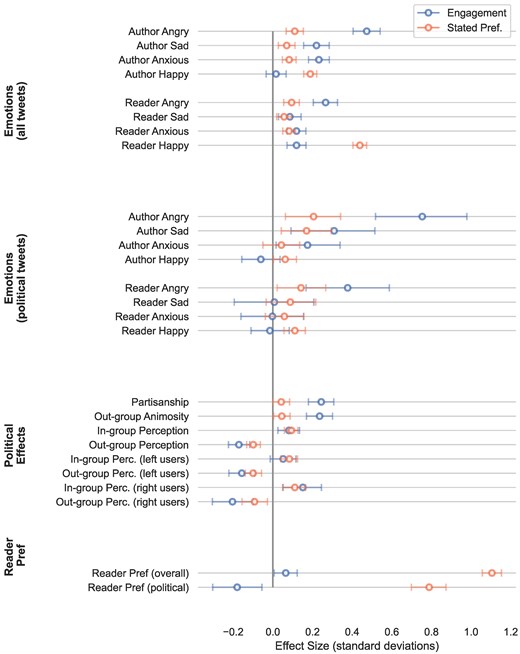
Abstract Social media ranking algorithms typically optimize for users’ revealed preferences, i.e. user engagement such as clicks, shares, and likes. Many have hypothesized that by focusing on users’ revealed preferences, these algorithms may exacerbate human behavioral biases. In a preregistered algorithmic audit, we found that, relative to a reverse-chronological baseline, Twitter’s engagement-based ranking algorithm amplifies emotionally charged, out-group hostile content that users say makes them feel worse about their political out-group. Furthermore, we find that users do not prefer the political tweets selected by the algorithm, suggesting that the engagement-based algorithm underperforms in satisfying users’ stated preferences. Finally, we explore the implications of an alternative approach that ranks content based on users’ stated preferences and find a reduction in angry, partisan, and out-group hostile content, but also a potential reinforcement of proattitudinal content. Overall, our findings suggest that greater integration of stated preferences into social media ranking algorithms could promote better online discourse, though potential trade-offs also warrant further investigation.
Auditing Political Exposure Bias: Algorithmic Amplification on Twitter/X During the 2024 U.S. Presidential Election
Approximately 50% of tweets in X's user timelines are personalized recommendations from accounts they do not follow. This raises a critical question: What political content are users exposed to beyond their established networks, and what implications does this have for democratic discourse online? In this paper, we present a six-week audit of X's algorithmic content recommendations during the 2024 U.S. Presidential Election by deploying 120 sock-puppet monitoring accounts to capture tweets from their personalized "For You" timelines. Our objective is to quantify out-of-network content exposure for right- and left-leaning user profiles and assess any potential inequalities and biases in political exposure. Our findings indicate that X's algorithm skews exposure toward a few high-popularity accounts across all users, with right-leaning users experiencing the highest level of exposure inequality. Both left- and right-leaning users encounter amplified exposure to accounts aligned with their own political views and reduced exposure to opposing viewpoints. Additionally, we observe that new accounts experience a right-leaning bias in exposure within their default timelines. Our work contributes to understanding how content recommendation systems may induce and reinforce biases while exacerbating vulnerabilities among politically polarized user groups. We underscore the importance of transparency-aware algorithms in addressing critical issues such as safeguarding election integrity and fostering a more informed digital public sphere.

Can We Fix Social Media? Testing Prosocial Interventions using Generative Social Simulation
Social media platforms have been widely linked to societal harms, including rising polarization and the erosion of constructive debate. Can these problems be mitigated through prosocial interventions? We address this question using a novel method - generative social simulation - that embeds Large Language Models within Agent-Based Models to create socially rich synthetic platforms. We create a minimal platform where agents can post, repost, and follow others. We find that the resulting following-networks reproduce three well-documented dysfunctions: (1) partisan echo chambers; (2) concentrated influence among a small elite; and (3) the amplification of polarized voices - creating a 'social media prism' that distorts political discourse. We test six proposed interventions, from chronological feeds to bridging algorithms, finding only modest improvements - and in some cases, worsened outcomes. These results suggest that core dysfunctions may be rooted in the feedback between reactive engagement and network growth, raising the possibility that meaningful reform will require rethinking the foundational dynamics of platform architecture.
Value misalignment in X’s feed algorithm is a reflection of value tensions in engagement
Social media feed algorithms rank content that is purported to be preferred by users, but the engagement behaviors that drive these algorithms are (at best) indirect proxies for users’ explicitly self-stated values. Are the resulting feeds value aligned, and if not, why? We investigate this question by annotating the basic human values expressed in participants’ X (Twitter) feeds (N = 715 US users), analyzing the relationship between the posts’ value expressions and the posts’ amplification in the ranked “For You” Page feed, and then comparing the amplified values to users’ own values. We observe that the inventory of posts from followed accounts reflects users’ self-stated values—but that there is an overall negative correlation (misalignment) between users’ explicit values and the value expressions the algorithm is more likely to amplify. We turn to engagement behavior to understand this misalignment and observe that users’ engagement behaviors can be misaligned with their stated values—likely causing the algorithm to learn and reflect these misaligned values. We also detect partisan differences consistent with this theory: While the algorithm amplifies values negatively correlated with both Democrats’ and Republicans’ self-stated values, they are more misaligned for Democrats. And in fact replying, a heavily weighted form of engagement, is associated with values that are less aligned for both Democrats’ and Republicans’ self-stated values, and is even more misaligned for Democrats. Taken together, these findings offer a glimpse into the tensions between the values that people hold and those that provoke reactions, and how these value tensions can produce misaligned outcomes.
Sharing without clicking on news in social media
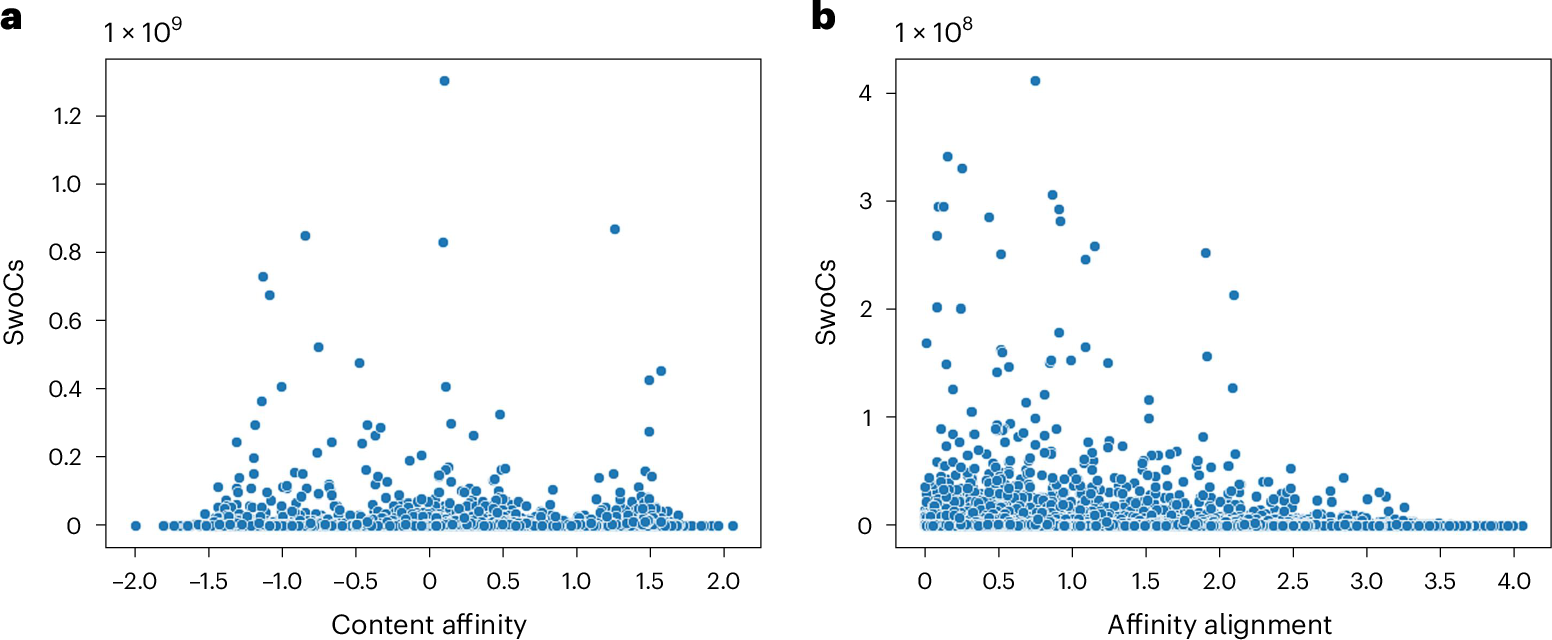
Social media have enabled laypersons to disseminate, at scale, links to news and public affairs information. Many individuals share such links without first reading the linked information. Here we analysed over 35 million public Facebook posts with uniform resource locators shared between 2017 and 2020, and discovered that such ‘shares without clicks’ (SwoCs) constitute around 75% of forwarded links. Extreme and user-aligned political content received more SwoCs, with partisans engaging in it more than politically neutral users. In addition, analyses with 2,969 false uniform resource locators revealed higher shares and, hence, SwoCs by conservatives (76.94%) than liberals (14.25%), probably because, in our dataset, the vast majority (76–82%) of them originated from conservative news domains. Findings suggest that the virality of political content on social media (including misinformation) is driven by superficial processing of headlines and blurbs rather than systematic processing of core content, which has design implications for promoting deliberate discourse in the online public sphere.
Interventions reducing affective polarization do not necessarily improve anti-democratic attitudes
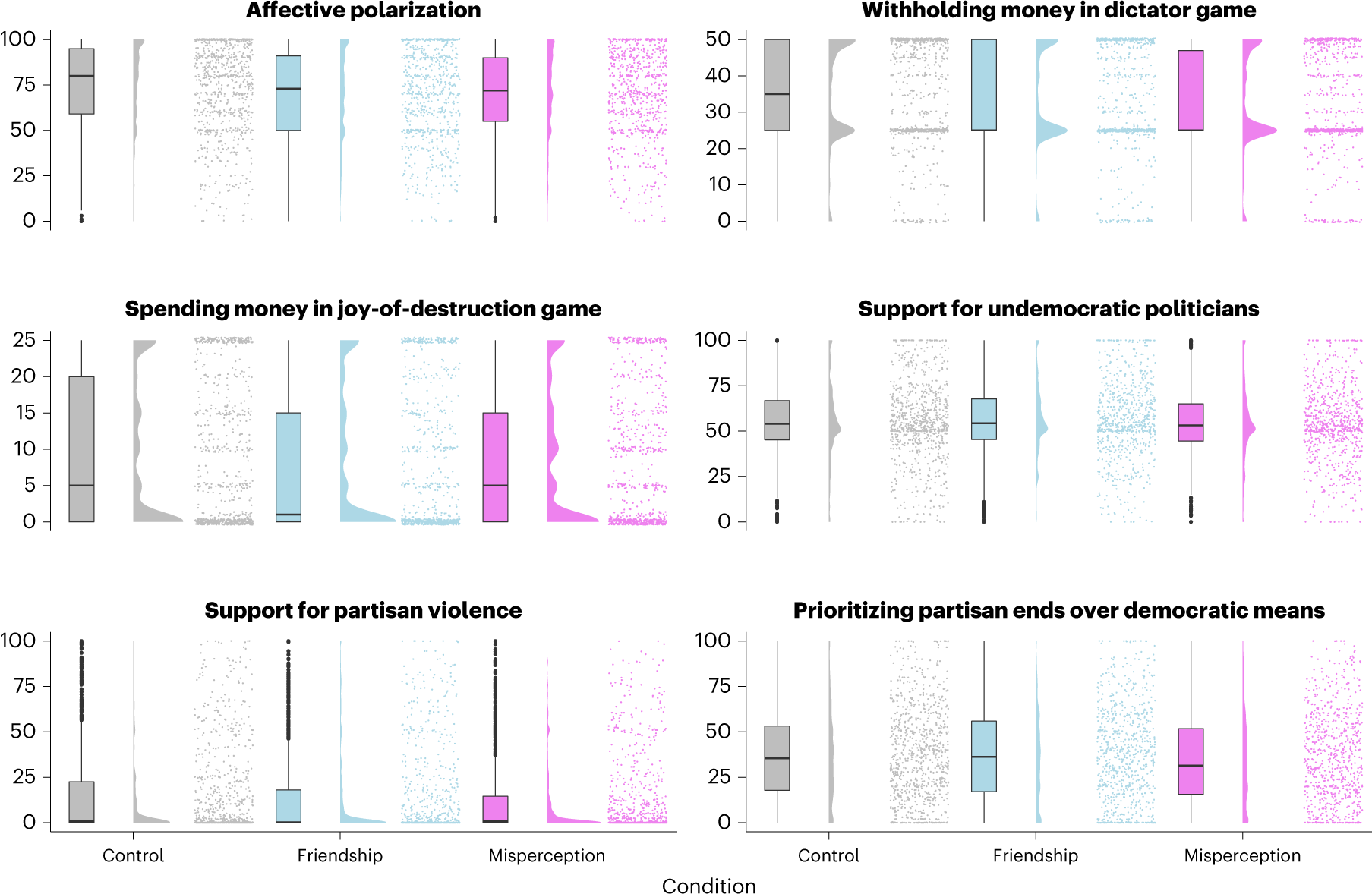
There is widespread concern that rising affective polarization—particularly dislike for outpartisans—exacerbates Americans’ anti-democratic attitudes. Accordingly, scholars and practitioners alike have invested great effort in developing depolarization interventions that reduce affective polarization. Critically, however, it remains unclear whether these interventions reduce anti-democratic attitudes, or only change sentiments towards outpartisans. Here we address this question with experimental tests (total n = 8,385) of three previously established depolarization interventions: correcting misperceptions of outpartisans, priming inter-partisan friendships and observing warm cross-partisan interactions between political leaders. While these depolarization interventions reliably reduced affective polarization, we do not find compelling evidence that these interventions reduced support for undemocratic candidates, support for partisan violence or prioritizing partisan ends over democratic means. Thus, future efforts to strengthen pro-democratic attitudes may do better if they target these outcomes directly. More broadly, these findings call into question the previously assumed causal effect of affective polarization on anti-democratic attitudes.
Shifts in U.S. Social Media Use, 2020–2024: Decline, Fragmentation, and Enduring Polarization
Using nationally representative data from the 2020 and 2024 American National Election Studies (ANES), this paper describes how U.S. social media use has shifted across platforms, demographics, and politics. Overall platform reach declined, driven by growth in the share of Americans — especially the youngest and oldest cohorts — who report using no social media. Visiting and posting activity on Twitter/X and Facebook have fallen by nearly 50% since 2020, with the decline on Twitter/X driven primarily by reduced participation among Democratic users. While Facebook, YouTube, and Twitter/X lost ground, TikTok and Reddit grew modestly, consistent with a more fragmented digital public sphere. Platform audiences aged and became slightly more educated and racially diverse. Politically, most platforms shifted toward Republican users while remaining, on balance, Democratic-leaning. Twitter/X experienced the largest change: among posters, the partisan balance swung over 70 percentage points from Democrats to Republicans. Across platforms, political posting remains closely tied to affective polarization, as the most partisan respondents are also the most active. As casual users disengage while polarized partisans remain vocal, online discourse becomes narrower and more ideologically extreme.
The Prosocial Ranking Challenge: Reducing Polarization on Social...
We report the first direct comparisons of multiple alternative social media algorithms on multiple platforms on outcomes of societal interest. We used a browser extension to modify which posts...