


A schema mapping is a specification that describes how data structured under one schema (the source schema) is to be transformed into data structured under a different schema (the target schema). A fundamental problem is composing schema mappings: given ...
Data exchange: getting to the core | ACM Transactions on Database Systems
Data exchange is the problem of taking data structured under a source schema and creating an instance of a target schema that reflects the source data as accurately as possible. Given a source instance, there may be many solutions to the data exchange ...

Relational foundations for functorial data migration | Proceedings of the 15th Symposium on Database Programming Languages
In this paper we present a simple database definition language: that of categories and functors. A database schema is a small category and an instance is a set-valued functor on it. We show that morphisms of schemas induce three ''data migration ...
Functorial data migration
In this paper we present a simple database definition language: that of categories and functors. A database schema is a small category and an instance is a set-valued functor on it. We show that morphisms of schemas induce three “data migration functors”, which translate instances from one schema to the other in canonical ways. These functors parameterize projections, unions, and joins over all tables simultaneously and can be used in place of conjunctive and disjunctive queries. We also show how to connect a database and a functional programming language by introducing a functorial connection between the schema and the category of types for that language. We begin the paper with a multitude of examples to motivate the definitions, and near the end we provide a dictionary whereby one can translate database concepts into category-theoretic concepts and vice versa.
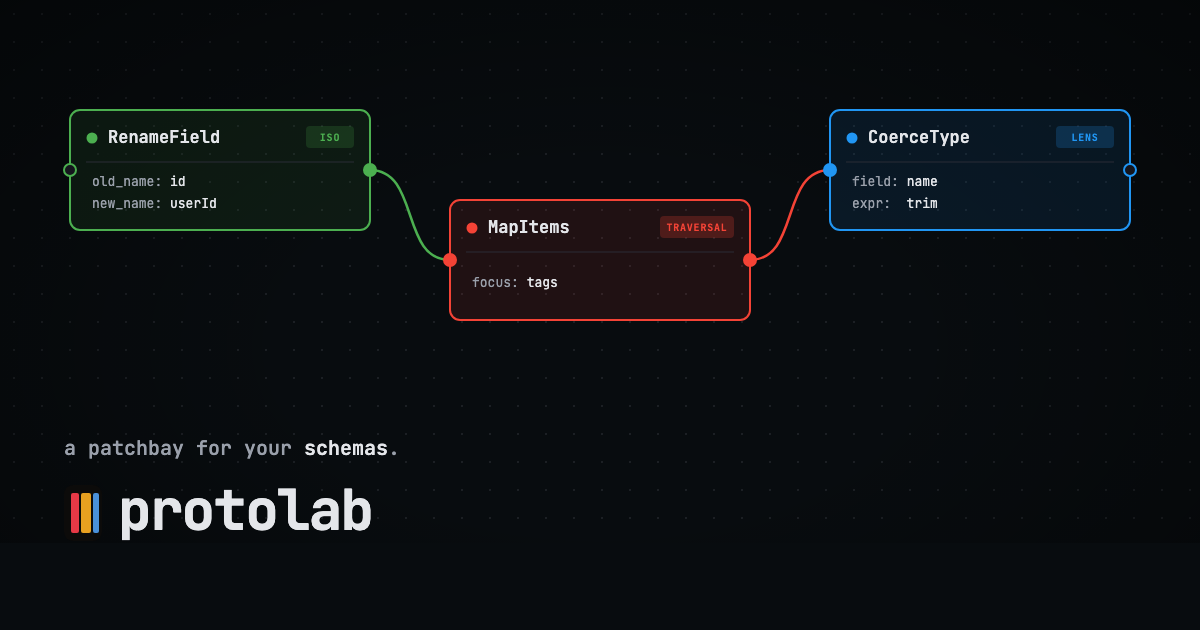
protolab
A patchbay for your schemas. Bidirectional data transformations, drawn as circuits.
protolab
A patchbay for your schemas. Bidirectional data transformations, drawn as circuits.
Graceful database schema evolution: the PRISM workbench: Proceedings of the VLDB Endowment: Vol 1, No 1
Supporting graceful schema evolution represents an unsolved problem for traditional information systems that is further exacerbated in web information systems, such as Wikipedia and public scientific databases: in these projects based on multiparty ...

Algebraic data integration
In this paper, we develop an algebraic approach to data integration by combining techniques from functional programming, category theory, and database theory. In our formalism, database schemas and instances are algebraic (multi-sorted equational) theories of a certain form. Schemas denote categories, and instances denote their initial (term) algebras. The instances on a schema S form a category, S–Inst, and a morphism of schemas F : S → T induces three adjoint data migration functors: ΣF : S–Inst → T–Inst, defined by substitution along F, which has a right adjoint ΔF : T–Inst → S–Inst, which in turn has a right adjoint ΠF : S–Inst → T–Inst. We present a query language based on for/where/return syntax where each query denotes a sequence of data migration functors; a pushout-based design pattern for performing data integration using our formalism; and describe the implementation of our formalism in a tool we call AQL (Algebraic Query Language).
A Categorical Unification for Multi-Model Data: Part I Categorical Model and Normal Forms
Modern database systems face a significant challenge in effectively handling the Variety of data. The primary objective of this paper is to establish a unified data model and theoretical framework for multi-model data management. To achieve this, we present a categorical framework to unify three types of structured or semi-structured data: relation, XML, and graph-structured data. Utilizing the language of category theory, our framework offers a sound formal abstraction for representing these diverse data types. We extend the Entity-Relationship (ER) diagram with enriched semantic constraints, incorporating categorical ingredients such as pullback, pushout and limit. Furthermore, we develop a categorical normal form theory which is applied to category data to reduce redundancy and facilitate data maintenance. Those normal forms are applicable to relation, XML and graph data simultaneously, thereby eliminating the need for ad-hoc, model-specific definitions as found in separated normal form theories before. Finally, we discuss the connections between this new normal form framework and Boyce-Codd normal form, fourth normal form, and XML normal form.


Mutual intelligibility for schema idiolects.

GitHub - idiolect-dev/idiolect: Mutual intelligibility for schema idiolects.
github.com