


In this article we investigate information scraps —personal information where content has been scribbled on Post-it notes, scrawled on the corners of sheets of paper, stuck in our pockets, sent in email messages to ourselves, and stashed in miscellaneous digital text files. Information scraps encode information ranging from ideas and sketches to notes, reminders, shipment tracking numbers, driving directions, and even poetry. Although information scraps are ubiquitous, we have much still to learn about these loose forms of information practice. Why do we keep information scraps outside of our traditional PIM applications? What role do information scraps play in our overall information practice? How might PIM applications be better designed to accommodate and support information scraps' creation, manipulation and retrieval? We pursued these questions by studying the information scrap practices of 27 knowledge workers at five organizations. Our observations shed light on information scraps' content, form, media, and location. From this data, we elaborate on the typical information scrap lifecycle, and identify common roles that information scraps play: temporary storage, archiving, work-in-progress, reminding, and management of unusual data. These roles suggest a set of unmet design needs in current PIM tools: lightweight entry, unconstrained content, flexible use and adaptability, visibility, and mobility.
Neo-Documentation and the End of Information
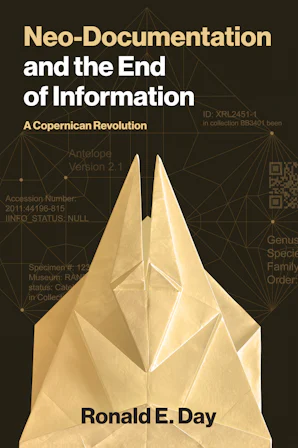
Ronald Day’s Neo-Documentation and the End of Information critiques the modern conception of information as representational “content.” The...
The Micro-Paper: Towards cheaper, citable research ideas and conversations
Academic, peer-reviewed short papers are a common way to present a late-breaking work to the academic community that outlines preliminary findings, research ideas, and novel conversations. By comparison, blogging or writing posts on social media are an unstructured and open way to discuss ideas and start new conversations. Both have limitations in the proliferation of research ideas. The short paper format relies on the conference and journal submission process while blogging does not operate within a structured format or set of expectations at all. However, at times the demand exists for late-breaking ideas and conversations to arise in a raw form or with urgency but should still be archived and recorded in a way that promotes citational honesty and integrity. To address this, I present: The Micro-Paper, as a micro-paper itself. The Micro-Paper is a small, cheap, accessible, digital document that is self-published and archived, akin to a pre-print of a short paper. This meta micro-paper discusses the context, goals, and considerations of micro-paper authoring.

Unbundling Tools for Thought
Disparate thoughts on personal information management after traversing the hype cycle.
Everything is miscellaneous : the power of the new digital disorder
Includes bibliographical references (p. [235]-257) and index; Prologue : information in space -- The new order of order -- Alphabetization and its discontents -- The geography of knowledge -- Lumps and splits -- The laws of the jungle -- Smart leaves -- Social knowing -- What nothing says -- Messiness as a virtue -- The work of knowledge -- Coda : misc; Philosopher Weinberger shows how the digital revolution is radically changing the way we make sense of our lives. Human beings constantly collect, label, and organize data--but today, the shift from the physical to the digital is mixing, burning, and ripping our lives apart. In the past, everything had its one place--the physical world demanded it--but now everything has its places: multiple categories, multiple shelves. Everything is suddenly miscellaneous. Weinberger charts the new principles of digital order that are remaking business, education, politics, science, and culture. He examines how Rand McNally decides what information not to include in a physical map (and why Google Earth is winning that battle), how Staples stores emulate online shopping to increase sales, why your children's teachers will stop having them memorize facts, and how the shift to digital music stands as the model for the future.--From publisher description; From A to Z, Everything Is Miscellaneous will completely reshape the way you think - and what you know - about the world. Includes information on alphabetical order, Amaxon.com, animals, Aristotle, authority, Bettmann Archive, blogs (weblogs), books, broadcasting, British Broadcasting Corporation (BBC), business, card catalog, categories and categorization, clusters, companies, Colon Classification, conversation, Melvil Dewey, Dewey Decimal Classification system, Encyclopaedia Britannica, encyclopedia, essentialism, experts, faceted classification system, first order of order, Flickr.com, Google, Great Books of the Western World, ancient Greeks, health and medical information, identifiers, index, inventory tracking, knowledge, labels, leaf and leaves, libraries, Library of Congress, links, Carolus Linnaeus, lumping and splitting, maps and mapping, marketing, meaning, metadata, multiple listing services (MLS), names of people, neutrality or neutral point of view, New York Public Library, Online Computer Library Center (OCLC), order and organization, people, physical space, everything having place, Plato, race, S.R. Ranganathan, Eleanor Rosch, Joshua Schacter, science, second order of order, simplicity, social constructivism, social knowledge, social networks, sorting, species, standardization, tags, taxonomies, third order of roder, topical categorization, tree, Uniform Product Code (UPC), users, Jimmy Wales, web, Wikipedia, etc

How People Use ChatGPT
Despite the rapid adoption of LLM chatbots, little is known about how they are used. We document the growth of ChatGPT’s consumer product from its launch in November 2022 through July 2025, when it had been adopted by around 10% of the world’s adult population. Early adopters were disproportionately male but the gender gap has narrowed dramatically, and we find higher growth rates in lower-income countries. Using a privacy-preserving automated pipeline, we classify usage patterns within a representative sample of ChatGPT conversations. We find steady growth in work-related messages but even faster growth in non-work-related messages, which have grown from 53% to more than 70% of all usage. Work usage is more common for educated users in highly-paid professional occupations. We classify messages by conversation topic and find that “Practical Guidance,” “Seeking Information,” and “Writing” are the three most common topics and collectively account for nearly 80% of all conversations. Writing dominates work-related tasks, highlighting chatbots’ unique ability to generate digital outputs compared to traditional search engines. Computer programming and self-expression both represent relatively small shares of use. Overall, we find that ChatGPT provides economic value through decision support, which is especially important in knowledge-intensive jobs.

Karpathy's LLM Knowledge Base Wiki for Enterprise | Vijoy Pandey posted on the topic | LinkedIn
There's a new kind of computer media in the enterprise: Write once, Read never. The docs are perpetually stale, constantly diverging from reality, and scattered across Confluence, SharePoint, GitHub, Webex (or Slack) threads, Notion, Obsidian - and in my personal life, add Apple Notes, Goodnotes, web clippings, and multiple Google Drives worth of docs and slides that nobody is ever going back to. Karpathy tweeted his LLM knowledge base wiki architecture which went viral last weekend and I decided to give it a run yesterday. Verdict: You *have* to try this out. Prediction: You won’t be able to live without it soon. There were a few mods and decisions I made to the base Karpathy provided. First, the vault / folder structure in Obsidian. I already use Obsidian as a human. Instead of creating separate vaults and dealing with the sync nightmare, I just have folders for Human and Agent, and a Raw folder. (1) The Human/ folder is where I write long form articles and notes independent of the knowledge base wiki. No LLM or agent touches this folder. (2) I do have Arnold Layne, my OpenClaw agent, doing background tasks for me. Raw/ is where both Arnold and I, dump raw snippets. Inclusive of diverse kinds of media. (3) The Agent/ folder is where the LLM (Claude in my case) synthesizes the wiki. No human touches this folder. Second, some customizations to CLAUDE.md for enterprise-like usage - (4) Domain extensions - the agent needs to know that quantum computing and agentic AI have different entity types and different provenance thresholds. (5) Primary source protection, when I drop in my own original work, secondary sources can extend it or raise questions against it, but they cannot overwrite it. It sounds like a small thing but its’s not, especially at enterprise scale where provenance actually matters. Karpathy is upfront that what he’s built is working memory for a single agent, and it’s truly remarkable at that. The jump to Shared Context across teams, reconciling conflicting beliefs at org scale, ontologies that don’t collapse under the weight of a hundred contributors - those are much harder problems and what we are exploring with the Internet of Cognition. PS: The screenshot shows my Obsidian vault after just two runs: one with Karpathy’s original tweet and gist file itself (so meta!) and one with our Internet of Cognition paper. Claude (Sonnet) read it, compiled it into structured summaries, entity pages, concept pages, backlinks, merged all the information cohesively, and keeps it all maintained from there. You just read the Wiki. It’s simply magical.

On fun simple social building blocks… - Scraps!
Replying to Jared's thoughts on decomposing social media experiences into building blocks (identities, data, interfaces) with some building blocks I'd like to explore in Leaflet!
The information flaneur: a fresh look at information seeking
Just in time software
I didn’t plan to write software in the grocery store last night. I was tired and hungry, kids in tow. My long shopping list sat in a text message. I wished I could check items off as I found them. Ideas filtered through my head: I could transfer the list to a piece of paper: too tedious I could copy/paste it into a notes app or an email draft and delete items: too much tapping I could search the web and app store for a thing that would do what I want (of which there were no doubt a great many): slow and painful and annoying Nope nope nope nope nope.
Creative Reading: Scaffolding Reading for Transformation
However, recent work on augmenting reading largely focuses on making reading more efficient, especially in knowledge-intensive contexts where people must rapidly make sense of research papers and other complex documents (Lo et al., 2024). These systems often aim to help readers skim, summarize, and synthesize large volumes of information in order to reduce cognitive effort and accelerate document- and corpus-level sensemaking at scale (Gu et al., 2025; Lo et al., 2024; Fok et al., 2023). At one extreme, the form of reading implicitly envisioned by these systems may resemble what we call “reading to discard”: extracting the essential, actionable informational core of a document as quickly and efficiently as possible, so that the rest can be swiftly tossed aside—much like we often process inbound mail. This motivates us to ask what scaffolding approaches might resist “reading to discard,” what alternative forms of reading we might scaffold, and what alternative views and values of reading might guide the conversation.
Scrappy – Make little apps for you and your friends | Hacker News
Decker[2] (which is also open-source) has answers to several of the things outlined on Scrappy’s roadmap, including facilities for representing and manipulating tabular data with its query language and grid widgets and the ability for users to abstract collections of parts into reusable "Contraptions".
Manuscript submission systems and metadata completeness in Crossref: Patterns and associations
The importance of open research information, particularly publication metadata, is widely recognised. Crossref is one of the most important infrastructures for registering open metadata as part of DOI record registration. It is widely known, however, that the metadata of many publications is far from complete, with many publishers making certain metadata openly available, but failing to do so for other metadata elements. Publishers’ ability to register this metadata with Crossref depends on their capacity to capture and retain this data in their production workflows. Manuscript submission systems are an important, yet largely overlooked, factor in the extent to which publishers make metadata available through Crossref. In this paper, we present the results of an analysis investigating the relation between the level of metadata that publishers deposit with Crossref and the submission systems that they deploy for their journals. We have looked at the 153 publishers with the largest amounts of publications in Crossref and concentrate on the four most commonly used systems: Editorial Manager, ScholarOne, Open Journal Systems (OJS) and eJournalPress. We show that some submission systems appear better suited to capturing certain metadata elements. However, there are always cases where publishers using the same system differ widely in the level of metadata they register, suggesting that technology is not the only prohibiting factor and other considerations are at play.
Erasure and Slop - Human-Generated Content · augment
Human Generated Content, Issue 4
Back into blogging and just published something I've been thinking about for a while now – making archival content more resilient and discoverable on atproto. Oral history, interactive transcripts, content addressing, and keeping important stories from being quietly erased. maboa.it/resilient-archives-on-the-at-…

Keeping Archives Alive: Resilience and Discovery on ATProto
maboa.itPost-Archive-Everything

For me personally there is a journey here - I was a firm believer in archive everything. This peaked in a period where I was very interested in IPFS, CIDs, CAS, etc. Now, the next step. Post-Archive(-Everything). Through a series of conversations I came to the conclusion that forgetting is probably more powerful than remembering. The links in this collections play a similar note, or are related to my understanding of this.
FOSDEM 2026 - Willow - Protocols for an uncertain future
Willow - Home
I Deleted My Second Brain

