Software-merging techniques face the challenge of finding a balance between precision and performance. In practice, developers use unstructured-merge (i.e., line-based) tools, which are fast but imprecise. In academia, many approaches incorporate information on the structure of the artifacts being merged. While this increases precision in conflict detection and resolution, it can induce severe performance penalties. Striving for a proper balance between precision and performance, we propose a structured-merge approach with auto-tuning. In a nutshell, we tune the merge process on-line by switching between unstructured and structured merge, depending on the presence of conflicts. We implemented a corresponding merge tool for Java, called JDime. Our experiments with 8 real-world Java projects, involving 72 merge scenarios with over 17 million lines of code, demonstrate that our approach indeed hits a sweet spot: While largely maintaining a precision that is superior to the one of unstructured merge, structured merge with auto-tuning is up to 12 times faster than purely structured merge, 5 times on average.
mergiraf
A syntax-aware git merge driver for a growing collection of programming languages and file formats.
weave — Merge without conflicts
Entity-level semantic merge driver for Git. Two agents edit different functions in the same file? Clean merge. Every time.
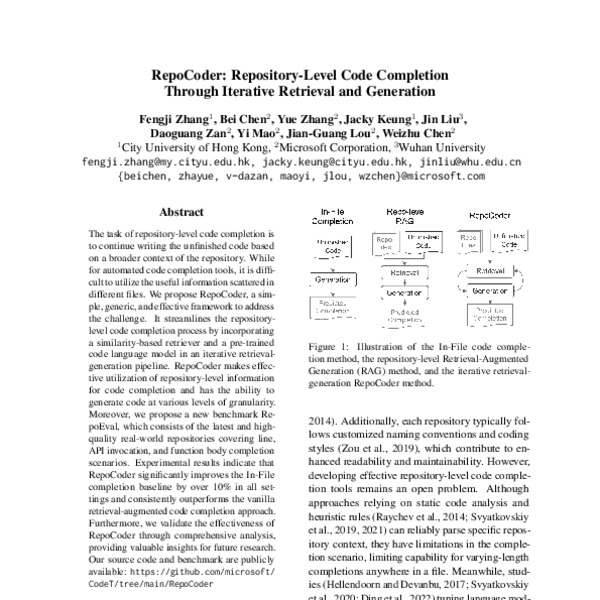
RepoCoder: Repository-Level Code Completion Through Iterative Retrieval and Generation
The task of repository-level code completion is to continue writing the unfinished code based on a broader context of the repository. While for automated code completion tools, it is difficult to utilize the useful information scattered in different files. We propose RepoCoder, a simple, generic, and effective framework to address the challenge. It streamlines the repository-level code completion process by incorporating a similarity-based retriever and a pre-trained code language model in an iterative retrieval-generation pipeline. RepoCoder makes effective utilization of repository-level information for code completion and has the ability to generate code at various levels of granularity. Moreover, we propose a new benchmark RepoBench, which consists of the latest and high-quality real-world repositories covering line, API invocation, and function body completion scenarios. Experimental results indicate that RepoCoder significantly improves the In-File completion baseline by over 10% in all settings and consistently outperforms the vanilla retrieval-augmented code completion approach. Furthermore, we validate the effectiveness of RepoCoder through comprehensive analysis, providing valuable insights for future research. Our source code and benchmark will be publicly available after the paper review.
A Categorical Theory of Patches
When working with distant collaborators on the same documents, one often uses a version control system, which is a program tracking the history of files and helping importing modifications brought by others as patches. The implementation of such a system requires to handle lots of situations depending on the operations performed by users on files, and it is thus difficult to ensure that all the corner cases have been correctly addressed. Here, instead of verifying the implementation of such a system, we adopt a complementary approach: we introduce a theoretical model, which is defined abstractly by the universal property that it should satisfy, and work out a concrete description of it. We begin by defining a category of files and patches, where the operation of merging the effect of two coinitial patches is defined by pushout. Since two patches can be incompatible, such a pushout does not necessarily exist in the category, which raises the question of which is the correct category to represent and manipulate files in conflicting state. We provide an answer by investigating the free completion of the category of files under finite colimits, and give an explicit description of this category: its objects are finite sets labeled by lines equipped with a transitive relation and morphisms are partial functions respecting labeling and relations.
WiCER: Wiki-memory Compile, Evaluate, Refine Iterative Knowledge Compilation for LLM Wiki Systems
The LLM Wiki pattern, to compile and provide domain knowledge into a persistent artifact and serve it to LLMs via KV cache inference, promises context access at sub-second latency with zero retrieval failure. Realizing this requires solving the compilation gap: LLM compilation distilling raw documents into a wiki without catastrophically discarding critical facts. We characterize this gap across 17 RepLiQA domains (6,800 questions): we observe that full context KV cache inference outperforms RAG on curated knowledge (4.38 vs. 4.08 out of 5, 7.3 faster TTFT) but degrades below RAG at scale due to attention dilution, and blind compilation fails entirely (2.14 to 2.32 vs. 3.46, 53 to 60% catastrophic failure rate). To address the compilation gap, we propose WiCER (Wiki-memory Compile, Evaluate, Refine), an iterative algorithm inspired by counterexample-guided abstraction refinement (CEGAR) that closes this gap. WiCER evaluates compiled wikis against diagnostic probes, identifies dropped facts, and forces their preservation in subsequent compilations. One to two iterations recover 80% of lost quality (mean 3.24 vs. 3.47 for raw full-context across the 15 topics with baselines), reducing catastrophic failures by 55% relative. An ablation across all 17 topics confirms that targeted diagnosis (+0.95), not generic pinning (+0.16), drives the gains. All code and benchmarks are released for reproducible research.

Compiling Match Statements to Bytecode
Full pipeline deep dive for purple garden: AST, BB SSA IR, Bytecode, Optimisations
Ante: A New Way to Blend Borrow Checking and Reference Counting
Ante has taken the first step towards something we all thought was impossible: blending reference counting and borrow checking without run-time crashes. 0
jdefrancesco/dskDitto
Ultra fast and easy duplicate file finder. Awesome TUI/GUI to manage results.
Solving Git's Pain Points with Jujutsu (with Martin von Zweigbergk)
Making Databases Faster with LLM Evolutionary Sampling
Traditional query optimization relies on cost-based optimizers that estimate execution cost (e.g., runtime, memory, and I/O) using predefined heuristics and statistical models. Improving these heuristics requires substantial engineering effort, and even when implemented, these heuristics often cannot take into account semantic correlations in queries and schemas that could enable better physical plans. Using our DBPlanBench harness for the DataFusion engine, we expose the physical plan through a compact serialized representation and let the LLM propose localized edits that can be applied and executed. We then apply an evolutionary search over these edits to refine candidates across iterations. Our key insight is that LLMs can leverage semantic knowledge to identify and apply non-obvious optimizations, such as join orderings that minimize intermediate cardinalities. We obtain up to 4.78$\times$ speedups on some queries and we demonstrate a small-to-large workflow in which optimizations found on small databases transfer effectively to larger databases.
Fine-grained and accurate source code differencing | Proceedings of the 29th ACM/IEEE International Conference on Automated Software Engineering
As part of the Digital Library's transition to Open Access, new features for researchers are available in the Premium Edition. Click here to learn more.

Trusting AI with Your Data: Safe Automation from Branch to Production
Retrieval-Augmented Code Generation: A Survey with Focus on Repository-Level Approaches
Recent advancements in large language models (LLMs) have substantially improved automated code generation. While function-level and file-level generation have achieved promising results, real-world software development typically requires reasoning across entire repositories. This gives rise to the challenging task of Repository-Level Code Generation (RLCG), where models must capture long-range dependencies, ensure global semantic consistency, and generate coherent code spanning multiple files or modules. To address these challenges, Retrieval-Augmented Generation (RAG) has emerged as a powerful paradigm that integrates external retrieval mechanisms with LLMs, enhancing context-awareness and scalability. In this survey, we provide a comprehensive review of research on Retrieval-Augmented Code Generation (RACG), with an emphasis on repository-level approaches. We categorize existing work along several dimensions, including generation strategies, retrieval modalities, model architectures, training paradigms, and evaluation protocols. Furthermore, we summarize widely used datasets and benchmarks, analyze current limitations, and outline key challenges and opportunities for future research. Our goal is to establish a unified analytical framework for understanding this rapidly evolving field and to inspire continued progress in AI-powered software engineering.
A Conflict-Free Replicated JSON Datatype
Many applications model their data in a general-purpose storage format such as JSON. This data structure is modified by the application as a result of user input. Such modifications are well understood if performed sequentially on a single copy of the data, but if the data is replicated and modified concurrently on multiple devices, it is unclear what the semantics should be. In this paper we present an algorithm and formal semantics for a JSON data structure that automatically resolves concurrent modifications such that no updates are lost, and such that all replicas converge towards the same state (a conflict-free replicated datatype or CRDT). It supports arbitrarily nested list and map types, which can be modified by insertion, deletion and assignment. The algorithm performs all merging client-side and does not depend on ordering guarantees from the network, making it suitable for deployment on mobile devices with poor network connectivity, in peer-to-peer networks, and in messaging systems with end-to-end encryption.
Speed Comparison - Programming Languages
Benchmarks run on GitHub Actions. Results may vary based on runner hardware.
Unison | A friendly, statically-typed, functional programming language from the future · Unison programming language
A friendly programming language from the future.