


This summary was generated using automated tools and was not authored or reviewed by the article's author(s). It is provided to support discovery, help readers assess relevance, and assist readers from adjacent research areas in understanding the work. It is intended to complement the author-supplied abstract, which remains the primary summary of the paper. The full article remains the authoritative version of record. Click here to learn more.
Instrumental interaction: an interaction model for designing post-WIMP user interfaces
Although the power of personal computers has increased 1000-fold over the past 20 years, user interfaces remain essentially the same. Innovations in HCI research, particularly novel interaction techniques, are rarely incorporated into products. In this ...

Instrumental interaction: an interaction model for designing post-WIMP user interfaces
As part of the Digital Library's transition to Open Access, new features for researchers are available in the Premium Edition. Click here to learn more.
Instrumental interaction: an interaction model for designing post-WIMP user interfaces
As part of the Digital Library's transition to Open Access, new features for researchers are available in the Premium Edition. Click here to learn more.
Substrates 2025 - Proceedings
This initial workshop of the Substrates community was held on June 3rd, 2025, hosted at the ‹Programming› 2025 Conference at Prague, Czechia.
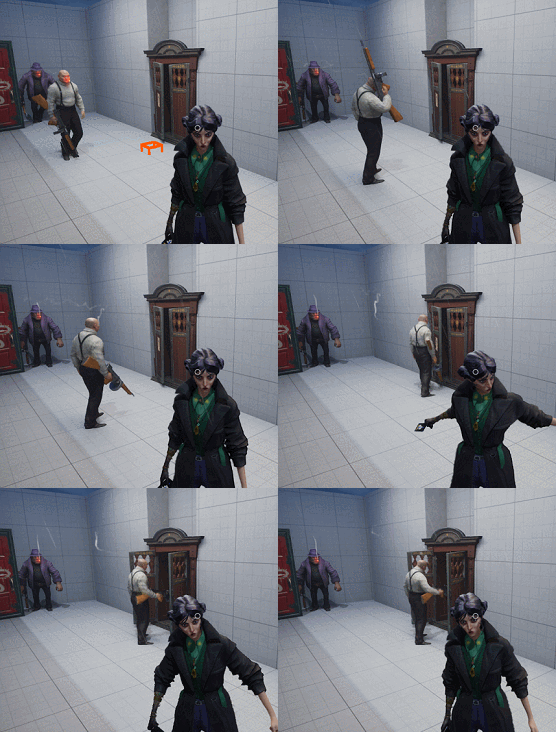
“interest sources”, contextual interactions for NPCs in Sleight of Hand
I’ve worked with a few “target-based” contextual interaction systems for NPCs on different projects, they’re one of my favourite things to make, and lately I’ve been making one for Sleight of Hand, a stealth game I’m working on at RiffRaff, deets of which I shall here now divulge. Everyone calls these objects something different: at Wolfeye and (I think) Arkane they were Distractions, I’ve also heard Smart Objects and Chores, but I call them Interest Sources on account of I first read about them in a technical article about Mark Of The Ninja while working on The Siege & The Sandfox, whose interest system I also made.
Why Do We Interface?
In this micro book we look at the past, present, and future of interfaces and how they allow us to utilize information in ways that change what it means to be human.

About — Every Object an Archive
We interview people about their experiences with technological objects that were once everywhere, but are now being replaced or redesigned. We are interested in the physical experience of living with these objects, their handfeel and relationships to our bodies. We are also interested in how they shaped our habits, relationships, and ways of being. Technologies are more than physical objects: whole worlds of infrastructure, process, policy and culture are built around them.

Substrates vision statement
Submitted to Substrates-25 Workshop Jonathan EdwardsMay 12, 2025

Interface Experimentation | Projects
This page indexes the files currently present in interface-experiments.
Substrates conference series - Substrates 2026
An increasing number of researchers see their work as interactive authoring tools or software substrates for interactive computational media. By talking about “authoring tools”, we remove the divide between programmers and users; “software substrates” let us look beyond conventional programming languages and systems; and “interactive computational media” promises a more malleable and adaptable notion of tools for thought we are striving for. This workshop aims to bring together a wide range of perspectives on these matters.
Design Frictions for Mindful Interactions: The Case for Microboundaries
Design frictions, a term found in popular media articles about user experience design, refer to points of difficulty occurring during interaction with technology. Such articles often argue that these frictions should be removed from interaction flows in order to reduce the risk of user frustration and disengagement. In this paper we argue that, in many scenarios, designing friction into interactions through the introduction of microboundaries, can, in fact, have positive effects. Design frictions can disrupt "mindless" automatic interactions, prompting moments of reflection and more "mindful" interaction. The potential advantages of intentionally introduced frictions are numerous: from reducing the likelihood of errors in data-entry tasks, to supporting health-behaviour change.

Close to the Metal — Real Life
The value of reintroducing friction into our interactions with computers

UChicago's Human Computer Integration Lab at CHI 2025 (Introduction by Pedro Lopes)
Welcoming The Interaction Company
Today, we’re welcoming The Interaction Company of California, the makers of Poke, to Cognition.
AlterEgo: Interfacing with devices through silent speech