


As part of the Digital Library's transition to Open Access, new features for researchers are available in the Premium Edition. Click here to learn more.
What is AI Literacy? Competencies and Design Considerations
As part of the Digital Library's transition to Open Access, new features for researchers are available in the Premium Edition. Click here to learn more.

Do People Engage Cognitively with AI? Impact of AI Assistance on Incidental Learning
As part of the Digital Library's transition to Open Access, new features for researchers are available in the Premium Edition. Click here to learn more.
Feeding the Beast: Superintelligence, Corporate Capitalism and the End of Humanity
As part of the Digital Library's transition to Open Access, new features for researchers are available in the Premium Edition. Click here to learn more.

AI Suggestions Homogenize Writing Toward Western Styles and Diminish Cultural Nuances
As part of the Digital Library's transition to Open Access, new features for researchers are available in the Premium Edition. Click here to learn more.

What AI Asks of Open Access - The Scholarly Kitchen
As AI systems increasingly reason from the scientific literature, the integrity signals that make research trustworthy - open data, structured metadata, robust retraction processes - matter more than ever. PLOS CEO Alison Mudditt on why open access publishers have a different set of obligations in an AI world.

New Studies Confirm Today’s Academic Publishing System Is A Terrible Deal For Society · Techdirt
Walled Culture has just written about the possibility that recent AI breakthroughs might accelerate a move to open access, at least in the field of mathematics. It would be particularly welcome against a backdrop of relatively slow progress in the open access world. That is not because the need for different business models that provide...
OpenAccess.ai — Rigorous Open Access Publishing
$20 to submit, free to read. AI peer review. Open to human and machine authors. All articles CC-BY 4.0.

Governing the scholarly AI Commons – Open Future
New report explores how academic communities can shape AI governance in research and publishing, from regulation to community-led approaches.
Incomplete Contracting and AI Alignment
As part of the Digital Library's transition to Open Access, new features for researchers are available in the Premium Edition. Click here to learn more.

Unpacking Open Source Artificial Intelligence: Toward a Framework for Openness in Foundation Models
Openness has long driven innovation in software,9 and AI is no exception.12 While some see openness in foundation models (FMs) as a security threat,18 others argue that restricting access will not meaningfully reduce risk and will limit the benefits of transparency, research, and global participation.3 As the EU AI Act reporting requirements on FMs—also referred to as general-purpose AI models (GPAIMs)—move toward implementation, there is an urgent need for a more nuanced and informed understanding of openness in AI systems.

White Paper on Public AI – Open Future
Today's AI landscape is dominated by a few tech companies. This White Paper presents an alternative: Public AI systems built on transparency, democratic governance, and open access to critical infrastructure.
As more Americans adopt AI tools, fewer say they can trust the results | TechCrunch
AI adoption is rising in the U.S., but trust remains low, with most Americans concerned about transparency, regulation, and the technology’s broader societal impact, according to a new Quinnipiac poll.

OpenAI, Google, and Microsoft Back Bill to Fund ‘AI Literacy’ in Schools
A new bill introduced by Senators Adam Schiff and Mike Rounds would award grants to the National Science Foundation—which has endured massive funding cuts under the Trump Administration for science research—to put “AI literacy” in schools.

AI-assisted Reviewing is Necessary and Should be Open
Peer review is facing a death spiral. AI production tools are speeding it up. AI-assisted reviewing is necessary and should be open.
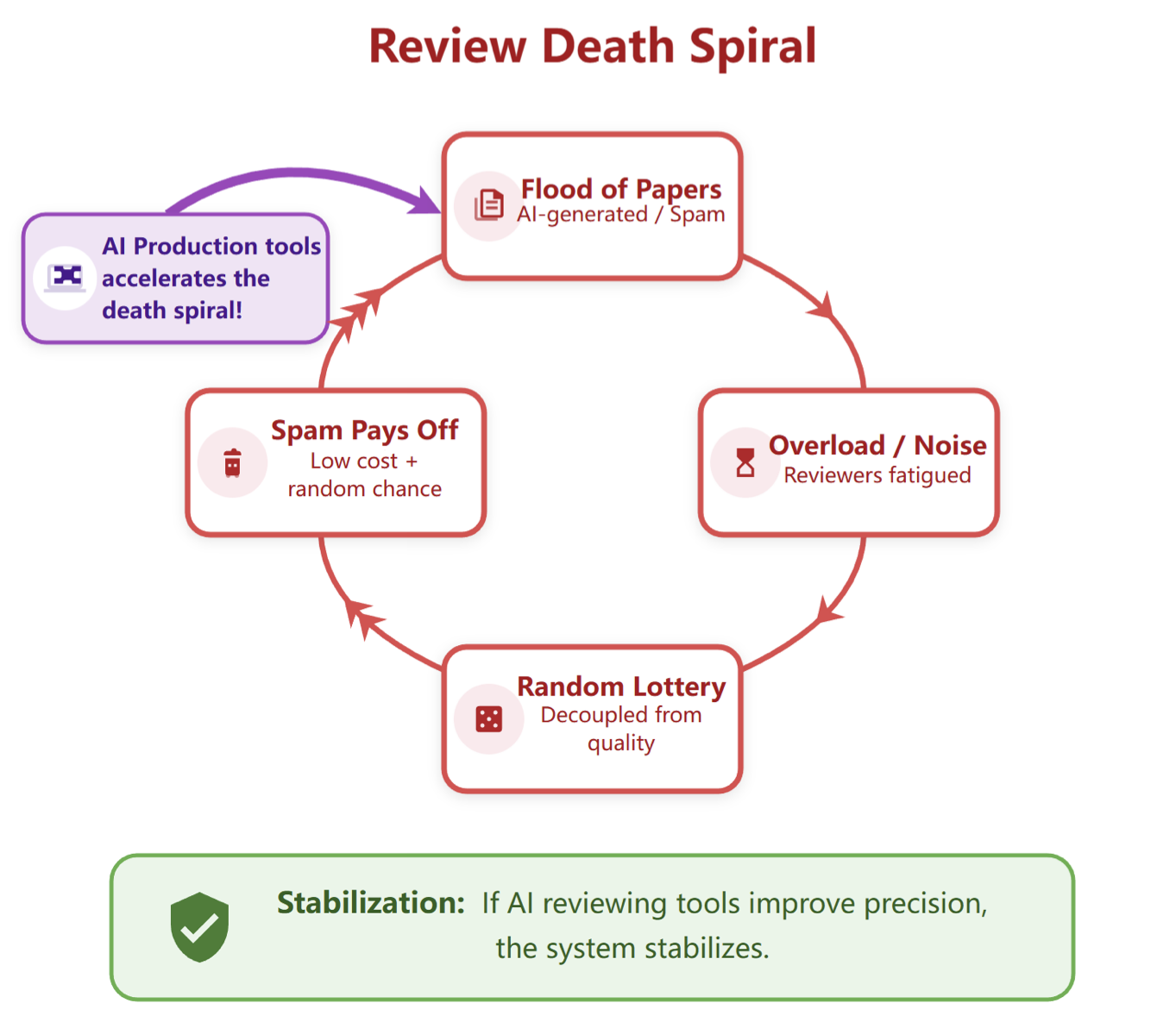
"AI makes it cheaper to contribute to Open Source, but it's not making life easier for maintainers. More contributions are flowing in, but the burden of evaluating them still falls on the same small group of people. That asymmetric pressure risks breaking maintainers." also relevant to slop science
Peer review is facing a death spiral, and AI production tools are speeding it up. AI-assisted reviewing is necessary and should be open. We built OpenAIReview: open AI reviewing for everyone, for the cost of a coffee. openaireview.github.io/blog.html 🧵

AI-assisted Reviewing is Necessary and Should be Open
openaireview.github.io
