

As part of the Digital Library's transition to Open Access, new features for researchers are available in the Premium Edition. Click here to learn more.
Boomerang | Proceedings of the 35th annual ACM SIGPLAN-SIGACT symposium on Principles of programming languages
Bidirectional programming languages are a practical approach to the view update problem. Programs in these languages, called lenses, define both a view and an update policy - i.e., every program can be read as a function mapping sources to views as well ...

The mythical matched modules | Proceedings of the 24th ACM SIGPLAN conference companion on Object oriented programming systems languages and applications
Certified compilers are complex software systems. Like other large systems, they demand modular, extensible designs. While there has been progress in extensible metatheory mechanization, scaling extensibility and reuse to meet the demands of full ...

A theory of type polymorphism in programming
The aim of this work is largely a practical one. A widely employed style of programming, particularly in structure-processing languages which impose n…
Theorems for free! | Proceedings of the fourth international conference on Functional programming languages and computer architecture
The polymorphic blame calculus integrates static typing, including universal types, with dynamic typing. The primary challenge with this integration is preserving parametricity: even dynamically-typed code should satisfy it once it has been cast to a ...
Resugaring | Proceedings of the 35th ACM SIGPLAN Conference on Programming Language Design and Implementation
Syntactic sugar plays a crucial role in engineering programming languages. It offers convenient syntax and higher-level of abstractions, as witnessed by its pervasive use in both general-purpose and domain-specific contexts. Unfortunately, the ...

Integrating functional and imperative programming | Proceedings of the 1986 ACM conference on LISP and functional programming
We present a new model, based on monads, for performing input/output in a non-strict, purely functional language. It is composable, extensible, efficient, requires no extensions to the type system, and extends smoothly to incorporate mixed-language ...
The Principal Type-Scheme of an Object in Combinatory Logic
R. Hindley, The Principal Type-Scheme of an Object in Combinatory Logic, Transactions of the American Mathematical Society, Vol. 146 (Dec., 1969), pp. 29-60
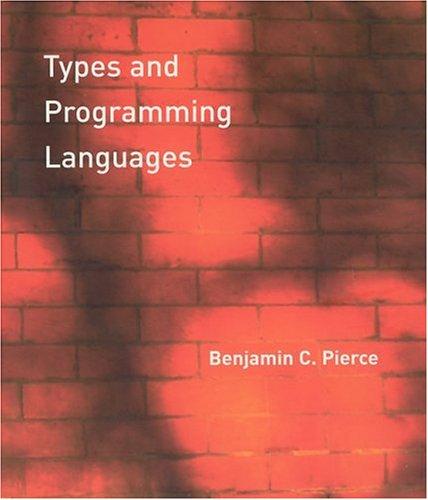
Types and Programming Languages
A type system is a syntactic method for automatically checking the absence of certain erroneous behaviors by classifying program phrases according to the kinds of values they compute. The study of type systems--and of programming languages from a type-theoretic perspective -- -has important applications in software engineering, language design, high-performance compilers, and security. This text provides a comprehensive introduction both to type systems in computer science and to the basic theory of programming languages. The approach is pragmatic and operational; each new concept is motivated by programming examples and the more theoretical sections are driven by the needs of implementations. Each chapter is accompanied by numerous exercises and solutions, as well as a running implementation, available via the Web. Dependencies between chapters are explicitly identified, allowing readers to choose a variety of paths through the material. The core topics include the untyped lambda-calculus, simple type systems, type reconstruction, universal and existential polymorphism, subtyping, bounded quantification, recursive types, kinds, and type operators. Extended case studies develop a variety of approaches to modeling the features of object-oriented languages.
Quotient lenses | Proceedings of the 13th ACM SIGPLAN international conference on Functional programming
Bidirectional programming languages are a practical approach to the view update problem. Programs in these languages, called lenses, define both a view and an update policy - i.e., every program can be read as a function mapping sources to views as well ...

Symmetric lenses | Proceedings of the 38th annual ACM SIGPLAN-SIGACT symposium on Principles of programming languages
A lens is a bidirectional transformation between a pair of connected data structures, capable of translating an edit on one structure into an appropriate edit on the other. Many varieties of lenses have been studied, but none, to date, has offered a ...

Generic deriving of generic traversals | Proceedings of the ACM on Programming Languages
Functional programmers have an established tradition of using traversals as a design pattern to work with recursive data structures. The technique is so prolific that a whole host of libraries have been designed to help in the task of automatically ...

Functional Query Languages with Categorical Types
We study three category-theoretic types in the context of functional query languages (typed lambda-calculi extended with additional operations for bulk data processing). The types we study are:
A modal analysis of staged computation | Journal of the ACM
We show that a type system based on the intuitionistic modal logic S4 provides an expressive framework for specifying and analyzing computation stages in the context of typed λ-calculi and functional languages. We directly demonstrate the sense in which ...

Programming Language Foundations in Agda – Table of Contents
This book is an introduction to programming language theory using the proof assistant Agda.
Foundations of Algebraic Specification and Formal Software Development
This book provides foundations for software specification and formal software development from the perspective of work on algebraic specification, concentrating on developing basic concepts and studying their fundamental properties. These foundations are built on a solid mathematical basis, using elements of universal algebra, category theory and logic, and this mathematical toolbox provides a convenient language for precisely formulating the concepts involved in software specification and development. Once formally defined, these notions become subject to mathematical investigation, and this interplay between mathematics and software engineering yields results that are mathematically interesting, conceptually revealing, and practically useful. The theory presented by the authors has its origins in work on algebraic specifications that started in the early 1970s, and their treatment is comprehensive. This book contains five kinds of material: the requisite mathematicalfoundations; traditional algebraic specifications; elements of the theory of institutions; formal specification and development; and proof methods. While the book is self-contained, mathematical maturity and familiarity with the problems of software engineering is required; and in the examples that directly relate to programming, the authors assume acquaintance with the concepts of functional programming. The book will be of value to researchers and advanced graduate students in the areas of programming and theoretical computer science.