The growth of the availability and use of detailed household financial transaction micro data has dramatically expanded the ability of researchers to understand both household decision making and aggregate economic fluctuations across a wide range of fields. This class of transaction data is derived from a myriad of sources, including financial institutions, FinTech apps, and payment intermediaries. We review how these detailed data have been utilized in finance and economics research and analyze both their benefits and limitations as compared to more traditional measures of income, spending, and wealth. Finally, we discuss the future potential of this flexible class of data in firm-focused research, real-time policy analysis, and macro statistics.
Debt and the Response to Household Income Shocks: Validation and Application of Linked Financial Account Data
The increasing availability of data derived from linked consumer financial accounts has the potential to dramatically expand the potential for research. Examining the most comprehensive existing set of linked-account data, consisting of transaction and balance sheet data for millions of Americans, I demonstrate the power and versatility of such sources. I discuss advantages and concerns arising from this type of data and match a range of distributional moments to external sources. As one application, I test consumption elasticities across households with varying levels, and types, of debt. I find that heterogeneity in consumption elasticity can be explained entirely by credit and liquidity.

Household Finance
Household financial decisions are complex, interdependent, and heterogeneous, and central to the functioning of the financial system. We present an overview of the rapidly expanding literature on household finance (with some important exceptions) and suggest directions for future research. We begin with the theory and empirics of asset market participation and asset allocation over the life cycle. We then discuss household choices in insurance markets, trading behavior, decisions on retirement saving, and financial choices by retirees. We survey research on liabilities, including mortgage choice, refinancing, and default, and household behavior in unsecured credit markets, including credit cards and payday lending. We then connect the household to its social environment, including peer effects, cultural and hereditary factors, intra-household financial decision-making, financial literacy, cognition, and educational interventions. We also discuss literature on the provision and consumption of financial advice.
The Co-holding Puzzle: New Evidence from Transaction-Level Data
Using detailed and highly disaggregated data on household finances, we examine the<br>tendency of consumers to “co-hold” savings and debt simultaneously. The di

Harnessing naturally occurring data to measure the response of spending to income
Balancing your incomings and outgoings Economic theory predicts that when someone receives money should have little effect on their spending patterns. Gelman et al. constructed a data set of 60 million transactions made by 75,000 people to test this theory. People do seem to go on a mini–spending spree after they get their paychecks or pensions. However, closer inspection reveals that that's mostly explained by the convenience of linking regular payments, such as rent and utilities, to regular income. Unsurprisingly, cash-strapped people are more likely to increase their spending in response to receiving income. Science , this issue p. 212 , How do theoretical predictions of individual fiscal behaviors match up against real-world, real-time data? , This paper presents a new data infrastructure for measuring economic activity. The infrastructure records transactions and account balances, yielding measurements with scope and accuracy that have little precedent in economics. The data are drawn from a diverse population that overrepresents males and younger adults but contains large numbers of underrepresented groups. The data infrastructure permits evaluation of a benchmark theory in economics that predicts that individuals should use a combination of cash management, saving, and borrowing to make the timing of income irrelevant for the timing of spending. As in previous studies and in contrast to the predictions of the theory, there is a response of spending to the arrival of anticipated income. The data also show, however, that this apparent excess sensitivity of spending results largely from the coincident timing of regular income and regular spending. The remaining excess sensitivity is concentrated among individuals with less liquidity.
The Coholding Puzzle: New Evidence from Transaction-Level Data
Abstract Why do individuals pay debt interest when they could use their savings to pay down the debt? We explore why individuals “cohold” debt and savings using detailed and highly disaggregated daily-level data on household finances. We find that coholding mostly occurs in short spells within the month and the level of coholding is typically modest. Periods of coholding are not associated with shocks at the individual level. We show that mental accounting has a role to play in explaining coholding, in particular how individuals allocate different categories of expenditure to accounts in credit and debit.
How Are SNAP Benefits Spent? Evidence from a Retail Panel
We use a novel retail panel with detailed transaction records to study the effect of the Supplemental Nutrition Assistance Program (SNAP) on house-hold spending. We use administrative data to motivate three approaches to causal inference. The marginal propensity to consume SNAP-eligible food (MPCF) out of SNAP benefits is 0.5 to 0.6. The MPCF out of cash is much smaller. These patterns obtain even for households for whom SNAP benefits are economically equivalent to cash because their benefits are below their food spending. Using a semiparametric framework, we reject the hypothesis that households respect the fungibility of money. A model with mental accounting can match the facts.
Household Debt: Facts, Puzzles, Theories, and Policies
Borrowing decisions affect most households, with large stakes and implications for research subfields as varied as macroeconomics and industrial organization. I review theoretical and empirical work on household debt: its prevalence, level, growth, and composition, as well as various measures of consumer choice and market (in)efficiency, elasticities, and prices, including new evidence on how borrowing heterogeneity affects the distribution of the opportunity cost of consumption. I also discuss opportunities and challenges in policy evaluation. A key takeaway is that puzzles abound, and I highlight numerous avenues for further research.
Global Data on Financial Inclusion | FinDev Gateway
Explore our curated list of data sources relevant for microfinance and financial inclusion.
Rules of Thumb in Household Savings Decisions: Estimation Using Threshold Regression
The rules of thumb offered by financial advisors regarding how much to hold in liquid reserves vary widely and usually imply far greater sums than low-income ho
Household Need for Liquidity and the Credit Card Debt Puzzle
Abstract. In the 2001 U.S. Survey of Consumer Finances, 27% of households report simultaneously revolving significant credit card debt and holding sizeable
Cash versus Debit Card: The Role of Budget Control
Due to the financial crisis, an increasing number of households face financial problems. This may lead to an increasing need for monitoring spending and budgets. We demonstrate that both cash and the debit card are perceived as helpful in this respect. We show that, on average, consumers responsible for financial decision making within a household find cash and the debit card equally helpful for monitoring their household finances. Individuals differ in major respects, however. In particular, low earners and the liquidity‐constrained prefer cash as a budgeting tool. Finally, we present evidence that at an aggregated level, such preferences strongly affect consumer payment behavior. These findings suggest that the substitution of cash by cards may slow down because of the financial crisis.

Asymmetric Consumption Smoothing
Analyzing account-level data from an account aggregator, we find that households increase consumption when they receive expected tax refunds, as if they face liquidity constraints. However, these same households smooth consumption when making payments in other years, primarily by transferring funds among liquid accounts. Even households carrying credit card debt smooth consumption when making payments, and even highly liquid households spend out of refunds. This behavior is inconsistent with pure liquidity constraints or hand-to-mouth behavior and is most consistent with a mental accounting life-cycle model.
Exponential Growth Bias and Household Finance
ABSTRACT Exponential growth bias is the pervasive tendency to linearize exponential functions when assessing them intuitively. We show that exponential growth bias can explain two stylized facts in household finance: the tendency to underestimate an interest rate given other loan terms, and the tendency to underestimate a future value given other investment terms. Bias matters empirically: More‐biased households borrow more, save less, favor shorter maturities, and use and benefit more from financial advice, conditional on a rich set of household characteristics. There is little evidence that our measure of exponential growth bias merely proxies for broader financial sophistication.

The Ostrich in Us: Selective Attention to Personal Finances
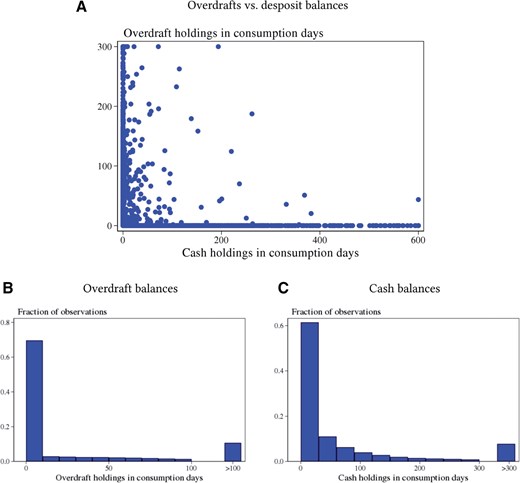
Abstract We analyze attention to personal finances using a high-frequency panel of bank data, including information on logins. We document a number of robust patterns. Relative to their personal histories, individuals pay more attention when holding more cash and liquidity and when receiving income. In contrast, attention decreases discretely as bank account balances go from positive to negative and then decreases further as overdraft debt increases. We conclude that Ostrich effects in a personal finance context, i.e., the avoidance of obtaining information on everyday personal finances, is a widespread phenomenon and explore a number of explanations for our findings.

Liquidity versus Wealth in Household Debt Obligations: Evidence from Housing Policy in the Great Recession
We exploit variation in mortgage modifications to disentangle the impact of reducing long-term obligations with no change in short-term payments ("wealth"), and reducing short-term payments with no change in long-term obligations ("liquidity"). Using regression discontinuity and difference-in-differences research designs with administrative data measuring default and consumption, we find that principal reductions that increase wealth without affecting liquidity have no effect, while maturity extensions that increase only liquidity have large effects. This suggests that liquidity drives default and consumption decisions for borrowers in our sample and that distressed debt restructurings can be redesigned with substantial gains to borrowers, lenders, and taxpayers.
The Impact of Payment Frequency on Consumer Spending and Subjective Wealth Perceptions
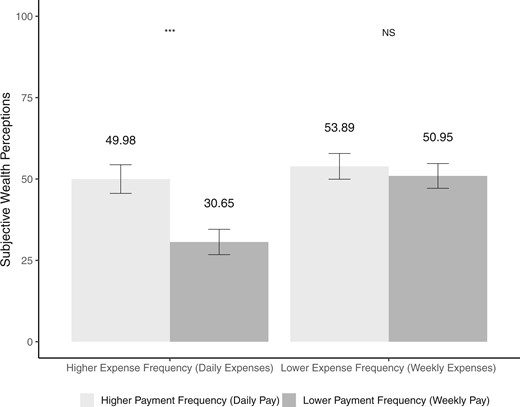
Abstract Payment frequency is a fundamental yet underexplored feature of consumers’ finances. As higher payment frequencies are becoming more prevalent, consumers are receiving more frequent yet smaller paychecks. An analysis of income and expenditure data of over 30,000 consumers from a financial services provider demonstrates a naturally occurring relationship between higher payment frequencies and increased spending. A series of lab studies support this finding, providing causal evidence that higher (vs. lower) payment frequencies increase spending. The effect of payment frequency on spending is driven by changes in consumers’ subjective wealth perceptions. Specifically, higher payment frequencies reduce consumers’ uncertainty in predicting whether they will have enough resources throughout a period, increasing their subjective wealth perceptions. As such, situational factors that reduce prediction uncertainty for those paid less frequently (e.g., the timing of consumers’ expenses, income levels) moderate the impact of payment frequency. The effects of payment frequency on subjective wealth and spending can occur even when objective wealth favors those with lower payment frequencies. More broadly, the current work underscores a need to understand how timing variations in consumers’ income impact their perceptions, behaviors, and general well-being.