


Sign in to access your institutional or personal subscription or get immediate access to your online copy - available in PDF and ePub formats
8 Sample Size Justification – Improving Your Statistical Inferences
This open educational resource contains information to improve statistical inferences, design better experiments, and report scientific research more transparently.
Controlling the False Discovery Rate: A Practical and Powerful Approach to Multiple Testing
SUMMARY The common approach to the multiplicity problem calls for controlling the familywise error rate (FWER). This approach, though, has faults, and we point out a few. A different approach to problems of multiple significance testing is presented. It calls for controlling the expected proportion of falsely rejected hypotheses — the false discovery rate. This error rate is equivalent to the FWER when all hypotheses are true but is smaller otherwise. Therefore, in problems where the control of the false discovery rate rather than that of the FWER is desired, there is potential for a gain in power. A simple sequential Bonferronitype procedure is proved to control the false discovery rate for independent test statistics, and a simulation study shows that the gain in power is substantial. The use of the new procedure and the appropriateness of the criterion are illustrated with examples.

Free EPA 608 Test Study Guide 2026: All Sections + Cheat Sheet
Free EPA 608 test study guide for Core, Type 1, 2, and 3, plus a printable cheat sheet with every number, date, and leak rate the exam tests. No PDF hunt, no signup.
As we may think
As part of the Digital Library's transition to Open Access, new features for researchers are available in the Premium Edition. Click here to learn more.
The control of the false discovery rate in multiple testing under dependency
Benjamini and Hochberg suggest that the false discovery rate may be the appropriate error rate to control in many applied multiple testing problems. A simple procedure was given there as an FDR controlling procedure for independent test statistics and was shown to be much more powerful than comparable procedures which control the traditional familywise error rate. We prove that this same procedure also controls the false discovery rate when the test statistics have positive regression dependency on each of the test statistics corresponding to the true null hypotheses. This condition for positive dependency is general enough to cover many problems of practical interest, including the comparisons of many treatments with a single control, multivariate normal test statistics with positive correlation matrix and multivariate $t$. Furthermore, the test statistics may be discrete, and the tested hypotheses composite without posing special difficulties. For all other forms of dependency, a simple conservative modification of the procedure controls the false discovery rate. Thus the range of problems for which a procedure with proven FDR control can be offered is greatly increased.

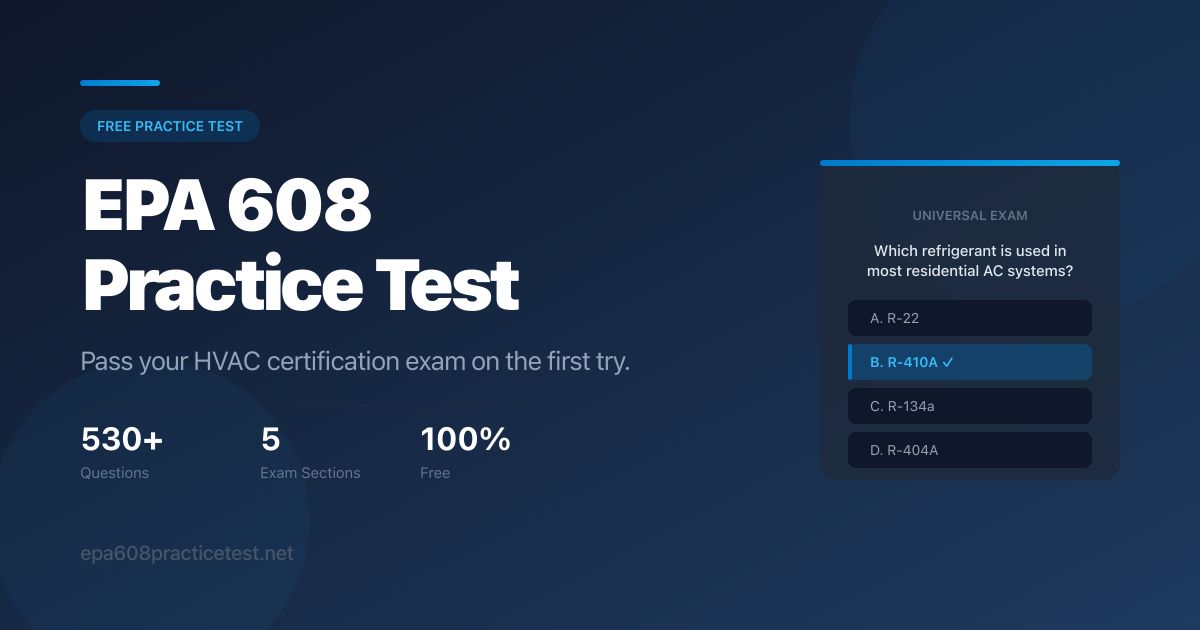
EPA 608 Universal practice test - free, all four sections
Take the free EPA 608 Universal practice test now: 100 questions across Core, Type I, Type II, and Type III. Pass each section at 72% (18 of 25).
EPA 608 Practice Test 2026: Free, Exam Format, All 5 Sections
This free EPA 608 practice test comes from the federal rule and names your weak section. Start with no signup, and all 604 stay free with an account.
calibre - E-book management
calibre: The one stop solution for all your e-book needs. Comprehensive e-book software.
Reading on an e-reader · Standard Reader
Put your unread queue on a Kobo, Kindle or phone as real EPUB files.
From novices to co-pilots: Fixing the limits on scientific knowledge production by accessing or building expertise
As part of the Digital Library's transition to Open Access, new features for researchers are available in the Premium Edition. Click here to learn more.

Martin Eden by Jack London
Free kindle book and epub digitized and proofread by volunteers.

The Application and Its Consequences for Non-Standard Knowledge Work
As part of the Digital Library's transition to Open Access, new features for researchers are available in the Premium Edition. Click here to learn more.

Just sent out an email to folks to for the alpha test of paid memberships for publications! So keep an eye out for that if you filled out the form in this post: lab.leaflet.pub/3mruusj6wtc2j If you're interested in trying it out, DM us or fill out the form!

Piloting paid memberships for the open social web!
lab.leaflet.pubThis is the future of scientific papers. Instead of a PDF, the paper is an AI agent that you can talk to, ask questions, run analyses. No more digging through supplements - just ask the paper directly: "what p-value cutoff was used in Fig 3B? Re-run at 0.01." nature.com/articles/s41586-026-11044-y

Reimagining research papers as interactive and reliable AI agents - Nature
www.nature.comReminder that I maintain a periodically-updated reading list of papers at the intersection of E2EE and Trust & Safety; suggestions welcome: docs.google.com/spreadsheets/d/1aYaDogBF6JegB…

Encryption + Trust & Safety reading list (updated 2026-05-20)
docs.google.com

