

Salami publication or segmented publication is a distinct form of redundant publication which is usually characterized by similarity of hypothesis, methodology or results but not text similarity. These aspects of publications are not objectively detected by software applications and therefore present a serious threat to publication ethics. This article presents a practical approach for dealing with manuscripts suspected of salami publication during the submission process and after article publication in Biochemia Medica.
Salami publication: definitions and examples
Salami publication or segmented publication is a distinct form of redundant publication which is usually characterized by similarity of hypothesis, methodology or results but not text similarity. These aspects of publications are not objectively detected by software applications and therefore present a serious threat to publication ethics. This article presents a practical approach for dealing with manuscripts suspected of salami publication during the submission process and after article publication in Biochemia Medica.

A journal named a sleuth in a correction. The sleuth says that was ‘ethical editorial malpractice’
As the publishing community debates the merits of naming sleuths in retraction or correction notices, one journal did so without the sleuth’s permission — by publishing an email from the authors na…

Why the Stockholm Declaration will never work
Abstract The Stockholm Declaration calls for a moral reformation of scientific publishing—replacing commercial publishers with scholar-led journals, rewarding quality over quantity and instituting independent oversight. While noble in spirit, it fundamentally misdiagnoses the disease. The crisis of science stems not from paper mills or profit motives but from systemic incentives that reward volume, novelty and prestige over validity and reliability. Non-profit ownership will not neutralize the prestige economy, sleuth-led policing cannot scale, and ‘integrity registries’ would merely replace metrics with surveillance. True reform requires rebuilding the publishing infrastructure as a public utility: publicly funded, free to publish and read, and stripped of hierarchy and financial incentives.

Reformation of science publishing: the Stockholm Declaration
Science relies on integrity and trustworthiness. But scientists under career pressure are lured to purchase fake publications from ‘paper mills’ that use AI-generated data, text and image fabrication. The number of low-quality or fraudulent publications is rising to hundreds of thousands per year, which—if unchecked—will damage the scientific and economic progress of our societies. The result is editor and reviewer fatigue, irreproducible experiments, misguided experiments, disinformation and escalating costs that devour funding from taxpayers intended for research. It is high time to reevaluate current publishing models and outline a global plan to stop this unhealthy development. A conference was therefore organized by the Royal Swedish Academy of Sciences to draft an action plan with specific recommendations, as follows. (i) Academia should resume control of publishing using non-profit publishing models (e.g. diamond open-access). (ii) Adjust incentive systems to merit quality, not quantity, in a reputation economy where the gaming of publication numbers and citation metrics distorts the perception of academic excellence. (iii) Implement mechanisms to prevent and detect fake publications and fraud which are independent of publishers. (iv) Draft and implement legislations, regulations and policies to increase publishing quality and integrity. This is a call to action for universities, academies, science organizations and funders to unite and join this effort.

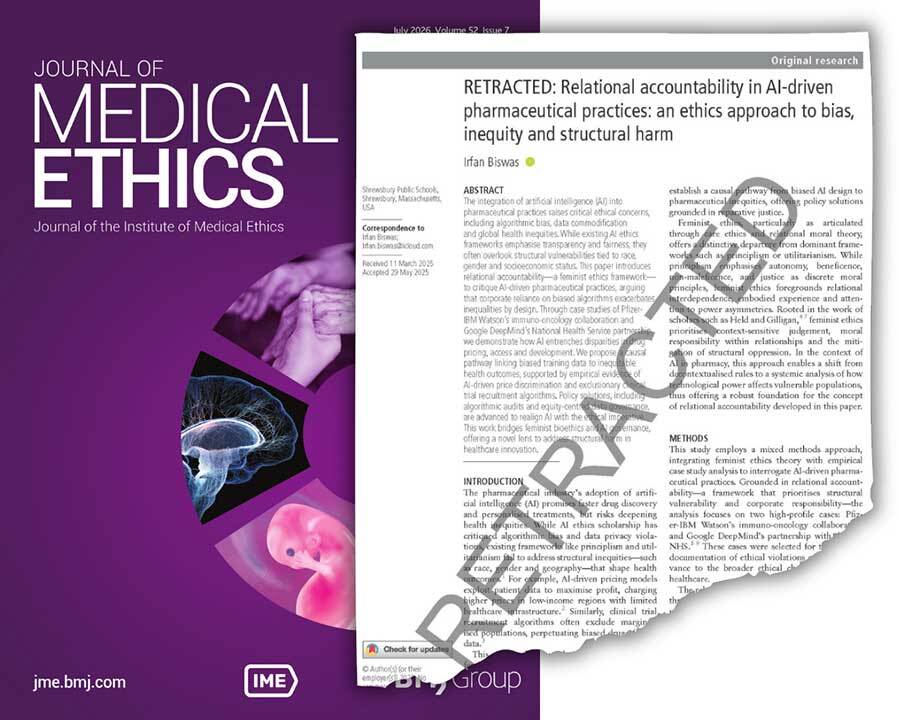
Ethics journal retracts paper by high school student for AI, peer review manipulation
The Journal of Medical Ethics has retracted a paper on the use of AI in the pharmaceutical industry for containing references that don’t exist. The article’s sole author: a high school student.&nbs…
Correction of scientific literature: Too little, too late!
The Coronavirus Disease 2019 (COVID-19) pandemic has highlighted the limitations of the current scientific publication system, in which serious post-publication concerns are often addressed too slowly to be effective. In this Perspective, we offer suggestions to improve academia’s willingness and ability to correct errors in an appropriate time frame.
Paperclip
Paperclip — search, read, and analyze 11M+ biomedical papers, regulatory documents, clinical trials, and biological databases (UniProt, PDB, ChEMBL) from the command line.
Paperclip
Paperclip — search, read, and analyze 11M+ biomedical papers, regulatory documents, clinical trials, and biological databases (UniProt, PDB, ChEMBL) from the command line.
Coordinating Research Assessment And Publishing Reform: Action Groups – ASAPbio
Connect with focused ASAPbio groups working on specific aspects of scientific communication, from preprint review to community engagement.

Reviewing post-publication peer review
Post-publication peer review (PPPR) is transforming how the life sciences community evaluates published manuscripts and data. Unsurprisingly, however, PPPR is experiencing growing pains, and some elements of the process distinct from standard pre-publication review remain controversial. I discuss the rapid evolution of PPPR, its impact, and the challenges associated with it.

Introducing COSIG: The Collection of Open Science Integrity Guides
Investigating the integrity of published scientific papers is key to the scientific process, but the necessary knowledge is in short supply. We present COSIG, an open collection of meta-scientific guides enabling anyone to perform forensic peer review.
RegisterDOI | Simplified DOI Registration for Publishers & Researchers
Get genuine Digital Object Identifiers (DOIs) for your research articles, journals, and publications through our trusted registration service.
This is a FRAUDULENT paper, AI-generated. My name was used as an author and I had nothing to do with it, never saw it until today e-pubmed.co.uk/journals/digital-health-imple… The "Editors" Angelo Rossi Mori, David Mensah, and Zarnie Khadjesari and this "Journal" should be reported.
This is a FRAUDULENT paper, AI-generated. My name was used as an author and I had nothing to do with it, never saw it until today e-pubmed.co.uk/journals/digital-health-imple… The "Editors" Angelo Rossi Mori, David Mensah, and Zarnie Khadjesari and this "Journal" should be reported.
