


Abstract. The term “money illusion” refers to a tendency to think in terms of nominal rather than real monetary values. Money illusion has significant impl
When Convenient Illusions Hold Precedence...
Language, Substance, and Money are intermediaries which crumble under weight of inspection

What is Money, Anyway?
Editor’s Note: This topic is now comprehensively covered in my book, Broken Money. Money is a surprisingly complex subject. People spend their lives seeking money, and in some ways it seems so straightforward, and yet what humanity has defined as money has changed significantly over the centuries. How could something so simple and so universal, […]

Quotes
I have a theory, which has not let me down so far, that there is an inverse relationship between imagination and money. Because the more money and technology that is available to [create] a work, the less imagination there will be in it.
Quotes
I have a theory, which has not let me down so far, that there is an inverse relationship between imagination and money. Because the more money and technology that is available to [create] a work, the less imagination there will be in it.
A Model of Money and Credit, with Application to the Credit Card Debt Puzzle
Abstract. Many individuals simultaneously have significant credit card debt and money in the bank. The credit card debt puzzle is as follows: given high in
The Future of Money: How the Digital Revolution Is Tran…
A cutting-edge look at how accelerating financial chang…

The Impact of Payment Frequency on Consumer Spending and Subjective Wealth Perceptions
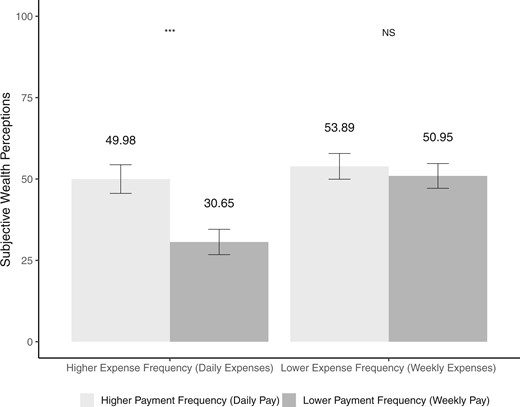
Abstract Payment frequency is a fundamental yet underexplored feature of consumers’ finances. As higher payment frequencies are becoming more prevalent, consumers are receiving more frequent yet smaller paychecks. An analysis of income and expenditure data of over 30,000 consumers from a financial services provider demonstrates a naturally occurring relationship between higher payment frequencies and increased spending. A series of lab studies support this finding, providing causal evidence that higher (vs. lower) payment frequencies increase spending. The effect of payment frequency on spending is driven by changes in consumers’ subjective wealth perceptions. Specifically, higher payment frequencies reduce consumers’ uncertainty in predicting whether they will have enough resources throughout a period, increasing their subjective wealth perceptions. As such, situational factors that reduce prediction uncertainty for those paid less frequently (e.g., the timing of consumers’ expenses, income levels) moderate the impact of payment frequency. The effects of payment frequency on subjective wealth and spending can occur even when objective wealth favors those with lower payment frequencies. More broadly, the current work underscores a need to understand how timing variations in consumers’ income impact their perceptions, behaviors, and general well-being.
Pay Enough or Don't Pay at All*
Abstract. Economists usually assume that monetary incentives improve performance, and psychologists claim that the opposite may happen. We present and disc
Economic idea — Offset documentation
In traditional monetary systems, money is issued by the state. Participants of the market can then use the money issued by the state to buy and sell goods and services in the market.
The Illusion of Clarity • Ness Labs
The illusion of clarity is the confident feeling that you understand something, when in reality your grasp is full of gaps you’ve never noticed.

value noun - Definition, pictures, pronunciation and usage notes | Oxford Advanced Learner's Dictionary at OxfordLearnersDictionaries.com
Definition of value noun in Oxford Advanced Learner's Dictionary. Meaning, pronunciation, picture, example sentences, grammar, usage notes, synonyms and more.
Pain of Paying? — A Metaphor Gone Literal: Evidence from Neural and Behavioral Science
How do individuals consider the price of a good when making purchase decisions? Standard economic theories assume an analytical process: Individuals consider th

The marketplace of rationalizations
Recent work in economics has rediscovered the importance of belief-based utility for understanding human behaviour. Belief ‘choice’ is subject to an important constraint, however: people can only bring themselves to believe things for which they can find rationalizations. When preferences for similar beliefs are widespread, this constraint generates rationalization markets, social structures in which agents compete to produce rationalizations in exchange for money and social rewards. I explore the nature of such markets, I draw on political media to illustrate their characteristics and behaviour, and I highlight their implications for understanding motivated cognition and misinformation.

Cognitive Capitalism - Public Seminar
There are broadly three ways of thinking historically about capitalism. One draws on Marx’s value theory and pretty much treats...Read More

Payment method and perceptions of ownership
How consumers pay influences how they feel about a transaction. In particular, paying by card has been argued to have an effect on the perception of cost, making it less salient and painful. We propose and show that payment method also influences how consumers feel about the acquired good. Specifically, we focus on effects of the payment method on psychological ownership, i.e., the perception of an object as “mine.” We propose that cash payment results in stronger psychological ownership because it influences the extent of perceived investment in an object. We provide evidence for the proposed effect from field and laboratory settings. Results of a longitudinal exit survey and an experiment show that cash payers report higher levels of immediate psychological ownership than card payers. However, this effect seems to depend on the meanings associated with a payment method. Asian students (who associate credit card payment with investment and debt) do not exhibit this effect. Moreover, the initial boost in psychological ownership seems to be comparably short-lived. While those paying in cash experience no further increase in psychological ownership over time, those paying by card do.

Ceptr & Holochain - Currencies of Social Coherence. Holography and Distributed Hash Tables vs. Consensus Bottlenecks in Monolithic Blockchains.
“Perhaps the first thing that comes to mind when thinking about science fiction and money is the different kinds of currencies that are imagined for future worlds: the poscreds of Philip K. Dick’s Ubik, a currency required for every minute transaction such that the door becomes not an item you own but, rather, a provider of services for which you must continually pay, leaving protagonist Joe Chip trapped in his own apartment until someone pays his door to open; the bars of gold-pressed latinum used by the avaricious Ferengi on Star Trek, the only thing that cannot be replicated in this post-scarcity world, useless other than as an atavistic marker of wealth; the reputation- based currency of whuffie in Cory Doctorow’s Down and Out in the Magic Kingdom, used to replace the social role money plays in creating a hierarchy in another post-scarcity world.