


Words are part of almost every marketplace interaction. Online reviews, customer service calls, press releases, marketing communications, and other interactions create a wealth of textual data. But how can marketers best use such data? This article provides an overview of automated textual analysis and details how it can be used to generate marketing insights. The authors discuss how text reflects qualities of the text producer (and the context in which the text was produced) and impacts the audience or text recipient. Next, they discuss how text can be a powerful tool both for prediction and for understanding (i.e., insights). Then, the authors overview methodologies and metrics used in text analysis, providing a set of guidelines and procedures. Finally, they further highlight some common metrics and challenges and discuss how researchers can address issues of internal and external validity. They conclude with a discussion of potential areas for future work. Along the way, the authors note how textual analysis can unite the tribes of marketing. While most marketing problems are interdisciplinary, the field is often fragmented. By involving skills and ideas from each of the subareas of marketing, text analysis has the potential to help unite the field with a common set of tools and approaches.
Content Products: The new way of doing Content Marketing
The era of the 'quick wins' in content marketing is long gone. Learn how to drive new leads by creating Content Products

Field Experimentation in Marketing Research
Despite increasing efforts to encourage the adoption of field experiments in marketing research (e.g., Campbell 1969 ; Cialdini 1980 ; Li et al. 2015 ), the majority of scholars continue to rely primarily on laboratory studies ( Cialdini 2009 ). For example, of the 50 articles published in Journal of Marketing Research in 2013, only three (6%) were based on field experiments. The goal of this article is to motivate a methodological shift in marketing research and increase the proportion of empirical findings obtained using field experiments. The author begins by making a case for field experiments and offers a description of their defining features. She then demonstrates the unique value that field experiments can offer and concludes with a discussion of key considerations that researchers should be mindful of when designing, planning, and running field experiments.
EXPRESS: Evaluating Novel Unstructured Treatments with Generative AI: A Causal Prediction Framework
Modern marketing increasingly requires managers to deploy new content at scale, often with limited opportunity for prior testing. As a result, decisions about what to launch become strategic managerial choices under uncertainty rather than purely creative exercises. While generative AI makes the creation of new content fast and highly scalable, it simultaneously expands the set of options managers must evaluate, making reliable content selection increasingly difficult. We develop a framework for causal prediction that enables managers to evaluate and deploy novel marketing content generated by AI. The framework uses pretrained large language models to represent previously deployed content and learn how its features causally relate to outcomes. Using a rejection-sampling procedure, the framework screens new content proposed by generative AI to avoid extrapolation beyond what historical data can reliably support. In a large-scale email marketing application (3.3 million observations across 34 campaigns), the framework improves out-of-sample prediction and real-world deployment performance relative to standard approaches, enabling outcome-guided generation of higher-performing AI-generated content. The framework establishes a threshold based on how closely new content resembles past campaigns, separating cases where causal prediction is reliable from cases where direct experimentation is warranted. The framework has important implications for marketing decision making in a rapidly evolving environment where generative AI is transforming content creation and deployment.
The Art of Writing One-Sentence Product Descriptions
A look back at early interviews with Facebook and Uber CEOs illustrates an ingenious way to communicate hard-to-describe products.

The potential of generative AI for personalized persuasion at scale
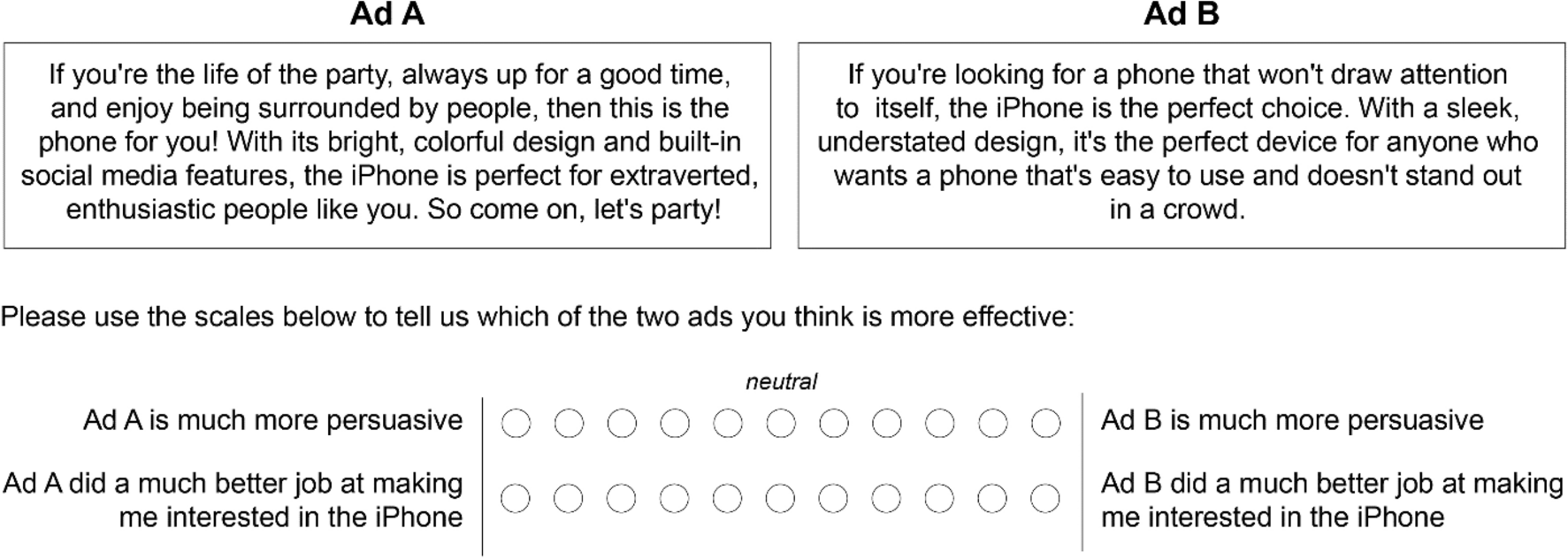
Matching the language or content of a message to the psychological profile of its recipient (known as “personalized persuasion”) is widely considered to be one of the most effective messaging strategies. We demonstrate that the rapid advances in large language models (LLMs), like ChatGPT, could accelerate this influence by making personalized persuasion scalable. Across four studies (consisting of seven sub-studies; total N = 1788), we show that personalized messages crafted by ChatGPT exhibit significantly more influence than non-personalized messages. This was true across different domains of persuasion (e.g., marketing of consumer products, political appeals for climate action), psychological profiles (e.g., personality traits, political ideology, moral foundations), and when only providing the LLM with a single, short prompt naming or describing the targeted psychological dimension. Thus, our findings are among the first to demonstrate the potential for LLMs to automate, and thereby scale, the use of personalized persuasion in ways that enhance its effectiveness and efficiency. We discuss the implications for researchers, practitioners, and the general public.
Jessica Livingston – Why Startups Need to Focus on Sales, Not Marketing
The most important thing an early-stage startup should know about marketing is rather counterintuitive: that you probably shouldn’t be doing anything you’d use the term “marketing

AIDA model | Marketing | Research Starters | EBSCO Research
<p>The AIDA model is a marketing framework that outlines the stages consumers typically go through when making a purchasing decision: Attention, Interest, Desire, and Action. Developed in the late 19th century by American marketer Elias St. Elmo Lewis and later refined by Edward Strong in the 1920s, this model aims to guide marketers in capturing potential buyers' attention and leading them toward a purchase. </p> <p>In the Attention stage, marketers employ engaging strategies to attract consumers, often using eye-catching visuals or intriguing information. Next, the Interest stage focuses on maintaining that attention through memorable content or relatable messaging. The Desire stage demonstrates how a product or service fulfills the consumer's needs, often using persuasive techniques like testimonials or demonstrations. Finally, the Action stage prompts the consumer to make a purchase, providing clear instructions on how to proceed.</p> <p>While the AIDA model remains relevant, marketers today may adapt it to incorporate new elements, such as Retention or Satisfaction, reflecting the evolving digital landscape and consumer behavior. Overall, the AIDA model serves as a foundational tool for understanding consumer engagement and facilitating effective marketing strategies.</p>

Brands using AI-generated influencers to promote products on social media
Investigation finds AI content that purports to show genuine customers, prompting calls for greater transparency

goabstract/Marketing-for-Engineers
A curated collection of marketing articles & tools to grow your product.
Why Word Of Mouth Marketing Is The Most Important Social Media
Word of Mouth Marketing (WOMM). Isn’t this really the original social media platform? Suzanne Fanning, President of WOMMA (Word of Mouth Marketing Association), shares interesting, data-based insight on the power of WOMM.

The Dynamics of Distortion: How Successive Summarization Alters the Retelling of News
This work advances and tests a theory of how news information evolves as it is successively retold by consumers. Drawing on data from over 11,000 participants across ten experiments, the authors offer evidence that when news is repeatedly retold, it undergoes a stylistic transformation termed “disagreeable personalization,” wherein original facts are increasingly supplanted by opinions and interpretations with a slant toward negativity. The central thesis is that when retellers believe they are more (vs. less) knowledgeable than their recipient about the information they are relaying, they feel more compelled to provide guidance on its meaning and to do so in a persuasive manner. This enhanced motivation to guide persuasively, in turn, leads retellers to not only select the subset of facts they deem most essential but, critically, to provide their interpretations and opinions on those facts, with negativity being used as a means of grabbing their audience’s attention. Implications of this work for research on retelling and consumer information diffusion are explored.
The Dynamics of Distortion: How Successive Summarization Alters the Retelling of News
This work advances and tests a theory of how news information evolves as it is successively retold by consumers. Drawing on data from over 11,000 participants across ten experiments, the authors offer evidence that when news is repeatedly retold, it undergoes a stylistic transformation termed “disagreeable personalization,” wherein original facts are increasingly supplanted by opinions and interpretations with a slant toward negativity. The central thesis is that when retellers believe they are more (vs. less) knowledgeable than their recipient about the information they are relaying, they feel more compelled to provide guidance on its meaning and to do so in a persuasive manner. This enhanced motivation to guide persuasively, in turn, leads retellers to not only select the subset of facts they deem most essential but, critically, to provide their interpretations and opinions on those facts, with negativity being used as a means of grabbing their audience’s attention. Implications of this work for research on retelling and consumer information diffusion are explored.
WP Growth Council
In the WordPress world, when we look back an 2016 I think we’ll remember it as the year that we awoke to the importance of marketing. WordPress has always grown organically through word of mouth an…

The Developer Marketing Guide
In this Developer Marketing Guide learn about essential developer content types, distribution plans, community projects, tools, services, and more. You've got a great product, let's get the word out.
Introduction to the Journal of Marketing Research Special Interdisciplinary Issue on Consumer Financial Decision Making
If you have citation software installed, you can download citation data to the citation manager of your choice
Commercial Persuasion in AI-Mediated Conversations
As Large Language Models (LLMs) become a primary interface between users and the web, companies face growing economic incentives to embed commercial influence into AI-mediated conversations. We present two preregistered experiments (N = 2,012) in which participants selected a book to receive from a large eBook catalog using either a traditional search engine or a conversational LLM agent powered by one of five frontier models. Unbeknownst to participants, a fifth of all products were randomly designated as sponsored and promoted in different ways. We find that LLM-driven persuasion nearly triples the rate at which users select sponsored products compared to traditional search placement (61.2% vs. 22.4%), while the vast majority of participants fail to detect any promotional steering. Explicit "Sponsored" labels do not significantly reduce persuasion, and instructing the model to conceal its intent makes its influence nearly invisible (detection accuracy < 10%). Altogether, our results indicate that conversational AI can covertly redirect consumer choices at scale, and that existing transparency mechanisms may be insufficient to protect users.
